
AI Voice Agents in Biotechnology: Beyond the Call Center
A single patient support hub for one specialty biologic can field more than 40,000 inbound calls a month, and roughly half are routine questions about refills, injection technique, and copay assistance. Every one of those calls costs a biotech company between eight and twelve dollars in fully loaded agent time, yet almost none require clinical judgment. This is the operational reality that makes AI voice agents in biotechnology an infrastructure decision rather than a novelty. The volume is high, the queries repeat, and the cost structure is punishing at scale.
Biotech is not a call center industry in the way retail or telecom are. It runs clinical trials, patient support programs, pharmacovigilance intake, and medical information desks, each with its own compliance surface and its own vocabulary of drug names and adverse events. That specificity is exactly why generic voice bots fail here, and purpose-built systems succeed. This blog covers where voice agents actually fit in biotech, the architecture that makes them credible, the compliance controls they must satisfy, the metrics that decide whether they work, a realistic implementation path, and the business case behind the investment.
Where Voice Agents Actually Fit in Biotechnology
Voice automation in biotech does not live in one department. It attaches to the specific, high-frequency, low-complexity interactions that already flow through phone lines and that carry a high human cost. Understanding these workflows precisely is the difference between a useful deployment and an expensive experiment.
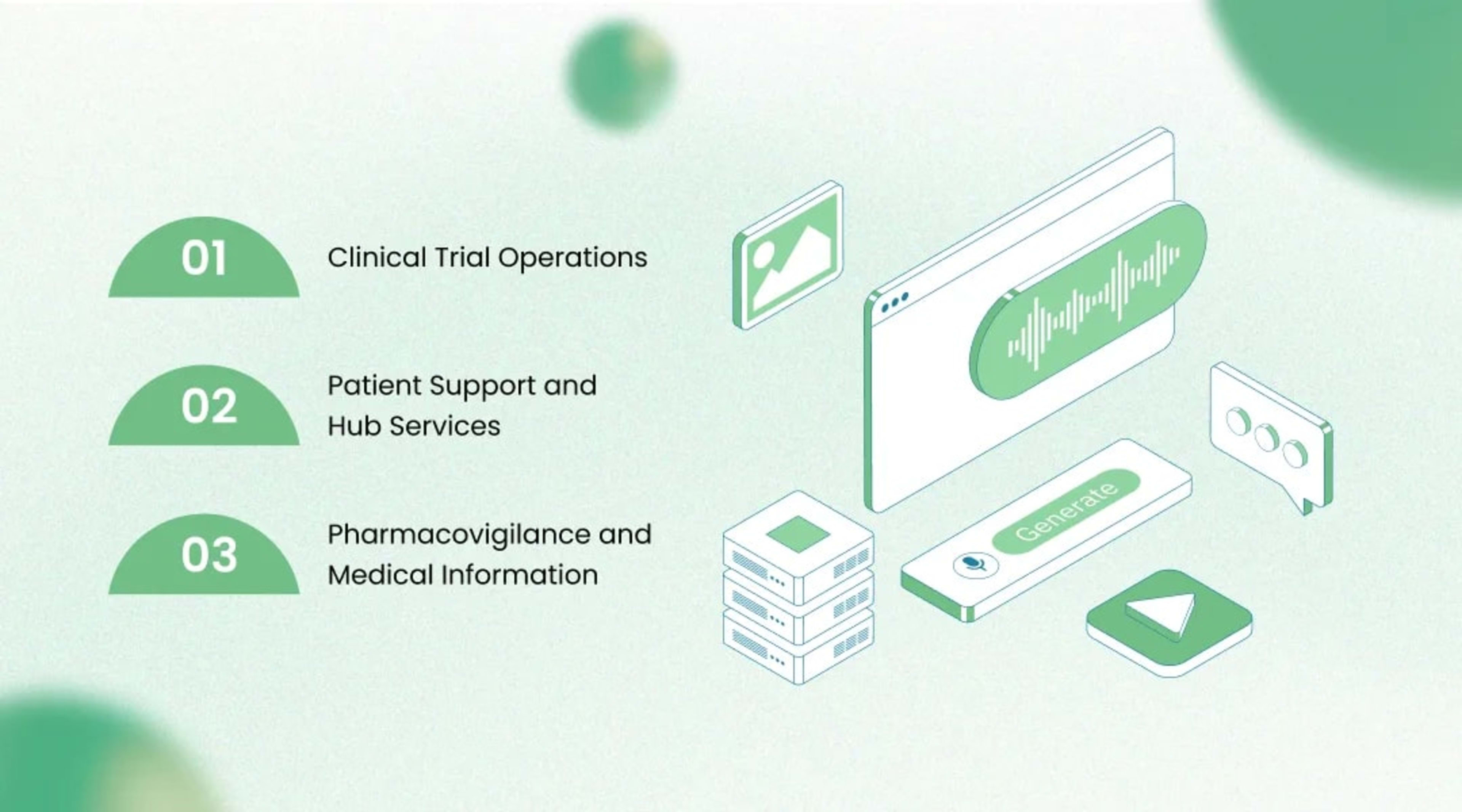
Clinical Trial Operations
Clinical trial recruitment automation is the most immediate fit because sites are chronically understaffed and screening is repetitive. A voice agent can run inbound and outbound prescreening, ask standardized inclusion and exclusion questions, and route only qualified candidates to a coordinator. It can also handle appointment reminders, visit window confirmations, and adherence check-ins between visits. When screening runs 24 hours a day, time to first contact drops from days to minutes, which directly protects enrollment timelines.
Patient Support and Hub Services
Healthcare patient support workflows are a natural fit here because patient support program voice agents handle the enrollment, benefits, and adherence traffic that specialty therapies generate. They can verify identity, capture refill requests, explain injection steps, and trigger a nurse callback when a patient reports a concern. Well-scoped hub deployments commonly automate 40 to 60 percent of routine contacts. The remaining calls, which involve clinical or emotional nuance, still reach a human, which is the correct design.
Pharmacovigilance and Medical Information
Adverse event intake and medical information are the third cluster where voice agents earn their place. A voice agent can capture an initial adverse event report, structure it toward MedDRA terminology, and flag serious cases for the expedited pathway that regulators require within 15 days. For medical information, the agent can answer approved product questions and escalate off-label or safety queries to a qualified specialist. In both cases, the value is a consistent capture, not a clinical interpretation.
Why Voice AI Suits Biotech Workflows Better Than Portals and IVR
Biotech patient populations skew older and sicker than the general consumer base, and many prefer a phone over an app or portal. Voice removes the friction of typing during a moment of confusion or discomfort, which is common with new injectable therapies. A patient who cannot navigate a portal will still ask a question aloud, and a well-built agent can answer it immediately. This accessibility is not a soft benefit; it directly affects adherence and retention.
Traditional IVR fails this audience because it forces callers through rigid menus that were never designed for open-ended clinical questions. A caller asking whether a missed dose is dangerous cannot be served by pressing two for pharmacy. Conversational NLP customer support automation understands the intent behind the utterance and responds with the relevant answer or the right escalation. The gap between voice AI and traditional IVR in pharma is the gap between deflecting a caller and actually resolving them.
Voice also carries signals that text does not. Hesitation, distress, and confusion are audible, and a mature system can infer sentiment and escalate before a routine call becomes a complaint or a safety event. That capability matters more in biotech than in most industries because a frustrated caller may be a patient in genuine medical difficulty. Designing for that possibility is a core reason biotech voice agents look different from consumer ones.
The Voice AI Architecture Behind Biotech Deployments
The architecture that makes AI voice agents in biotechnology reliable is a streaming pipeline where every stage is tuned for medical language and strict latency budgets. Each layer carries specific engineering choices that a generic assistant stack does not make. This is where KriraAI, a company that designs and deploys production-grade AI voice agent systems, spends most of its engineering effort.
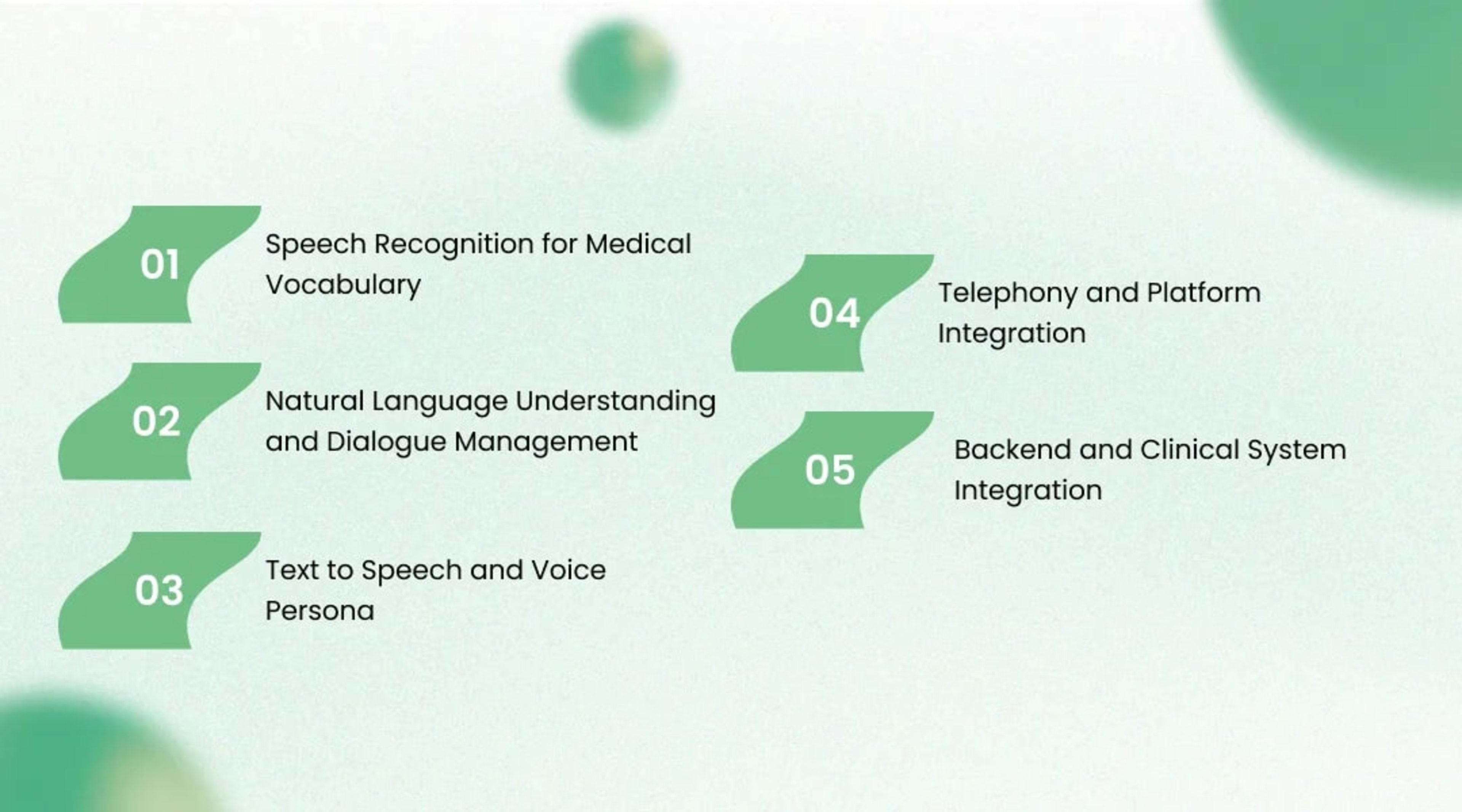
Speech Recognition for Medical Vocabulary
Drug name recognition is the hardest automatic speech recognition problem in biotech voice, and it is where off-the-shelf models break. General-purpose Whisper variants deliver strong word error rates on clean conversational speech, often near five percent, but they mishear specialty drug names and biologic suffixes. Production systems favor streaming architectures such as RNN Transducer or Conformer-based models with contextual biasing, so a custom lexicon of drug names, protocol numbers, and indication terms is injected at inference. With domain-adapted biasing, drug name recognition can move from unreliable to above 90 percent, which is the threshold where automation becomes safe.
Natural Language Understanding and Dialogue Management
The understanding layer in biotech is typically a hybrid rather than a single model. A fine-tuned classifier, often RoBERTa-based, handles the finite set of high-stakes intents such as adverse event and refill, where precision must be near certain. A large language model handles the open-ended long tail, framed by retrieval so that answers stay grounded in approved content. For dialogue management, a frame-based manager governs regulated flows like consent and screening, while a retrieval-augmented model handles conversational questions. This split keeps compliance critical paths deterministic and auditable.
Text-to-Speech and Voice Persona
The speech synthesis layer must sound calm, clear, and human without introducing lag. Neural TTS systems in the VITS family, or comparable proprietary engines, produce natural prosody, and streaming synthesis lets the first audio play before the full sentence is generated. Voice persona is a deliberate choice in biotech, where a measured, reassuring voice supports patients discussing serious conditions. The persona is validated with patient-facing stakeholders, not selected by engineers alone.
Telephony and Platform Integration
The telephony layer connects the agent to real phone traffic over SIP and RTP, with WebRTC used for web-based calls. Integration usually runs through platforms such as Twilio, Amazon Connect, Vonage, or Genesys, which provide the SIP trunks and contact center hooks for warm transfer to human staff. High concurrency matters because campaign spikes and recruitment surges can drive hundreds of simultaneous calls. The infrastructure must scale elastically without degrading the latency budget.
Backend and Clinical System Integration
The final layer wires the agent into the systems of record. A patient support agent queries the CRM and hub platform during the call to confirm enrollment and refill status. A trial agent reads and writes to the CTMS or eligibility database, and an adverse event flow pushes a structured case into the safety system. Every real-time lookup and every write must be logged, secured, and reversible.
Building for Compliance: HIPAA, 21 CFR Part 11, and GxP
Yes, voice AI can be HIPAA compliant, but compliance is an architectural property, not a feature you switch on. A HIPAA-compliant voice AI system handles protected health information inside a controlled cloud boundary under a signed business associate agreement, and it never leaks identifiers into unmonitored logs or third-party models. In regulated biotech workflows, the bar rises further because 21 CFR Part 11 governs electronic records and signatures, and trial systems must meet GxP validation standards. These are the controls that separate a demo from a deployable system.
A production biotech voice agent must implement the following controls before it touches live patients or trial data:
Encrypt all data in transit and at rest, and confine every piece of protected health information within a HIPAA-eligible cloud boundary covered by a business associate agreement.
Maintain tamper-evident audit trails that capture each prompt, action, and data write, as 21 CFR Part 11 requires for electronic records.
Enforce role-based access control and strong authentication so only authorized systems and staff can retrieve patient identifiers during a call.
Capture consent at the start of any recorded interaction and retain the recording and transcript under the study or program retention schedule.
Pass computerized system validation with documented test evidence that the agent behaves exactly as specified before production release.
Getting HIPAA-compliant voice AI wrong is not a minor bug; it is a reportable breach with regulatory and reputational costs. This is why compliance is designed into the pipeline at the start rather than bolted on before launch. The audit trail, the consent flow, and the escalation logic are treated as first-class components, not afterthoughts.
Latency, Accuracy, and the Metrics That Matter
Conversation latency is the single most felt quality in a voice agent, and biotech gives no slack on it. The end-to-end turn latency, from the moment a caller stops speaking to the moment the agent starts responding, should stay under 800 milliseconds. At roughly 1.2 seconds, the pause feels unnatural, and anxious patients start talking over the agent, which corrupts the interaction. Hitting the budget requires streaming ASR, fast intent handling, and streaming TTS working in concert.
Accuracy is measured where it changes outcomes, not as a single vanity number. Drug name recognition, intent classification precision on adverse event capture, and safe escalation rate are the metrics that decide trust. A biotech agent should escalate rather than guess whenever confidence drops, so a slightly higher transfer rate is a feature, not a failure. The wrong answer to a safety question is far more costly than a handoff to a nurse.
Containment and resolution tell the business story. Containment is the share of calls fully handled without a human, and resolution confirms the caller actually got what they needed. Well-scoped hub deployments often reach 40 to 60 percent containment on routine traffic while preserving high satisfaction. These numbers only hold when monitoring is continuous and failed interactions feed back into tuning.
Implementation Roadmap for a Biotech Voice Agent
A biotech voice deployment succeeds when it starts narrow and expands on evidence. Trying to automate every call type at once is the most reliable way to fail. KriraAI, which brings serious engineering depth to conversational AI, sequences the work so that compliance and value are proven before scale. The phased path below reflects how production programs are actually delivered.
Run discovery and build a call taxonomy that ranks intents by volume, cost, and clinical risk, so the safest high-value targets are clear.
Map the data and integration surface, documenting every CRM, CTMS, hub, and safety system the agent must read from or write to.
Prototype the single highest-volume, low-risk intent end-to-end, and validate ASR, intent accuracy, and latency against real recordings.
Complete the compliance and security review, covering the business associate agreement, audit trails, consent flows, and system validation evidence.
Launch a controlled pilot with a human fallback on every path, measuring containment, escalation quality, and patient satisfaction on live traffic.
Scale to additional intents and higher concurrency, feeding failed interactions into a continuous tuning loop that improves the agent monthly.
The discipline here is that no intent goes fully live until its escalation path is proven safe. This protects patients, and it protects the program from an early failure that erodes stakeholder trust. Each phase produces evidence that justifies the next, which is how these deployments earn organizational confidence.
The Business Case and ROI of AI Voice Agents in Biotechnology
The clearest return from AI voice agents in biotechnology comes from marginal cost. A fully loaded human support call in the United States costs roughly eight to twelve dollars, while the marginal cost of an automated voice interaction is often under one dollar. When an agent handles half of 40,000 monthly calls, the arithmetic becomes a material line item rather than a rounding error. The savings compound every month the volume holds.
Cost, Capacity, and Timeline Realism
The second driver is capacity that does not fatigue or churn. A voice system absorbs recruitment surges and refill spikes without hiring, training, or overtime, and it runs 24 hours a day across time zones. That elasticity matters most during trial startup and product launch, when call volume is least predictable. Human teams then focus on the complex, empathetic conversations they are actually good at.
The honest tradeoffs deserve equal attention. Upfront integration, compliance validation, and tuning mean these systems take months to deploy, not days, and a serious program is an investment before it is a saving. Poorly scoped bots that over-automate clinical judgment destroy trust and can create safety exposure. The return is real and often reaches positive territory within the first year on high-volume workflows, but only when the design respects the risk profile of biotech.
Common Failure Modes and How to Avoid Them
Most biotech voice failures trace back to a handful of avoidable decisions. Recognizing them early is the cheapest form of quality assurance. The list below reflects the errors that most often derail otherwise promising deployments.
Treating drug name recognition as a solved problem and skipping the custom lexicon and contextual biasing that medical vocabulary demands.
Deploying without a clean human escalation path leaves patients stranded on exactly the questions the agent should never answer alone.
Recording interactions without proper consent for capture and retention turns a helpful feature into a compliance breach.
Overautomating clinical judgment, so that a system built for logistics starts fielding questions that require a licensed professional.
Ignoring accent, dialect, and language diversity in the patient population degrades recognition for the callers who most need help.
The correction for all of these is the same principle. Automate the routine, escalate the ambiguous, and prove safety before scaling. A biotech voice agent that respects its own limits is far more valuable than one that tries to do everything.
Conclusion
Three takeaways matter most for anyone evaluating this technology. First, voice agents in biotech succeed only where the work is high volume and low complexity, which means clinical trial recruitment automation, patient support, pharmacovigilance intake, and medical information, with everything clinical escalated to humans. Second, the architecture must be engineered for medical vocabulary, sub-second latency, and continuous monitoring, because generic assistant stacks mishear drug names and miss the metrics that decide trust. Third, compliance is designed in from the first prototype, since HIPAA, 21 CFR Part 11, and GxP are structural requirements rather than final checkboxes.
KriraAI designs and deploys production-grade AI voice agent systems for exactly these environments, combining the ASR tuning, dialogue engineering, telephony integration, and compliance discipline that biotech deployments demand. The team brings both the domain knowledge to respect clinical risk and the delivery experience to make voice automation perform reliably at real enterprise scale. If you are weighing where voice agents fit inside your trials, hubs, or safety operations, the KriraAI team would welcome a conversation about your specific requirements and the workflows worth automating first.
FAQs
AI voice agents can be HIPAA compliant when protected health information is handled inside a controlled cloud boundary under a business associate agreement, with encryption, tamper-evident audit trails, role-based access, and consent capture. Compliance is an architectural property built into the pipeline, not a switch, and regulated trial workflows add 21 CFR Part 11 and GxP validation on top.
Voice agents run inbound and outbound prescreening, ask standardized eligibility questions, and route only qualified candidates to coordinators, which frees overstretched site staff. Because screening runs around the clock, time to first contact falls from days to minutes, and automated reminders reduce visit no-shows, directly protecting enrollment timelines and retention across the study.
Voice AI can capture initial adverse event reports, structure them toward MedDRA terminology, and flag serious cases for the expedited pathway regulators require within 15 days. The agent handles consistent intake and routing rather than clinical assessment, so trained safety staff still review every case, which keeps the workflow both faster and compliant.
Return comes mainly from marginal cost, since a fully loaded human call costs roughly eight to twelve dollars while an automated interaction often costs under one dollar. Patient support program voice agents commonly contain 40 to 60 percent of routine calls, and high-volume hubs frequently reach positive return within the first year when scoped correctly.
Voice agents handle medical terminology through streaming ASR models with contextual biasing, where a custom lexicon of drug names, indications, and protocol identifiers is injected at inference. With domain adaptation, drug name recognition can exceed 90 percent, and the system escalates low-confidence utterances instead of guessing, which keeps clinical interactions safe.
Ridham Chovatiya is the COO at KriraAI, driving operational excellence and scalable AI solutions. He specialises in building high-performance teams and delivering impactful, customer-centric technology strategies.