Contact centers handling more than 50,000 calls per month are spending between 60 and 70 percent of their operational budget on agent labor, yet industry-wide first-call resolution rates average only 74 percent and average handle time for routine queries regularly exceeds four minutes. An AI voice agent for customer support addresses this structural inefficiency directly — not by layering a chatbot over an existing IVR menu, but by deploying a full conversational system that understands natural speech, manages multi-turn dialogue, retrieves live data from backend systems, and resolves queries without human involvement. The difference in business impact between these two approaches is not incremental. Organizations that deploy production-grade voice agents on high-volume support lines consistently report automation rates between 55 and 80 percent on in-scope queries, with average handle time for automated interactions under 90 seconds. This blog covers the complete technical architecture of a customer support AI voice agent, the engineering decisions that determine whether the system performs reliably in production, the integration patterns that enable autonomous resolution, the implementation timeline, and a grounded ROI methodology that contact center operations leaders can use to build the investment case.
A customer support AI voice agent is a software system that conducts live telephone conversations with customers, understands their spoken requests in natural language, retrieves relevant data from backend systems in real time, applies dialogue logic to determine the correct resolution, and delivers responses in synthesised speech — all without a human agent on the line. This is categorically different from a traditional interactive voice response system. An IVR routes callers through decision trees using keypad inputs or shallow keyword matching, and the caller must conform to the system's rigid structure. A production AI voice agent for customer support handles free-form spoken sentences, manages context across multiple conversational turns, and resolves requests that require live data lookups such as retrieving account balances, checking order status, processing returns, or updating contact information.
The problems this agent type is built to solve are specific and financially significant. The volume problem is the most visible: most contact centers experience predictable peaks — Monday mornings, post-billing periods, product launch windows — where call volume exceeds staffing capacity and queue times spike. An AI voice agent scales elastically with concurrent call volume at near-zero marginal cost per additional call, eliminating the direct relationship between call volume and headcount. The consistency problem matters equally: human agents vary in quality, tone, and script adherence across shifts, skill levels, and fatigue states. A voice agent delivers uniform interaction quality across every call regardless of time or volume conditions.
The resolution speed problem is the third driver. A trained voice agent with direct access to the same backend systems human agents use resolves a routine query in 60 to 90 seconds, compared to an average human handle time of 4 to 6 minutes for equivalent calls — the difference coming from eliminated hold time, instant data retrieval, and zero post-call wrap-up. There is a fourth problem that receives less attention but is often more financially significant: the after-hours gap. Most contact centers are not staffed around the clock, and calls arriving outside business hours are either lost or routed to voicemail. A voice agent closes this gap completely, providing full resolution capability at any hour with the same quality as peak business hours.
Understanding how an AI voice agent for customer support actually works at an engineering level is essential for any team evaluating vendors, overseeing a build, or managing a deployment. The system is not a single model but a coordinated pipeline of specialised components operating within strict latency constraints. End-to-end response latency — the time from when the caller finishes speaking to when the agent begins its response — must remain below 1,000 milliseconds in production. Latency above this threshold introduces perceived pauses that callers register as unresponsive or broken, degrading experience measurably. Achieving sub-1,000ms requires careful engineering at every layer of the stack.
The ASR layer converts incoming audio into text in real time. For customer support deployments, the choice between batch and streaming transcription is not architectural preference — streaming is mandatory. Batch ASR models that process audio only after the speaker has finished cannot meet sub-second response latency requirements under any configuration. Production voice agents use streaming ASR models that generate partial transcripts while the caller is still speaking, allowing the NLU layer to begin processing before the utterance completes.
The leading architectures for this layer are Conformer-based models — specifically Conformer-CTC and Conformer-RNN-T variants — which offer strong accuracy on telephony audio sampled at 8kHz and respond well to fine-tuning on domain vocabulary specific to a company's product catalog and customer phrasing patterns. OpenAI's Whisper performs excellently for offline and near-real-time transcription but is not suited for the live streaming path in a low-latency voice agent due to its encoder architecture requiring the complete utterance before generating output. Whisper remains valuable in the post-call processing pipeline for accurate full transcripts and compliance archiving. A well-tuned Conformer model on in-domain telephony audio achieves word error rates between 4 and 8 percent, which is sufficient for intent recognition provided the NLU layer is designed to handle transcription noise gracefully.
The NLU layer receives the streaming transcript and performs intent classification and entity extraction simultaneously. For customer support agents with a bounded intent set — typically 30 to 150 intents in a well-scoped deployment — a fine-tuned encoder-architecture classifier based on RoBERTa achieves 94 to 97 percent intent accuracy on in-domain utterances with inference latency below 20 milliseconds, fitting comfortably within the end-to-end latency budget. For deployments requiring open-ended handling or dynamic intent expansion, a hybrid architecture is increasingly standard: a fast classifier handles known intents confidently, while a quantised LLM fallback — typically a 7B or 8B parameter model such as Llama 3 or Mistral running in 4-bit quantisation — handles utterances that fall below the classifier's confidence threshold.
Dialogue management in a customer support voice agent must maintain state coherently across multiple turns. The most reliable production architecture for bounded support workflows is a frame-based dialogue manager operating under an LLM orchestrator. The frame-based layer manages structured workflows — authentication, account lookup, return processing — where business rules and required data slots are well-defined and deterministic. The LLM orchestrator manages conversational coherence, handles off-script turns, and determines when to transfer control between structured frames. This hybrid is more auditable and predictable than a fully generative dialogue approach, which matters significantly in regulated industries where every system decision must be explainable to compliance teams.
Response generation in a customer support voice agent is predominantly template and retrieval-based rather than generative. For the majority of interactions — balance queries, order status checks, policy confirmations, return initiations — the correct response is a data-populated template drawn from a pre-approved library, not a sentence generated by a language model. This matters for two distinct reasons. First, retrieval-based responses can be assembled and passed to the TTS layer in under 30 milliseconds, whereas LLM generation of even a short two-sentence response adds 150 to 400 milliseconds of latency. Second, generative models can produce plausible but incorrect specific values — account details, policy terms, procedural steps — creating liability and eroding caller trust at scale. Generative capability is reserved for genuinely open-ended queries and clarification dialogues where no template covers the required response surface.
The TTS layer synthesises the assembled response into natural speech. Production deployments use neural TTS systems — architectures such as VITS, NaturalSpeech 2, or commercial systems from ElevenLabs, Cartesia, or Azure Neural TTS — that produce natural voice output with controllable prosody and speaking rate. Streaming TTS, where audio chunks are synthesised and played back before the full sentence is complete, is essential for meeting end-to-end latency targets. A streaming VITS implementation begins audio playback within 80 to 120 milliseconds of receiving input text. Custom voice personas — a branded voice designed specifically for a company — are achievable with 30 to 60 minutes of high-quality reference audio and fine-tuning, creating a meaningfully differentiated caller experience compared to generic system voices.
The voice agent connects to telephone infrastructure via SIP trunking for PSTN calls, with RTP handling real-time audio transport between the telephony platform and the voice agent media server. For contact center deployments on platforms such as Amazon Connect, Genesys Cloud, or Twilio Flex, the typical integration pattern uses the platform's native bot connector or a WebRTC-based media streaming path to route calls to the voice agent. High-concurrency production deployments require a media processing infrastructure designed for horizontal scaling. The voice agent must handle hundreds of simultaneous calls without per-call latency degradation, which is achieved through containerised deployment on Kubernetes with auto-scaling based on active call count, with each pod configured to handle between 10 and 50 concurrent calls depending on allocated compute resources.
Building a voice agent that performs in a controlled demo is straightforward. Building one that performs reliably at 50,000 calls per month across diverse callers, acoustic environments, and query types is a fundamentally different engineering challenge. Several design decisions have disproportionate impact on whether the production system meets its performance targets.
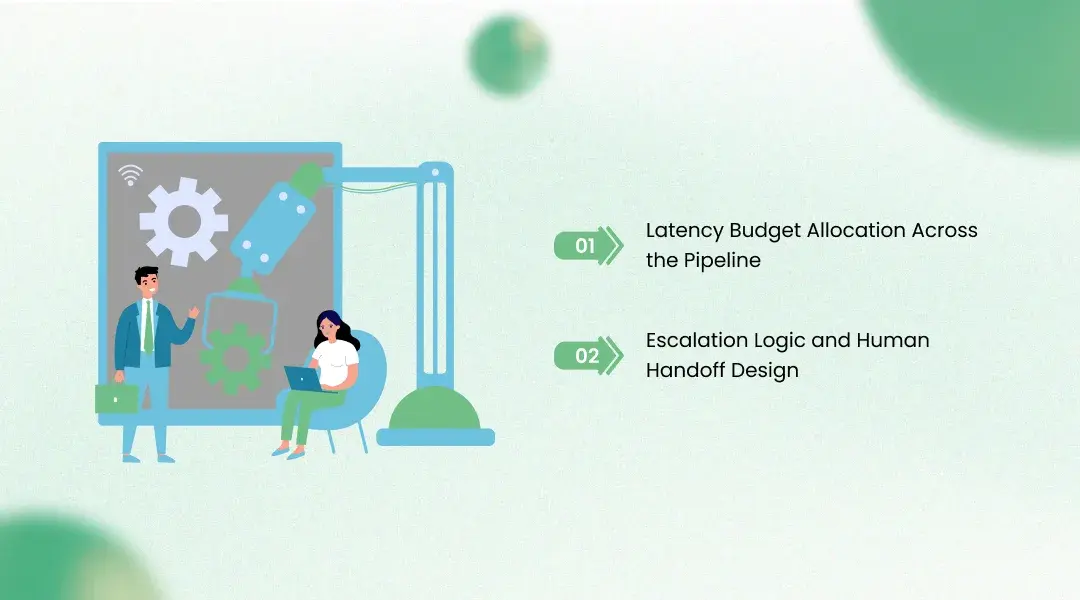
The sub-1,000ms end-to-end target requires each pipeline component to operate within a defined latency budget. In practice, a workable allocation looks like this: ASR streaming latency to first token runs 100 to 200ms, NLU inference 15 to 30ms, backend API round-trip 50 to 200ms depending on the integration, response assembly under 30ms, and TTS first-chunk delivery 80 to 120ms. The backend API call is the largest and most variable component. Teams at KriraAI — a company that designs and deploys production-grade AI voice agent systems across enterprise environments — consistently identify three strategies that reliably reduce this variable: caching frequently accessed account data at the voice agent layer for warm retrieval, implementing async pre-fetch of likely data needs immediately at conversation start using ANI lookup, and enforcing strict 200ms SLA contracts on all backend APIs before production launch.
No customer support voice agent should be architected to handle every possible caller scenario autonomously. Escalation logic — the rules determining when a call transfers to a human agent — is one of the highest-leverage design decisions in the system. Poorly calibrated escalation logic either traps callers in a failed automation loop or escalates too aggressively, eliminating the cost savings that justify the deployment. Production-grade escalation logic monitors four real-time signals: intent recognition confidence falling below a per-intent threshold, caller sentiment shifting negative through prosodic indicators such as elevated speech rate, increased pitch variance, and shortened turn duration, repeated failed resolution attempts within the same session, and explicit escalation requests in the caller's language. When any of these signals crosses its calibrated threshold, the system initiates a warm transfer to a human agent, passing the full conversation transcript, identified intent, and resolved data slots so the human begins with complete context rather than requiring the caller to repeat their situation.
An AI voice agent for customer support can only resolve queries without human involvement if it has real-time access to the same data systems human agents use. This principle is obvious in theory but consistently underestimated in practice, and integration readiness is the most common cause of deployment delays and post-launch performance failures. The voice agent requires API access to the CRM for account data and interaction history, the order management system for fulfilment status, the billing system for payment records, the knowledge base for policy content, and the identity and authentication layer for verifying caller identity before any data is disclosed.
CRM integration is the most universally required and most commonly underestimated integration in a voice agent deployment. The voice agent must perform account lookup by phone number, email, or account reference within the authentication phase — typically within the first two conversational turns. It must then read account attributes relevant to the query, write interaction records post-call, and in many deployments create or update support tickets based on call outcome. All read operations must complete within the latency budget, requiring CRM API calls to return in under 150 milliseconds. Standard REST calls to Salesforce, ServiceNow, or Zendesk are achievable within this range for indexed field lookups, but complex queries and write operations require careful optimisation or asynchronous handling to avoid blocking the conversation.
Authentication within the voice conversation is a distinct design problem that requires explicit architecture attention. Most production deployments implement a two-factor pattern: automatic ANI matching against the CRM record combined with spoken confirmation of a secondary factor such as date of birth, postcode, or account PIN. Voice biometrics — speaker verification models that authenticate based on the caller's vocal characteristics — are increasingly viable in production, eliminating the friction of spoken PINs while achieving false acceptance rates below 1 percent on modern verification architectures. The authentication approach chosen affects both caller experience friction and fraud exposure, and the tradeoff should be evaluated against the specific risk profile of the deployment.
Deploying a customer support AI voice agent is a structured engineering and organisational process that runs in parallel tracks — technical build, integration, quality assurance, and change management. Teams that treat it purely as a software deployment consistently encounter avoidable problems. KriraAI's delivery framework, built across production implementations in multiple industries, organises the process into five phases with defined outputs and acceptance criteria at each stage.
The phases proceed as follows:
Phase 1 — Discovery and Scope Definition (Weeks 1 to 3): Analysis of existing call recordings to identify intent distribution, call volume by intent category, average handle time per intent, and automation suitability. In a typical enterprise contact center, the top 10 to 15 intents account for 60 to 70 percent of total monthly volume. These become the initial automation scope. Backend integration architecture is defined and API contracts with CRM, order management, and billing systems are established and tested before build begins.
Phase 2 — Core Build (Weeks 4 to 10): ASR model fine-tuning on in-domain audio samples, intent classifier training on labeled call transcript data, dialogue flow design and implementation for all in-scope intents, backend integration development, and TTS voice persona design and approval. Each dialogue flow is built as a modular unit testable in isolation before integration.
Phase 3 — Quality and Safety Testing (Weeks 11 to 13): Adversarial testing across caller types, accent profiles, background noise conditions, and edge-case intents. Escalation threshold calibration using simulated stress scenarios. End-to-end latency validation across simulated concurrent call loads at 2x expected peak volume.
Phase 4 — Controlled Production Launch (Weeks 14 to 16): Go-live on 5 to 10 percent of live inbound volume with full monitoring and rapid-response optimisation. A/B comparison against the control group on resolution rate, caller satisfaction score, and average handle time.
Phase 5 — Optimisation and Expansion (Week 17 onward): Continuous improvement from production conversation analysis. Intent scope expansion. Escalation threshold tuning. Additional language or dialect support where required. Most production deployments reach 60 percent automation on in-scope intents by week 20 and continue improving as the system accumulates production training signal.
The financial case for an AI voice agent for customer support is one of the clearest ROI calculations in enterprise software, but it requires honest inputs to remain credible. KriraAI, which brings rigorous analytical depth to every voice agent deployment it delivers, uses a consistent methodology that avoids the inflated automation rate projections that have made some early voice AI deployments fail to meet their business cases.
On the cost side, a human support agent in a developed market costs between $25 and $35 per hour fully loaded including salary, benefits, training cost amortisation, and attrition replacement cost. At an average handle time of five minutes per call, this translates to a fully loaded cost of $2.50 to $3.00 per resolved call. An AI voice agent handling the same call at production scale costs between $0.05 and $0.20 per call in infrastructure and platform costs. For a contact center processing 100,000 calls per month with a 65 percent automation rate on in-scope intents, the monthly labor cost offset is between $162,500 and $195,000 against a platform and infrastructure cost of $5,000 to $13,000 per month. Implementation investment at enterprise scale ranges from $150,000 to $400,000 depending on integration complexity and intent scope, placing the payback period at 6 to 12 months for deployments at this volume.
Beyond direct labor cost, the financial model should account for after-hours call capture — which adds revenue or reduces churn where missed calls result in lost customers — and for quality consistency, which reduces downstream complaint handling costs. Production voice agent deployments consistently show complaint escalation rates 30 to 40 percent lower on AI-handled calls compared to baseline human agent averages, primarily because the system never deviates from the approved resolution policy and never introduces the variability that creates customer complaints.
The most damaging mistake in customer support voice agent deployments is over-scoping the initial automation intent list. Attempting to automate 80 intents in the first deployment results in shallow dialogue flows, insufficient training data per intent, and a system that performs inconsistently across all intents rather than reliably on a focused set. The correct approach is to select the highest-volume, lowest-complexity intents for initial automation, achieve above 90 percent accuracy on those, then expand scope incrementally using production performance data to inform prioritisation.
The second most common failure is treating backend API reliability as an integration concern rather than a system design concern. If the CRM or order management system returns errors or timeouts on 2 percent of calls, the voice agent fails on 2 percent of calls with no graceful path to resolution. At 100,000 monthly calls, that represents 2,000 failed interactions monthly — each degrading customer experience and generating escalations that partially undermine the automation economics. Production voice agents require fault-tolerant integration patterns including circuit breakers, retry logic with exponential backoff, graceful degradation responses when data is unavailable, and fallback to human escalation rather than silent failure.
A third category of failure is neglecting real-time sentiment monitoring. Voice agents that continue attempting automated resolution after a caller has become frustrated — detectable through elevated speech rate, shorter turn durations, and repetitive escalation language — compound a negative experience rather than containing it. Prosodic sentiment models are not architecturally complex to integrate, and the cost of omitting one is measurable in CSAT scores and repeat call rates.
A well-engineered and properly deployed AI voice agent for customer support should achieve specific, measurable performance thresholds in production. These are not aspirational targets but the benchmarks that responsible delivery teams build to and hold themselves accountable against.
Intent recognition accuracy above 93 percent on in-scope utterances measured across 30 days of production traffic, not held-out test data.
End-to-end response latency below 900 milliseconds at the 95th percentile across concurrent calls at peak volume.
Automation containment rate between 55 and 75 percent on in-scope call types within 90 days of production launch.
First-call resolution rate for automated calls above 85 percent, measured as calls where the caller did not re-contact on the same issue within 24 hours.
Escalation rate to human agents below 25 percent on in-scope intents after 60 days of production optimisation.
Caller satisfaction score for automated calls within 5 percentage points of human agent CSAT baseline within 6 months of launch.
These benchmarks are achievable in production. They are not theoretical projections. They represent the performance criteria that KriraAI — a production-grade AI voice agent company with deep conversational AI engineering experience — uses internally to evaluate deployment quality before declaring any system production-ready.
Three things define whether an AI voice agent for customer support succeeds or fails in a real production environment. The technical architecture must be designed for actual telephony conditions with firm latency constraints — not for demonstration scenarios on clean audio. The automation scope must be defined based on call data analysis rather than commercial ambition, with excellent performance on a focused intent set driving the economics more effectively than mediocre coverage of a broad one. And the backend integration layer must be treated as a first-class engineering concern from day one, because the voice agent's ability to resolve queries autonomously is entirely dependent on reliable, low-latency access to the systems that hold the customer's data.
Systems built on these three principles consistently achieve automation rates above 60 percent, caller satisfaction within range of human agent benchmarks, and ROI payback periods under 12 months. Systems that compromise on any of them become expensive pilots that generate cautionary case studies rather than enterprise deployments.
KriraAI designs and deploys production-grade AI voice agent systems built on exactly these principles. The engineering team brings serious technical depth to every layer of the conversational AI stack — from Conformer ASR fine-tuning and hybrid NLU architecture to fault-tolerant CRM integration, prosodic sentiment monitoring, and contact center platform connectivity. KriraAI has delivered voice automation that performs reliably at enterprise scale across customer support, healthcare, financial services, and retail verticals, with production systems handling millions of calls monthly and meeting the performance benchmarks outlined in this guide. If your organisation is evaluating an AI voice agent for customer support and wants a delivery partner who will be honest about what it takes to build one that performs, reach out to KriraAI to discuss your requirements.
An AI voice agent for customer support operates as a coordinated multi-layer pipeline. When a caller speaks, the audio streams in real time to an ASR engine using a Conformer-CTC or RNN-T architecture fine-tuned on telephony audio, converting speech to text as the caller speaks. The text passes to an NLU layer that classifies the caller's intent and extracts entities — account references, product names, dates — within milliseconds using a fine-tuned RoBERTa-based classifier or a hybrid classifier-plus-LLM architecture. A frame-based dialogue manager, orchestrated by an LLM for conversational coherence, determines the next step and triggers a real-time API call to the relevant backend system — CRM, order management, billing — to retrieve the data needed for resolution. The response is assembled from a pre-approved template populated with live data and passed to a streaming neural TTS engine that begins audio playback within 80 to 120 milliseconds of receiving the text. This entire pipeline completes in under 1,000 milliseconds from end of caller utterance to start of agent response. The system maintains full conversational context across turns, handles clarification dialogues, monitors caller sentiment through prosodic signals, and transfers to a human agent with complete context when escalation logic determines it is required.
The ROI of deploying an AI voice agent for customer support is calculated by comparing the per-call cost of automation against the fully loaded per-call cost of human agent handling on the same query types. Human support agents in developed markets cost between $25 and $35 per hour fully loaded, translating to $2.50 to $3.00 per call at a five-minute average handle time. AI voice agent infrastructure and platform costs at production scale range from $0.05 to $0.20 per call, representing a per-call cost reduction of 90 to 95 percent on automated interactions. For a contact center automating 65,000 of 100,000 monthly calls, the monthly labor cost offset is approximately $150,000 to $180,000 against a platform cost of $5,000 to $13,000 per month. Implementation investment at enterprise scale typically ranges from $150,000 to $400,000, yielding a payback period of 6 to 12 months at this volume and a three-year ROI that exceeds 400 percent in most production deployments. Additional financial value from after-hours coverage and reduced complaint escalation rates further strengthen the case in industries where both factors are financially material.
An AI voice agent and a traditional IVR system differ fundamentally in how they process caller input and what they can resolve autonomously. A traditional IVR routes callers through pre-defined menu trees using keypad inputs or basic keyword detection — the caller must navigate the system's structure, and the system cannot understand free-form speech, maintain context across conversational turns, or retrieve account-specific data without routing the call to a human agent. An AI voice agent understands natural spoken language in full sentences, manages multi-turn dialogue where context accumulates across exchanges, retrieves and acts on live backend data during the conversation, and resolves queries end-to-end without human involvement. The practical outcome difference is the containment rate: a well-designed IVR typically contains 15 to 25 percent of calls without human agent involvement, while a production AI voice agent for customer support achieves 55 to 80 percent containment on in-scope intents. Caller experience surveys consistently show satisfaction scores for conversational voice agent interactions 25 to 35 percent higher than equivalent IVR interactions, primarily because callers can speak naturally without conforming to a menu structure.
AI voice agents are highly effective on queries that require structured data access, defined resolution workflows, and management of a bounded set of customer scenarios — which describes the majority of contact center inbound volume. Account inquiries, order status, return initiations, payment processing, address updates, appointment scheduling, and standard policy lookups are all within the reliable autonomous capability of a production voice agent. Genuinely complex queries — those requiring discretionary judgment on unusual account situations, regulatory exceptions, multi-party disputes, or high-value financial decisions — fall outside the appropriate automation boundary and should be routed to human agents via intelligent escalation logic. The practical guidance from production deployments is to define the automation scope around the top 60 to 70 percent of call volume by intent frequency, automate those intents to high accuracy, and use calibrated escalation to route the remainder. An automation rate of 65 percent on total call volume is achievable and financially compelling without requiring the system to handle queries where human judgment genuinely adds resolution quality.
A production-grade AI voice agent for customer support, deployed through a structured five-phase process with proper discovery, scoped automation, full backend integration, and adversarial testing, requires between 14 and 20 weeks from project kickoff to controlled production launch on live call volume. The discovery and scope definition phase takes 2 to 3 weeks and is the foundation that determines whether the subsequent build is correctly targeted. Core build including ASR fine-tuning, NLU training, dialogue flow development, and backend integration takes 6 to 8 weeks. Quality and safety testing adds 2 to 3 weeks. Controlled production launch on 5 to 10 percent of live traffic followed by a 2-week monitoring and tuning window accounts for the remainder. Deployments that compress this timeline by skipping discovery or abbreviated testing consistently encounter production performance failures that cost more to remediate than the original schedule savings justified. Teams working with a delivery partner who brings pre-built voice AI infrastructure, domain-specific training data, and production deployment experience can reduce the core build phase by 3 to 4 weeks without compromising quality.
Founder & CEO
Divyang Mandani is the CEO of KriraAI, driving innovative AI and IT solutions with a focus on transformative technology, ethical AI, and impactful digital strategies for businesses worldwide.