A 2025 industry study by the International Textile Manufacturers Federation found that 67 percent of textile companies with more than 500 employees have at least one AI system in active production use, while only 9 percent of textile businesses with 10 to 50 employees have adopted any AI tool beyond basic spreadsheet automation. That nine percent is not struggling. They are outperforming their peers by 18 to 26 percent in material utilization and cutting defect rates by nearly a third. The rest of the small textile industry is leaving money on the factory floor, not because AI tools for small textile businesses do not exist, but because nobody has explained which ones actually work at this scale and what they realistically cost.
If you operate a textile business with 10 to 50 employees, whether that is a weaving unit, a dyeing and finishing operation, a small garment manufacturing workshop, or a fabric trading business with value-added processing, this blog is written for your exact situation. You are not a solo tailor looking for a design app. You are not a multinational with a digital transformation budget. You are a business owner managing real production pressures with a lean team and margins that punish waste. This guide covers the specific AI opportunities that small textile businesses are missing, what they cost, what they return, and exactly how to implement them without disrupting operations.
Small textile businesses with 10 to 50 employees represent the backbone of the global textile supply chain, yet they operate under constraints that make them invisible to most technology vendors. Understanding these constraints is essential before any AI conversation can be productive.
The typical small textile business in this segment is owner-managed, with the founder or a small family leadership team making virtually every operational and financial decision. There is no dedicated IT department. Technology decisions fall to whoever is least busy, which usually means the owner or a trusted floor supervisor who has learned to troubleshoot existing machinery software. The workforce consists of skilled operators, a small quality checking team, a production supervisor, and one to three people handling accounts, dispatch, and procurement.
The technology stack is minimal. Production machinery may have basic programmable controllers, but data from those machines is rarely captured digitally. Quality inspection is done visually by experienced workers. Inventory is tracked in spreadsheets or simple accounting software. Order management relies on WhatsApp messages, email threads, and physical order books. ERP systems, if they exist at all, cover invoicing and stock counts but do not connect to the production floor.
Annual revenue for businesses of this size typically ranges from 500,000 to 10 million dollars depending on geography and product segment. Spending on software and digital tools usually amounts to 5,000 to 30,000 dollars per year, justified project by project rather than as a strategic allocation. A solution requiring a 200,000 dollar upfront investment or a dedicated data engineer is not a solution for this segment. It is a fantasy dressed up as advice.
The AI strategies promoted at textile technology expos are designed almost exclusively for large manufacturers. They assume dedicated innovation teams, six-figure pilot budgets, and integration with enterprise resource planning systems that small businesses do not have. Applying that advice to a 30-person weaving unit is like applying Formula One engineering to a delivery van. The principles might overlap, but the practical execution is completely different.
At enterprise scale, textile AI automation involves custom computer vision systems trained on millions of fabric images, digital twin simulations of entire production lines, and predictive analytics platforms integrated with SAP or Oracle. These projects cost 500,000 to 5 million dollars and take 12 to 24 months to implement. At the solo operator level, AI means consumer-grade design tools. Neither extreme serves the small textile business.
For a company with 10 to 50 employees, the right AI tools share five characteristics. They must work with minimal data infrastructure, requiring no more than a standard internet connection and a tablet at each key station. They must deliver measurable value within 60 to 90 days. They must cost less than 500 to 2,000 dollars per month in subscription fees with implementation costs under 10,000 dollars. They must be operable by existing staff after training measured in days, not months. And they must solve a problem that directly affects the bottom line.
KriraAI has observed across dozens of small textile deployments that the businesses achieving the strongest returns are not buying the most advanced AI. They are matching the right level of AI capability to their most expensive operational problem. A 25-person dyeing unit does not need a neural network identifying 400 fabric defects. It needs an AI system that reliably catches the three defect types costing it 80 percent of its rejection losses.
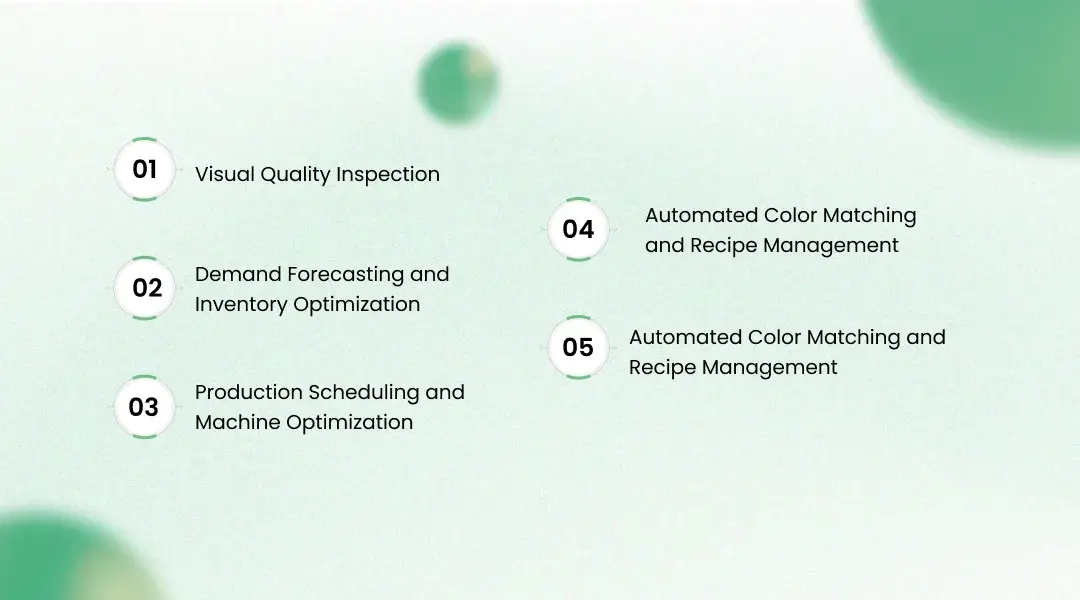
Several AI applications have matured enough to work reliably at small scale without enterprise infrastructure. These are production-ready tools generating measurable returns for businesses of this size today.
AI-powered visual inspection is the single highest-return application for small textile manufacturers. Camera-based systems using trained machine learning models inspect fabric at production speed for defects including holes, stains, shade variations, and weave faults. Unlike human inspectors who fatigue after two to three hours, these systems maintain consistent accuracy across full shifts. Cloud-based inspection platforms offer entry-level configurations at 300 to 800 dollars per month, with camera hardware costing 3,000 to 8,000 dollars. A 20-person fabric unit can expect to catch 25 to 40 percent more defects before dispatch, directly reducing returns and rework.
Small textile businesses frequently carry excess raw material inventory as a hedge against supply uncertainty, tying up 15 to 25 percent of working capital. AI demand forecasting tools analyze order history, seasonal patterns, and customer reorder cycles to predict material requirements with 70 to 85 percent accuracy. Available at 200 to 600 dollars per month, these tools integrate with basic spreadsheets or simple ERP systems. The working capital freed by reducing excess inventory typically pays for the tool within the first quarter.
AI scheduling tools analyze order deadlines, machine capacities, and setup times to generate optimized schedules that reduce idle time and changeover waste. For a small operation running 5 to 15 machines, this translates to AI-driven textile production efficiency gains of 12 to 20 percent in output per shift without additional labour or equipment. Solutions from firms like KriraAI offer configurations scaled for small manufacturers at 400 to 1,200 dollars per month.
For dyeing and printing operations, AI color matching systems reduce lab dips required to achieve target shades from four to five attempts down to one to two. Each failed lab dip costs time, chemicals, water, and energy. An AI system learning from historical dye recipes saves small dyehouses an estimated 8,000 to 25,000 dollars annually in material waste. Cloud-based platforms suitable for small operations range from 150 to 500 dollars per month.
Textile manufacturing is energy intensive, with electricity and steam representing 15 to 30 percent of total production costs. AI energy monitoring tools connect to existing meters to identify consumption patterns, flag inefficiencies, and recommend adjustments. Small businesses report 8 to 15 percent reductions in energy costs within six months. Hardware and software packages start at 5,000 to 12,000 dollars with monthly fees of 100 to 300 dollars.
The numbers that matter for small textile businesses are calibrated to margins where each percentage point is significant. A 15 percent improvement at a workshop producing 200,000 meters annually is the difference between a profitable year and a loss.
Small textile businesses deploying AI visual inspection report defect detection improvements of 25 to 40 percent, translating to rejection rate reductions from an industry-typical 5 to 8 percent down to 3 to 5 percent. For a business with 2 million dollars in annual production value, each percentage point reduction recovers 20,000 dollars. A well-implemented system delivering a two to three point reduction returns 40,000 to 60,000 dollars against a total cost of 12,000 to 18,000 dollars.
AI-driven production scheduling delivers 12 to 20 percent improvements in machine utilization. For a business running 10 looms producing an average of 800 dollars per machine per day, a 15 percent utilization improvement adds approximately 300,000 dollars annually in additional capacity without new equipment or labour.
Demand forecasting reduces raw material carrying costs by 15 to 25 percent. A business carrying 400,000 dollars in average inventory that reduces levels by 20 percent frees 80,000 dollars in cash. Combined with reduced emergency procurement premiums of 10 to 20 percent, total annual savings from affordable AI for textile manufacturing in inventory reach 30,000 to 50,000 dollars. Energy optimization AI delivers 8 to 15 percent utility cost reductions, saving a business spending 120,000 dollars annually on energy approximately 14,400 dollars per year.
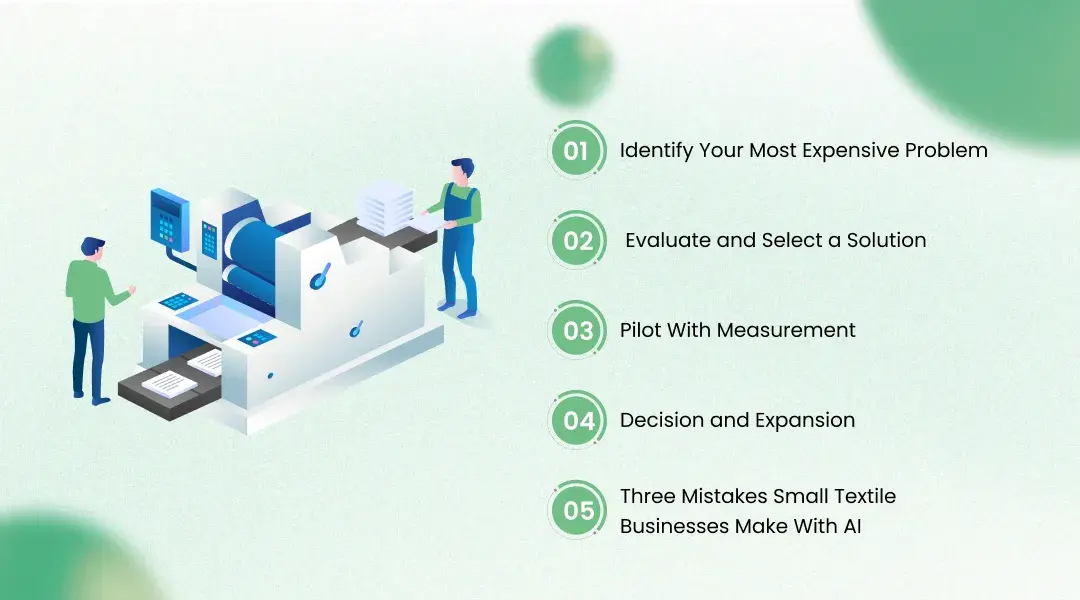
Before evaluating any tool, quantify your top three operational cost drains. Common candidates include quality rejections, excess inventory costs, machine idle time, energy waste, and late delivery penalties. Assign a realistic annual dollar cost to each. The problem with the highest cost and most consistent pattern is your starting point.
Evaluate two to four vendors using criteria specific to small textile businesses:
The tool must work with your existing data sources, even spreadsheets and digitized paper records.
Pricing must be under 1,500 dollars per month with no multi-year lock-in initially.
Implementation must be achievable within 30 to 45 days with vendor support.
The vendor must provide references from textile businesses with fewer than 50 employees.
A 60 to 90 day pilot with clear exit terms must be available.
Deploy on one production line or product category. Assign one existing team member as the internal point person for daily interaction and weekly metric reporting. Do not judge results before 60 days. AI systems in textile environments need calibration time to learn your specific materials and production patterns.
Evaluate pilot results against your cost baseline. If ROI is positive, extend deployment. Begin evaluating your second-priority problem for a new pilot. This creates a disciplined cycle of how to implement AI in small textile business operations without overwhelming your team.
The first mistake is buying technology before defining the problem. An AI system detecting 200 defect types is wasted money if your business encounters only 8 regularly. The second mistake is underinvesting in staff training. Budget at least 15 to 20 percent of total implementation cost for hands-on training delivered on the production floor. The third mistake is expecting AI to fix process problems. If your dyeing inconsistencies stem from poor water quality or inconsistent chemical storage, no AI system will produce consistent results. Fix fundamentals first, then amplify with AI.
The most immediate challenge is data readiness. Most small textile operations have never systematically captured production data digitally. Loom efficiency, defect frequency, and dyeing parameters exist in operator memory and handwritten logbooks. Overcoming this requires a digitization phase before AI deployment, adding two to four weeks and 2,000 to 5,000 dollars. KriraAI addresses this by including structured data capture onboarding in all small manufacturer deployments, recognizing that data readiness is the foundation without which no AI tool delivers results.
Workforce concerns must be addressed honestly. In a 30-person business, AI-powered inspection can trigger anxiety about job displacement. Unlike a large corporation, a small business relies on every team member's loyalty and institutional knowledge. Successful implementations frame AI as a tool that reduces tedious tasks, not a replacement for skilled workers. The businesses achieving the best results are those where operators participate in the evaluation process.
Cash flow sensitivity is the third challenge. Small textile businesses operate on tight cycles with 60 to 90 day payment terms from buyers. An AI investment requiring 10,000 dollars upfront creates real pressure even with strong 12-month ROI. Vendors offering monthly subscriptions with no upfront hardware purchase remove this barrier entirely.
The textile industry is entering a period where the gap between AI-adopting and non-adopting small businesses will become structurally permanent. Small businesses implementing AI quality inspection now will build defect databases and model accuracy that competitors starting later cannot replicate quickly. A system that has processed 500,000 meters of your specific fabric develops detection accuracy a new installation cannot match in its first year.
Buyer expectations are shifting directly. Major retail brands increasingly require digital quality certificates, AI-verified inspection reports, and data-backed consistency guarantees from suppliers. Small textile businesses that cannot provide this documentation will lose access to premium buyers within two to three years. The businesses investing in AI-driven textile production efficiency today are positioning themselves as verified suppliers that larger buyers prefer.
Labour market dynamics will accelerate the divide. Skilled textile workers are aging out of the workforce, and younger workers expect technology-enabled environments. Small businesses with AI tools will attract better talent and maintain production continuity while those without face compounding shortages.
The textile industry's AI transformation is not waiting for small businesses to catch up. Three points from this guide stand out. First, specific AI applications including visual inspection, demand forecasting, production scheduling, colour matching, and energy monitoring are now available at price points matching the reality of a 10 to 50 person textile business. Second, the quantified returns ranging from 15 to 40 percent improvements in defect detection, utilization, and cost reduction are proportionally more impactful at small scale where every percentage point directly affects profitability. Third, the competitive window is narrowing as buyer requirements, labour dynamics, and early-mover data advantages create a divide that will be difficult to cross within three to five years.
KriraAI works directly with small textile manufacturers to identify, deploy, and optimize AI tools for small textile businesses built for the operational constraints of 10 to 50 employee operations. Rather than offering enterprise platforms requiring dedicated IT teams or consumer tools lacking production-grade reliability, KriraAI delivers targeted implementations matching specific production problems to right-sized AI solutions, including data onboarding support that addresses the digitization gap most small textile operations face. If your textile business is ready to move from manual processes to measurable AI-driven efficiency, explore how KriraAI can help you start with the one application that delivers the strongest return for your specific operation.
The total first-year cost of implementing a single AI application typically ranges from 8,000 to 35,000 dollars depending on hardware requirements. Visual inspection systems sit at the higher end due to camera costs of 3,000 to 8,000 dollars plus monthly subscriptions of 300 to 800 dollars. Software-only solutions like demand forecasting or energy monitoring cost 200 to 1,200 dollars per month with minimal setup fees. Budget an additional 2,000 to 5,000 dollars for data onboarding and staff training regardless of the tool selected. Most businesses find that a single well-chosen application pays for itself within four to eight months through measurable reductions in waste, energy, inventory, or labour costs.
Yes, and the majority of successful deployments in small textile businesses operate without dedicated IT personnel. Modern tools for this segment are built for operation by production supervisors and floor managers. The vendor handles setup, model training, cloud infrastructure, and updates remotely. The internal requirement is one team member spending two to four hours weekly monitoring dashboards and communicating feedback. This person needs familiarity with production processes and the ability to identify when outputs do not match shop floor reality, not programming or data science skills.
The most effective affordable AI for textile manufacturing quality control combines edge-based camera hardware with cloud-processed machine learning models. Systems use one to three industrial cameras at inspection points, analyzing images in real time against trained defect models. The critical selection criterion for small businesses is whether the vendor offers pre-trained models for your specific fabric type, as training from scratch requires thousands of samples. KriraAI provides pre-trained models for common categories including woven cotton, knitted jersey, denim, and synthetics, reducing deployment from months to weeks.
Small textile companies typically see measurable improvements within 45 to 60 days and positive financial ROI within four to eight months. Quality inspection systems show improved catch rates within two weeks, though financial impact takes one to two production cycles to quantify. Demand forecasting shows ROI within one to two order cycles as excess stock declines. Production scheduling needs eight to twelve weeks before optimization accuracy reaches reliable levels. The most common cause of delayed ROI is insufficient data capture during onboarding, which starves the model of historical patterns needed for accurate predictions.
The largest risk is investing in a tool that does not match your actual operational problem, creating a system that generates outputs nobody uses. Mitigate this by quantifying the problem's cost before evaluating vendors. The second risk is data quality failure where inconsistent input produces unreliable outputs. A structured onboarding process validating data quality before the model goes live prevents this. The third risk is vendor dependency where critical processes become tied to a single provider. Selecting vendors with transparent data export policies and open formats ensures your production data remains accessible regardless of vendor changes.
Founder & CEO
Divyang Mandani is the CEO of KriraAI, driving innovative AI and IT solutions with a focus on transformative technology, ethical AI, and impactful digital strategies for businesses worldwide.