Here is a number that should stop every small agency owner mid-scroll: among firms with 10 to 49 employees, only 11.9% were using AI as of 2024, compared to 40% of firms with 250 or more employees. In marketing and advertising, where speed, output volume, and creative quality determine which agencies win clients and which ones lose them, that adoption gap is not just a statistic. It is a competitive window, and it is closing faster than most small agency leaders realize.
This blog is written specifically for marketing and advertising agencies with between 10 and 50 employees. Not for solo consultants who can survive on one or two tools. Not for mid-size agencies with dedicated operations and technology teams. For the agencies in the middle: the ones carrying real client rosters, running multi-channel campaigns, managing junior creative staff, and doing all of it without the budgets or the headcount of their larger competitors. If that describes your agency, everything in this post is written for you.
What follows is a grounded, specific guide to AI tools for small marketing agencies, covering the AI applications that make practical sense at your scale, including how targeted generative AI development can eliminate the blank-page problem in content production, the realistic ROI you can expect, a step-by-step implementation roadmap calibrated to your resource constraints, and a look at what the competitive landscape will look like in three to five years for the agencies that act now versus those that wait.
If you run or lead a marketing agency with 10 to 50 employees, your day does not look like anything described in enterprise AI transformation white papers. You are managing a small team where account managers often double as strategists, where your one or two designers are expected to produce social assets, pitch decks, banner ads, and brand documents within the same week, and where your content producers are perpetually behind on deadlines because client briefs keep shifting.
Your typical technology stack at this size includes a project management platform like Asana or Monday, a CRM that probably is not fully configured, Google Analytics, at least two social scheduling tools tied into your broader social media solutions, and a patchwork of subscriptions your team has accumulated over time. You are not running a data warehouse. You do not have a machine learning engineer. You have a digital marketing manager who is interested in technology and a team of seven to fifteen people who are stretched thin across deliverables.
Budget is the constant constraint. Marketing agencies at this size typically operate on gross profit margins between 35 and 55 percent, and your technology budget, separate from the tools directly billed to clients, probably sits somewhere between two and six thousand dollars per month across all platforms. Any new investment has to justify itself quickly, ideally within a single billing quarter, because cash flow discipline is existential at your scale in a way it simply is not for a 200-person agency with a finance team and a CFO.
Decision-making is fast by necessity but often reactive. When a client asks for an additional deliverable, your agency absorbs the scope. When a campaign underperforms, your account manager rebuilds the creative brief personally. There is very little slack in the system, which means any tool that claims to save time needs to actually save time, not just theoretically. The pressures unique to your scale include the following:
Competing on pitch quality against agencies twice your size that have dedicated research and proposal teams.
Retaining junior talent who increasingly expect modern tooling and interesting work.
Maintaining service quality across multiple client accounts without the specialization depth that larger agencies can afford.
Winning on responsiveness and relationship quality since you cannot win on scale alone.
These realities shape which AI applications are worth your attention and which are not.
The mistake most small agency leaders make when reading about AI in marketing is assuming that the advice is scalable downward from enterprise case studies. It is not. A Fortune 500 company adopting AI is spending millions on custom model fine-tuning, proprietary data integrations, and dedicated AI operations teams. A solo consultant adopting AI is subscribing to one or two generative writing tools and using them personally. Neither of those situations describes your agency, and following their playbooks will either leave you under-invested or over-committed.
At the 10-to-50 employee scale, you occupy a genuinely distinct position. Your agency is large enough to have repeatable workflows worth automating. You have enough clients to generate meaningful data about what content performs and what does not. You have enough team members that AI-driven productivity gains compound across multiple people rather than benefiting only one person. But you are small enough that you do not need, and cannot maintain, enterprise-grade infrastructure.
The vendor landscape reflects this. Enterprise AI platforms like Adobe Sensei, Salesforce Einstein, and IBM Watson are built for organizations with dedicated implementation teams and six-figure annual contracts. The solo-operator tools, free or near-free tiers of consumer AI products, lack the workflow integration, usage volume, and team collaboration features that a 20-person agency genuinely needs. The sweet spot for your size sits in the mid-tier SaaS market: platforms like Jasper, Copy.ai Business, HubSpot AI suite, Perplexity for research, Midjourney or Adobe Firefly for creative, and workflow orchestration tools like Make or Zapier with AI integrations, several of which we break down in our guide to affordable AI software built for lean teams. The average cost of integrating an AI solution for an SME has dropped from $15,000 to $3,000 between 2023 and 2026, an 80% decrease that makes these technologies genuinely accessible.
The timeline to results also differs meaningfully by size. Enterprise AI transformations are multi-year programs with complex change management requirements. A 10- to 50-person agency can meaningfully transform one or two core workflows within 60 to 90 days if the right tools are selected and adoption is taken seriously. ROI can appear within 2 to 3 months, depending on the workflow automated and the team's adoption speed. The internal skill requirement is not a data scientist or an AI engineer. It is one person on your team who is curious, process-oriented, and willing to become your internal AI workflow lead, likely someone already in a senior content or operations role.
What you do not need, and should not attempt to build, is a custom AI solution. Off-the-shelf AI tools at the mid-tier SaaS level are sophisticated enough to deliver genuine returns at your scale without requiring engineering resources you do not have.
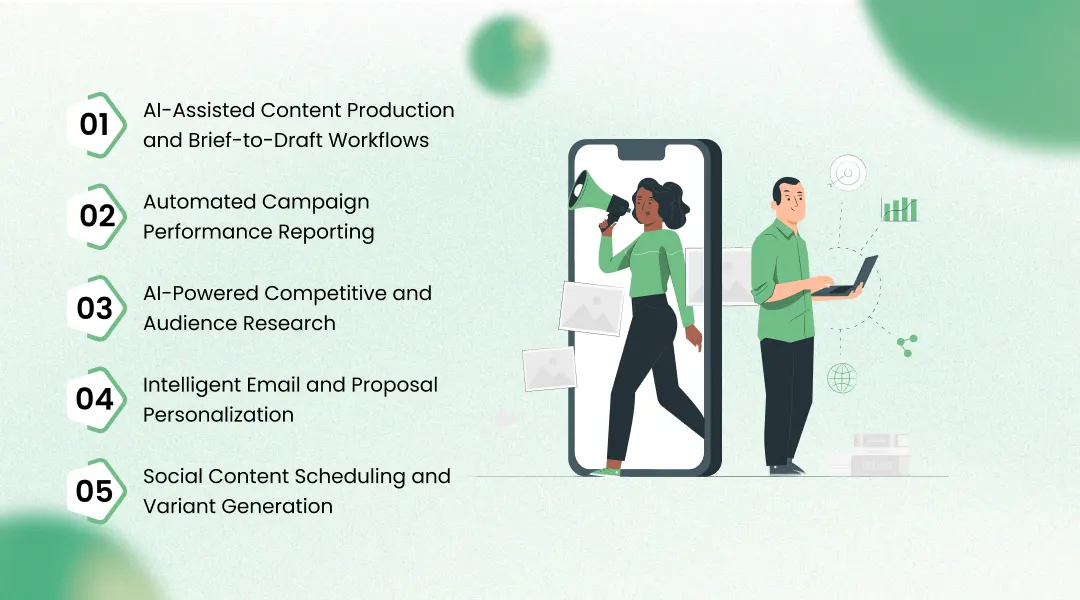
Not all AI capabilities are equally relevant to an agency your size, a lesson that holds up across industries, as we found when applying the same 10-to-50 employee adoption framework to small logistics companies. The following applications represent the highest return opportunities for agencies with 10 to 50 employees, ranked by the combination of implementation simplicity, cost at your scale, and realistic business impact.
The single largest time sink in most small agencies is content production. Brief interpretation, first draft creation, revision cycles, and format adaptation for multiple channels consume a disproportionate share of your team's hours. AI writing tools integrated into your content workflow can reduce first-draft production time by 50 to 70 percent when configured correctly with client brand voice guidelines and content frameworks. Content marketing using AI delivers a 50 to 70 percent reduction in production time, with ROI achieved in 2 to 3 months. Att a 20-person agency producing content for eight to twelve clients simultaneously, that time saving translates to either handling more clients with the same headcount or dramatically improving the depth of creative work your team produces.
The practical implementation for your size involves loading each client's brand guidelines, tone documents, and top-performing content examples into an AI writing platform configured with custom personas per client. Your content team then uses AI to generate structured first drafts,ts which they refine rather than create from scratch. This is not about replacing your writers. It is about eliminating the blank-page problem that consumes the first hour of every content block.
Most small agency account managers spend between three and six hours per week per client compiling performance reports from multiple platforms: Google Ads, Meta, LinkedIn, email platforms, and Google Analytics. This is high-effort, low-value work that directly competes with time that should go into strategic client conversations and campaign optimization.
AI-powered reporting tools, many of which integrate directly with your existing platforms, can automate data aggregation, anomaly detection, and narrative generation. Your account managers receive a structured report with key metrics, performance flags, and recommended talking points before the client call rather than assembling it manually. At your scale, automating reporting for ten clients saves 30 to 60 hours per month across your account team, hours that directly increase your capacity for strategic work.
Research is another hidden time sink. Competitive landscape analysis, audience persona development, and keyword and content gap research that previously required half a day of manual work can now be completed in under two hours using AI research tools with web access. For small agencies pitching new business frequently, this creates a compounding advantage: you can deliver richer, more specific strategic insights in pitches without deploying senior team time to produce them.
AI users report a 47% boost in productivity and save an average of 12 hours per week by automating repetitive tasks, with prospect outreach and client relationship building among the top tasks that received more attention as a result. ZoomInfo: For a small agency, the business development pipeline is perpetually under-resourced. AI tools that generate personalized outreach sequences, proposal frameworks, and follow-up messaging based on prospect industry and pain points allow your business development effort to punch above its weight without adding headcount.
Producing multiple creative variants of social posts, ad copy, and email subject lines for A/B testing is standard best practice, but manual variant generation is slow and inconsistent. AI tools can generate eight to twelve variants of any content piece in minutes, allowing your team to test more systematically and optimize faster. Companies that leverage AI personalization see a 5 to 8x ROI on their marketing spend. Even conservative application of this principle at the client campaign level produces measurable lift in campaign performance over time.
The business case for AI tools for small marketing agencies is clearest when you translate industry-level statistics into what they mean specifically for an agency your size.
Consider a 25-person agency with 15 people in billable client-facing roles. The average marketer saves 6.1 hours per week through AI tools, with senior practitioners saving 8 to 10 hours and junior staff saving 3 to 4 hours. Appliedd to 15 billable team members at mixed seniority, that is approximately 75 to 90 hours of recovered time per week across the agency. At a blended billing rate of $100 per hour, that represents between $7,500 and $9,000 in weekly recoverable capacity, either absorbed by growth in client scope or redirected toward new business acquisition.
Business owners report saving 13 hours per week on their own tasks and another 13 hours per week for their employees through AI tools, and employees using AI report an 80% boost in productivity. Lucid: For a small agency principal who currently splits time between client delivery and business development, reclaiming 13 hours per week is transformative. It is the difference between reactive leadership and strategic leadership.
On the cost side, SMEs using AI achieve an average of 23% savings on operational costs, primarily through automation of repetitive tasks and process optimization. For a small agency spending $400,000 annually on staff costs related to content production, research, reporting, and administrative coordination, a 23% operational savings represents $92,000 in annual cost reduction at full AI adoption maturity. Even at half that figure, the ROI substantially exceeds the cost of mid-tier AI tool subscriptions.
The median payback on AI tooling investments is now 4.2 months, down from 7.8 months in 2024. For content-heavy agencies, payback arrives even faster, often within the first billing quarter. A digital marketing agency achieved a 500% ROI by automating email campaigns, saving $10,000 in operational costs while generating $50,000 in new revenue. While not every agency will achieve those precise numbers, the directional reality is clear: the cost of not adopting AI is now measurably greater than the cost of adopting it.
From a revenue growth perspective, marketing departments report revenue increases of 3 to 15% and sales ROI improvements of 10 to 20% following AI implementation. For a small agency billing $2 million annually, a 10% revenue improvement from AI-enabled capacity expansion and better campaign performance represents $200,000 in incremental annual revenue, achievable without adding headcount.
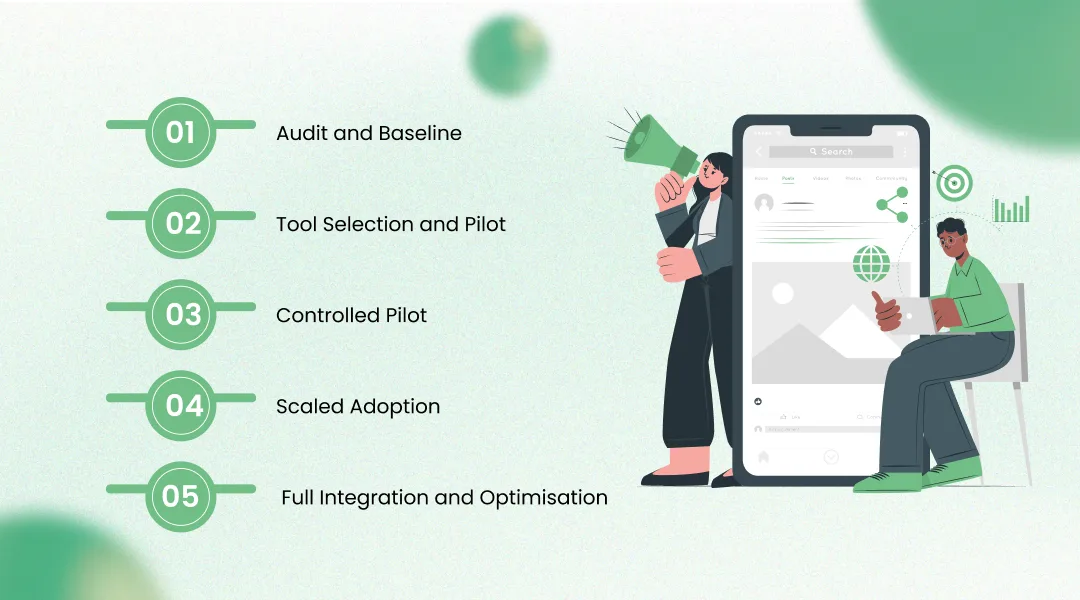
The right approach to AI adoption at your agency size is sequential, not simultaneous. Attempting to transform every workflow at once creates disruption, resistance, and the appearance of chaos rather than progress. The following roadmap is designed specifically for the resource constraints and decision-making dynamics of a10-0 to 50-person agency.
Begin by mapping the five workflows that consume the most time relative to the value they produce. For most small agencies, these will be content first-draft creation, campaign performance reporting, competitive research for new business pitches, email and proposal writing, and social content variant production. Record baseline time measurements for each workflow across your team. These numbers will be your ROI proof points six months later.
Select one primary tool for each priority workflow. Do not adopt five new platforms simultaneously. Start with the workflow that combines the highest time cost with the lowest risk to client quality, typically internal reporting or research. Configure the tool with your agency's standard templates, client personas, and brand voice documents. Assign one team member as the workflow lead for the pilot. Designate this person as your internal AI champion, not an external hire, but someone already embedded in the work who will become the institutional knowledge holder for AI-powered workflows.
Run the first AI-powered workflow for a subset of clients or a single team. Measure time against baseline. Collect feedback on output quality. Iterate on prompt templates, configurations, and review processes. The goal of this phase is not perfection. It is learning what works at your specific agency with your specific clients and establishing a quality control process that your team trusts.
Roll out the first successful workflow across the full team and begin piloting the second workflow. Create a shared prompt library and workflow documentation. Establish a monthly review of time savings, quality metrics, and tool costs against the baseline you captured in Phase 1.
At this stage, AI tools should be embedded in your standard operating procedures, not treated as optional add-ons. Begin exploring more advanced applications, including AI-assisted campaign strategy, predictive audience modeling, and automated client communication workflows.
The first mistake is adopting AI tools without a clear workflow integration plan. Subscribing to Jasper or a similar platform and telling your team to "use it when helpful" produces inconsistent results and eventual abandonment. AI tools deliver returns only when embedded in defined workflows with clear standards for input, review, and output quality.
The second mistake is trying to replace human judgment with AI output rather than augmenting human work with AI efficiency. Over 70% of marketers have encountered an AI-related incident in their advertising efforts, including hallucinations, bias, or off-brand content. Small agencies that skip the human review layer because they are trying to maximize time savings expose themselves to client relationship damage that no efficiency gain can offset.
The third mistake is waiting until the technology is "more mature." The agencies that are building AI-powered workflows today are accumulating institutional knowledge, refined prompt libraries, and client trust in AI-augmented deliverables. That institutional knowledge is not transferable. By the time a competitor agency finally adopts AI, the early movers will be producing twice the output at comparable quality and will have twelve months of workflow refinement that cannot be purchased or shortcut. KriraAI works with agencies at exactly this stage, helping teams build practical AI workflow frameworks that match their actual capacity and client commitments rather than theoretical best practices from enterprise transformation programs.
Honest analysis of AI adoption for agencies at your size requires naming the real friction points, not just the opportunities.
The talent readiness challenge is genuine. Not every member of a small agency team is equally comfortable with AI-powered tools, and the agencies that manage adoption best are those that address this asymmetry directly. Senior team members who have built their reputations on craft, writing ability, and creative instinct may experience genuine resistance to AI-augmented workflows that they perceive as devaluing their skills. Managing this requires explicit communication that AI is amplifying their output capacity, not replacing their expertise, and demonstrating that clearly through the work itself.
Brand voice consistency is a legitimate concern that off-the-shelf AI tools do not automatically solve. A 25-person agency managing twelve client accounts is working with twelve distinct brand voices, twelve sets of messaging guidelines, and twelve audiences with different expectations. Configuring AI tools to maintain genuine voice consistency across this complexity requires upfront investment in prompt engineering and template development that many small agencies underestimate. KriraAI addresses this directly by helping agencies build client-specific AI configuration frameworks that maintain brand integrity across all AI-assisted outputs.
Data privacy and client confidentiality deserve serious attention. Many AI platforms use input data for model training unless you explicitly configure otherwise or select enterprise tiers with appropriate data handling agreements. For agencies working with clients in regulated industries or with sensitive campaign data, this is not a minor footnote. It requires deliberate vendor selection and clear internal policies about what client information enters AI systems.
Finally, the pricing model disruption that AI creates is a challenge that goes beyond operations. 38% of US digital agencies have moved at least one service line from hourly billing to retainer-plus-performance or outcome-based pricing in 2026, with another 29% reporting client pushback on hourly rates, with clients explicitly citing AI-driven productivity gains. Small agencies need to proactively reframe their pricing around outcomes and strategy rather than production hours, or they risk clients reclaiming the efficiency savings that AI tools generate.
Project forward three years to 2028, and the marketing and advertising industry for agencies at the10-to-500 employee scale looks materially different from today. The agencies that have systematically adopted AI workflows by mid-2026 will have accumulated an 18-to-24-month advantage in workflow efficiency, prompt library depth, and client confidence in AI-augmented deliverables. That advantage compounds because AI-powered agencies can take on more clients without proportional headcount growth, which increases revenue, which funds better AI tooling, which extends the lead further.
The median mid-market marketing team spent $1,200 per month on AI tools in Q1 2025 and $3,400 per month in Q1 2026. As AI tool costs continue to represent an increasing share of operational budgets, agencies that have already built adoption culture, internal AI champions, and workflow documentation will integrate new tools faster and at lower cost than agencies starting from zero. The switching cost of late adoption is not just financial. It is organizational.
The capability gap that will most clearly separate winning agencies from struggling ones by 2028 will be speed and personalization at scale. An AI-equipped 20-person agency will be capable of producing the research depth, campaign personalization, and creative volume that currently requires a 50-person agency to deliver. For clients, this is attractive because they receive enterprise-level strategic output from a smaller partner who knows their business more deeply. For competing agencies that have not adopted AI, this capability shift represents an existential threat to their value proposition.
The agencies that wait will not simply fall behind on efficiency. They will lose pitches to competitors who can demonstrate richer insights, faster turnaround, and more systematic optimization processes. They will lose talent to agencies that offer more interesting work and modern tools. And they will face pricing pressure from clients who know exactly what AI-enabled production efficiencies look like because they will have worked with agencies that are delivering them. A Mercer study found that 54% of business leaders believe their companies will not remain competitive beyond 2030 without adopting AI at scale. For small marketing agencies, that timeline is even more compressed because the agency market is intensely competitive at every price point.
KriraAI's work with small and mid-size agency clients consistently shows that the agencies gaining the most ground are not the ones spending the most on AI tools. They are the ones that have made systematic, thoughtful adoption part of how they operate, with clear ownership, defined standards, and genuine integration into client delivery rather than experimentation on the side.
Three insights from this analysis stand above the rest for small marketing agency leaders considering AI adoption. First, the cost barrier has effectively disappeared. AI tools appropriate for a10-0 to 50-person agency now cost a fraction of what they did two years ago, and the payback period has compressed to under five months on average. Second, the opportunity is specifically favorable for agencies at your scale because you are large enough to compound productivity gains across a team, nimble enough to integrate new workflows quickly, and relationship-oriented enough to maintain the client trust that makes AI-augmented work credible. Third, the window for early-mover advantage is not indefinitely open. The agencies investing in systematic AI workflow integration in 2025 and 2026 are building institutional knowledge that will be very difficult for late adopters to replicate by 2028.
KriraAI works with small and mid-size marketing agencies to build practical, scalable AI implementations designed specifically for the resource realities of a10-0 to 550-personbusiness. Not enterprise solutions scaled down, and not solo-operator tools scaled up. Purpose-built AI workflow frameworks that match your actual client delivery structure, team skills, and budget, helping your agency produce more, pitch stronger, and grow without proportional hiring. If you are ready to move from exploring AI to actually building the workflows that deliver results, reach out to KriraAI to start with a focused workflow audit and implementation plan built around your agency's specific situation.
The best AI tools for small marketing agencies depend on your most time-intensive workflows, but the highest-impact starting points for agencies at this size are AI writing platforms like Jasper or Copy.ai Business for content production, HubSpot's AI-powered suite for CRM and campaign automation, Perplexity or similar AI research tools for competitive analysis and pitch preparation, and reporting automation tools that integrate with Google Analytics, Meta, and Google Ads. For creative production, Adobe Firefly and Canva's AI features offer practical image and asset generation without requiring design engineering expertise. The important principle is that small agencies should select one tool per workflow and integrate it deeply rather than subscribing to ten tools and using all of them superficially. An agency with 20 employees that masters two or three AI workflows will outperform an agency of the same size that has scattered adoption across many platforms with no defined standards for any of them.
AI implementation costs for a small marketing agency with 10 to 50 employees are significantly lower than most leaders assume. Mid-tier SaaS AI tools appropriate for your scale typically run between $50 and $500 per month per platform, meaning a complete four to five tool AI stack for your agency costs between $300 and $2,000 per month in software subscriptions. The more meaningful cost is the internal time investment in configuration, training, and workflow development, typically 40 to 80 hours over the first 60 to 90 days. Outsourcing initial setup and workflow design to a specialist like KriraAI, which builds practical AI implementation frameworks for small agencies, can compress that timeline substantially and reduce the trial-and-error cost that most agencies absorb when implementing independently. The average SME AI integration investment has dropped by 80% since 2023, making a fully configured multi-tool setup realistic at a small agency budget.
AI tools for small marketing agencies typically begin showing measurable ROI within 60 to 90 days of genuine workflow integration, with most agencies recovering the full cost of their AI tool subscriptions within the first four months. The key qualifier is "genuine workflow integration," meaning AI tools are used in defined, documented workflows with team adoption standards rather than optional usage at individual discretion. Agencies that assign a dedicated internal workflow lead, configure tools with client-specific templates, and measure baseline time before implementation consistently reach positive ROI faster than those that treat AI tools as general-purpose assistants. Content-heavy workflows show the fastest returns, with 50 to 70 percent production time reductions translating to measurable capacity gains within the first billing period. Reporting automation typically follows, with account managers recovering three to six hours per client per month once automated reporting pipelines are established.
AI will not eliminate roles at a well-managed small marketing agency, but it will fundamentally change what every role involves. Junior content writers who previously spent most of their time producing first drafts will shift toward editorial refinement, brand voice quality control, and creative strategy. Account managers who spent hours compiling performance reports will spend that time on strategic client conversations and campaign optimization. The agencies most at risk of workforce disruption are those that adopt AI without rethinking what their team's time should be spent on, continuing to use the time recovered by AI on the same tasks at reduced rates rather than redeploying it toward higher-value work. The agencies that navigate this best treat AI as a leverage multiplier for existing talent, asking what better work their team could do if they had 10 more hours per week, and then building AI workflows that actually deliver those hours. Junior roles in content production are contracting industry-wide, but senior strategist, analyst, and AI-native operator roles are growing.
A small marketing agency with 10 to 50 employees can meaningfully compete with agencies two to five times its size by using AI to eliminate the output capacity gap without eliminating the relationship quality advantage that small agencies naturally hold. Specifically, AI-equipped small agencies can produce the research depth that previously required dedicated research teams, generate the content volume that larger production teams delivered, and demonstrate campaign personalization sophistication that clients previously associated only with large agencies. The competitive argument is straightforward: a 25-person AI-powered agency can deliver the strategic depth of a 60-person traditional agency while maintaining the account intimacy and responsiveness that larger agencies structurally cannot offer. The practical steps are selecting AI tools that match your highest-volume workflows, building a shared prompt library and quality standards, designating an internal AI champion, and explicitly repositioning your agency's value proposition around strategic outcome rather than production capacity.
Ridham Chovatiya is the COO at KriraAI, driving operational excellence and scalable AI solutions. He specialises in building high-performance teams and delivering impactful, customer-centric technology strategies.