A 2025 report from Cerulli Associates found that independent financial advisory firms with fewer than ten employees spend an average of 62 percent of their working hours on administrative and operational tasks rather than billable client work. Meanwhile, solo and micro financial firms that have adopted even one AI tool report reclaiming 12 to 18 hours per week of that lost time, translating directly into revenue capacity they were previously leaving untouched. If you run a financial planning practice, a boutique wealth management firm, a small tax advisory office, or an independent insurance brokerage with one to nine people on the team, these numbers should reframe how you think about technology spending entirely.
The conversation around AI tools for small financial firms has been dominated by noise. Enterprise banks announce hundred-million-dollar AI transformation programs. Fintech startups raise venture capital to build AI native platforms from scratch. Neither reality has anything to do with yours. Your decision is whether adopting custom AI software solutions via monthly subscriptions can free up enough hours and reduce enough errors to pay for itself within 90 days. This blog answers that question with specific costs, returns, and implementation guidance written exclusively for financial firms operating with one to nine people.
The operational reality of a microfinance firm is fundamentally different from what most technology vendors understand or design for. Grasping this reality is the prerequisite for any honest conversation about AI at this scale.
A typical independent financial advisory firm with one to nine employees is built around one or two principals who are simultaneously the revenue generators, compliance officers, client relationship managers, and strategic decision makers. Supporting them are one to four staff members handling scheduling, document preparation, CRM data entry, compliance filing, and client communications. In firms with fewer than five people, the principal handles several of these functions personally.
The technology stack centres on a CRM platform such as Redtail, Wealthbox, or Salesforce Financial Services Cloud alongside a financial planning tool like MoneyGuidePro or RightCapital. Portfolio management runs through Orion or Black Diamond. Document management uses a mix of cloud storage and compliance archiving. These systems rarely communicate natively, creating manual data transfer work that consumes hours every week.
Annual technology spending ranges from 15,000 to 60,000 dollars, covering software subscriptions, cybersecurity, compliance platforms, and basic IT support. There is no IT department. Revenue per firm ranges from 300,000 to 3 million dollars annually, with net margins between 25 and 45 percent. Every technology dollar must demonstrably earn or save more than a dollar. There is no budget for experimentation.
The AI playbooks circulating in financial services media are written for large enterprises, whereas tailored AI solutions for financial services focus on practical efficiency at a micro scale. Applying that guidance to a six-person wealth management firm is counterproductive because it frames AI as a massive undertaking when, for this segment, it should be a series of targeted tool adoptions.
A large bank implementing AI deploys custom machine learning models, integrates them into legacy systems through months of API development, and hires data engineers for maintenance. The budget runs from 5 million to 50 million dollars over 12 to 36 months. A solo financial advisor subscribes to a cloud tool, connects it to their CRM through a pre-built integration, and starts seeing results within two to four weeks at 100 to 800 dollars per month. These are entirely different activities.
For firms with one to nine employees, the right AI tools for small financial firms must require zero technical setup beyond connecting existing accounts, operate on monthly subscriptions without long-term contracts, produce measurable value within 30 days, and require no dedicated staff to manage. KriraAI has found through work with microfinance firms that tools meeting all four criteria get adopted and retained, while tools violating even one are abandoned within 60 days regardless of their capabilities.
The vendor landscape differs at this scale too. Enterprise financial AI is dominated by Palantir, C3.ai, and major consultancy custom builds. Micro firms access AI features embedded in platforms they already use, standalone tools designed for small professional services firms, and horizontal AI productivity tools adapted for financial workflows. Understanding which tier to shop in saves weeks of wasted evaluation.
The applications worth investing in directly address time drains and revenue constraints specific to microfinance firms. Each includes realistic cost ranges and expected returns for this scale.
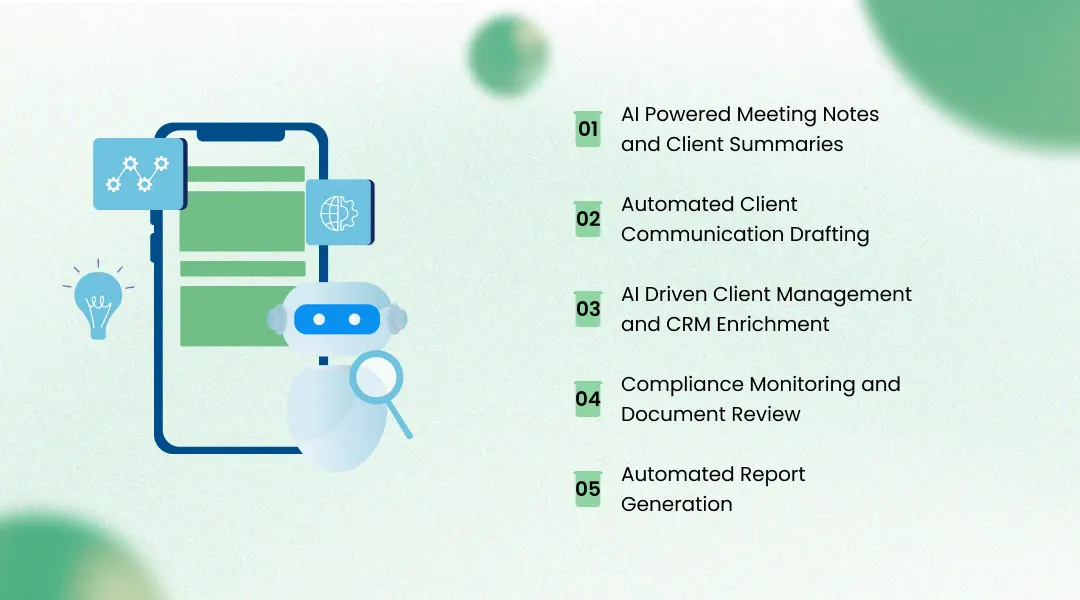
Financial advisors spend 30 to 45 minutes after every client meeting writing notes and updating CRM records. AI meeting assistants such as Fireflies.ai or Otter.ai record conversations, generate structured summaries, extract action items, and push notes into CRM systems at 20 to 50 dollars per user monthly. For a solo advisor conducting 15 to 20 meetings weekly, this recovers 8 to 12 hours. At an effective rate of 200 dollars per hour, recovered time represents 1,600 to 2,400 dollars weekly in capacity against a minimal subscription cost.
Preparing personalised client emails for portfolio reviews, market commentary, and scheduling consumes significant staff time. AI writing assistants trained on financial communication patterns generate compliant, personalised drafts in seconds for review before sending at 30 to 100 dollars monthly. Firms report reducing email preparation time by 60 to 75 percent while maintaining personalisation quality.
AI-driven client management finance tools analyse CRM data to identify attrition-risk clients, flag life events creating planning opportunities, and prioritise outreach by revenue potential and engagement patterns. These capabilities are increasingly embedded in CRM platforms at no extra cost or available as add-ons for 50 to 200 dollars monthly. For a firm managing 150 to 400 households, AI-driven prioritisation ensures limited outreach hours target the highest impact clients.
Regulatory compliance burdens small firms disproportionately because requirements match those of large firms, but compliance staff is often zero dedicated people. AI compliance tools scan communications and assist audit preparation, making it essential to choose the right ML service that meets strict regulatory standards. Firms using these tools report reducing compliance review time by 40 to 55 percent and lowering the risk of costly regulatory findings.
Preparing quarterly performance reports and financial plan summaries requires pulling data from multiple systems and formatting it into client-ready presentations. AI tools integrating with portfolio management platforms generate draft reports in minutes. For a firm producing 100 to 300 client reports per quarter, this saves 40 to 80 hours quarterly, directly freeing capacity for revenue-generating work.
The ROI calculations for affordable AI for financial planning firms must reflect the economics that govern micro businesses where every hour directly affects the principal's income.
AI meeting automation delivers the most immediate return. A solo advisor investing 30 dollars monthly who recovers 10 hours weekly gains 520 hours annually. At a conservative rate of 200 dollars per hour, that represents 104,000 dollars in recovered capacity on a 360 dollar annual investment. Even if only 30 percent converts to revenue-generating activity, the return exceeds 31,000 dollars.
Automated client communication shows strong returns at a small scale because every hour saved is felt directly. A three-person firm spending 15 hours weekly on email drafting that reduces this to 5 hours saves 520 hours annually. Redistributed to client acquisition, those hours typically yield three to five new client relationships per year, representing 15,000 to 75,000 dollars in recurring annual revenue.
AI compliance monitoring delivers returns through risk reduction. A single compliance violation can result in fines of 5,000 to 50,000 dollars for small firms plus remediation costs. Tools reducing compliance risk by 30 percent provide insurance value exceeding the monthly subscription. Firms report 40 to 55 percent faster audit preparation, saving 20 to 40 hours each annual review cycle.
CRM intelligence demonstrates ROI through retention improvements. Acquiring a new financial planning client costs 3,000 to 7,000 dollars. Losing clients due to insufficient engagement costs far more than the 50 to 200 dollars monthly for AI-driven CRM enrichment. Firms report 15 to 25 percent improvements in client retention, which for a 200-household firm translates to retaining three to five additional clients annually worth 30,000 to 100,000 dollars cumulatively.
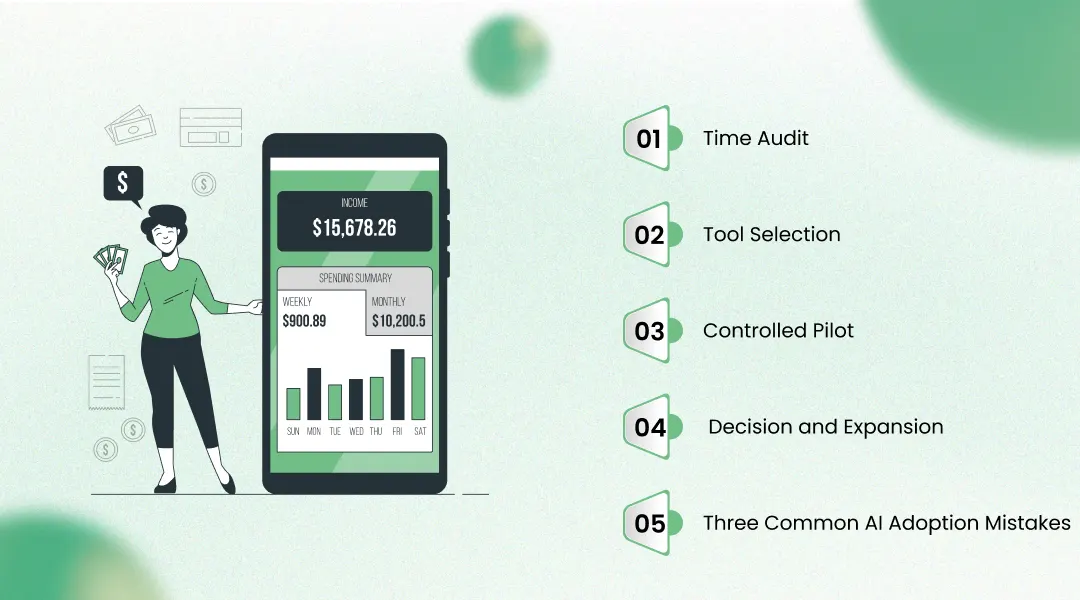
Every person in the firm should track time for one full week, categorising activities into client-facing revenue work, administrative work, compliance work, and communication. The category consuming the most non-revenue hours is your starting point. KriraAI consistently finds that firms skipping this audit select the wrong tool first and lose confidence in AI adoption entirely.
Evaluate two to three tools for your priority problem using these criteria:
Free trial of at least 14 days with no credit card required for initial testing.
Monthly pricing under 500 dollars for the entire firm, not per-seat pricing that scales beyond budget.
Pre-built integration with your existing CRM and core platforms.
Onboarding support is included in the subscription and is not billed separately.
SOC 2 certification and encryption meet financial industry standards.
Deploy for one workflow with one or two team members. Define three measurable outcomes before starting. Track weekly. Do not judge results before 21 days because AI tools in financial workflows need calibration time to learn your communication style and client terminology.
If the pilot delivers positive results, expand to all team members and evaluate your second-priority problem. This creates a sustainable cycle for implementing AI in small finance business operations without overwhelming a lean team.
The first mistake is subscribing to too many tools simultaneously. A three-person firm adopting five AI tools in one month will not integrate any of them properly. Adopt one, build it into daily habits over 30 days, then consider the next. The second mistake is choosing tools by feature count rather than workflow fit. The platform with 50 features is less valuable than the one with 5 features addressing your costliest time drain. The third mistake is failing to involve all team members in evaluation. In a four-person firm, if even one person resists the new tool, adoption collapses.
The most significant friction point is compliance uncertainty around AI-generated content. As seen with AI agents in action across industries, when a solo advisor uses AI to draft client communications, regulatory responsibility for accuracy remains entirely with the advisor. Unlike a large firm with a compliance department reviewing AI outputs, a micro firm must build personal review habits that catch errors without recreating the time burden AI was supposed to eliminate.
Data privacy creates a second layer. Financial firms handle sensitive client information, including account numbers, net worth figures, and estate plans. Every AI tool must be evaluated for how it stores, processes, and potentially trains on client data. For a firm without a compliance officer, this evaluation adds hours to the selection process. KriraAI addresses this by providing pre-vetted vendor assessments for microfinance firms, ensuring data handling meets regulatory standards before any recommendation.
Client perception presents a third challenge. Some clients, particularly older and higher net worth individuals, may view AI involvement negatively. Micro firms must position AI as a tool giving their advisor more time for personalised attention rather than replacing the human relationship clients value.
Within three to five years, the financial advisory industry will show measurable differences in client capacity, service quality, and profitability between firms that integrated AI automation for independent financial advisors and those that did not.
An advisor reclaiming 12 hours weekly through AI tools can serve 20 to 30 percent more client households without hiring additional staff. Over three years, this capacity advantage compounds into a larger revenue base, a deeper client roster, and stronger referral networks. A competing firm waiting three years cannot close the gap through technology alone because the early mover has compounded both capability and client relationships.
Client expectations are shifting as AI-powered experiences become standard through consumer platforms like Wealthfront and Betterment. Clients of independent advisors will increasingly expect similar responsiveness, personalisation, and reporting sophistication. Firms unable to deliver technology-enhanced experiences will lose clients regardless of their underlying advice quality. The firms investing in AI-driven client management finance tools now are building the service infrastructure defining expectations for the next decade.
Three findings should guide every small financial firm's AI strategy. First, the cost of meaningful AI tools for small financial firms ranges from 150 to 800 dollars monthly, with most applications priced between 20 and 400 dollars, making the barrier far lower than most firm owners assume. Second, the quantified returns, including 8 to 12 hours recovered weekly, 40 to 55 percent reductions in compliance preparation time, and 15 to 25 percent client retention improvements, are proportionally transformative at a scale where every hour and every client directly impact the principal's income. Third, the competitive divide between adopting and non-adopting small firms is compounding now, and firms waiting three to five years will face capacity gaps that technology alone cannot close.
KriraAI works with solo operators and microfinance firms to select, implement, and optimise AI solutions matching the actual budget, team size, and compliance requirements of firms with one to nine employees. Rather than repackaging enterprise platforms or recommending consumer tools lacking financial industry security standards, KriraAI builds targeted implementation roadmaps starting with the single highest impact application for each firm's workflow and expanding as returns are validated. If your firm is ready to convert administrative hours into client-facing revenue through practical AI adoption, explore how KriraAI can help you identify the right starting point for your practice.
The realistic monthly cost of a meaningful AI tool stack for a financial firm with one to nine employees ranges from 150 to 800 dollars depending on the applications adopted. Meeting automation costs 20 to 50 dollars per user monthly. Client communication AI runs 30 to 100 dollars. CRM intelligence features are often included in existing subscriptions or available for 50 to 200 dollars monthly. Compliance monitoring ranges from 100 to 400 dollars. Most firms begin with one or two tools totalling 100 to 300 dollars monthly and expand as returns validate. First year total investment including setup typically stays below 5,000 to 10,000 dollars.
A solo financial advisor can use AI tools while maintaining full regulatory compliance provided specific precautions are followed. The advisor must review all AI generated client communications before sending, ensure tools processing client data meet SOC 2 certification and financial industry encryption standards, maintain records of AI assisted outputs as required by SEC or state regulatory bodies, and verify no AI tool makes investment recommendations without human oversight. The regulatory framework does not prohibit AI usage. It requires the advisor to remain responsible for all outputs and client data handling to meet established privacy standards. Firms should document AI usage policies within their compliance manuals.
The fastest path to measurable ROI is implementing an AI meeting assistant, which typically delivers positive returns within the first week. A solo advisor conducting 15 meetings weekly who saves 30 minutes of note taking per meeting recovers 7.5 hours weekly. At any reasonable hourly value for advisory work, this single tool pays for itself within days. The key is selecting a tool integrating directly with the firm's CRM so notes and action items flow automatically. Firms starting with meeting automation consistently report it as their highest confidence investment, creating momentum for subsequent adoptions.
The most effective affordable AI for financial planning firms focused on retention combines CRM intelligence with automated communication workflows. AI driven CRM tools analyse engagement patterns, identify disengagement signals such as declining meeting attendance, and flag life events creating planning opportunities. Paired with AI communication tools generating personalised outreach drafts, the combination enables proactive relationship management that would otherwise require dedicated staff most micro firms cannot afford. Firms using this combination report 15 to 25 percent retention improvements, with the highest impact among clients in the 500,000 to 2 million dollar asset range.
Using AI with sensitive client financial data is safe when firms select vendors meeting specific security standards and implement proper protocols. Minimum requirements include SOC 2 Type II certification, encryption in transit and at rest, contractual confirmation the vendor does not use client data for model training, and data residency within compliant jurisdictions. Firms should also restrict AI tool access to authorised personnel, use anonymised data where possible, and maintain audit logs of AI interactions involving client information. The risk is not in AI itself but in selecting vendors without adequate security infrastructure or using consumer grade tools not designed for regulated financial data.
Founder & CEO
Divyang Mandani is the CEO of KriraAI, driving innovative AI and IT solutions with a focus on transformative technology, ethical AI, and impactful digital strategies for businesses worldwide.