The global textile industry generates approximately $1.7 trillion in annual revenue and produces over 100 billion garments every year. Yet beneath this scale lies a structural inefficiency that no additional headcount can resolve: fabric defect rates between 5% and 15% across most mid-tier mills, translating to an estimated $50 billion in annual losses from rework, order rejection, and waste. Add the cost of unplanned machine downtime — which runs between $30,000 and $80,000 per incident at large spinning operations — and it becomes clear that the textile sector is not a mature, optimized system. It is a high-volume operation held together by human vigilance and manual workarounds that compound in cost at every production stage.
AI in textile manufacturing is changing this equation in ways that are measurable, auditable, and increasingly difficult to ignore. Computer vision systems are inspecting fabric at 1,200 meters per minute with detection accuracy above 95%. Predictive maintenance algorithms are flagging bearing failures 72 hours before they cause a stoppage. Demand forecasting models trained on retail sell-through data are cutting raw material overstock by 30% in documented pilot deployments. These are not projections from a technology vendor — they are operational results being reported by mills in South Asia, Southeast Asia, and Turkey today.
This blog covers the structural challenges the textile industry faces, the specific AI technologies transforming each production stage, the quantified business results manufacturers are achieving, a practical implementation roadmap, the real difficulties of adoption, and a five-year outlook for where this transformation is headed.
The textile industry operates under a convergence of pressures that its traditional production model was not designed to absorb simultaneously. Fast fashion brands have compressed product development cycles from an industry standard of six months to as few as three to four weeks for trend-responsive lines. This acceleration forces manufacturers to interpret market signals, procure raw materials, adjust production schedules, and confirm quality compliance at speeds that overwhelm manual planning processes built for a slower commercial environment.
Raw material volatility compounds the operational stress. Cotton prices fluctuated by more than 40% between 2020 and 2023, driven by climate disruptions in major growing regions, freight cost spikes, and currency movements across key sourcing markets. Synthetic fiber prices track crude oil with a lag that creates its own forecasting complexity. For a mid-size woven fabric mill operating on 60-day forward purchase commitments, even a 10% swing in polyester filament pricing can erase an entire quarter's operating margin.
Labor costs are rising across every major textile-producing economy. Bangladesh, the world's second-largest apparel exporter, has raised its minimum garment worker wage significantly in recent years. Vietnam and India face comparable dynamics. The labor arbitrage model that powered offshore textile production for four decades is narrowing, and manufacturers cannot simply relocate to successively cheaper markets — the available options are diminishing and setup costs are rising with each move.
The machinery challenge is structural rather than cyclical. A large proportion of operational looms and spinning frames across South Asian mills are between 15 and 25 years old. These machines are mechanically functional but data-dark — their sensors were never designed to transmit operational data to any analytics system. Retrofitting is technically feasible, but without a coordinated technology strategy, most mills have lacked both the roadmap and the internal capability to execute it.
Environmental compliance is no longer a distant regulatory concern. The European Union's Ecodesign for Sustainable Products Regulation directly affects textile imports. Global apparel brands including H&M, Inditex, and PVH are pushing sustainability requirements downstream to tier-two and tier-three suppliers, demanding chemical traceability data and carbon documentation that few mills currently have systems to produce. These pressures together — speed, cost, labor, aging infrastructure, and compliance — form the environment into which AI in textile manufacturing is being deployed, addressing not a single problem but an interconnected set of failures that have compounded over decades.
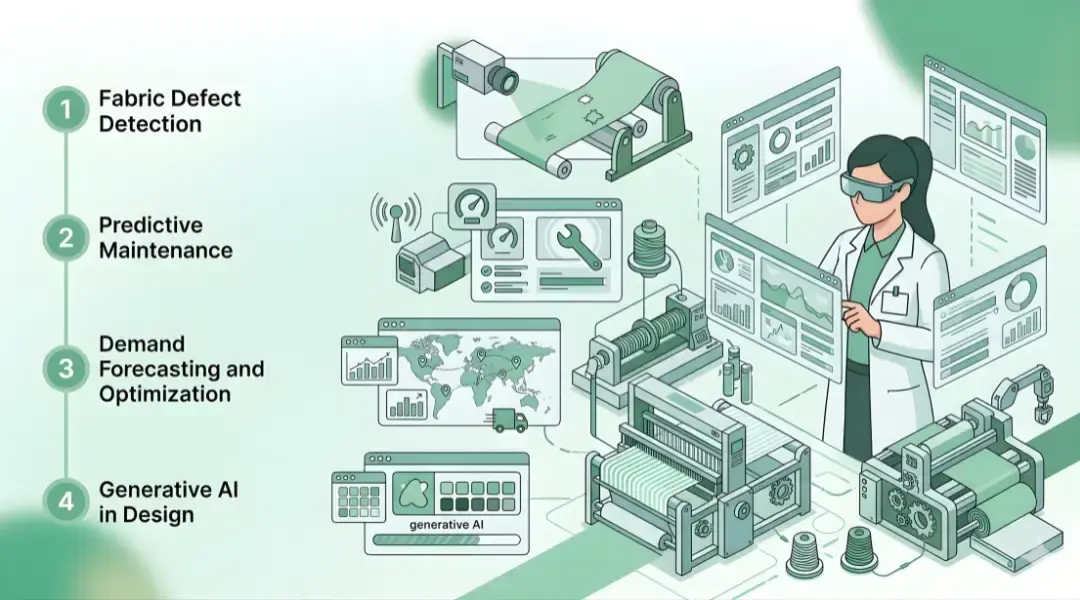
Artificial intelligence arrives in textile manufacturing not as a single system but as a layered set of technologies, each mapped to a specific operational problem. Machine learning, computer vision, generative AI, and predictive analytics are all active in this sector today — at different stages of the production chain, delivering measurably different kinds of value.
Fabric defect detection has historically relied on human inspectors scanning moving fabric under fluorescent lighting at speeds between 40 and 80 meters per minute. Human detection accuracy under sustained working conditions falls between 60% and 70%, meaning that a substantial portion of defective fabric reaches cutting, finishing, or even export without being flagged.
Fabric defect detection AI powered by deep learning models trained on labeled defect libraries now achieves accuracy above 95% at speeds exceeding 1,200 meters per minute. These systems identify weaving errors, yarn contamination, holes, stains, and pilling at granularity no human inspector can match — and they do not fatigue across a 12-hour shift. Critically, they log every defect's precise position on the roll, enabling targeted cutting decisions rather than wholesale downgrading of entire fabric lengths.
Predictive maintenance in the textile industry is built on IoT sensor arrays mounted on ring frames, air-jet looms, rapier looms, and stenter frames. These sensors capture vibration frequency, motor current draw, temperature deviation, and tension variation at rates of several hundred readings per second. Machine learning models trained on historical failure data establish baseline operating signatures for each machine type and flag anomalous patterns that precede mechanical failure by 24 to 72 hours.
The value is not simply preventing a single breakdown — it is transforming the maintenance function from a reactive cost center into a proactive operational capability. Companies like KriraAI, which builds practical AI solutions for manufacturing enterprises, have implemented predictive maintenance architectures that integrate sensor data, historical maintenance logs, and OEM machine specifications into unified anomaly detection models, substantially reducing the false-positive alerts that erode operator trust and lead to unnecessary interventions.
Traditional demand forecasting in textiles relies on historical order books, seasonal buyer commitments, and sales judgment. This approach produces forecast accuracy of approximately 60% to 70%, meaning that 30% to 40% of production planning decisions rest on incorrect demand signals. The consequence is chronic overproduction in some categories and stockouts in others.
Textile supply chain optimization through machine learning — trained on retail sell-through data, social media trend indicators, and macroeconomic signals — raises forecast accuracy to between 85% and 92% for core product categories. This tightens procurement cycles, reduces safety stock requirements, and aligns production scheduling more closely with actual demand, directly reducing the finished goods excess that destroys margin at the end of each selling season.
Generative AI is transforming the design and dyeing functions at a pace that has surprised experienced industry observers. Text-to-pattern systems trained on textile design libraries can produce thousands of colorway and pattern variations from a designer's brief in under an hour, compressing what previously required four weeks of iterative physical sampling into a two-day digital review cycle before any fabric is committed.
AI-powered quality control in color matching calculates the precise dye recipe required to hit a target LAB color value, accounting for fiber type, dye class, and batch parameters. These systems reduce dye recipe errors, cut average lab dip iteration counts from between four and six down to one or two, and reduce chemical waste in the dyeing process by 20% to 35% — cutting both production cost and environmental impact simultaneously.
AI in textile manufacturing is not generating theoretical projections — documented deployments across South Asia, Southeast Asia, and Turkey are producing auditable results that manufacturing executives can take to a board.
On fabric defect detection, mills deploying computer vision systems report customer complaint rates dropping by 50% to 70% within the first operating year. Customer rejection of international shipments — triggering chargebacks, airfreight replacement costs, and potential buyer relationship loss — falls by comparable margins. Because a single rejected export shipment can equal months of system operating cost, the ROI on defect detection deployments is typically recovered within six to nine months of go-live.
Predictive maintenance for the textile industry is delivering equally compelling returns. Multiple case studies document unplanned machine downtime reductions of 35% to 45% in spinning and weaving operations after predictive systems are fully operational. Given that a modern air-jet loom costs between $150,000 and $400,000 and operates at utilization rates above 80% in efficient mills, preventing two unplanned stoppages per year per machine generates significant financial impact at scale.
Textile supply chain optimization through AI-driven forecasting consistently produces inventory reductions of 20% to 35% for mills implementing demand-driven planning. For a mill carrying $8 million in raw material and work-in-progress inventory, a 25% reduction frees $2 million in working capital — compressing the payback period for the entire forecasting platform to under 18 months in most implementations.
Energy efficiency applications - where AI systems optimize sequencing of stentering, dyeing, and drying processes - reduce energy consumption by 10% to 18% in documented deployments. For a mill spending $1.5 million annually on energy, a 15% reduction generates $225,000 in annual savings with no reduction in throughput or quality.
KriraAI's enterprise AI implementations in manufacturing have demonstrated that combining defect reduction, downtime prevention, and inventory optimization as an integrated program — rather than as isolated pilots — creates a compounding efficiency gain that individually scoped projects consistently fail to match. The interdependence of these systems means that integrated deployment outperforms siloed implementation in both speed to value and long-term return on investment.
Implementing AI in textile manufacturing is not a single procurement decision. It is a staged transformation that requires a structured approach to produce results within a defined timeline. The mills that achieve measurable outcomes within 12 months share one distinguishing characteristic: they complete a rigorous operational audit before selecting any technology.
The implementation process moves through five connected stages:
Operational readiness assessment: A systematic audit of data availability, machine interface capability, and process maturity. This produces a documented baseline for current defect rates, downtime frequency, and inventory accuracy — the foundation against which AI results will later be measured. This stage should take four to six weeks.
Infrastructure and data foundation: Installing IoT sensor arrays on priority machines, building data pipelines to a central processing layer, and implementing storage architecture capable of handling high-frequency operational streams. This stage typically requires two to four months and is essential before any model training begins.
Pilot program execution: A focused deployment targeting the single highest-impact use case identified in the readiness assessment. The pilot runs on one production line or machine group, with the measurement framework established before deployment begins — not after. Three to six months is the appropriate duration.
Evaluation and scaling decision: A structured assessment against Stage 1 baselines. If the pilot meets or exceeds targets, the quantified business case for scaling is presented to leadership. Scaling should be phased, adding one deployment at a time rather than implementing across all production lines simultaneously.
System integration and continuous learning: Connecting AI systems with existing ERP, MES, and quality management platforms. A fabric defect detection system that cannot write findings to the quality management system creates manual reconciliation work that erodes operator trust and degrades system value over time.
The most frequent failure mode in textile AI adoption is selecting technology before defining the problem. A mill that purchases a computer vision system because a competitor has one — without establishing a target defect rate, a baseline, or a success measurement framework — will struggle to justify the investment within 24 months.
A second common mistake is underinvesting in change management. Machine operators who believe an AI quality system will replace their jobs will find ways to undermine it — covering sensors, generating false positives, or ignoring recommendations. Positioning operators as system supervisors rather than manual inspectors, through transparent communication and targeted retraining, is not optional. It is the difference between a system that operates at 95% accuracy and one that operates at 60% because the people around it have stopped trusting it.
A third mistake is launching pilots without clean data. A predictive maintenance model trained on incomplete historical maintenance logs will generate alerts that operators quickly learn to dismiss. Data cleaning and validation before model training is the single most important determinant of model reliability — no amount of algorithm sophistication compensates for poor input data quality.
AI in textile manufacturing delivers real returns, but the path to those returns involves genuine obstacles that any honest implementation plan must address directly.
Data quality is the foundational challenge. Most textile mills have operated without structured data collection for decades. Historical maintenance records exist in paper logs. Quality inspection results live in inconsistent spreadsheet files maintained by individual inspectors with no shared taxonomy. When AI implementation teams arrive to build machine learning models, they frequently discover that the required training data either does not exist in usable form or requires months of cleaning. KriraAI's implementation teams, which specialize in practical AI deployment for manufacturing enterprises, consistently report that data readiness work consumes 30% to 40% of total project timelines — a proportion that regularly surprises clients who underestimated it in their initial planning.
Talent scarcity presents a structural barrier for most mid-size mills. The skills required to deploy, maintain, and evolve AI systems — data engineering, machine learning operations, computer vision architecture — are scarce in the labor markets where most textile production is concentrated. A mill in Gujarat, a weaving cluster in Bursa, Turkey, or a garment manufacturer in Dhaka cannot recruit a machine learning engineer the way a technology company in Bangalore or Istanbul might. This makes AI deployment partners and managed service arrangements operational necessities rather than optional preferences for the majority of the industry.
Integration complexity with legacy systems is routinely underestimated. Many mills run ERP systems implemented between 2000 and 2010, with limited API capabilities and data structures that do not map cleanly to modern AI platform requirements. Making an AI defect detection system communicate with a legacy quality management module frequently requires custom middleware development that extends timelines and adds costs that initial project estimates did not account for.
Regulatory and accountability considerations are emerging as AI systems take on consequential decisions — flagging batch rejections, recommending maintenance actions, adjusting dye recipes. Buyers and certification bodies are beginning to require documentation of how AI-generated quality decisions are recorded, audited, and overridden when appropriate. Change management, finally, remains the most consistently underestimated challenge across every sector where AI is deployed. Supervisors and quality managers who have built careers on tacit knowledge frequently perceive AI systems as threats rather than tools, and without leadership-driven cultural change, technically sound deployments can and do fail at the adoption layer.
Looking ahead to 2029 and 2030, AI in textile manufacturing will have progressed from solving point problems to orchestrating entire production systems. The isolated defect detection application and the standalone predictive maintenance system will give way to integrated AI layers spanning fiber processing, fabric formation, dyeing, finishing, logistics, and customer delivery — with feedback loops running continuously between each stage.
Autonomous quality management is the nearest-term evolution. Systems that today detect defects and flag them for human decision will within three years be adjusting loom tension, warp speed, and weft density in real time to prevent defects before they form rather than identifying them after the fact. The shift from reactive detection to proactive parameter control will compress defect rates toward zero for the defect categories that are within machine-controllable parameters.
Digital twin technology will become standard practice in large-scale textile operations by 2028. A digital twin of a spinning mill allows process engineers to simulate the impact of changing raw material specifications, machine speed adjustments, or production schedule modifications before implementing them physically, eliminating the costly trial-and-error cycles that currently consume production time and generate waste across the industry.
Supply chain AI will evolve from demand forecasting into autonomous procurement. Systems will monitor commodity markets, supplier capacity data, and buyer order signals simultaneously, executing purchase commitments within defined parameters without human intervention for routine decisions. The competitive divide between AI-adopting manufacturers and those that have not invested will be structurally decisive by 2028 — buyers for global apparel brands will treat documented AI quality management and supply chain optimization as baseline sourcing criteria rather than differentiators. Organizations building AI foundations today with partners like KriraAI are positioning themselves for the competitive landscape of the next decade, not merely solving today's operational problems.
Three conclusions from the evidence are worth stating plainly. First, AI in textile manufacturing is delivering real, auditable results today — not in ten years. Defect rejection rates are falling by more than half, unplanned downtime is being cut by nearly half, and inventory capital is being freed at a scale that compresses ROI timelines to under 18 months in documented deployments. Second, the difference between AI projects that scale and those that stall is almost never the technology — it is the quality of the operational foundation built before deployment began, specifically data readiness, baseline measurement, and change management. Third, the competitive window for getting ahead of this transformation is narrowing. By 2028, AI capability will be a sourcing prerequisite for global buyers, not a conversation for future planning.
KriraAI works with textile manufacturers to turn these conclusions into operational reality. As a company that builds practical, enterprise-grade AI solutions designed for the specific constraints of manufacturing environments — aging infrastructure, limited data maturity, complex integration requirements — KriraAI has delivered implementations that produce measurable results from the first pilot and are structured to scale across full production operations. The approach begins with a focused readiness assessment that tells you exactly where AI can deliver impact in your specific mill, not a generic capability overview. If your organization is ready to move from awareness to implementation, contact KriraAI to start that conversation.
AI in textile manufacturing is applied across multiple production stages through several distinct technologies, each addressing a specific operational challenge. Computer vision systems inspect fabric in real time at speeds above 1,200 meters per minute, detecting defects with accuracy above 95%. Machine learning models connected to IoT sensor arrays predict equipment failures 24 to 72 hours in advance, giving maintenance teams actionable warning before a breakdown occurs. Demand forecasting algorithms trained on retail sell-through data and trend signals raise planning accuracy from the traditional 60%–70% range to 85%–92% for core product categories. Generative AI tools produce thousands of pattern and colorway variations from a designer's brief in hours rather than weeks. AI systems in the dyeing function calculate optimal dye recipes, cut lab dip iteration counts from four-to-six down to one or two, and reduce chemical waste by 20% to 35%. Together these applications make AI in textile manufacturing the operational backbone of any competitive modern mill.
The business benefits of AI in textile manufacturing are documented and quantifiable across multiple dimensions. Fabric defect detection AI reduces customer rejection rates by 50% to 70% within the first year of deployment, directly protecting buyer relationships and eliminating the chargeback and airfreight costs that rejected export shipments trigger. Predictive maintenance systems reduce unplanned machine downtime by 35% to 45%, recovering the equivalent of additional production days every month. AI-driven textile supply chain optimization reduces raw material and finished goods inventory by 20% to 35%, freeing working capital that would otherwise be locked in overstock. Energy optimization applications deliver 10% to 18% reductions in consumption for energy-intensive processes like dyeing and stentering. When these improvements are implemented together as an integrated program rather than isolated pilots, the compounding operational advantage reshapes the cost structure of a mill over a two-to-three-year horizon in ways that individual point solutions cannot replicate.
AI-powered quality control in textiles replaces the subjective, fatigue-prone human inspection process with machine vision systems that operate at consistent accuracy regardless of shift duration or operator experience. High-resolution industrial cameras positioned at inspection points capture images at speeds human inspectors cannot match. Deep learning models trained on thousands of labeled images across dozens of defect categories analyze each frame in real time, classify anomalies, and record their precise position and severity on the fabric roll. This enables downstream decisions — cutting around a defect, downgrading a roll, quarantining a batch — to be made with full information rather than partial awareness. The system produces a complete, auditable quality record for every roll, satisfying the documentation requirements that international buyers and sustainability certifying bodies are increasingly placing on their manufacturing partners as conditions of continued business.
Textile companies face several interconnected challenges when adopting AI. Data quality is the most fundamental — decades of paper-based operations mean that the historical data needed to train machine learning models often does not exist in structured form, and data preparation alone can consume 30% to 40% of total project time. Talent scarcity in manufacturing-heavy geographies means most mills cannot independently hire the engineers needed to build and maintain AI systems, making implementation partners a practical necessity. Legacy ERP and production systems with limited API capabilities create integration complexity that extends timelines beyond initial estimates. Change management is chronically underestimated: operators and supervisors who perceive AI as a threat to their expertise actively resist adoption in ways that are invisible to technology teams but devastating to project outcomes. Finally, most manufacturers fail to establish clear success baselines before deployment, making it impossible to evaluate whether the investment delivered the value it was supposed to.
AI will fundamentally reshape the competitive structure of the textile industry over the next five years. In the near term, fabric defect detection AI and predictive maintenance will become baseline capabilities that serious buyers expect from suppliers rather than differentiating advantages. By 2027 to 2028, autonomous quality management systems will shift from detecting defects to preventing them through real-time machine parameter adjustment during fabric formation. Digital twin technology will allow mills to simulate production changes before implementing them physically, eliminating the costly trial cycles that currently consume machine time and generate waste. Textile supply chain optimization will evolve from demand forecasting to autonomous procurement execution for routine decisions. The manufacturers who have built integrated AI foundations by 2028 will operate at cost structures, quality levels, and speed-to-market capabilities that mills relying on manual processes cannot match — making AI adoption not a competitive advantage but a survival requirement for any manufacturer with serious global ambitions.
Founder & CEO
Divyang Mandani is the CEO of KriraAI, driving innovative AI and IT solutions with a focus on transformative technology, ethical AI, and impactful digital strategies for businesses worldwide.