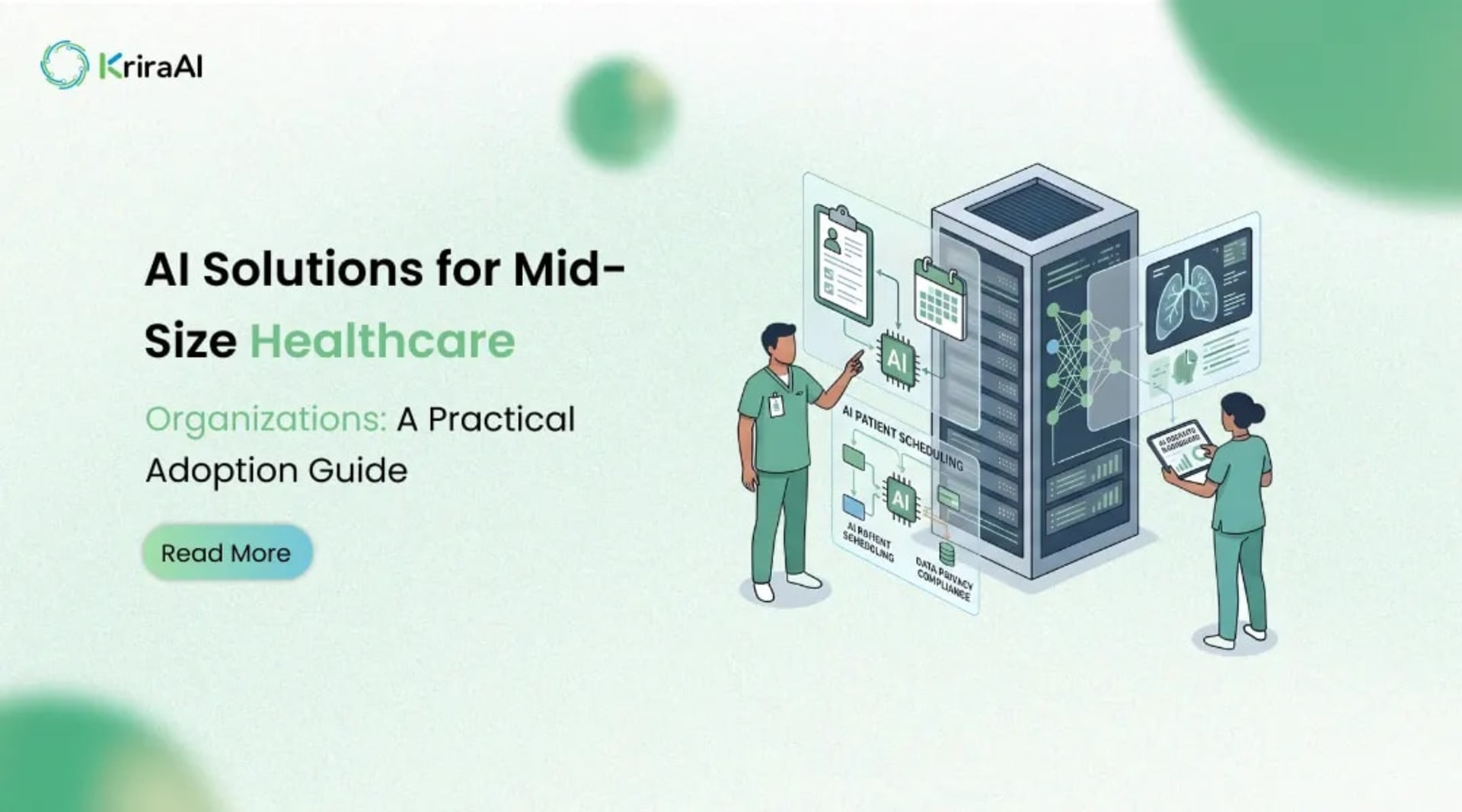
A 2025 survey by the American Hospital Association found that 78 percent of hospitals with more than 1,000 beds have active AI programs, while only 23 percent of hospitals with 100 to 300 beds have moved beyond pilot projects. That gap is not a technology problem. It is a guidance problem. Nearly every AI playbook published in healthcare is written for massive health systems with dedicated innovation teams and eight-figure technology budgets, or for solo practitioners looking for a single app to streamline scheduling. If your organization falls somewhere in between, with 50 to 500 employees, multiple departments, real regulatory obligations, and a technology budget that is meaningful but not unlimited, you have been largely ignored by the AI conversation.
This blog is written specifically for you. Whether you run a regional hospital group, a multi-location specialty clinic, a behavioral health network, or a mid-size home health organization, the AI decisions you face look nothing like those at Cleveland Clinic or a two-physician family practice. You need solutions that integrate with your existing EHR without a six-month custom build. You need pricing models that work for an organization billing between 20 million and 200 million dollars annually. This guide walks through exactly how mid-size healthcare organizations are adopting AI solutions in 2026, what is working, what is failing, and how to build a healthcare AI adoption roadmap that fits your actual resources.
[Media: mid-size healthcare AI gap]
Mid-size healthcare organizations occupy a uniquely challenging position in the industry. You are large enough to face the full weight of regulatory compliance, staffing complexity, and operational overhead, but small enough that every budget decision carries real trade-off consequences.
A typical mid-size healthcare organization operates with a lean leadership team. The CEO or administrator often oversees both clinical and operational strategy. There is usually a CFO, a director of nursing, and an IT manager or small IT team of three to eight people. Unlike large health systems, there is rarely a Chief Information Officer, let alone a Chief AI Officer. Technology decisions are made by committee, often involving clinical leadership, finance, and operations simultaneously, which means the decision cycle runs 60 to 120 days on average.
The technology stack is typically centered around one or two core systems. An EHR like Epic, Cerner, or Athenahealth handles clinical documentation. A practice management platform handles billing. Beyond that, the stack is often fragmented, with standalone tools for scheduling, patient communication, and inventory that do not communicate with each other. This fragmentation is both a challenge and an opportunity, because many high-value AI applications for this segment involve connecting workflows across these disconnected systems.
Budget for technology typically runs between three and seven percent of total revenue. For an organization generating 50 million dollars annually, that means 1.5 to 3.5 million dollars for all technology, not just AI. Any AI investment must compete with EHR upgrades, cybersecurity requirements, equipment purchases, and basic infrastructure maintenance. This is why enterprise approaches costing two million dollars for a custom AI platform are completely unrealistic for this segment, and why off-the-shelf tools designed for solo practitioners lack the depth needed to address multi-department complexity.
The staffing pressures facing mid-size healthcare organizations add another layer of urgency to the AI conversation. Organizations of this size typically operate with nurse-to-patient ratios that leave almost no margin for absenteeism or volume spikes. Administrative staff handle multiple functions simultaneously, with a single billing specialist often managing tasks that a larger system would distribute across an entire department. When these organizations lose even one experienced employee, the knowledge gap is felt immediately across operations. AI adoption in this context is not about competitive advantage alone. It is about operational survival in an environment where labor costs are rising faster than reimbursement rates.
The single biggest mistake mid-size healthcare organizations make is trying to follow the AI strategy of a large health system. What works for a 5,000-employee hospital network will not translate to an organization one-tenth that size. Equally, plug-and-play AI tools marketed to individual physicians cannot handle multi-department complexity.
At the enterprise level, organizations negotiate custom contracts and co-develop solutions with major technology vendors. At the mid-market level, your organization needs subscription-based pricing, pre-built EHR integrations, and implementation support included in the contract rather than billed at consulting rates of 300 to 500 dollars per hour. KriraAI and similar firms that specialize in practical AI deployment for mid-size organizations understand this constraint and build modular implementations that let you start with one department and expand as you prove ROI.
Large health systems hire data scientists and clinical informatics specialists. A mid-size organization cannot justify these roles. You need AI solutions managed by your existing IT team with vendor support, requiring clinical staff to learn new workflows rather than new technical skills. Implementation timelines also differ sharply. Where a large system might run a 12 to 18 month implementation, a mid-size organization should expect a 60 to 120 day timeline from contract signing to live deployment. Mid-size healthcare organizations typically see measurable returns within 90 to 180 days, compared to 12 to 24 months for enterprise implementations, because adoption is faster and baseline inefficiencies are more pronounced.
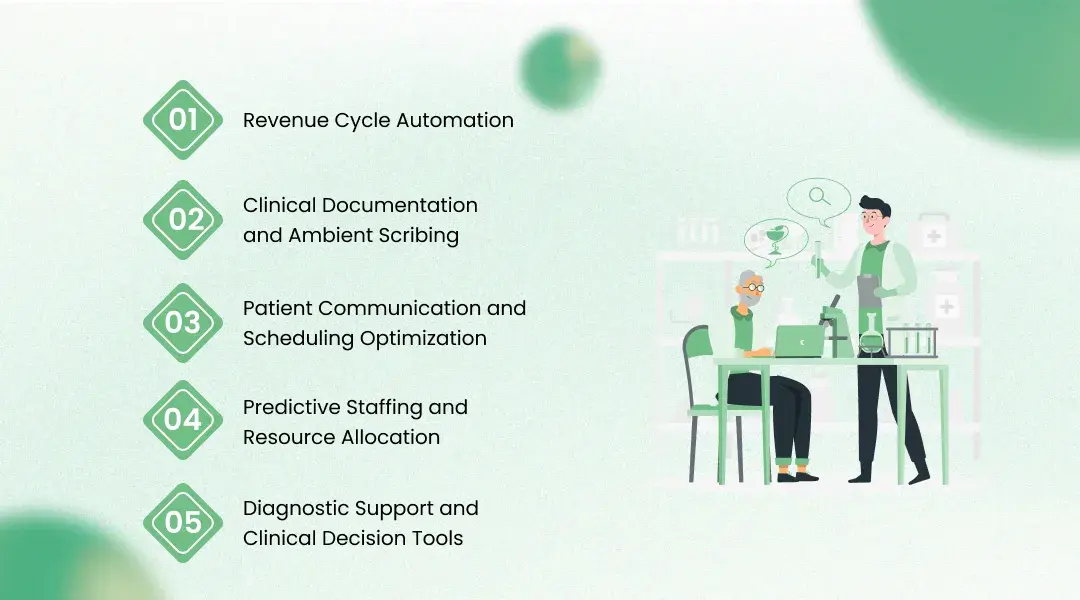
Not every AI application makes sense for your organization. The most hyped technologies require investment scales irrelevant to you. The highest-return AI solutions for mid-size healthcare organizations fall into five practical categories.
Denied claims cost the average mid-size healthcare organization between 5 and 11 percent of net revenue. AI-powered revenue cycle tools analyze denial patterns, flag at-risk claims before submission, and automate appeals. For an organization processing 50,000 to 500,000 claims annually, this recovers 200,000 to 2 million dollars per year at price points between 2,000 and 15,000 dollars per month, with typical implementation in 45 to 90 days.
AI-powered ambient scribing tools listen to patient encounters and generate structured clinical notes directly into the EHR. At 200 to 500 dollars per provider per month, a 30-provider organization recovers an estimated 15 to 25 hours per provider per month in documentation time. That recovered time translates to increased patient volume or reduced overtime costs.
AI chatbots and scheduling tools reduce no-show rates by 15 to 30 percent and handle routine inquiries without staff intervention. Solutions typically cost 1,000 to 5,000 dollars per month, and for a mid-size organization with a 12 percent no-show rate, the revenue recovery is substantial.
AI-powered predictive staffing tools forecast needs 7 to 14 days in advance by analyzing patient volume patterns, seasonal trends, and real-time admission data. These tools are particularly valuable for mid-size organizations because the margin for error is smaller. Overstaffing by three nurses for a week at a 200-bed hospital costs far more proportionally than at a 1,000-bed facility.
AI diagnostic tools assist radiologists, pathologists, and primary care providers with image analysis and differential diagnosis. For mid-size organizations with only two to five radiologists, these tools effectively multiply clinical capacity without additional specialist hires at 500 to 3,000 dollars per month per modality.
Mid-size healthcare organizations implementing AI-powered revenue cycle management report a 22 to 35 percent reduction in claim denials within six months. For an organization with 60 million in annual net revenue and a 9 percent denial rate, a 30 percent reduction recovers approximately 1.62 million dollars annually against a technology investment of 120,000 to 180,000 dollars, representing ROI exceeding 800 percent.
In clinical documentation, ambient scribing reduces documentation time by an average of 2.1 hours per provider per day. For a 40-provider organization generating 350 dollars per hour in billable services, recovered time represents a potential revenue opportunity of over 13 million dollars annually, assuming 40 percent conversion to additional encounters.
Predictive staffing AI shows 12 to 18 percent reductions in overtime costs and 8 to 14 percent improvements in staff satisfaction scores within 12 months. For an organization spending 2 million annually on overtime, a 15 percent reduction saves 300,000 dollars, which alone funds multiple AI implementations. Patient communication AI reduces call center volume by 30 to 45 percent for routine inquiries. One regional health network with 180 employees reduced their patient services team from 12 to 7 full-time equivalents within eight months, saving approximately 250,000 dollars annually.
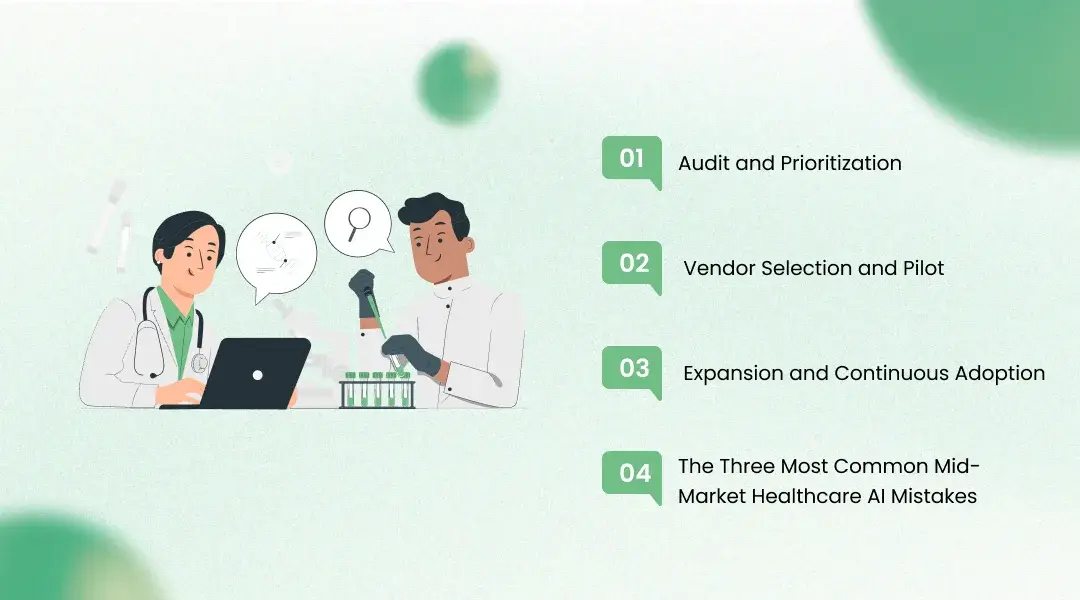
Identify your three highest-cost operational pain points, such as claim denials, documentation burden, or staffing volatility. For each, quantify annual cost in dollars and staff hours. Evaluate which have commercially available AI solutions integrating with your existing systems. Prioritize where the savings gap is largest and integration complexity lowest. KriraAI recommends resisting the temptation to launch multiple AI initiatives simultaneously, because spreading limited IT resources across three projects guarantees none will demonstrate clear value.
Evaluate three to five vendors using criteria specific to mid-size healthcare AI implementation:
Pre-built integration with your specific EHR, not just API availability.
Pricing that scales with your volume, not enterprise-tier minimums.
Implementation support included in the subscription.
A 90-day pilot option with defined success metrics and penalty-free exit.
References from similarly sized organizations.
Design a focused pilot covering one department or workflow with three to five measurable outcomes tracked over 60 to 90 days.
If the pilot succeeds, plan phased rollout over 8 to 16 weeks. Begin evaluating your second use case for a new pilot, creating a continuous cycle.
The first mistake is selecting a vendor based on feature lists rather than integration fit. The most capable platform is worthless if it requires 200 hours of custom integration your three-person IT team cannot absorb. The second is launching without clinical buy-in. AI tools that change workflows will fail if physicians view them as mandates rather than genuine improvements. Involve clinical staff in evaluation, not just post-decision training. The third is expecting immediate perfection. AI tools require calibration, and organizations abandoning tools after 30 days miss the accuracy trajectory that typically reaches target levels by day 90.
The most significant challenge is the compliance-resource tension. You face the same HIPAA and HITECH requirements as major health systems with a fraction of the compliance staff. Vendor selection must include rigorous evaluation of compliance certifications, BAA terms, data governance, and incident response procedures. You cannot afford regulatory exposure, but you also cannot hire a dedicated compliance officer for each technology evaluation.
Interoperability remains persistent. Mid-size organizations often run a mix of legacy and modern systems, and AI tools that integrate seamlessly with Epic may have no pathway for older platforms. This forces some organizations into costly middleware solutions or manual data bridging that erodes the efficiency gains AI was supposed to deliver. Before committing to any AI vendor, mid-size organizations should demand a documented integration assessment specific to their technology environment, not a generic compatibility checklist.
Talent retention compounds the problem. When you successfully train IT staff on AI systems management, those employees become attractive targets for larger health systems that can offer higher salaries and dedicated technology roles. Building institutional knowledge around AI tools requires not just training but retention strategies, including competitive compensation adjustments and professional development pathways, that keep your trained team in place long enough to realize the investment.
Change management has its own mid-market dynamics. In a small practice, the physician owner can mandate adoption by directive. In a large system, there are dedicated change management teams with formal methodologies. In a mid-size organization, change must be driven through influence and demonstrated value without either the authority of sole ownership or the resources of a formal program. This makes the pilot-and-expand approach doubly important, because successful pilots create internal champions who drive adoption through peer influence rather than top-down mandates.
By 2029, organizations using AI-powered revenue cycle management for three or more years will have compounding advantages in cash flow and payer negotiation leverage. The financial gap between early and late adopters at mid-market scale is projected to reach 8 to 15 percent of net revenue within five years. That gap is not simply a matter of efficiency. Organizations with cleaner claim histories and lower denial rates negotiate better contracts with payers, creating a self-reinforcing advantage that widens over time.
Clinically, organizations using AI diagnostic support and ambient documentation will attract and retain physicians more effectively than those requiring traditional manual workflows. As the physician shortage intensifies, the ability to offer technology-enabled practice environments will become a decisive recruiting advantage for mid-size organizations competing against both large systems and technology-forward startups for the same limited talent pool.
Patient expectations are also shifting rapidly. By 2028, patients will expect AI-powered communication, automated scheduling, personalized follow-up, and transparent pricing from every healthcare provider regardless of size. Mid-size organizations that invest in patient-facing AI now will build the digital infrastructure and patient relationship capital that competitors cannot replicate quickly once they recognize they are falling behind. The organizations that act now also benefit from current pricing dynamics. AI tools for healthcare are in a competitive market phase where vendors price aggressively to build share among mid-size organizations, and early adopters lock in favorable terms that late entrants will not access once the market consolidates.
The path to AI adoption for mid-size healthcare organizations is not about replicating what major health systems do at smaller scale. It is about selecting specific applications that deliver outsized returns for your operational reality, implementing through disciplined pilot-and-expand approaches, and building confidence through measured results. The three essential takeaways are that revenue cycle automation and clinical documentation tools deliver the fastest returns at this scale, that successful healthcare AI implementation mid-market requires clinical buy-in and a single-use-case start, and that the competitive window for early adoption is narrowing.
KriraAI works specifically with mid-size healthcare organizations to design AI solutions matching their actual budget, team capacity, and complexity. Rather than offering scaled-down enterprise products or scaled-up small practice tools, KriraAI builds practical implementations recognizing the unique constraints of 50-to-500-employee healthcare organizations. If your organization is ready to move from curiosity to implementation with a partner that understands realistic success at your scale, visit KriraAI to explore solutions built for your segment of healthcare.
Total first-year costs typically range from 50,000 to 300,000 dollars, including subscriptions, integration, and training. Revenue cycle AI tools fall in the 24,000 to 180,000 dollar range annually depending on claim volume. Ambient scribing costs 200 to 500 dollars per provider per month. The critical factor is choosing vendors whose pricing scales with your actual volume rather than requiring enterprise minimums. Most organizations find that starting with a single use case at 50,000 to 100,000 dollars provides sufficient ROI data to justify expansion within 12 months. Budget 10 to 15 percent of technology cost for internal staff time dedicated to implementation oversight.
Revenue cycle management AI consistently delivers the fastest measurable ROI, with most organizations seeing positive returns within 90 to 120 days. Denial reduction translates directly to recovered revenue with minimal lag. Patient scheduling optimization shows results within 60 to 90 days through reduced no-show rates. Ambient scribing delivers significant returns but requires a longer 60 to 90 day adoption curve. For AI tools for regional healthcare providers specifically, combining revenue cycle AI with patient communication automation delivers the highest first-year return because both address pain points disproportionately affecting organizations with lean administrative teams.
Yes, and most successful implementations at this scale proceed without data science hires. Current healthcare AI tools are designed for deployment by general IT staff with vendor support. The key is selecting managed AI services where the vendor handles model training and performance monitoring while your team manages integration and clinical liaison. Your IT staff will need 20 to 40 hours of initial training on administrative interfaces and monitoring dashboards. The more valuable hire, if any, is a clinical informatics coordinator who bridges technology and clinical workflow without requiring data science expertise.
Initial measurable results appear within 60 to 90 days, with statistically significant results at the six-month mark. Revenue cycle tools show denial rate reductions within the first billing cycle, as early as 30 to 45 days. Clinical documentation AI requires longer provider adoption. Predictive staffing needs 8 to 12 weeks of data collection before forecasting reaches actionable accuracy. The most common reason for delayed results is insufficient change management rather than technology failure, particularly when clinical staff lack trust in tools they were not involved in selecting.
The largest risk is selecting a solution requiring more integration effort than your IT team can sustain, leading to partial implementation that disrupts workflows without delivering benefits. This is mitigated by evaluating integration simplicity rigorously. The second risk is regulatory exposure from processing protected health information without adequate safeguards, requiring thorough vendor compliance review. The third is clinical workflow disruption during transition, especially if providers were excluded from selection. A structured implementation partner like KriraAI reduces these risks through phased rollout and dedicated change management support designed for mid-market resource constraints.
Founder & CEO
Divyang Mandani is the CEO of KriraAI, driving innovative AI and IT solutions with a focus on transformative technology, ethical AI, and impactful digital strategies for businesses worldwide.