
In high-volume e-commerce, the difference between a customer who converts and one who abandons a session is rarely about price. It is almost always about relevance. When a returning shopper lands on a homepage that shows them the same generic category banners as a first-time visitor, and when search results surface products based on keyword matching instead of purchase intent, the platform is systematically destroying the value of every acquisition dollar spent to bring that customer back.
A leading e-commerce enterprise operating across fourteen product verticals and serving over 4.2 million monthly active users was living this exact reality. Despite having years of transactional data, detailed browse histories, and a sophisticated logistics operation, the company's recommendation engine was a five-year-old collaborative filtering system that treated every user interaction with the same uniform weight. Demand forecasting was being done in spreadsheets updated weekly, leading to stockouts on fast-moving SKUs and overstock situations on slow-movers that tied up working capital quarter after quarter. Customer service teams were manually triaging roughly 38,000 support tickets per month, with average first-response times exceeding 14 hours and escalation rates running at 23 percent, far above the 8 percent industry benchmark for automated-first support models.
KriraAI was brought in to build an AI-native intelligence layer that could operate across personalisation, demand planning, and customer service in a unified, production-hardened architecture. This blog walks through the exact problem we solved, the system we built, the architecture we designed, the challenges we overcame in delivery, and the measurable outcomes the client realised within six months of go-live.
The Problem KriraAI Was Called In to Solve
The operational situation at this leading e-commerce enterprise had several interacting failure modes that, taken together, were creating compounding damage across revenue, inventory, and customer satisfaction simultaneously.
The existing recommendation system was built on matrix factorisation, specifically a neighbourhood-based collaborative filtering model that computed item-item similarity using cosine similarity on a user-item interaction matrix. At the time it was deployed, the catalogue had roughly 80,000 SKUs and the user base was a fraction of its current size. By the time KriraAI engaged, the catalogue had grown to 1.4 million active SKUs across apparel, electronics, home goods, health products, sporting equipment, and specialty food, among other categories. The interaction matrix had become so sparse in the tail of the catalogue that the model simply could not generate meaningful recommendations for approximately 67 percent of the product range. Cold-start handling for new SKUs was entirely absent, which meant any product added to the catalogue in the first 90 days of its listing received effectively zero recommendation exposure unless manually curated by the merchandising team. The team was spending 340 collective hours per week on manual curation tasks that existed solely to compensate for what the algorithm could not do.
The click-through rate on recommendations had fallen from a historical high of 8.3 percent to 3.1 percent over three years, a decline the business had attributed to seasonal shifts and changing consumer preferences, when in reality the algorithm had simply fallen behind the complexity of its own catalogue.
Inventory planning was being driven by a combination of Excel-based time series analysis using twelve-week trailing averages and the intuition of category managers who had learned to distrust the outputs of even that rudimentary process. The models could not account for promotional calendars, competitor pricing events, social media virality, or geographic demand variance. During a major promotional period fourteen months before KriraAI's engagement, a single viral social media post caused demand for one SKU to spike 1,800 percent in 72 hours. The company had 340 units in stock. The stockout lasted eleven days, and the total lost-revenue attribution from that single incident was estimated internally at $2.1 million.
On the other side of the ledger, the same forecasting inadequacy caused 18 percent of warehouse storage capacity to be occupied at any time by slow-moving inventory with greater than 180-day sell-through horizon. The carrying costs from this chronic overstock condition were running at approximately $890,000 per quarter.
The third failure mode was in post-purchase customer experience. With 38,000 support tickets per month coming through email, live chat, and social channels, and with a support team of 94 agents, the average queue depth meant customers were waiting an average of 14.3 hours for a first human response. Roughly 34 percent of all tickets were straightforward order status queries, return initiation requests, or delivery exception notifications that required no human judgment whatsoever. Nevertheless, every one of these tickets was landing in the same queue as complex fraud disputes, product damage claims, and subscription billing issues. The triage was manual, the routing was error-prone, and agent burnout was contributing to a 28 percent quarterly churn rate on the support team itself, which meant the company was constantly training new agents on policies and systems while simultaneously trying to reduce response times.
Together these three problems represented a business that had scaled its transaction volume without scaling its intelligence infrastructure to match. The gap was widening every quarter, and the competitive pressure from native AI-first platforms entering the same verticals made the status quo genuinely unsustainable.
KriraAI designed and delivered a three-system AI platform that addressed personalisation, demand forecasting, and customer service automation as interdependent components of a single unified intelligence architecture rather than three separate point solutions. The decision to build them on shared data infrastructure was deliberate: the same feature store that feeds the recommendation engine also feeds the demand forecasting model, and the same customer behaviour signals that drive personalisation are used to pre-populate support agent context when a customer opens a ticket.
The personalisation system is a two-stage retrieval and ranking pipeline. The first stage uses a two-tower neural retrieval model with separate query and item encoders built on a transformer backbone, specifically a six-layer BERT-style encoder with 128-dimensional embedding projections. User behaviour sequences are encoded using a causal attention mechanism over the last 60 interaction events, weighted by recency and event type, with add-to-cart events receiving a 3.2x multiplier over browse events based on supervised fine-tuning signal. The retrieval stage uses approximate nearest neighbour search over a 1.4-million-item FAISS index using HNSW graph indexing, retrieving 500 candidate items per request at sub-30-millisecond latency. The second stage re-ranks these 500 candidates using a cross-attention transformer ranker that takes the (user, item) pair as a joint input, incorporating real-time contextual features such as session device type, time of day, current cart contents, and recent price change signals. The ranker produces a calibrated relevance score, and the top-N items are returned to the storefront API.
The demand forecasting system is built on a Temporal Fusion Transformer architecture, a multi-horizon time series model that combines recurrent processing for local temporal patterns with self-attention for long-range dependencies and variable selection networks to weight input features appropriately. The model ingests 47 input features across four categories: historical sales at SKU, subcategory, and category levels; calendar and promotional signals including campaign schedules, public holiday flags, and payday proximity indicators; external signals including weather forecasts for relevant geographies and a social trend score derived from weekly API extracts from major platforms; and inventory position signals including current stock level, inbound purchase order quantities, and supplier lead time estimates. The model generates probabilistic forecasts at daily granularity over a 28-day horizon with 10th, 50th, and 90th percentile outputs, giving the planning team a full uncertainty envelope rather than a point estimate.
The customer service system is a retrieval-augmented generation pipeline built on a fine-tuned large language model serving as the reasoning core. A Sentence-BERT encoder converts incoming tickets into semantic embeddings that are matched against a knowledge base of 14,000 indexed support articles, policy documents, and resolved ticket examples stored in a Qdrant vector database using IVF-PQ indexing. Relevant context is retrieved and injected into the LLM prompt alongside the customer message, order history, and current order status pulled in real time from the OMS via a gRPC call. The system classifies ticket intent across 31 categories, resolves fully automated responses for 16 of those categories where no human judgment is required, and routes the remaining categories to appropriately skilled agents with a pre-generated draft response and a confidence score.
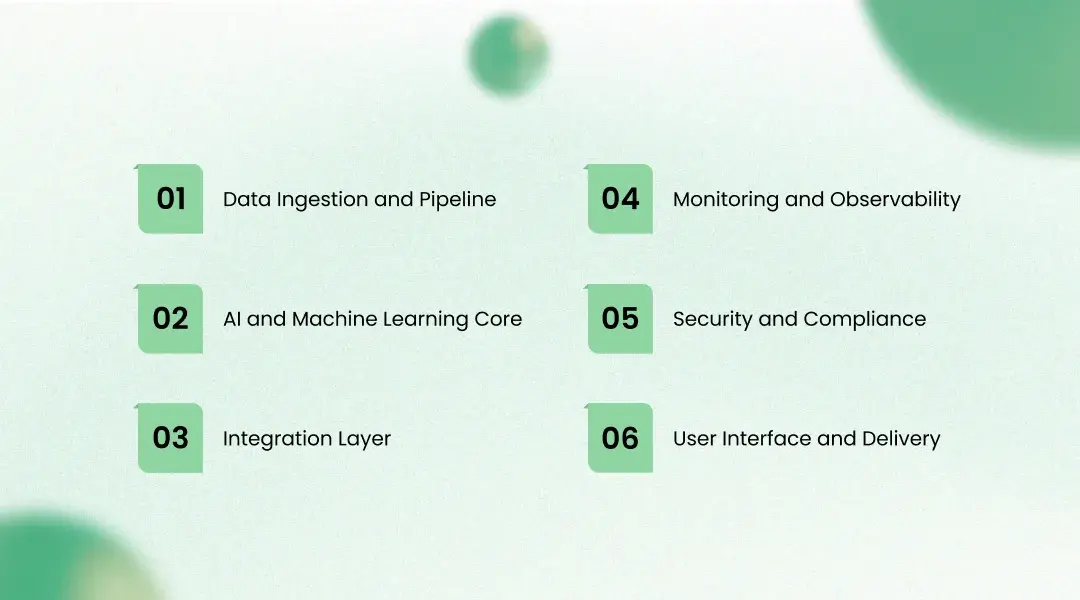
The architecture KriraAI designed is organised into six layers, each with distinct responsibilities and clear interfaces to adjacent layers.
The data foundation consists of three ingestion paths converging on a unified feature store. Transactional data from the client's PostgreSQL and MongoDB operational databases is ingested using Debezium-based change data capture, streaming row-level changes into Apache Kafka topics at sub-second latency. The Kafka cluster runs on Confluent Cloud with topic-level schema enforcement via Confluent Schema Registry using Avro serialisation, which prevents schema drift from propagating downstream. User behaviour events from the web and mobile application are published directly to Kafka by the client's existing event tracking infrastructure, requiring only topic configuration and consumer group setup on KriraAI's side.
Batch ingestion paths handle external data sources: weather forecast data is pulled on a 6-hour schedule via Airflow DAGs, social trend scores are computed weekly by a separate feature engineering pipeline, and supplier lead time data is extracted from the client's SAP ERP system via JDBC connection on a nightly batch. All ingestion pipelines are orchestrated by Apache Airflow with full DAG versioning, SLA monitoring, and automatic retry with exponential backoff on failure.
The feature store is built on Feast, deployed with Redis serving the online path for sub-5-millisecond feature retrieval at inference time, and Apache Parquet on S3 serving the offline path for training data materialisation. Feature definitions are versioned in Git and deployed through a CI/CD pipeline, ensuring that training and serving features are always computed from identical logic, which eliminates training-serving skew as a production concern.
The ML core hosts three independent model services, each containerised in Docker and orchestrated on Kubernetes with Horizontal Pod Autoscaling configured against p95 inference latency thresholds. The recommendation models are served using TorchServe with custom handlers that manage FAISS index loading and ANN query execution. The Temporal Fusion Transformer forecasting model is served using TensorRT-optimised INT8 quantised weights, reducing memory footprint by 62 percent relative to the FP32 checkpoint while sustaining less than 0.8 percent degradation on held-out evaluation metrics. The RAG support agent LLM runs on vLLM with continuous batching, achieving 340 tokens per second throughput on the A10G GPU instances allocated for the service.
Model training pipelines run on Amazon SageMaker with distributed training across four-GPU p3.8xlarge instances for the recommendation models, with training jobs triggered by the automated retraining pipeline when performance metrics breach defined thresholds. The Temporal Fusion Transformer is retrained weekly on a rolling 104-week training window. The recommendation models are retrained nightly using an incremental fine-tuning approach that updates embedding weights on the previous 24 hours of interaction data without requiring full retraining from scratch.
All AI model outputs are surfaced to consuming systems through a set of well-defined service contracts. The personalisation API is exposed as a gRPC service for internal storefront consumption, with a REST gateway wrapping it for the mobile clients that cannot consume gRPC natively. The forecasting system outputs are written to a PostgreSQL results table on a 24-hour cycle and consumed by the inventory planning system through a direct DB connection, with a webhook notification triggering the planning system to reload its data cache after each write cycle. The support automation platform integrates with the client's Zendesk instance via Zendesk's Sunshine Conversations API, with the AI system acting as a first-response agent that either resolves the ticket fully or creates a pre-populated draft for a human agent, using Zendesk's ticket update API to write both the customer-facing response and the internal agent note simultaneously.
The monitoring architecture distinguishes between data quality monitoring, model performance monitoring, and infrastructure observability, because each requires different detection approaches and different response protocols. Data quality monitoring runs on Great Expectations, with expectation suites defined for every upstream data source and executed at ingestion time, with failures halting the pipeline and alerting on-call through PagerDuty.
Model performance monitoring tracks recommendation click-through rate, forecast mean absolute percentage error against actuals, and support resolution rate on a 24-hour lag, with alerts triggered when any metric crosses a 15 percent relative degradation threshold from the 30-day rolling baseline. Data drift is monitored using Population Stability Index computed hourly over the user feature distribution, with a PSI value above 0.2 triggering an automated retraining workflow. Infrastructure observability runs on Prometheus with Grafana dashboards exposing p50, p95, and p99 latency percentiles for all three model services, with p99 alerts configured at 250 milliseconds for the recommendation service and 4 seconds for the support agent service.
The entire platform runs within a private VPC with no public endpoints, with all inter-service communication traversing internal VPC DNS. Model inputs and outputs are encrypted in transit using TLS 1.3 and at rest using AES-256. Customer PII is masked at the feature store boundary using attribute-level data masking controlled by a role-based access control policy that restricts raw PII access to the support automation service and a designated compliance role. All API calls, model inference requests, and data access events are written to an immutable append-only audit log in Amazon S3 with Object Lock enabled, satisfying the client's data governance requirements under their applicable data protection obligations.
Three interfaces surface AI outputs to human operators. The merchandising dashboard, built in React with a FastAPI backend, gives category managers visibility into real-time recommendation performance by category and the ability to apply business rules such as margin floors and brand exclusions that constrain but do not override the model. The demand planning console shows probabilistic forecast outputs as interactive confidence interval charts, with one-click export to the ERP replenishment module. The support supervisor interface shows live queue composition by intent category, resolution rate by automated handling tier, and agent-level productivity metrics computed from ticket handling time and customer satisfaction scores.
The technology choices across the stack reflected three constraints specific to this client: an existing AWS-native infrastructure footprint, a data engineering team already proficient in Apache Kafka and Airflow, and a requirement that the platform operate within a 99.9 percent uptime SLA for the recommendation service given its direct revenue impact.
The selection of FAISS over alternatives such as Pinecone or Weaviate for the recommendation retrieval index was driven by the need to host the index in-process with the model server to eliminate network latency on the retrieval hop, which would have added 15 to 40 milliseconds on every inference request. At 4.2 million monthly active users with peak concurrency requiring sub-100-millisecond end-to-end recommendation latency, that margin was not available. FAISS with HNSW indexing, loaded into shared memory on the TorchServe worker processes, kept retrieval latency consistently below 8 milliseconds even at peak load.
The selection of the Temporal Fusion Transformer over alternatives such as N-BEATS or DeepAR was driven by its native handling of static covariates, known future inputs such as promotional calendars, and its variable selection network, which provides interpretable feature importance outputs that the planning team uses to understand why the model is forecasting what it is forecasting. Interpretability was a non-negotiable requirement from the planning team, who had experienced black-box forecast outputs from a previous vendor and had subsequently stopped trusting and therefore stopped using the system.
Feast was selected as the feature store over Tecton and Hopsworks primarily because of its open-source licensing and its native Airflow integration, which allowed the existing data engineering team to manage feature pipelines without adopting a new orchestration paradigm. The ability to define feature transformations in Python and execute them identically in both offline batch and online serving contexts was the decisive technical factor.
vLLM was selected for LLM serving over alternatives such as Hugging Face TGI because of its continuous batching implementation and its PagedAttention memory management, which together allowed the support agent service to handle concurrent ticket processing at 3.4 times the throughput achievable with naive sequential inference on equivalent hardware, directly reducing the GPU cost per resolved ticket to economically viable levels.

The engagement ran across five phases over a total of 28 weeks from kickoff to full production go-live.
The discovery phase involved embedding a KriraAI data engineer and ML architect with the client's engineering teams for four weeks to audit the data infrastructure, map all upstream data sources, assess data quality at each source, and validate the feasibility of the designed architecture against the actual available data. This phase surfaced the first major challenge: the client's user behaviour event stream had a 23 percent duplicate event rate caused by a retry logic bug in their mobile app SDK that had gone undetected for 14 months. Raw event counts were being used directly in the existing recommendation system, which had been silently inflating engagement signals for a subset of users and distorting similarity computations across the interaction matrix. We built a deduplication layer into the Kafka consumer using a Redis-backed bloom filter with a 72-hour TTL window before any data touched the feature store, and we back-filled a corrected historical dataset covering the prior 18 months to use for initial model training.
Development proceeded in two parallel tracks: the recommendation and personalisation system in one track, the demand forecasting system in the other, with the support automation platform beginning three weeks into this phase once the feature store schema was stabilised. The second significant challenge arose in the forecasting track: the external social trend signal, which had been a design assumption, turned out to correlate with actual demand with a one-week lag rather than the concurrent relationship assumed in the feature design. Including it as a concurrent feature was adding noise rather than signal and degrading model performance by 4.2 percent on the validation set. We redesigned the feature to use the signal with a seven-day forward shift, which converted it from a noise source into one of the top five features by importance in the variable selection network.
Integration testing with the client's production systems surfaced the third significant challenge: the Zendesk Sunshine Conversations API had a rate limit of 200 requests per minute per integration, which was insufficient for the peak incoming ticket volume of approximately 380 tickets per minute during post-promotional periods. KriraAI implemented a queued processing architecture using SQS as a buffer between the AI processing layer and the Zendesk API calls, with priority scoring ensuring that tickets from high-value customer segments processed first, and with the SQS consumer scaled to respect the rate limit while maintaining maximum throughput within that constraint.
The recommendation system went live using a gradual traffic allocation strategy, starting at 5 percent of users in week 21 and reaching 100 percent by week 24, with automatic rollback triggers configured if click-through rate fell below the baseline system's performance. The forecasting system went live in parallel with the existing spreadsheet process for the first three weeks, giving planning managers the ability to compare outputs side by side before the handover. The support automation system was deployed with a conservative 16-intent automated resolution scope and a human review queue for the first two weeks to validate classification accuracy before removing the review gate.
KriraAI ran a structured two-week knowledge transfer covering model retraining procedures, monitoring dashboard interpretation, alert response runbooks, and the API contract documentation. All operational runbooks were written into the client's existing Confluence documentation system.
Results were measured over the 90-day period following full production go-live across all three systems.
The personalisation system increased recommendation click-through rate from 3.1 percent to 8.7 percent, a 181 percent improvement, surpassing the historical high of 8.3 percent that had been achieved when the catalogue was an order of magnitude smaller. Revenue attributable to recommendation-driven conversions increased by 31 percent in absolute terms over the same 90-day period compared to the prior year equivalent period. Merchandising team manual curation hours fell from 340 hours per week to 41 hours per week, a reduction of 88 percent, allowing those team members to redirect effort toward supplier negotiations and campaign planning.
The demand forecasting system reduced the mean absolute percentage error on 28-day demand forecasts from 34 percent using the legacy spreadsheet approach to 11.2 percent using the Temporal Fusion Transformer, measured against held-out actuals on 60,000 SKUs over the 90-day evaluation window. Stockout incidents on top-200 revenue SKUs fell by 67 percent. Slow-moving inventory occupying warehouse capacity at the 180-plus-day sell-through threshold declined from 18 percent to 9 percent of total warehouse capacity within the first 60 days, releasing approximately $3.4 million in working capital from inventory reduction. The planning team estimates the annualised inventory carrying cost saving at $1.8 million.
The customer service automation system achieved a fully automated resolution rate of 41 percent of all incoming tickets across the 16 automated intent categories, eliminating 15,580 tickets per month from the human agent queue. Average first-response time for the remaining human-handled tickets fell from 14.3 hours to 2.1 hours as a direct result of the reduced queue volume. The escalation rate fell from 23 percent to 9.4 percent, approaching the 8 percent benchmark target. Agent churn in the support team fell from 28 percent quarterly to 14 percent in the first quarter post-deployment, which the client's people operations team attributed to the reduction in routine, low-complexity ticket volume that had been the primary driver of burnout.
The architecture KriraAI designed was deliberately over-provisioned in two dimensions: the feature store schema can accommodate up to 200 features per entity without schema migration, and the model serving infrastructure is sized to 3x the current inference load without adding nodes. Both decisions were made to ensure that expanding into new use cases does not require architectural rework. For a retail AI platform, the ability to extend without rebuilding is what separates a multi-year competitive asset from a proof of concept that calcifies into technical debt.
The most immediate extension the client is planning is the integration of real-time price elasticity scoring into the recommendation re-ranker. The two-tower retrieval model already encodes a price sensitivity feature at the item level, and the ranker already receives current price signals as contextual input. Adding calibrated elasticity coefficients computed by a separate gradient-boosted model as an additional ranker feature is an additive change that does not require retraining the retrieval stage.
The second extension on the client's roadmap is multi-channel inventory rebalancing, where the demand forecasting system's probabilistic outputs are used to drive automated stock transfer recommendations between fulfilment centres based on regional demand variance in the 90th percentile forecast scenario. The infrastructure for this already exists: the forecasting system produces regional breakdowns as a standard output, and the integration with the SAP ERP system is already live. The work required is a new planning rules engine that translates forecast variance into transfer recommendations, which represents a two-month development scope.
The third extension under evaluation is a conversational shopping assistant for the storefront that combines the RAG architecture of the support agent with the recommendation retrieval system, allowing customers to express shopping intent in natural language and receive recommendation results grounded in both semantic understanding of the query and the user's behavioural history. The technical feasibility of this extension is confirmed by the existing architecture: the two systems share the same feature store and the same Qdrant vector database infrastructure. The product design and user experience work is the longer pole in the tent.
Any other company operating in e-commerce at comparable scale can adapt this architecture to their own situation. The three-system structure reflects the three deepest problems that exist across the industry: recommendation systems that cannot keep pace with catalogue growth, demand planning that cannot incorporate non-linear external signals, and customer service operations that cannot separate routine queries from complex ones at the triage stage. All three problems are architecture problems with known AI solutions. The question is whether those solutions are built to production standards or to demonstration quality.
Three insights from this engagement are worth carrying into every conversation about AI implementation in e-commerce. The technical insight is that production-grade AI systems require data infrastructure investments that precede model development, and that teams who attempt to shortcut this sequence by training models on unaudited data pay compounding costs in production that dwarf the cost of the upfront data quality work. The operational insight is that AI systems built as isolated point solutions create integration debt and monitoring overhead that exceeds their value; designing them on a shared feature store and unified observability infrastructure from the start is the difference between a platform and a collection of experiments. The strategic insight is that the competitive advantage from AI in e-commerce is not in having a recommendation system or a forecasting model but in having a unified intelligence layer that improves the precision of every commercial decision the business makes, from what to stock to what to show to how to respond.
KriraAI brings the same engineering depth, delivery discipline, and production mindset to every engagement we take on. We design systems that are built to run, not to demo, and we measure our work by the outcomes our clients achieve in production, not by the sophistication of our architectures on a whiteboard. If you are facing a version of the problems described in this blog, whether in e-commerce or in another industry where the gap between the intelligence your business needs and the intelligence your current systems provide is costing you measurably, we want to hear about it. Bring your challenge to KriraAI, and let us show you what serious AI engineering looks like in practice.
For an enterprise e-commerce platform with a mature data infrastructure and an existing event tracking pipeline, KriraAI's experience shows that a production-grade personalisation system covering retrieval, ranking, and storefront delivery can be delivered in 16 to 22 weeks from kickoff to full go-live. The primary time variables are data quality remediation and integration complexity with existing OMS and ERP systems. In the engagement described in this case study, the discovery phase alone required four weeks due to a previously undetected event duplication issue in the client's mobile SDK that required a deduplication layer and an 18-month data back-fill before model training could begin. Organisations that have already conducted a data audit and resolved quality issues in their behaviour event streams can expect the total timeline to compress toward the lower bound. Attempting to compress timelines by skipping the data audit phase almost always results in models that perform well in offline evaluation and fail in production, because training data quality problems do not surface until the model encounters the distribution shift that exists between clean evaluation sets and live traffic.
The Temporal Fusion Transformer is the most effective architecture for e-commerce demand forecasting scenarios where the signal environment includes non-stationary external inputs such as social media trends, promotional calendars, and competitor pricing events. Unlike classical statistical models such as SARIMA or exponential smoothing, which cannot incorporate multivariate external features without substantial manual feature engineering, and unlike earlier deep learning approaches such as DeepAR, which treat all features as concurrent time series, the Temporal Fusion Transformer uses a variable selection network to assign learned importance weights to each input feature independently for each forecast horizon. This architecture natively handles known future inputs such as promotional schedules as a distinct input type from observed historical inputs, which is critical for retail applications where promotional events are planned weeks in advance and should be treated as high-confidence future information rather than uncertain extrapolations. In the engagement described in this blog, the model achieved an 11.2 percent mean absolute percentage error on 28-day forward forecasts across 60,000 SKUs, compared to 34 percent under the previous spreadsheet-based approach.
Recommendation engine degradation as catalogue size grows is a structural problem with matrix factorisation approaches, which suffer from interaction sparsity as the catalogue expands beyond the scale at which most items accumulate sufficient interaction history. The solution is to move from a similarity computation that depends on co-occurrence to a representation learning approach where both users and items are encoded into a shared embedding space through a two-tower neural architecture. In this architecture, the item encoder learns a dense representation of each product from its content features, including title, description, category hierarchy, price point, and image embeddings, in addition to any available interaction signals. This means that a newly listed product with zero purchase history can still be encoded into a meaningful position in the embedding space from its content attributes alone, solving the cold-start problem that makes matrix factorisation systems progressively less useful as catalogues grow. To prevent model staleness as user preference distributions shift over time, the recommendation models in the system KriraAI built are retrained nightly using incremental fine-tuning on the previous 24 hours of interaction data, with Population Stability Index monitoring triggering a full retraining cycle whenever the user feature distribution shifts by a PSI value above 0.2.
The return on investment from AI-powered customer service automation in e-commerce is most accurately measured across three dimensions: direct cost reduction from reduced agent handling volume, indirect revenue impact from improved response times and resolution quality, and talent retention improvement from reducing the routine ticket burden on human agents. In the engagement described in this case study, a retrieval-augmented generation pipeline achieved a 41 percent fully automated resolution rate within 90 days of production deployment, eliminating approximately 15,580 tickets per month from the human agent queue. Average first-response time for the remaining human-handled tickets fell from 14.3 hours to 2.1 hours. Agent quarterly churn fell from 28 percent to 14 percent, which has significant cost implications given that the average cost to recruit, onboard, and train a support agent in a high-volume e-commerce environment is estimated at 0.8 to 1.2 times annual salary. Organisations evaluating AI implementation for e-commerce customer service should model these three return streams independently and use conservative automation rate assumptions of 30 to 45 percent for initial planning, as actual rates vary significantly with the proportion of routine query types in the incoming ticket mix.
Multi-category recommendation is one of the harder problems in e-commerce AI because a user's affinity signals in one category, say athletic footwear, may have low correlation with their preferences in another category, say kitchen appliances, and a model that conflates these signals will produce recommendations that are irrelevant and erode trust. The approach KriraAI used is to train the user encoder in the two-tower retrieval model with category-conditioned session segmentation, meaning that the 60-event interaction window used to compute the user query embedding is segmented by product category before encoding, and the final user representation is a weighted concatenation of per-category session embeddings. This preserves within-category preference signal while preventing cross-category contamination. The weight assigned to each category embedding in the concatenation is a learned parameter conditioned on the context of the current request, specifically the category page or search query that triggered the recommendation call, so that recommendations served on an athletic footwear page draw primarily from the user's athletic footwear session history rather than being diluted by their home goods browsing. This architecture handled 14 product verticals in the client's catalogue without requiring separate per-category models, which would have been operationally intractable at that scale.
Founder & CEO
Divyang Mandani is the CEO of KriraAI, driving innovative AI and IT solutions with a focus on transformative technology, ethical AI, and impactful digital strategies for businesses worldwide.