The global AI in logistics market reached an estimated $26.35 billion in 2025, growing at a compound annual growth rate exceeding 44% and projected to surpass $700 billion by 2034. Behind that explosive growth sits a simple truth: most logistics companies are still planning routes the way they did a decade ago, and it is costing them millions. According to McKinsey, integrating AI into logistics operations can reduce transport costs by 15% to 20% and lower inventory levels by 20% to 30%. Yet a significant share of mid sized logistics operators continue to rely on static planning tools, manual dispatching, and experience based route decisions that ignore real time variables entirely.
The cost of inaction is no longer theoretical. Fuel remains one of the largest operational expenses in freight and logistics, and price volatility makes manual forecasting unreliable. Labor shortages across the trucking and warehousing sectors have pushed hiring costs above $5,000 per employee in 2025, not accounting for training or turnover risk. Meanwhile, consumer expectations for same day and next day delivery continue to compress delivery windows, forcing companies to move faster with fewer resources. In this environment, AI route optimization in logistics has shifted from a competitive advantage to a baseline operational requirement.
This blog examines how AI powered route optimization works in practice, the specific technologies driving it, the measurable financial results companies are achieving, and the concrete steps logistics operators should follow to implement these systems.
To understand why AI route optimization matters, it helps to first examine the structural pressures reshaping the logistics landscape, independent of any technology solution.
The logistics industry globally supports over $12 trillion in annual commerce, yet it operates on thin margins that leave little room for inefficiency. Trucking companies, third party logistics providers, and last mile delivery networks all face a convergence of cost pressures that have intensified since 2020. Fuel price volatility remains a persistent challenge, with crude oil fluctuations creating unpredictable transportation cost swings that make quarterly budgeting unreliable. Carriers that locked in fuel surcharge rates during low price periods have found themselves absorbing losses when prices spike, while those that adjust dynamically face customer resistance to variable pricing.
Labor constraints represent an equally severe structural problem. The trucking industry has faced a documented driver shortage for over a decade, and the problem has expanded beyond drivers to include warehouse workers, dispatchers, and supply chain coordinators. In the United States, voluntary employee turnover in logistics related roles reached 27% in 2023, and the trend has not meaningfully reversed. Companies that raise wages to attract talent see their cost per delivery increase, while those that do not raise wages face capacity constraints.
E commerce growth has added a layer of complexity that traditional logistics networks were never designed to handle. Global e commerce now accounts for roughly 17.5% of total retail sales, representing billions of individual parcels that need to be picked, packed, sorted, and delivered within increasingly narrow time windows. The shift from bulk wholesale distribution to individual parcel delivery has fundamentally changed the economics of routing, because the number of stops per route has increased dramatically while the revenue per stop has decreased. Urban congestion compounds this further, as delivery vehicles spend more time idling in traffic than actually making deliveries in many metropolitan areas.
The phrase "AI route optimization" covers a range of specific technologies, each addressing a different dimension of the routing problem. Understanding what these technologies actually do is essential for evaluating their practical value.
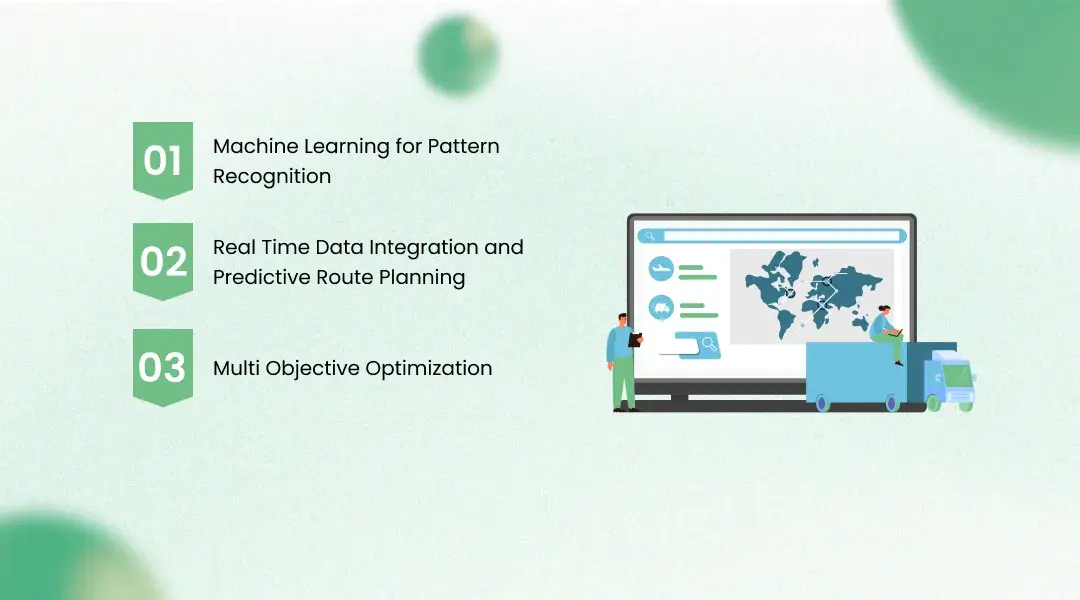
At the core of most AI routing systems is machine learning, specifically supervised and reinforcement learning models that analyze historical delivery data to identify patterns invisible to human planners. These models examine millions of past deliveries to learn which routes performed well under specific conditions, which time windows consistently led to delays, and which stop sequences minimized total drive time. A machine learning model trained on twelve months of delivery data for a regional carrier can identify, for example, that deliveries to a particular industrial park are 23% faster when routed from the south entrance between 6:00 AM and 8:00 AM.
KriraAI has developed machine learning models specifically designed for logistics networks that learn from a company's own operational data rather than relying on generic routing algorithms. This approach produces recommendations that reflect the unique characteristics of each fleet, including vehicle capacity constraints, driver skill profiles, and customer specific delivery requirements that off the shelf solutions cannot account for.
Static route planning calculates the best route based on conditions at the time of planning. AI route optimization continuously recalculates based on real time inputs, including live traffic data, weather conditions, road closures, and delivery confirmation signals from drivers in the field. Predictive route planning extends this further by anticipating conditions before they occur. If a machine learning model has learned that a particular highway corridor experiences congestion every Tuesday between 3:00 PM and 5:30 PM, the system proactively reroutes vehicles before congestion appears.
The integration layer is where many implementations succeed or fail. AI routing systems need to pull data from multiple sources simultaneously:
GPS and telematics data from fleet vehicles providing location, speed, and engine diagnostics.
Traffic APIs delivering real time and predicted congestion data for road segments along planned routes.
Weather services feeding localized forecasts that affect driving speed and delivery feasibility.
Customer systems providing updated delivery windows, cancellations, and priority changes.
Driver availability platforms tracking hours of service compliance and shift transitions.
Traditional routing tools optimize for a single variable, usually shortest distance or fastest time. AI systems perform multi objective optimization, balancing several competing priorities simultaneously. A logistics company might need to minimize total fuel consumption while ensuring that 95% of deliveries arrive within their promised time windows, while distributing workload evenly across drivers to comply with regulations, while prioritizing high value customers who pay premium rates for guaranteed delivery slots.
These objectives often conflict with each other. AI optimization engines evaluate thousands of possible route combinations and identify the solution set that best balances all objectives according to the company's weighted priorities. This is a class of problem that human dispatchers cannot solve manually at scale, because the number of possible combinations grows exponentially with each additional vehicle and stop.
The financial case for logistics cost reduction with AI is supported by measurable results across multiple operational dimensions.
Fuel cost reduction is typically the most immediately visible benefit. AI optimized routes reduce total miles driven by eliminating unnecessary backtracking, consolidating stops more efficiently, and selecting routes that minimize idle time. Industry data indicates that AI powered routing reduces fuel consumption by 10% to 20% depending on fleet size and route density. For a mid sized logistics company operating 200 vehicles with an annual fuel budget of $8 million, a 15% reduction translates to $1.2 million in direct annual savings. One European logistics provider reported saving $12 million in fuel and driver hours in a single year after deploying AI route planning, while cutting average trip times by 18%.
Labor efficiency gains represent the second major impact category. AI routing reduces the number of driver hours required to complete the same volume of deliveries by optimizing stop sequences and eliminating wait times. Companies typically report a 12% to 25% improvement in deliveries per driver hour after AI implementation. This does not necessarily mean reducing headcount, but rather handling more volume with the existing workforce, which is particularly valuable during periods of driver shortage.
Customer satisfaction improvements drive measurable revenue retention. AI fleet management systems that provide accurate estimated arrival times reduce missed delivery rates. Some logistics companies using predictive route planning have achieved first attempt delivery rates above 97%, compared to industry averages closer to 85% to 90%. Each failed delivery attempt costs between $12 and $20 when accounting for return trips and re delivery scheduling.
KriraAI worked with a logistics company operating a 150 vehicle fleet across six metropolitan regions. Through phased implementation of AI route optimization, including predictive analytics for traffic patterns and multi objective optimization balancing fuel costs against delivery compliance, the company achieved $2.1 million in verified annual savings. The savings came from a combination of 17% fuel cost reduction, 22% improvement in deliveries per driver hour, and a 34% decrease in failed first delivery attempts.
Implementing AI route optimization is not a matter of purchasing software and switching it on. Successful deployments follow a structured process.
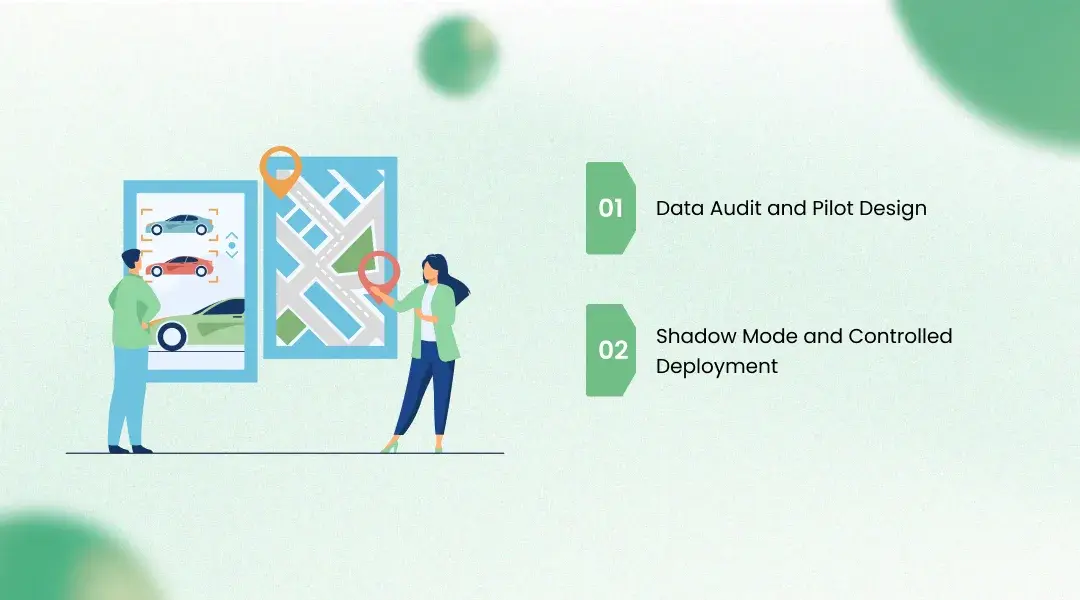
The foundation of any AI routing system is data. Before selecting a technology partner, logistics companies must assess the quality, completeness, and accessibility of their operational data. This includes historical delivery records with timestamps and GPS coordinates, vehicle telematics data, customer order information, and driver schedule records.
Common issues discovered during data audits include incomplete GPS logging, inconsistent timestamp formats across systems, inaccurate address geocoding, and siloed data stores that do not communicate. Addressing data quality issues typically takes four to eight weeks and is the single most important predictor of implementation success.
Rather than deploying AI routing across an entire fleet, successful implementations begin with a controlled pilot covering 15 to 30 vehicles in a single geographic region. During the pilot, the AI system runs in shadow mode for two to four weeks, generating route recommendations alongside the existing process without directing drivers. This allows the operations team to compare AI recommendations against current routes and build confidence before switching to live operation.
Key metrics to track during the pilot phase include total miles driven per delivery, average time per stop, fuel consumption per route, on time delivery percentage, and driver compliance with suggested routes.
The most frequent implementation failure is treating AI routing as a technology project rather than an operational transformation. Companies that hand the project entirely to IT without involving operations managers consistently underperform compared to those that make operations teams co owners.
Another common mistake is expecting immediate perfection. AI routing models improve over time as they accumulate data and feedback. Companies that abandon their pilot after two weeks miss the fact that the typical breakeven point where AI routes consistently outperform manual planning is six to twelve weeks. Data integration shortcuts also cause problems, as companies that feed the AI system partial data get partial results.
Adopting supply chain AI solutions is not without significant challenges, and logistics companies should enter the process with realistic expectations.
Data quality remains the most persistent obstacle. Many logistics companies have accumulated years of operational data, but much of it is inconsistent, incomplete, or stored in formats that AI systems cannot easily ingest. Address databases contain errors, GPS logs have gaps, and delivery timestamps may reflect when a driver marked a delivery complete rather than when the package was actually handed over. Cleaning this data is unglamorous work, but it is non negotiable.
Talent gaps present a different challenge. Most mid sized logistics companies do not employ data scientists. They need partners, such as KriraAI, that provide technical expertise while transferring enough knowledge to internal teams for independent system management. The alternative of hiring a full internal AI team is cost prohibitive for most operators.
Integration complexity is often underestimated. AI routing systems must connect with existing transportation management systems, warehouse management systems, and driver communication tools. These systems were rarely designed with AI integration in mind, requiring custom API development and ongoing maintenance.
Change management is the challenge that technology focused implementations most often overlook. Dispatchers who have built careers on route planning expertise can feel threatened by a system that claims to do their job better. Drivers told to follow AI generated routes rather than their own judgment may resist. Successful implementations invest as much in training and communication as they do in technology.
The next three to five years will see AI route optimization evolve from a standalone technology into an embedded component of fully autonomous logistics networks.
Autonomous vehicle integration represents the most transformative near term development. AI routing systems will increasingly coordinate mixed fleets of human driven and autonomous vehicles, assigning each delivery to the most appropriate vehicle type based on route characteristics, cargo requirements, and cost efficiency. Urban last mile deliveries handled by autonomous delivery robots will be routed by the same AI systems that manage long haul trucking.
Predictive supply chain orchestration will extend AI routing beyond transportation to encompass end to end logistics. AI systems will determine the optimal time to pick and stage orders, the optimal carrier based on real time capacity, and the optimal delivery window based on predicted network conditions. Generative AI will play an expanding role, with the market projected to grow from $1.47 billion in 2025 to over $33 billion by 2035, producing scenario plans for disruption response and natural language explanations of routing decisions.
Companies that delay AI adoption will face compounding disadvantages. As early adopters accumulate more operational data, their AI systems become progressively more accurate, widening the performance gap. A company that starts in 2026 will have two years of learning data by 2028, while a competitor that waits until 2028 starts from zero. In an industry where margins are measured in single digit percentages, a 15% to 20% cost advantage is the difference between growth and obsolescence.
Three themes emerge from this analysis that logistics leaders should internalize. First, AI route optimization in logistics is no longer experimental technology but a proven operational capability with documented financial returns across companies of varying size and complexity. Second, successful implementation depends as much on data quality, organizational readiness, and change management as it does on the underlying technology. Third, the competitive gap between AI adopters and non adopters is widening with each passing quarter, making delayed adoption increasingly costly.
The logistics companies that will thrive over the next decade are those that treat AI not as a one time technology purchase but as a continuous operational capability that improves with every delivery and every data point collected. This requires selecting the right implementation partner, one that combines deep technical expertise in AI and machine learning with practical understanding of logistics operations.
KriraAI partners with logistics companies to build AI route optimization systems tailored to each operator's specific network characteristics, customer requirements, and growth objectives. Rather than offering a generic platform, KriraAI designs solutions that adapt to how each company actually operates, delivering measurable cost savings from the first phase of deployment. If your logistics operation is ready to move beyond manual routing and start capturing the savings that AI optimization can deliver, exploring what KriraAI can build for your fleet is the practical next step.
The cost of implementing AI route optimization varies based on fleet size, data readiness, and integration scope. For a mid sized logistics company operating 50 to 200 vehicles, initial implementation costs typically range from $150,000 to $500,000, covering data integration, model training, pilot deployment, and system configuration. Ongoing costs include software licensing, data infrastructure maintenance, and periodic model retraining, generally running between $3,000 and $8,000 per vehicle per year. These costs should be evaluated against documented savings, which routinely exceed the investment within 12 to 18 months. Companies with cleaner baseline data reach positive ROI faster because less upfront preparation is required.
Traditional route planning software uses fixed algorithms that calculate routes based on static inputs such as distance, speed limits, and known road networks. These systems produce the same output every time they receive the same input. AI route optimization uses machine learning models that continuously learn from historical performance data, adapt to real time conditions including traffic and weather, and optimize for multiple objectives simultaneously. A traditional system might find the shortest path between ten stops, while an AI system evaluates thousands of sequences and timings to find the combination that minimizes fuel, maximizes on time performance, and balances driver workload, all while adjusting dynamically throughout the day. The practical result is that AI systems improve over time while traditional systems remain static.
Most logistics companies begin seeing measurable improvements within eight to twelve weeks of active deployment, following a pilot phase of four to six weeks. Fuel savings and miles per delivery reductions tend to appear first. Driver productivity improvements and on time delivery gains usually follow within the second and third months as AI models refine their understanding of local conditions and driver behavior patterns. Full financial impact, including maintenance cost reductions and customer retention benefits, typically becomes visible after six to twelve months. Companies that invest in thorough data preparation and maintain active feedback loops between drivers, dispatchers, and the AI system reach meaningful results faster than those treating implementation as a passive rollout.
Small logistics companies with as few as 20 to 30 vehicles can achieve meaningful benefits, though absolute dollar savings will be proportional to fleet size. The percentage improvements in fuel efficiency, delivery density, and driver productivity apply regardless of scale, meaning a small operator can expect similar 10% to 20% efficiency gains. Cloud based solutions and AI platforms offered by companies like KriraAI have reduced the upfront investment required, eliminating the need for expensive on premise infrastructure. Small operators often see a faster path to ROI because their operations have more obvious inefficiencies that AI can address quickly, and their smaller scale makes change management simpler. The key requirement is not fleet size but data quality, because even a 25 vehicle fleet generates enough data to train effective models.
An effective AI route optimization system requires several categories of operational data. At minimum, the system needs historical delivery records including pickup and delivery addresses with accurate geocoding, timestamps for arrivals and departures, and the sequence in which stops were visited. Vehicle telematics data including GPS positions, speed, fuel consumption, and engine diagnostics provides the real time operational layer. Customer data including delivery time windows, access restrictions, and service level agreements allows optimization against actual business constraints. External data feeds for traffic conditions, weather forecasts, and road network updates enable the predictive capabilities that distinguish AI routing from static planning. Companies that also provide driver profile information enable more sophisticated matching of the right driver to the right route. The depth and quality of input data directly determines the precision of the system's output.
Founder & CEO
Divyang Mandani is the CEO of KriraAI, driving innovative AI and IT solutions with a focus on transformative technology, ethical AI, and impactful digital strategies for businesses worldwide.