The global computer vision market reached an estimated $20.75 billion in 2025 and is projected to surpass $72 billion by 2034, growing at a compound annual growth rate of 14.8% according to Fortune Business Insights. That trajectory is not the result of hype cycles or speculative investment. It reflects a fundamental recalibration in how enterprises extract value from visual data, and it signals that AI in computer vision services has moved from a research curiosity to an operational necessity. Nearly 75% of manufacturers now run some form of AI powered visual inspection, and the broader AI in computer vision segment is expanding at rates that dwarf most adjacent enterprise software categories.
What makes this moment different from earlier waves is the convergence of three forces: deep learning architectures that have reached production grade accuracy, edge computing hardware that processes visual data in real time, and cloud infrastructure that makes deployment scalable without requiring every organization to build its own AI lab. Computer vision for business automation is no longer reserved for companies with nine figure R&D budgets. Mid market manufacturers, regional healthcare networks, and logistics operators are deploying these systems and seeing returns within months. The enterprises that delay are accumulating a competitive debt that compounds with every quarter of inaction.
This blog examines the current state of computer vision services, maps AI technologies to specific problems, quantifies real business impact, provides a detailed implementation roadmap, confronts genuine adoption challenges, and projects where the industry is heading.
The computer vision services industry sits at an inflection point where demand is accelerating faster than supply. Enterprises across manufacturing, healthcare, retail, logistics, agriculture, and security are recognizing that visual data contains signals that can drive transformative operational improvements. Yet the industry faces structural challenges that shape how quickly value gets delivered.
The talent bottleneck remains the most persistent constraint. Training a computer vision engineer requires expertise across linear algebra, convolutional neural network architectures, data pipeline engineering, and domain specific knowledge of the industry they serve. The global shortage of professionals with this combination of skills means that computer vision service providers compete fiercely for talent, which drives up project costs and extends timelines. A 2025 survey by Datature found that only 26% of organizations have the internal capabilities to move AI proof of concepts into production, which means the remaining 74% depend on external service providers or managed platforms to bridge the gap.
Data quality presents another systemic challenge. Visual data is messy, voluminous, and expensive to label. A single manufacturing inspection use case might require tens of thousands of annotated images, and the annotation process demands domain expertise that general purpose labeling services often lack. The cost of building high quality training datasets can represent 60% to 80% of total project cost, a ratio that surprises adopters who assume the expense lies in model development.
Integration complexity adds a third layer of difficulty. Computer vision systems must connect to manufacturing execution systems, ERP platforms, warehouse management software, and electronic health records. Each integration point introduces latency, compatibility issues, and failure modes. Even technically successful pilots frequently stall at the integration stage, never reaching the production deployment where real value materializes.
Cost pressures from both sides of the market are reshaping provider strategies. Enterprise buyers demand faster time to value and lower upfront investment, while the underlying costs of GPU compute, data storage, and specialized talent continue to rise. This squeeze is driving consolidation among smaller providers and pushing larger players toward platform based delivery models that amortize infrastructure costs across multiple customers. KriraAI, which builds practical AI solutions for enterprises, has observed this dynamic across its client engagements and has structured its computer vision service offerings around reusable components and pre trained models that reduce the per project cost without sacrificing accuracy.
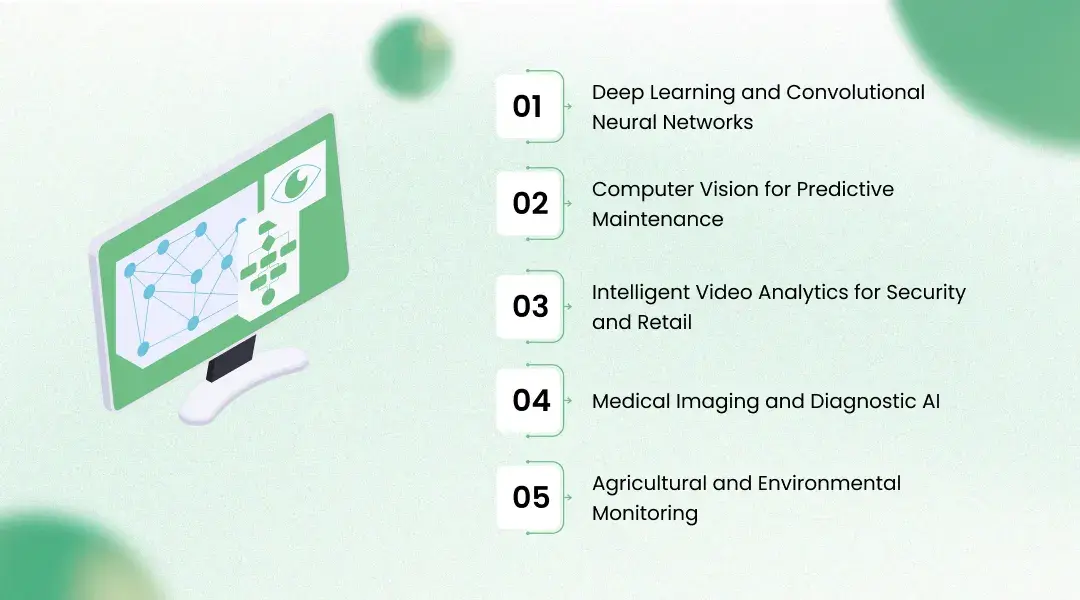
The foundational technology driving modern computer vision services is deep learning, specifically convolutional neural networks and their successor architectures including vision transformers. These models learn hierarchical visual features directly from data, eliminating the need for hand engineered feature extractors that made earlier systems brittle. Deep learning image recognition now routinely achieves accuracy rates above 95% on well defined tasks, and architectures like YOLO (You Only Look Once) can perform real time object detection exceeding 100 frames per second on edge hardware. This combination of accuracy and speed is what makes enterprise visual inspection AI commercially viable at scale.
One of the highest ROI applications of computer vision for business automation is predictive maintenance in industrial settings. Traditional maintenance follows either a reactive model, repairing equipment after failure, or a time based preventive model that replaces components on a fixed schedule regardless of condition. Both approaches waste money. Computer vision enables condition based maintenance through continuous visual monitoring, where cameras capture images of critical components and deep learning models detect early signs of wear, misalignment, or degradation. When a model identifies that a bearing surface is developing micro fractures, the maintenance team can schedule replacement during planned downtime. Industry data shows that AI driven predictive maintenance reduces maintenance costs by 25% to 40% and cuts unplanned downtime by up to 50%.
Intelligent video analytics solutions represent another major category of AI in computer vision services. In security applications, modern systems go far beyond simple motion detection, performing real time behavior analysis that identifies unauthorized access attempts, perimeter breaches, and crowd density violations. These systems reduce the burden on human security operators who suffer from attention fatigue when monitoring multiple camera feeds.
In retail environments, intelligent video analytics solutions transform existing security cameras into revenue optimization tools. Heat mapping reveals which store areas attract the most foot traffic, dwell time analysis shows which displays capture attention, and queue length monitoring triggers staffing adjustments. These capabilities convert a cost center into a source of actionable business intelligence.
Healthcare represents one of the most consequential applications of deep learning image recognition. AI models trained on X rays, CT scans, MRI sequences, pathology slides, and retinal photographs can detect disease patterns at accuracy levels matching specialist physicians in specific diagnostic tasks, with sensitivity and specificity rates above 90% for conditions including diabetic retinopathy and certain cancers.
The impact extends beyond accuracy. AI powered medical imaging reduces time from acquisition to diagnosis, which is critical in emergency settings. It also addresses the global shortage of radiologists by serving as a screening layer that flags cases requiring specialist attention. KriraAI has worked with healthcare organizations to deploy computer vision systems that integrate with existing PACS workflows, ensuring AI augments clinical decision making without disrupting established processes.
Computer vision for business automation in agriculture combines drone mounted and satellite cameras with deep learning models to monitor crop health, detect pest infestations, and estimate yield across thousands of hectares daily. Early detection of a pest outbreak or nutrient deficiency can mean the difference between a profitable harvest and a significant loss, making agricultural computer vision one of the fastest growing market subsegments.
The measurable returns from AI in computer vision services vary by industry and application, but the consistent finding across sectors is that well implemented systems deliver positive ROI within 6 to 18 months of production deployment. The numbers are specific enough to build business cases on and large enough to justify the upfront investment even for conservative organizations.
In manufacturing, computer vision powered quality inspection has demonstrated the most compelling results. An AI integrated solar manufacturing plant opened in Surat, Gujarat in March 2025 reported that its computer vision quality control systems reduced defect rates from the industry standard of 8% to 10% down to below 2%. That reduction translates directly to material cost savings, reduced rework labor, fewer warranty claims, and improved customer satisfaction. Across the manufacturing sector more broadly, companies deploying enterprise visual inspection AI report defect detection accuracy improvements of 30% to 60% compared to manual inspection, with throughput increases of 200% to 400% because machines do not need breaks, shift changes, or training periods.
Computer vision systems deployed for workplace safety monitoring are delivering dramatic results. OSHA cited studies indicate that effective safety programs deliver $4 to $6 saved for every $1 invested. AI powered safety monitoring platforms have documented up to 98% reductions in near miss incidents within six months of deployment. The financial impact extends beyond direct injury costs to include reduced insurance premiums, lower workers compensation claims, avoided regulatory fines, and improved employee retention in hazardous work environments. The worldwide workplace safety market reached $21.25 billion in 2025, with computer vision emerging as a primary technology driving next generation safety programs.
Retailers implementing intelligent video analytics solutions report conversion rate improvements of 5% to 15% through better store layouts, shrinkage reductions of 20% to 35% through AI powered loss prevention, and labor cost savings of 10% to 20% through traffic based staffing optimization. These gains compound across a multi location retail network, turning pilot improvements into meaningful profitability impact.
In healthcare, radiology departments deploying AI screening tools report 30% to 50% reductions in time to diagnosis for routine imaging studies. Pathology labs using AI assisted slide analysis document a 40% increase in throughput without additional headcount. For health systems operating under staffing constraints, these numbers represent the difference between sustainable operations and chronic bottleneck.
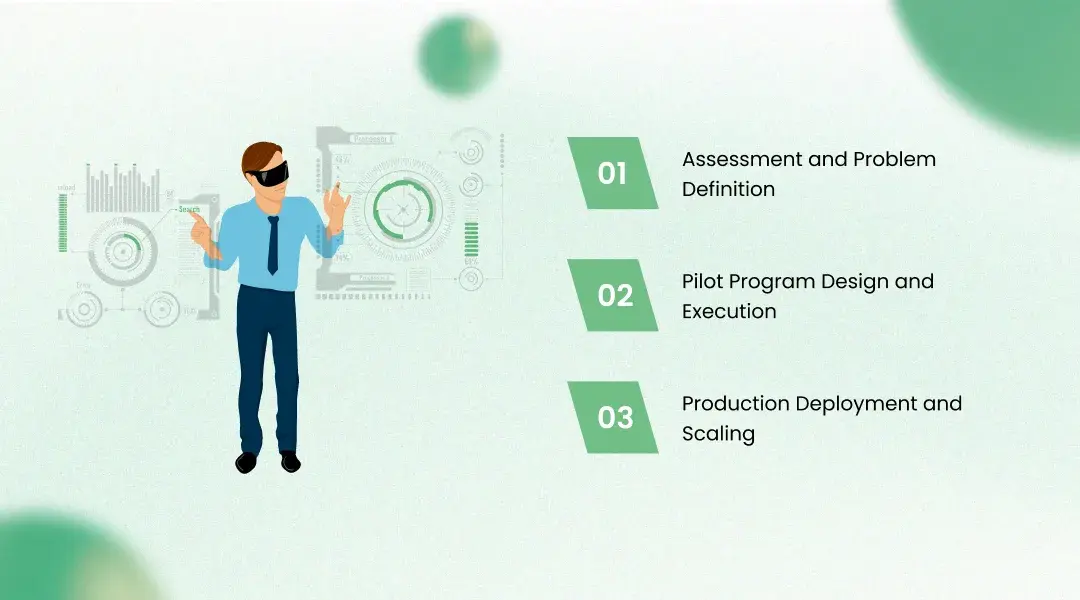
The implementation journey begins not with technology selection but with rigorous problem definition. The most common mistake is starting with a technology and searching for problems to solve. Successful implementations start with a specific, measurable business problem: a defect rate that is too high, a safety incident rate that is unacceptable, or a diagnostic backlog that delays patient care.
During the assessment phase, organizations should complete four critical activities:
Identify the three to five highest impact visual inspection or analysis tasks where human performance is insufficient, inconsistent, or unsustainably expensive.
Audit existing visual data assets, including cameras already deployed and historical labeled data in quality management or medical records systems.
Evaluate infrastructure readiness, including network bandwidth, compute resources, and integration points with existing enterprise systems.
Establish clear baseline metrics so that AI driven improvements can be measured against a concrete starting point.
This assessment typically takes four to eight weeks and should involve both technical and operational stakeholders.
A well designed pilot has three characteristics: it is scoped narrowly enough to deliver results within 8 to 12 weeks, it targets a problem where success is measurable, and it operates in a controlled environment where failures have limited business impact. Running a pilot on a single production line, in one retail location, or within one hospital department allows the team to iterate without enterprise wide disruption.
The data pipeline is often the most underestimated element. Building a reliable, automated flow from camera capture to model inference to business system output requires engineering that accounts for variable lighting, camera angle inconsistencies, and edge case handling. KriraAI typically embeds its engineering teams alongside client operations during the pilot phase, ensuring systems are tuned to real world conditions rather than laboratory assumptions.
Moving from pilot to production is where many organizations falter. A 2025 study found that 42% of companies abandoned most AI initiatives before reaching production, up from 17% the prior year. The primary failure reasons are organizational: lack of executive sponsorship, unclear ownership, insufficient change management, and unrealistic ROI timelines.
Successful scaling requires a phased rollout that expands to additional lines or locations in a controlled sequence, with feedback loops that capture performance data and edge cases for model retraining. Organizations should establish a dedicated MLOps function or partner with a provider like KriraAI that offers ongoing model monitoring and performance optimization as part of its delivery model.
The most costly errors in computer vision implementation follow predictable patterns:
Starting with insufficient or poorly labeled data produces models that perform well on test sets but fail in production. Invest in data quality before model complexity.
Optimizing for accuracy alone while ignoring latency produces models that cannot operate at production speed. Define all performance requirements before model selection.
Neglecting edge cases creates systems that work 90% of the time but fail on the unusual inputs that matter most. Build human escalation workflows into the architecture.
Treating deployment as the finish line results in model decay as conditions drift from training data. Continuous monitoring and retraining are operational necessities.
Underinvesting in change management produces systems that users resist. Frontline workers must understand and trust the system's outputs.
Between 70% and 85% of AI initiatives fail to meet expected outcomes according to multiple industry surveys, and computer vision projects are not exempt. Understanding where failures occur is essential for any organization considering adoption.
Data scarcity and quality remain the most fundamental challenges. Many industries lack the large, well labeled datasets that deep learning requires. Medical imaging data is constrained by privacy regulations. Manufacturing defect data is inherently imbalanced because defective items are rare. Synthetic data and few shot learning techniques are improving the situation but do not yet eliminate the need for substantial real world training data.
The talent gap shows no sign of closing. The combination of deep learning expertise, software engineering skills, and domain knowledge needed for production systems is rare. Organizations that cannot hire this talent must rely on external providers or platform based tools, each introducing tradeoffs in flexibility and vendor dependency.
Regulatory uncertainty adds complexity. The EU AI Act classifies certain computer vision applications as high risk, imposing strict documentation and testing requirements. Healthcare applications face additional regulatory obligations from bodies like the FDA. Navigating this landscape requires legal expertise most technology teams lack. Infrastructure costs are also frequently underestimated, as cameras, networking, edge compute, and cloud resources represent significant capital investment beyond software and services.
Looking three to five years ahead, several developments will separate market leaders from laggards.
Foundation models for vision, analogous to large language models, are the most significant architectural shift. Models like Meta's Segment Anything have demonstrated that a single pre trained model can perform well across dozens of tasks with minimal fine tuning. This will dramatically reduce data requirements and development time, making it viable to deploy AI in situations where custom model costs were previously prohibitive.
Edge AI deployment will accelerate as specialized inference chips reach price points accessible to mid market enterprises. By 2028, most new computer vision deployments will process data at the point of capture rather than in the cloud, reducing latency, bandwidth costs, and privacy concerns simultaneously.
Multimodal AI that combines computer vision with natural language processing and reasoning will unlock entirely new use cases. A quality inspection system that detects a defect, explains its root cause in natural language, and updates quality records automatically represents the next frontier of computer vision capability.
The competitive implications are clear. Organizations that have built data pipelines and validated use cases will adopt next generation technologies as they mature. Those that have not started will face an increasingly steep catch up curve against rivals with years of accumulated training data and operational learning.
Three conclusions emerge from this analysis with particular clarity. First, AI in computer vision services has crossed the threshold from experimental technology to production infrastructure, with measurable ROI documented across manufacturing, healthcare, retail, logistics, and agriculture. Second, the gap between organizations that have begun implementation and those that have not is widening rapidly, creating a competitive divide that will become increasingly difficult to cross. Third, successful adoption requires not just technical capability but organizational readiness, including executive sponsorship, data governance, change management, and a realistic understanding of both the potential and the limitations of current technology.
For enterprises ready to move from evaluation to action, the path forward begins with identifying the highest impact visual data problem in your operations and building a focused pilot program around it. KriraAI partners with enterprises across industries to design, build, and deploy computer vision solutions that are practical, measurable, and engineered for production scale. With deep expertise in deep learning image recognition, intelligent video analytics solutions, and end to end MLOps, KriraAI helps organizations navigate the complexity of implementation while avoiding the common pitfalls that derail most AI initiatives.
If your organization is evaluating how computer vision can drive operational improvement, explore how KriraAI's enterprise AI solutions can accelerate your path from pilot to production. The window for building competitive advantage through computer vision is open today, but it will not remain open indefinitely.
The cost of implementing AI in computer vision services for a mid sized business typically ranges from $50,000 to $500,000 for an initial pilot project, depending on use case complexity, training data availability, and integration requirements. Hardware costs for cameras and edge computing devices represent 20% to 40% of total budget, while data collection and labeling account for another 30% to 40%. Ongoing operational costs including cloud compute, model monitoring, and periodic retraining run 15% to 25% of initial implementation cost per year. Organizations should plan for 12 to 24 months from assessment through production deployment, with ROI typically becoming positive within 6 to 18 months of production launch.
Most organizations begin seeing measurable returns from computer vision AI within 6 to 18 months of production launch. Manufacturing quality inspection delivers the fastest ROI because defect costs are well understood and before and after comparisons are straightforward. Workplace safety applications often show ROI within 3 to 6 months due to immediate reductions in incident rates. Healthcare diagnostic applications may take longer because benefits manifest as clinical outcome improvements and workflow efficiencies that accumulate over time. The most important factor in accelerating ROI is starting with a narrowly scoped pilot targeting a high impact problem with readily available data.
Manufacturing, healthcare, agriculture, and logistics derive the greatest measurable benefit from enterprise visual inspection AI. Manufacturing leads with nearly 75% of facilities running AI powered inspection for quality control, driven by the direct financial impact of reducing defect rates. Healthcare benefits through diagnostic imaging AI that augments radiologists and pathologists. Agriculture uses drone and satellite based computer vision to monitor crop health across thousands of hectares for early pest and disease intervention. Logistics applies computer vision for package sorting, inventory verification, and damage detection. These industries share a common characteristic: they generate large volumes of visual data containing actionable signals that human inspection cannot extract consistently at scale.
Small businesses can increasingly afford AI powered computer vision thanks to cloud based platforms, pre trained models, and no code tools that reduce upfront investment. Platform solutions now allow businesses to train and deploy basic models for $500 to $5,000 per month in subscription fees. Cloud deployment eliminates expensive on premises GPU hardware, and pre trained foundation models reduce labeled training data requirements from thousands of images to hundreds or even dozens for simpler tasks. Small businesses should focus on well defined use cases where the current manual process is clearly costly or error prone, such as quality inspection for food products, inventory counting, or equipment condition monitoring.
The five most significant risks are model accuracy degradation over time, data privacy and regulatory compliance failures, integration fragility, organizational resistance from frontline workers, and vendor lock in. Model drift occurs when real world conditions diverge from training data, causing gradual performance decline without obvious indicators unless monitoring is in place. Data privacy risk is acute in applications involving facial recognition, where frameworks like the EU AI Act impose strict obligations. Integration fragility arises because computer vision must connect to multiple enterprise systems, and failure at any point can disable the whole pipeline. Organizational resistance manifests when workers perceive AI as surveillance rather than augmentation. Vendor lock in becomes a concern when proprietary platforms make switching costly.
Founder & CEO
Divyang Mandani is the CEO of KriraAI, driving innovative AI and IT solutions with a focus on transformative technology, ethical AI, and impactful digital strategies for businesses worldwide.