Three years ago, I watched a SaaS founder celebrate.
They had just scaled to 10,000 users. Revenue was growing. The dashboard looked… impressive.
Six months later? Growth stalled.
Not because the product was bad. Because it stopped learning.
Here’s the uncomfortable truth: Most SaaS products scale users, but leveraging expert AI SaaS development services ensures your platform scales intelligence alongside growth.
And in 2026, that difference decides who survives.
Let’s strip this down. No jargon.
AI SaaS solutions are simply software platforms that don’t just serve users; they adapt to them.
Traditional SaaS:
Fixed workflows
Static dashboards
Manual decision-making
AI-powered SaaS solutions:
Learn from user behavior
Predict outcomes
Automate decisions
That’s the shift.
Machine Learning (ML): Finds patterns in data
Natural Language Processing (NLP): Understands human language
Automation Engines: Executes actions without manual input
If your SaaS doesn’t evolve with usage… It becomes irrelevant faster than you think.
Let me ask you something.
When was the last time you tolerated a “dumb” product?
Exactly.
Not optional anymore. Expected.
Users want:
Recommendations that make sense
Interfaces that adapt
Faster decisions
They’re building AI SaaS platforms from day one.
And they move faster because their product learns while scaling.
At some point, your team becomes the bottleneck.
AI removes that ceiling.
Not theoretically. Practically.
I’ve seen founders invest in AI for the wrong reasons.
“Everyone is doing it.”
That’s how you burn money.
Here’s what actually matters:
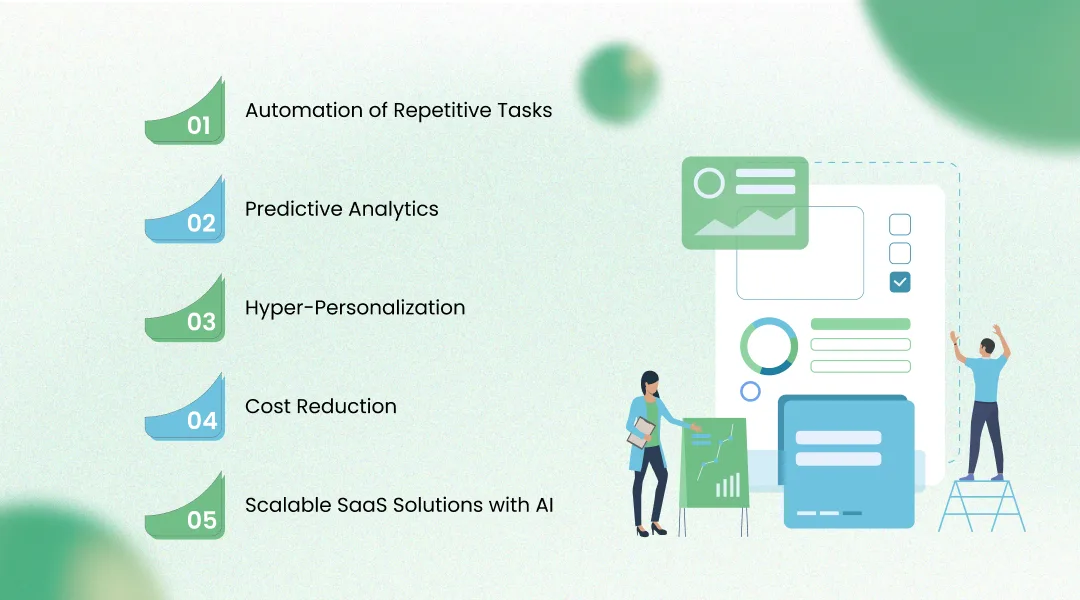
Support tickets. Data entry. Reporting.
Gone. Or at least… minimized.
Instead of asking: “What happened?”
You start asking: “What will happen next?”
That’s a different level of control.
Every user gets a slightly different product experience.
That’s how retention quietly improves.
Fewer manual processes. Smaller operational load.
Margins improve without hiring more people.
Growth without proportional cost increase.
That’s the real win.
This is where things get interesting.
AI identifies:
High-conversion leads
Churn risks
Best follow-up timing
HR SaaS
Resume screening becomes:
Faster
More consistent
Less biased (if done right)
Campaigns optimize themselves.
Yes. Automatically.
Fraud detection happens in real-time.
Not after damage is done.
Here’s something most blogs won’t tell you.
AI isn’t just a feature. It’s an architectural decision.
Scalability comes from combining both.
Not choosing one.
Your product improves as usage increases.
That’s exponential growth, not linear.
The system evolves without constant developer intervention.
Less dependency on human decisions.
More consistency. More speed.
I’ve seen teams jump straight to models.
Big mistake.
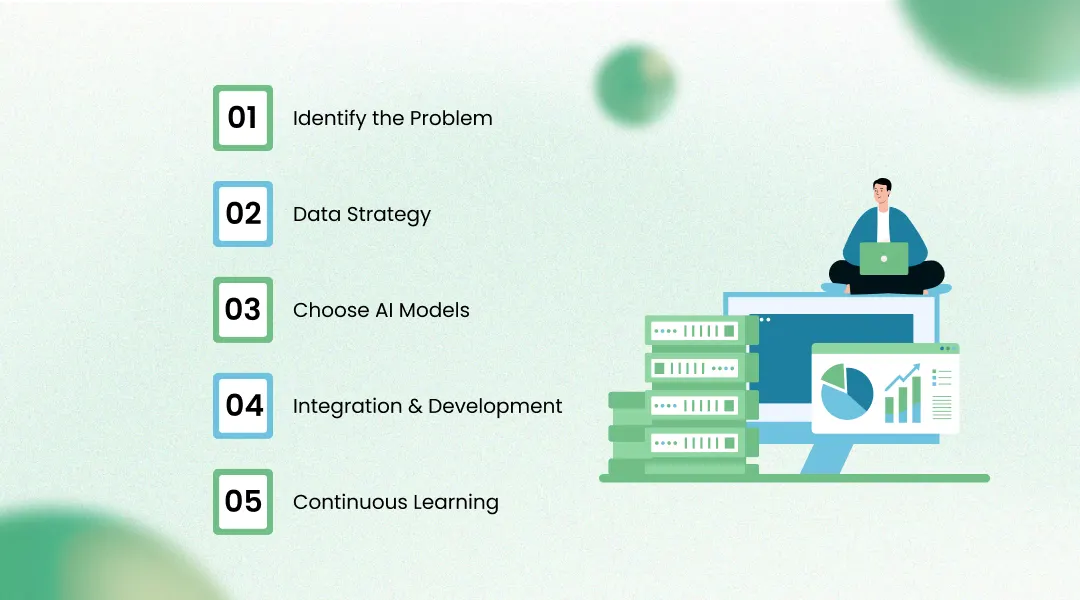
Here’s the actual sequence:
Not “where can we use AI?” But “where are we losing efficiency or insight?”
No data = no AI.
Simple. Brutal. True.
Pick based on use case, not hype.
This is where most complexity hides.
Your AI should improve over time.
If it doesn’t… it’s just expensive automation.
Let’s not pretend this is easy.
Bad data = bad outcomes.
Every time.
Yes, AI SaaS development requires investment.
But the ROI… if done right… is worth it.
Getting from 70% to 95% accuracy?
That’s where the real work begins.
Existing systems rarely cooperate nicely.
You’ll need experience here.
This is where things get slightly uncomfortable.
Because the pace is accelerating.
Products that make decisions without user input.
Not assistants. Decision-makers.
Non-technical founders entering the space faster.
Milliseconds matter.
And systems are adapting accordingly.
You can build internally.
Many try.
Few succeed efficiently.
Experience reduces trial-and-error.
Avoid costly mistakes early.
Built right from day one.
Because your business isn’t generic.
Working with a Best AI development Company gives you leverage, not in the buzzword sense, but in real execution speed and clarity.
Let me leave you with this.
AI in the SaaS industry isn’t about adding features.
It’s about building systems that think, adapt, and improve.
And the companies that partner with KriraAI to understand this early don't just scale; they compound.
They don’t just scale.
They compound.
So the real question isn’t:
“Should we use AI?”
It’s:
“How long can we afford not to?”
AI SaaS solutions are cloud-based software platforms that use AI to automate tasks, predict outcomes, and personalize user experiences in real-time.
AI reduces manual processes and enables systems to learn and adapt, allowing SaaS platforms to scale users and operations without increasing costs proportionally.
Costs vary based on complexity, data requirements, and features. Basic AI integrations may start small, but advanced systems require significant investment.
Yes—if applied strategically. AI helps startups compete with larger players by automating processes and delivering smarter user experiences.
Start with a clear problem, build a strong data strategy, choose the right models, integrate carefully, and continuously improve the system over time.
Founder & CEO
Divyang Mandani is the CEO of KriraAI, driving innovative AI and IT solutions with a focus on transformative technology, ethical AI, and impactful digital strategies for businesses worldwide.