Every large-scale fitness operation eventually hits the same wall. Members arrive with diverse goals, wildly different fitness baselines, and varying schedules. Coaches and trainers are stretched across hundreds of simultaneous member journeys. Digital content libraries grow into unnavigable archives. And somewhere in the noise of daily operations, the precise moment when a member begins to disengage gets missed completely - until the cancellation notification arrives. For a leading fitness enterprise managing over 200,000 active members across a network of physical and digital touchpoints, this was not a hypothetical scenario. It was the daily operational reality costing them an estimated 18% annual member churn rate, with each lost member representing an average lifetime value erosion of over $1,400. When they engaged KriraAI, the mandate was clear: build an AI-powered fitness platform through dedicated machine learning development services capable of delivering personalised member experiences at scale, predicting disengagement before it became cancellation, and giving coaching staff leverage they had never had before. This blog covers the complete story - the problem, the architecture KriraAI designed, the technology decisions we made, the challenges we worked through, and the results the client achieved after go-live.
The fitness and sports industry operates on a deceptively simple business model: attract members, keep them engaged, help them achieve results, and convert their success into advocacy and renewal. In practice, at enterprise scale, every one of those four steps is operationally complex and highly dependent on data that most fitness organisations collect but never meaningfully use.
For a leading fitness enterprise, the data problem was acute. Their member management platform generated millions of event-level records per month, check-in timestamps, equipment usage logs, class booking and cancellation events, in-app workout completions, wearable sync data from Garmin and Apple Health integrations, and NPS survey responses. This data lived in four separate systems: a legacy CRM built on Salesforce with heavy custom configuration, a homegrown class booking platform, a third-party mobile app with its own backend, and a data warehouse that was refreshed nightly in batch. No single view of the member existed. No system could tell a coach, in real time, that a member who had visited four times per week for six months had suddenly dropped to once in the last three weeks and had not opened the mobile app in eighteen days.
Coaching and programming decisions were made manually. Each facility's head trainer would review a weekly spreadsheet export and attempt to identify at-risk members by eye. This process took approximately twelve hours per facility per week across a network of thirty-one locations. The data being reviewed was already five to seven days stale by the time a human acted on it. Personalised workout plans were written from templates, lightly adjusted by trainers who had at most a few minutes to review a member's history before a session. There was no mechanism to incorporate longitudinal performance trends, injury flags from previous sessions, or goal drift over time into the planning workflow.
The content recommendation problem was equally severe. The enterprise had invested heavily in a digital content library containing over 4,200 video-based workout sessions, nutrition guides, and recovery protocols. Members navigating this library without guidance had a documented discovery rate of under 7%, meaning 93% of the content investment was producing no engagement return. The recommendation logic in the mobile app was a simple popularity-weighted filter with no personalisation, no sequencing logic, and no connection to the member's current training phase or recent activity patterns.
The commercial consequence of all this was a member churn rate of 18% annually, significantly above the industry benchmark of 12 to 14% for multi-location fitness operators. Reactivation campaigns were broadcast-style email sequences with no behavioural triggering, generating open rates under 9% and conversion rates below 1.2%. New member onboarding dropped off sharply at the 90-day mark, precisely when the initial motivation surge subsides, and habitual engagement needs to take over. No system existed to detect this cliff or intervene before members reached it. The competitive pressure from well-funded digital-first competitors offering algorithmically personalised fitness experiences made the status quo not just inefficient but existentially risky.
KriraAI designed and delivered a unified AI-powered fitness platform that operates across four interconnected intelligent systems: a real-time member engagement scoring engine, a personalised workout and content recommendation engine, a proactive churn intervention system, and a coach augmentation layer that surfaces AI-generated insights directly into trainer workflows.
The engagement scoring engine processes every member interaction event in near real-time, computing a composite engagement health score that combines recency, frequency, intensity, and goal-alignment signals. This score is not a static metric refreshed nightly. It is a continuously updated probabilistic state estimate, computed using a temporal transformer architecture trained on eighteen months of longitudinal member behaviour data. The model was trained using supervised fine-tuning on labelled engagement outcomes, with contrastive learning applied to the embedding layer to ensure that members with superficially similar activity patterns but different trajectory signals are separated meaningfully in the representation space.
The personalised workout recommendation engine uses a two-tower retrieval architecture. The first tower encodes member state, incorporating fitness level, training history, recent session load, stated goals, injury flags, and time-of-day preferences into a dense embedding. The second tower encodes workout content, incorporating modality, intensity, duration, muscle group targeting, equipment requirements, and trainer style signals. At serving time, approximate nearest-neighbour retrieval using HNSW indexing over the workout embedding space returns candidate sets in under 12 milliseconds, which are then re-ranked by a lightweight cross-encoder model that incorporates real-time context signals, including current facility occupancy and remaining session time.
The churn intervention system is a multi-horizon survival model built on a gradient-boosted ensemble with a CoxPH-inspired temporal hazard layer. It generates three parallel predictions for each member: the probability of cancellation within 14 days, 30 days, and 90 days. These predictions are computed every four hours against the full active member base and are used to trigger a priority-ranked intervention queue consumed by both automated CRM workflows and coach notification dashboards. Interventions are matched to predicted cause using a classification head trained on historical exit survey data, so the system does not just flag at-risk members but recommends specific intervention types: personal outreach, goal reset session, class recommendation, or promotional offer.
The coach augmentation layer delivers all of this intelligence through a purpose-built interface integrated directly into the existing facility management workflow, echoing the same experience-first approach KriraAI applies across other guest-facing sectors through its hospitality technology solutions. Coaches receive a daily briefing surface showing their assigned members ranked by engagement health score, with natural language summaries generated by a fine-tuned language model running on quantized infrastructure. These summaries translate statistical signals into coach-readable language: "This member's cardio session frequency has dropped by 60% over the past 21 days. Their last completed workout was below their established intensity baseline. A goal check-in is recommended before their next scheduled visit."
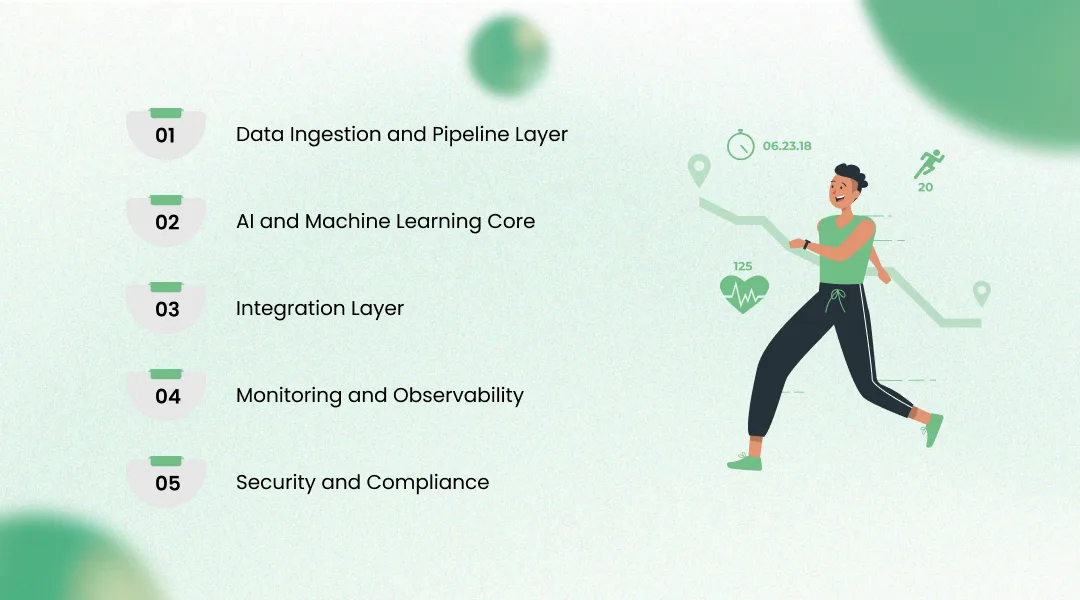
The architecture KriraAI designed is a layered, event-driven system built for sustained production throughput at enterprise scale. Every layer was designed to be independently deployable, observable, and replaceable without requiring a full system rebuild.
Member interaction events are ingested through an Apache Kafka cluster deployed on AWS MSK, with dedicated topics partitioned by member region and event type. The mobile app, facility access control systems, class booking platform, and wearable sync endpoints all publish to Kafka in real time via instrumented SDKs and webhook receivers. Legacy CRM data is ingested through change data capture using Debezium connected to the Salesforce database replica, ensuring every record mutation propagates into the pipeline without polling overhead.
The stream processing layer runs on Apache Flink, with stateful operators maintaining per-member rolling feature windows across 7-day, 30-day, and 90-day horizons. Temporal feature engineering at this layer produces derived signals including session frequency decay rates, intensity trend slopes, class cancellation ratios, and content consumption velocity. Entity resolution logic reconciles member identities across the four source systems using a probabilistic matching model trained on deterministic ground-truth pairs, handling the common case where a member's mobile app ID and CRM contact ID were not consistently linked in the legacy systems.
Processed features are written to a dual-path feature store. The online store runs on Redis with sub-millisecond read latency for serving-time feature retrieval. The offline store persists to Delta Lake on S3, managed by Apache Airflow DAGs that orchestrate daily feature materialisation jobs, model retraining pipelines, and data quality validation checks. Pipeline orchestration uses Airflow with SLA-monitored task groups, and any pipeline stage breach triggers automated alerting through PagerDuty.
The engagement scoring transformer was pre-trained on a masked event prediction objective using the full eighteen-month event history, then fine-tuned with a binary engagement classification head on a labelled dataset of 340,000 member trajectories. Training was distributed across a four-node GPU cluster using PyTorch with FSDP sharding, with mixed-precision training at BF16 reducing memory footprint without measurable accuracy degradation. The final model checkpoint was exported to ONNX and served via Triton Inference Server with dynamic batching enabled, achieving p99 inference latency of 34 milliseconds at peak load.
The two-tower recommendation model was trained using in-batch negative sampling with hard negative mining, a technique that dramatically improves retrieval precision for content libraries with long-tail engagement distributions. Workout content embeddings are pre-computed nightly and indexed into Qdrant using HNSW with an ef_construction of 200 and m of 16, calibrated through offline recall benchmarking against held-out interaction logs. The cross-encoder re-ranker is a distilled BERT-based model fine-tuned on member-workout interaction pairs with explicit relevance labels collected through in-app feedback.
The churn survival model uses a LightGBM base with 847 input features, including hand-engineered temporal features, embedding-derived latent features from the engagement transformer, and CRM-sourced demographic and contract signals, a modelling approach we break down in more practical terms in our guide on AI for gyms and member retention. The CoxPH-inspired hazard layer converts the gradient-boosted output into calibrated time-to-event probabilities, validated on a prospective hold-out set spanning three months of live member data with a Brier score of 0.09 at the 30-day horizon.
The natural language summary generation layer uses a quantised version of a 7-billion-parameter instruction-tuned language model, served via vLLM with 4-bit GPTQ quantisation on A10G instances. Prompt templates are versioned and stored in a model registry alongside evaluation rubrics, and summary quality is monitored through automated LLM-as-judge scoring pipelines that flag any output below the threshold for human review.
The AI platform integrates with the client's existing systems through an event-driven architecture built on AWS EventBridge. Downstream CRM automation workflows in Salesforce are triggered via webhook contracts when the churn model generates a high-priority intervention flag. The coach dashboard integrates with the facility management system through a versioned GraphQL API, with real-time subscription support for live score updates during facility operating hours. The mobile app content recommendation endpoint is served via a REST API with semantic versioning, supporting graceful degradation to popularity-weighted fallback recommendations during model serving outages. Internal service communication between the feature store, model serving layer, and API gateway uses gRPC with Protocol Buffers, chosen for its schema enforcement guarantees and sub-millisecond serialisation overhead at high request volumes.
The MLOps monitoring stack is built on Evidently AI for data drift and prediction drift detection, with the population stability index computed weekly against the training data distribution for all 847 input features. KL divergence monitoring on the engagement score output distribution detects silent model degradation not captured by downstream business metrics. Latency is tracked at p50, p95, and p99 across all serving endpoints using Prometheus with Grafana dashboards, with automated circuit breakers triggering fallback serving paths when p99 latency exceeds 150 milliseconds. Automated retraining is triggered when the 30-day churn model Brier score on a rolling evaluation window degrades by more than 0.015 from the baseline, initiating a Dagster-orchestrated retraining pipeline that completes within four hours.
All member data is encrypted in transit using TLS 1.3 and at rest using AES-256 managed through AWS KMS with per-tenant key isolation. The platform is deployed entirely within a private VPC with no public-facing model serving endpoints, with all external traffic routing through an AWS WAF-protected API Gateway. Role-based access control with attribute-level data masking ensures coaches see only their assigned member data, regional managers see aggregated facility metrics without individual member details, and data science teams access anonymised training datasets with PII stripped at the feature store boundary. All model inference inputs and outputs are written to an append-only audit log in S3 with object lock enabled, supporting GDPR data subject access request workflows and CCPA compliance obligations. Security controls were validated through a third-party penetration test prior to production go-live.
The technology decisions across this platform were made with the client's existing AWS-native infrastructure in mind, prioritising operational familiarity for their internal engineering team while introducing specialised AI infrastructure where generic solutions would have been inadequate.
Data and Streaming Infrastructure: Apache Kafka on AWS MSK for event streaming, Apache Flink for stateful stream processing, Debezium for CDC ingestion, Delta Lake on S3 for offline feature storage, Redis for online feature serving.
Orchestration and Pipeline Management: Apache Airflow for batch pipeline orchestration, Dagster for ML pipeline and retraining workflow management. Airflow was retained from the client's existing data engineering stack to minimise migration overhead. Dagster was introduced specifically for ML workflows due to its asset-centric model, which maps cleanly onto the dependencies between feature sets, model artefacts, and evaluation reports.
Model Training and Serving: PyTorch with FSDP for distributed training, ONNX Runtime and Triton Inference Server for low-latency model serving, vLLM with GPTQ quantisation for language model serving, LightGBM for the survival model. Triton was selected over TorchServe due to its superior dynamic batching implementation and native ONNX support, which reduced the serving engineering surface area.
Vector Search: Qdrant for workout embedding indexing, chosen over Pinecone due to self-hosting capability within the client's VPC and superior performance on filtered ANN queries, which the recommendation use case requires heavily. HNSW indexing was calibrated through offline benchmarking to achieve 97.3% recall at 10 at sub-15-millisecond query latency.
Monitoring: Evidently AI for drift detection, Prometheus and Grafana for infrastructure and latency observability, a custom LLM-as-judge pipeline for natural language summary quality monitoring.
Integration and APIs: AWS EventBridge for event-driven CRM integration, GraphQL with real-time subscriptions for the coach dashboard, REST with semantic versioning for mobile app serving, gRPC with Protobuf for internal service communication.
The engagement began with a four-week discovery phase, during which the KriraAI team embedded with the client's product, engineering, and operations leadership to map every data source, document every existing workflow, and establish ground truth on what the business actually needed versus what had been discussed in the initial brief. This phase uncovered two critical realities that shaped every subsequent architecture decision.
The first was the identity fragmentation problem. Member identities were inconsistently linked across the four source systems, with an estimated 23% of active members having unresolved duplicate or split records. Any AI system consuming this data without resolving it first would be training and serving on fundamentally corrupted inputs. KriraAI built the entity resolution pipeline as Phase 1 of delivery, before any model development began, treating clean member identity as a prerequisite rather than an assumption.
The second was the feature lag problem. The client's data warehouse refresh cycle meant that the freshest data available to any analytical system was approximately 18 to 36 hours old, depending on the event type. Real-time engagement scoring was architecturally impossible on this foundation. The decision to introduce Apache Kafka and Flink for stream processing was not in the original project scope. KriraAI presented the technical case to the client's CTO in week three. The scope was revised, and the streaming infrastructure was added to Phase 2. This added six weeks to the delivery timeline but made the core AI capabilities viable at the performance levels the business required.
Model development ran through Phase 3, with the engagement transformer taking the longest iteration cycle. Early versions of the model showed strong offline evaluation metrics but poor online A/B test performance, a signal that the training label definition was misaligned with the actual business outcome. KriraAI ran three rounds of label refinement in collaboration with the client's retention operations team, shifting from a binary churn label to a continuous engagement trajectory label, which produced models whose offline metrics were slightly lower but whose online lift was materially higher.
Integration development in Phase 4 surfaced a Salesforce API rate-limiting constraint that was not documented in the client's internal wiki. The CRM automation workflows were consuming webhook events faster than the Salesforce API tier allowed, causing queued interventions to back up and arrive hours late. KriraAI implemented an adaptive rate-limiting layer with priority-weighted queuing, ensuring high-priority churn interventions always consumed available API quota before lower-priority notification events.
User acceptance testing in Phase 5 with the coaching staff revealed that the natural language summaries generated by the early prompt templates were too verbose for in-session use. Coaches wanted actionable signals in under thirty words, not paragraph-length analyses. KriraAI iterated the prompt templates and introduced a brevity constraint into the automated quality monitoring rubric. Go-live occurred in Phase 6 with a canary deployment covering three facilities before full rollout, allowing the production monitoring stack to validate latency and drift baselines under real load before expanding.
Within ninety days of full platform go-live across all thirty-one facilities, the results were measurable and consistent across regions. Annual member churn dropped from 18% to 10.7%, a reduction of 7.3 percentage points, representing over 14,600 retained members at the full network scale. Applying the average member lifetime value of $1,400, the first-year retention impact alone was approximately $20.4 million in preserved revenue.
Personalised content recommendation drove average monthly content engagement per member from 2.1 sessions to 7.8 sessions, a 271% increase. The content library discovery rate, previously at 7%, rose to 34% within sixty days of recommendation engine activation, validating the hypothesis that the content investment had been producing near-zero return not due to content quality but due to zero discovery infrastructure.
Coaching operational overhead fell by 63%. The twelve hours per facility per week previously spent on manual spreadsheet review was reduced to under four hours, with coaches reporting that the AI-generated briefing surfaces gave them higher-confidence member insight than the manual process had ever produced. Trainer satisfaction scores, measured through an internal quarterly survey, increased by 28 points on a 100-point scale between the pre-go-live and three-month post-go-live measurements.
The churn intervention system demonstrated a 41% reduction in cancellation conversion among members who received a triggered intervention within 48 hours of the system flagging them as high-risk. The 14-day prediction window showed the highest intervention efficacy, with a 44% cancellation prevention rate for acted interventions. Email reactivation campaign open rates for AI-triggered personalised sequences rose from 8.7% to 31.4%, and conversion rates from 1.2% to 6.8%.
The platform KriraAI built was deliberately designed as a foundation, not a ceiling. Every architectural decision was made with the assumption that the client's data volumes would grow, their product surface area would expand, and the AI use cases they could envision today would multiply as their team builds intuition about what AI can do for their operations.
The streaming infrastructure built on Kafka and Flink scales horizontally without architectural changes. Adding new event sources, whether from newly acquired facilities, new wearable integrations, or expanded digital product surfaces, requires only new Kafka topic configurations and Flink operator extensions. The feature store's dual-path design means new features can be introduced for new use cases without rebuilding the serving infrastructure that existing models depend on.
The two-tower recommendation architecture generalises beyond workout content to any content or service recommendation problem the client operates. Nutrition plan recommendations, recovery protocol sequencing, personal training package matching, and group class affinity prediction are all architecturally supported by the same retrieval and re-ranking infrastructure already in production. Each new use case adds a new content tower and a new training dataset but reuses the member state tower already trained and serving.
The client's AI roadmap for the next two to three years, developed collaboratively with KriraAI during the engagement, includes three major next phases. The first is injury risk prediction, using session intensity telemetry and movement pattern data from computer vision applied to in-facility camera feeds to flag biomechanical risk signals before injuries occur. The second is dynamic pricing and membership personalisation, using the engagement model's member state representations to optimise upgrade offers, renewal incentives, and add-on recommendations at the individual level. The third is AI-assisted group programming, using the aggregated engagement and performance signals across a facility's active member base to optimise class schedules, instructor assignments, and programming cycles in real time.
Three insights from this engagement stand above everything else. Technically, the most consequential decision was treating streaming infrastructure as a prerequisite rather than a future enhancement. Real-time AI is not possible on batch data foundations, and organisations that attempt to build predictive member intelligence on stale warehouse refreshes will consistently find that their models are accurate in evaluation and ineffective in production. Operationally, the most important lesson is that AI-generated insight delivered to the wrong person at the wrong point in their workflow produces no behaviour change. The coach augmentation layer worked because it was designed around how coaches actually make decisions during their working day, not around what data the AI was capable of generating. Strategically, the most transferable insight is that a well-designed AI platform in the fitness industry does not replace the human relationships at the centre of the member experience. It amplifies them by ensuring that every coach conversation, every automated message, and every content recommendation is informed by a complete and current understanding of where that member actually is in their fitness journey.
KriraAI brings this level of engineering rigour and delivery discipline to every client engagement, combining deep AI research capability with the practical delivery experience that production enterprise systems require. If you are leading a fitness or sports organisation facing the challenges described in this blog, we would welcome the opportunity to explore what the right AI architecture looks like for your specific operational context.
Traditional CRM automation in fitness operations relies on rule-based triggers: a member misses two consecutive bookings and an automated email fires. This approach treats all members identically and reacts to events that have already happened. An AI-powered fitness platform changes the fundamental model from reactive to predictive. By processing continuous streams of behavioural data, including visit frequency decay, content engagement velocity, session intensity trends, and in-app interaction patterns, a properly designed platform can generate probabilistic estimates of cancellation risk days or weeks before any rule-based trigger would fire. The fitness enterprise KriraAI built for achieved a 41% reduction in cancellation conversion among flagged members who received AI-triggered interventions, compared to the baseline conversion rate from broadcast retention campaigns. The difference in efficacy comes from specificity: the right intervention, matched to the predicted cause of disengagement, delivered at the moment of highest receptivity.
An enterprise fitness AI platform performs best when it consolidates signals from at least four distinct data source categories. Behavioural data from physical touchpoints, such as facility check-in logs, equipment usage records, and class booking and attendance histories, provides the core engagement frequency signals. Digital product data from mobile app usage, including content consumption, session completions, and feature interaction events, provides the between-visit engagement picture that facility data alone misses. Wearable and biometric integrations from platforms such as Garmin, Apple Health, and Whoop provide physiological signals including workout intensity, recovery status, and sleep quality that contextualise the training load picture. CRM and contract data provides member tenure, membership tier, past cancellation or freeze events, and support interaction history, all of which are strong predictive signals for churn propensity. The platform KriraAI built unified all four source categories through a real-time streaming ingestion architecture, with entity resolution as a prerequisite step to ensure consistent member identity across sources.
For a multi-location fitness enterprise with existing data infrastructure, a full AI platform implementation covering engagement scoring, personalised recommendations, and churn intervention typically requires between seven and eleven months from discovery to full production go-live. The timeline is driven primarily by three factors: the complexity of the existing data landscape and how much entity resolution and data quality remediation is required before model development can begin, the depth of integration work required to connect AI outputs into the operational workflows where they will be acted upon, and the number of model iteration cycles needed to close the gap between offline evaluation performance and online business lift. The KriraAI engagement described in this blog ran across six structured phases over nine months, with the streaming infrastructure addition in Phase 2 accounting for approximately six weeks of timeline extension beyond the original plan. Organisations with cleaner existing data infrastructure and modern cloud-native data stacks can complete comparable implementations closer to the seven-month end of the range.
Fitness member churn prediction is a survival analysis problem, meaning the goal is not simply to classify a member as churned or retained but to estimate the probability of cancellation over a specific time horizon given what is observable about their behaviour today. Gradient-boosted ensemble models with a time-to-event calibration layer consistently outperform pure classification approaches on this task because they handle the high feature dimensionality of member behaviour data well while producing calibrated probability estimates across multiple future horizons simultaneously. The churn model KriraAI built uses a LightGBM base ensemble with 847 input features, including latent features derived from the engagement transformer's hidden representations, and achieves a Brier score of 0.09 at the 30-day prediction horizon on prospective hold-out data. Deep learning approaches such as temporal transformer architectures add value at the feature representation stage, as used in the engagement scoring model, but gradient-boosted ensembles remain the superior choice for the survival modelling layer due to their interpretability, calibration stability, and training efficiency on tabular member data.
The return on investment from an AI-powered fitness platform is most accurately measured across three value streams. The first is retention revenue preservation, calculated as the reduction in annual churn rate multiplied by the average member lifetime value across the active membership base. The second is operational cost reduction, measured as the decrease in manual coaching and retention management labour hours multiplied by the fully loaded cost of that labour. The third is content and programme investment activation, measured as the increase in engagement with existing content library and programming assets that were previously underutilised due to the absence of intelligent recommendation infrastructure. For the enterprise KriraAI served, these three streams combined produced a first-year measurable impact of approximately $20.4 million in preserved retention revenue, a 63% reduction in coaching operational overhead, and a 271% increase in content engagement per member. Organisations evaluating this investment should expect a payback period of twelve to eighteen months for full-scale implementations, with the retention impact typically becoming statistically significant within the first ninety days of platform operation.
Founder & CEO
Divyang Mandani is the CEO of KriraAI, driving innovative AI and IT solutions with a focus on transformative technology, ethical AI, and impactful digital strategies for businesses worldwide.