
AI PoC to Production: An Enterprise Roadmap From Proof of Concept to Scale
Moving an AI PoC to production is the step where most enterprise AI programs lose momentum. The demo works, the steering committee is impressed, and then months pass while the system sits in a sandbox that no customer or employee ever touches. Research from IDC, run in partnership with Lenovo and reported by CIO.com, found that 88% of the AI proofs of concept it observed never reached widescale deployment, with roughly four out of every 33 graduating to production.
For an executive sponsor, the question has shifted. Nobody doubts that a model can classify invoices or summarize support tickets in a controlled test, so the real question is whether the business can depend on that model every day. The answer rarely turns on model quality. It turns on five stages (use case, proof of concept, pilot, production, and scale), three workstreams that run through all of them (data, MLOps, and change management), and a clear gate between each stage where someone with authority decides to proceed, fix, or stop.
What Does AI PoC to Production Actually Mean?
Taking an AI PoC to production means turning a time-boxed experiment that proved an idea is feasible into a monitored, owned system that real users rely on inside their normal workflow. A proof of concept answers whether an approach can work on representative data. Production answers whether it keeps working when the data is messy, the volume is real, and someone gets paged when it breaks.
The confusion starts because teams use PoC, prototype, pilot, and MVP interchangeably. Each stage retires a different kind of uncertainty, and treating a successful PoC as if it were a successful pilot is how projects skip the hard middle. The table below separates the stages this roadmap uses after a use case has been chosen.
Stage
Proof of concept
Question it answers
Can this approach meet a defined quality bar on our real data?
Who touches it
A small technical team and one business reviewer
What "done" looks like
A written go, revise, or stop decision against thresholds set in advance
Stage
Pilot
Question it answers
Will real users trust it and change how they work?
Who touches it
One team, region, or queue using live data
What "done" looks like
Adoption, override, and outcome metrics from actual work
Stage
Production
Question it answers
Can it run reliably, securely, and affordably at full volume?
Who touches it
Every intended user, plus an operations owner
What "done" looks like
Service targets met, monitoring live, on-call owner named
Stage
Scale
Question it answers
Can we repeat the result for new use cases at lower cost?
Who touches it
Multiple business units on shared infrastructure
What "done" looks like
Each new use case ships faster and cheaper than the last
Why Most AI Proofs of Concept Stall Before Production
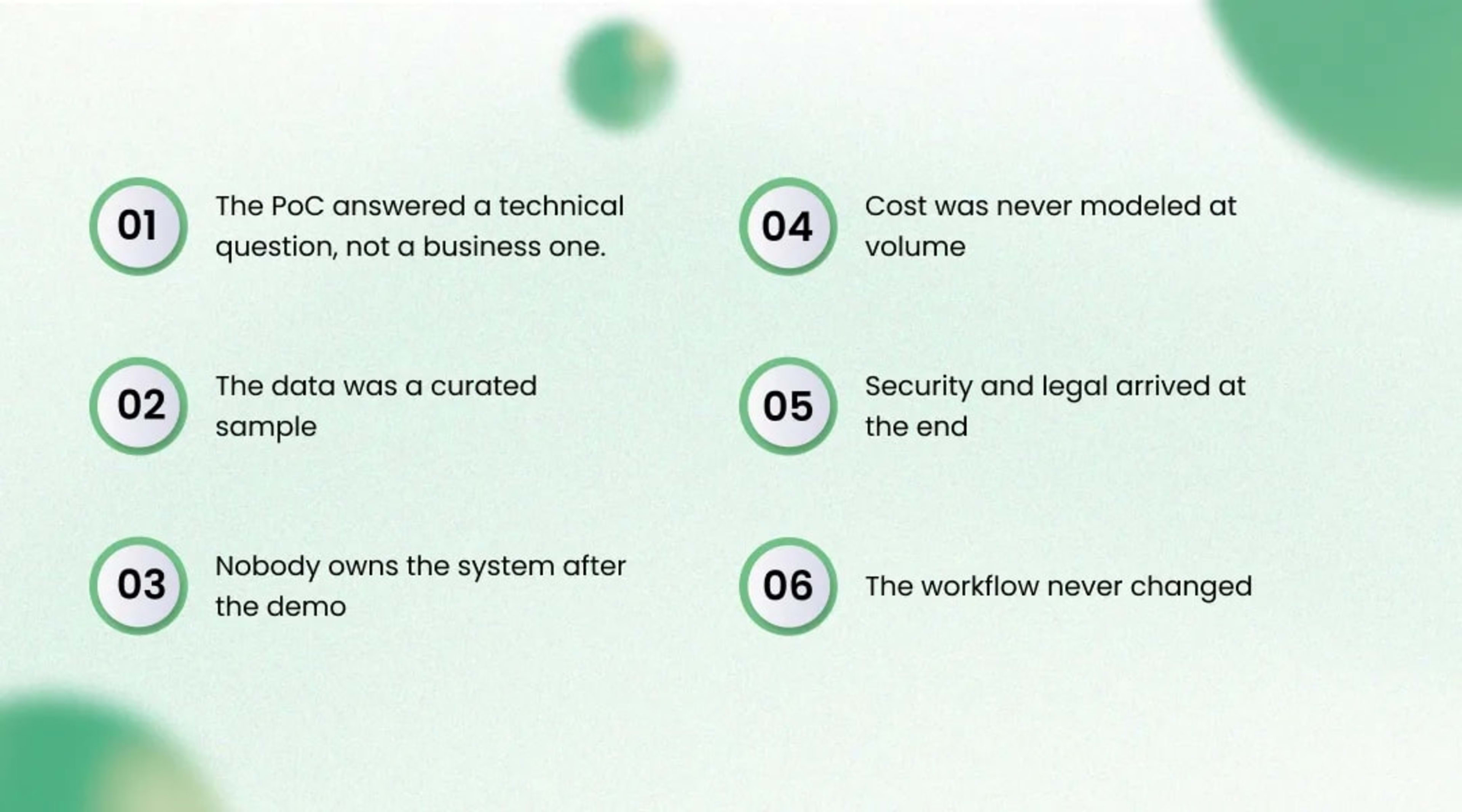
Most AI proofs of concept stall for organizational and operational reasons rather than because the model failed. Gartner predicted in July 2024 that at least 30% of generative AI projects would be abandoned after the proof of concept stage by the end of 2025, pointing to poor data quality, weak risk controls, rising costs, and unclear business value. McKinsey's State of AI 2025 survey shows the other side of the picture: 88% of respondents said their organizations use AI regularly in at least one business function, yet nearly two-thirds had not begun scaling it across the enterprise. Six patterns explain most of the projects that go quiet after a promising demo:
The PoC answered a technical question, not a business one. The team proved a model could extract fields from contracts, but nobody agreed what accuracy level would justify changing the legal review process.
The data was a curated sample. A hand-cleaned extract hides the missing fields, duplicate records, and new document formats that production pipelines deliver every day.
Nobody owns the system after the demo. Data scientists built the PoC, but running it needs platform engineers, a product owner, and an on-call rotation that were never staffed.
Cost was never modeled at volume. A PoC that costs very little in API calls during testing can become a material line item once thousands of employees use it every shift.
Security and legal arrived at the end. Reviews that start after the build often force redesigns around data residency, access controls, or audit logging.
The workflow never changed. If the AI output lives in a separate tab that employees must remember to check, usage tends to fade within weeks regardless of quality.
Only one of these six is about the model itself, and even that one is really about data. That is why the fix lies in process and ownership far more than in a better algorithm. Practitioners call the stuck state pilot purgatory: an endless loop of new experiments that each look promising and none of which ever carry real business load.
How a Production AI System Actually Works
A production AI system is a chain of components around the model that moves data in, checks it, generates an output, applies rules, delivers the result into a business workflow, and watches the whole chain for problems. Most PoCs contain only the model and a notebook, which is why the distance to production surprises so many sponsors. Here is the end-to-end pipeline in the order data flows through it:
Ingestion. Data arrives from source systems such as a CRM, an ERP, a document store, or an event stream through scheduled or real-time pipelines.
Validation and quality checks. Automated rules catch missing fields, schema changes, and out-of-range values before they reach the model.
Context layer. For classic machine learning this is a feature store that serves consistent inputs, and for generative AI it is usually a retrieval index that supplies approved documents, a pattern called retrieval-augmented generation (RAG).
Model serving. A versioned model, pulled from a model registry, runs behind an API endpoint with defined latency and throughput targets.
Guardrails and business rules. Filters block unsafe or off-policy outputs, and deterministic rules handle the cases the business never wants a model to decide alone.
Workflow integration. The output lands where people already work, often with a human-in-the-loop approval step when the stakes are high.
Observability. Logs, traces, and dashboards track quality, latency, cost per request, and model drift, which is the gradual loss of accuracy as real-world data shifts away from what the model learned.
Feedback and retraining. User corrections and outcome data flow back into evaluation sets and, when needed, into retraining or prompt updates.
Each of the five stages below adds more of this chain. A PoC needs steps 3 and 4 plus a basic evaluation, a pilot adds integration and human review, and production requires all eight with someone accountable for each. Keeping this list in view helps sponsors budget accurately, because it shows exactly how much work sits outside the model.
The Five-Stage Roadmap From Use Case to Scale
A dependable AI implementation roadmap moves through five gated stages: use case selection, proof of concept, pilot, production, and scale. Each stage exists to retire one specific risk, and each ends with a recorded decision rather than an assumption that work will simply continue. The table summarizes what each stage is for before the detail that follows.
Stage
1. Use case
Main risk it retires
Solving a problem that is not worth solving
Exit gate
Approved business case with baseline and stop criteria
Accountable owner
Business sponsor
Stage
2. Proof of concept
Main risk it retires
The approach cannot hit the quality bar on real data
Exit gate
Results measured against pre-agreed thresholds
Accountable owner
Technical lead with a business reviewer
Stage
3. Pilot
Main risk it retires
Users will not trust or adopt it
Exit gate
Adoption and outcome targets met in live work
Accountable owner
Product owner
Stage
4. Production
Main risk it retires
It fails under real volume, security, or cost conditions
Exit gate
Service targets, monitoring, and runbooks in place
Accountable owner
Operations or platform owner
Stage
5. Scale
Main risk it retires
Every new use case costs as much as the first
Exit gate
Shared components reused and unit cost falling
Accountable owner
AI platform team or center of excellence
Stage 1: Choose a Use Case Worth Producing
Stage 1 picks one use case that has a measurable business problem, accessible data, and a named owner who will change their process if the AI works. Score every candidate on the same five criteria: business value, data readiness, technical feasibility, regulatory risk, and whether a specific workflow owner is committed. A use case that scores high on value but has no willing workflow owner is a demo waiting to happen.
Two outputs matter more than the scoring itself. The first is a baseline: how long the process takes today, what an error costs, and how often errors happen. The second is a set of stop criteria written before any build, such as an accuracy floor or a cost-per-transaction ceiling, so the team knows in advance what result would end the project.
Consider an insurance claims team that wants to triage incoming claims by complexity. A good Stage 1 output names the claims operations lead as owner, records how long adjusters currently spend routing each claim, and states that the project stops if the model cannot route at least as accurately as the current manual process. That one page of agreement prevents months of argument later.
Stage 2: Run a Proof of Concept Designed to Give a Real Answer
A well-run AI PoC is a time-boxed test of one approach against representative data and thresholds that were agreed before the work began. Representative is the key word, because the evaluation set (sometimes called a golden dataset) should include the ugly cases such as scanned documents, incomplete records, and ambiguous requests, since those are what production will send. The team should also estimate cost per request at expected volume, because an accurate model that costs more than the process it replaces has failed the test.
Keep the build deliberately small. A PoC needs data access, a model or model endpoint, an evaluation harness, and basic logging, and nothing more. Teams that build production infrastructure during the PoC spend the time box on plumbing and arrive at the gate without evidence.
The gate at the end of Stage 2 is a written decision with four possible outcomes: proceed to pilot, proceed with changes, test a different approach, or stop. A stop counts as a successful PoC when it saves the organization from funding a pilot that was never going to work. Sponsors who treat every stop as a failure teach their teams to soften thresholds after the fact.
Stage 3: Pilot the System With Real Users
A pilot puts the validated approach in front of a limited group of real users doing real work, so you learn whether people trust it and whether outcomes improve. This is where integration starts in earnest, because a pilot that lives in a separate interface tests curiosity rather than adoption. The output needs to appear inside the tool the team already uses, whether that is a ticketing queue, a CRM record, or an ERP screen.
Two techniques reduce risk at this stage. Shadow mode runs the AI alongside the existing process without acting on its outputs, which lets you compare its decisions with human ones on live data before anyone relies on it. A limited cohort rollout then lets one team, region, or queue use it for real, with a human approving outputs until the error profile is understood.
Measure the pilot on behavior as much as accuracy. Track how often users accept, edit, or override the AI's output, how long reviews take, and whether the business metric from Stage 1 moves against its baseline. A high override rate is useful information, since it usually points to a gap in the data, a confusing interface, or a case type the model was never shown.
Stage 4: Harden the System for Production
Production is the stage where the system becomes an owned service with performance targets, security controls, monitoring, and a named team that responds when something breaks. The jump from AI pilot to production is mostly engineering and operations work rather than data science. Expect to define latency and availability targets, add fallback behavior for when the model or a vendor API is unavailable, complete security and privacy reviews, and write runbooks so an on-call engineer can diagnose problems at 2 a.m. without the original builder.
Release gradually even at this stage. A canary release sends a small share of traffic to the new version first, and a tested rollback path lets you revert a model or prompt change in minutes rather than days. This is also the moment to decide whether PoC code is kept or rebuilt: code that already runs on target infrastructure with versioned prompts and real access controls can usually stay, while logic that only exists in a notebook with credentials pasted inline is cheaper to rewrite than to patch.
Generative AI adds its own production concerns. Prompts need version control just like code, retrieval quality has to be evaluated alongside answer quality, and token costs can climb quickly once usage grows. Is your use case built on a large language model? Our guide on Deploying LLMs in production goes deeper into those specifics.
Stage 5: Scale the Win Across the Enterprise
Scaling means repeating a proven result in new use cases and business units while the cost and time of each new deployment falls. The first production system usually carries the cost of building pipelines, monitoring, and governance from scratch. To scale an AI project beyond its first team, those components need to become shared services (a common model gateway, evaluation framework, observability stack, and approval process) that the next team can reuse instead of rebuilding.
Many enterprises formalize this through an AI center of excellence, a small team that owns the shared platform and standards while business units own outcomes. The metric that tells you scaling is working is simple: time and cost from approved use case to first production user should drop with each deployment. If every new use case still takes as long as the first, you are running several isolated projects rather than building a capability.
Success Metrics and Governance Gates at Each Stage
Every stage needs both success metrics that prove value and a governance gate that proves the system is safe to advance, and both should be agreed before the stage begins. Metrics without governance produce systems that work until an audit or incident stops them. Governance without metrics produces systems that are safe but never prove they were worth building.
Stage
Use case
Success metrics
Baseline captured, value estimate approved, stop criteria written
Governance gate
Use case risk classified, data access approved in principle
Stage
Proof of concept
Success metrics
Accuracy, precision, or groundedness against thresholds, plus cost per request at projected volume
Governance gate
PoC data handling reviewed, vendor data retention terms checked
Stage
Pilot
Success metrics
Acceptance and override rates, review time, movement in the Stage 1 business metric
Governance gate
Human oversight design approved, fairness checked across relevant user groups
Stage
Production
Success metrics
Latency and availability against targets, incident rate, cost per transaction, business KPI against baseline
Governance gate
Security review passed, audit logging live, rollback tested, owner named
Stage
Scale
Success metrics
Time to deploy new use cases, reuse of shared components, portfolio return
Governance gate
Central registry of models and use cases, periodic review for every live system
A useful structure for the governance column is the NIST AI Risk Management Framework, a voluntary framework from the US National Institute of Standards and Technology first published in January 2023. Its core is organized into four functions: Govern (policies and accountability), Map (understanding the context and risks of each system), Measure (testing and monitoring those risks), and Manage (acting on them). Mapping your stage gates to those functions gives security, legal, and engineering teams a shared vocabulary instead of a last-minute negotiation.
Financial metrics deserve particular care, because AI benefits often show up as avoided costs or faster cycle times rather than new revenue. Agree with finance on how each benefit will be counted, and compare it against the full running cost, including inference, data work, monitoring, and support. For a step-by-step method, see our AI ROI measurement guide.
The Three Workstreams That Decide Most Outcomes

Data readiness, MLOps, and change management run through all five stages, and weakness in any one of them can stall a project that is otherwise on track. They are easy to underfund because none of them produces a visible demo. Treat each as a funded workstream with its own owner from Stage 1 onward.
Data Readiness
Data readiness means the data a use case needs is accessible, representative of production conditions, governed, and maintained by someone accountable for its quality. Gartner predicted in February 2025 that through 2026, organizations will abandon 60% of AI projects that are not supported by AI-ready data. The practical lesson is to audit data during Stage 1 rather than after the PoC succeeds, because a data gap found early costs a conversation while a gap found late costs a rebuild.
Ask four questions about every data source: who owns it, how it is accessed in production (not just exported once), how often its structure changes, and whether it contains personal or regulated information. If the answers are unclear, that uncertainty belongs in the business case as a risk with a cost attached. Security and legal reviewers will ask the same questions later, so collecting the answers early saves a second round of work.
MLOps and LLMOps
MLOps (machine learning operations) is the set of practices that makes deploying, monitoring, and updating models repeatable, much as DevOps did for software releases. LLMOps applies the same discipline to large language model applications, adding version control for prompts, evaluation of retrieval quality, and guardrail testing. Without these practices, every model update becomes a manual, risky event that only the original builder knows how to perform.
At minimum, a production system needs a model or prompt registry with version history, automated evaluation that runs before each release, monitoring for drift and cost, and a rollback path. These rarely need to be built from scratch, since the major cloud platforms offer managed options, and the choice between managed and self-hosted tooling usually comes down to data residency, existing skills, and how many models you expect to run. What matters most is that the practices exist and someone is accountable for them, whichever tools you pick.
Change Management and Adoption
Change management is the work of preparing people to use the system, adjusting roles and incentives around it, and building enough trust that employees act on its outputs. An accurate model that nobody uses delivers no value, and adoption problems often look like technical problems at first glance. When users override most suggestions, the cause may be poor accuracy, but it may just as easily be unclear explanations, missing context, or worry about what the tool means for their job.
Involve the eventual users while designing the pilot instead of waiting until launch. Explain what the system does, what it does not do, and who is accountable when it is wrong, then train people inside the tool they use rather than in a separate session. Track adoption by team so you can see where support is needed, and treat persistent resistance as feedback about the design.
What an AI Roadmap Cannot Do
A staged roadmap reduces the risk of building the wrong thing or deploying it badly, but it cannot guarantee a return, create data that does not exist, or rescue a use case with no real value. Being clear about these limits helps sponsors set honest expectations with their boards. Five limits matter most:
It cannot manufacture value. If the process being automated is rare, cheap, or already fast, a flawless production system still produces a small return.
It cannot replace missing data. When the historical records needed to train or ground a model do not exist, the right move may be to start capturing them and revisit the use case later.
It adds time. Formal gates are worth it for customer-facing or regulated systems, but they can be excessive for a low-risk internal tool, where a lighter path from PoC to pilot is often enough.
It does not freeze the technology. Foundation models and vendor terms change frequently, and a model update can reopen evaluation and governance questions you thought were settled.
It does not resolve organizational politics. A roadmap makes decisions visible, yet someone with authority still has to make them, including the decision to stop a project a senior leader championed.
Agentic AI deserves a specific caution. Gartner predicted in June 2025 that over 40% of agentic AI projects will be canceled by the end of 2027, citing escalating costs, unclear business value, and inadequate risk controls. Systems that take actions on their own need tighter scoping, stronger human oversight, and longer pilots than systems that only recommend, so plan for that instead of assuming the same timeline.
Questions an Executive Sponsor Should Ask at Each Gate
The most useful thing a sponsor can do at each gate is ask a small set of pointed questions and decline to advance until the answers are written down. These questions keep the conversation on evidence rather than enthusiasm. They also signal to the team that a well-reasoned stop decision is welcome.
Before the PoC: What is the baseline, and what result would make us stop?
Before the pilot: Did the PoC pass on representative data, and what will each request cost at real volume?
Before production: Which team runs this at 2 a.m., and how do we roll back a bad release?
Before scaling: Which components will the next use case reuse, and is the business metric still above baseline?
At every gate: What would we do differently if we were starting this stage today?
Build In-House or Work With a Partner?
The right choice depends on how much production AI experience you already have on staff, how quickly you need results, and whether you want to own the capability long term. Building in-house makes sense when you already employ data, platform, and MLOps engineers with spare capacity and the use case sits close to your core product. A partner tends to help most on a first production deployment, on novel use cases, or when the bottleneck is integration and operations skills rather than modeling. Many enterprises combine the two, with a partner leading the first one or two deployments while internal teams take over ownership as the shared platform matures.
A partner is not always the answer. If the use case is a commodity capability such as meeting transcription or standard document OCR, buying an existing product is often faster and cheaper than any custom build. Whichever route you take, make sure evaluation sets, prompts, and documentation stay with your organization so you are never locked into one team's knowledge.
Turning Your Next Proof of Concept Into a Production System
The organizations that move an AI PoC to production reliably treat the transition as its own project, with stages, owners, and decisions, rather than as the last step of an experiment. Start with one use case that has a real baseline and a committed owner, set the stop criteria before anything is built, and fund data, MLOps, and change management as seriously as the model. Then move through each gate on evidence, and be willing to stop when the evidence says so.
Most enterprises reach this point with at least one experiment worth pushing forward. KriraAI builds and deploys production-grade AI systems for enterprise clients across more than 22 industries. If you have a promising pilot that has not yet earned its place in daily operations, explore our AI & Software Development Services to plan and deliver the path to production.
FAQs
An AI proof of concept is a short, time-boxed experiment that tests whether a specific AI approach can meet an agreed quality and cost bar on representative data for one defined use case. Its output is a decision to proceed, revise, or stop rather than a finished product. A good proof of concept sets its success thresholds before any model is built.
A PoC tests whether an AI approach can work technically on real data, usually with a small internal group. A pilot tests whether real users will trust and adopt the system in live work, with the output integrated into their normal tools. The PoC retires technical risk, while the pilot retires adoption and workflow risk.
The timeline depends mostly on data readiness, integration depth, and regulatory review rather than on model complexity. A narrow internal use case with clean, accessible data can move much faster than a customer-facing system connected to several enterprise applications. The most reliable way to estimate is to scope each stage separately during use case selection and revisit the estimate at every gate.
Production usually costs far more than the proof of concept, because spending shifts from a small fixed experiment to ongoing integration, data pipelines, monitoring, security, and usage-based inference. The exact figure depends on volume, model choice, and how much shared infrastructure already exists. Modeling cost per transaction at expected volume during the proof of concept keeps the business case grounded in real economics.
A PoC that ends in a clear stop decision is valuable when it prevents an organization from funding a pilot that would not have worked. It also leaves behind reusable assets such as an evaluation dataset, data access approvals, and a clearer view of where the real bottleneck sits. The only truly wasted PoC is one that ends without a decision.
Teams can sometimes compress the pilot for low-risk internal tools where errors are cheap and easy to reverse. For customer-facing, regulated, or high-volume systems, skipping the pilot usually means discovering adoption and edge-case problems in front of real customers. A short shadow-mode run, where the AI works alongside the existing process without acting, is a reasonable middle ground when time is tight.
Generative AI and large language model projects follow the same five stages, with extra attention to a few areas. Prompts and retrieval sources need version control, outputs need evaluation for groundedness and hallucination, and token costs need close monitoring as usage grows. Guardrails that filter unsafe or off-policy responses should be in place before the pilot begins.
When monitoring shows that quality has fallen, often because real-world data has drifted away from what the model learned, the on-call owner investigates and can roll back to a previous version if needed. The fix may involve retraining, updating prompts or retrieval sources, or adjusting business rules. Systems without drift monitoring tend to degrade quietly until users stop trusting them.
A named business owner should be accountable for the outcome of a live AI system, while an operations or platform team owns reliability, monitoring, and incident response. Data owners remain responsible for the quality of the inputs feeding the system. Without clear ownership, issues fall between teams and the system slowly loses support.
PoC code can often be reused when it already runs on the target infrastructure, reads data through governed access, and keeps prompts and configuration under version control. Code that depends on local files, hardcoded credentials, or logic that exists only in a notebook is usually cheaper to rebuild. Either way, keep the evaluation sets and lessons from the PoC, because they carry forward regardless of the code.
Krushang Mandani is the CTO at KriraAI, driving innovation in AI-powered voice and automation solutions. He shares practical insights on conversational AI, business automation, and scalable tech strategies.