Telecommunications networks generate more operational data per hour than most industries produce in a month. A single mid-sized carrier running a hybrid 4G and 5G infrastructure can stream upward of 14 million telemetry events every sixty minutes across radio access, core, and transport layers. The promise of AI in telecommunications has been discussed at every industry forum for the better part of a decade, yet for most operators, the gap between that promise and operational reality remained wide. That data sat in disconnected systems, partially ingested, partially analysed, and almost never acted on in time to prevent the failures it was predicting. The result was a pattern that any operations leader in this industry knows intimately: engineers chasing alarms that should never have fired, service degradations discovered by customers before they were discovered by the network operations centre, and churn attribution reports landing weeks after the customers they described had already left. KriraAI was engaged by a leading telecommunications enterprise to change that pattern permanently. This blog is a complete account of what we built, how we built it, and what the client achieved once the system went live.
The operational situation at the client when our engagement began was not unusual for a carrier of this scale. It was, however, unsustainable. To modernize this infrastructure, enterprise carriers often deploy custom machine learning development services to replace rigid static rules with adaptive ML models, transforming how the network operations centre handles alarm triage. The monitoring stack at the time consisted of legacy SNMP-based collectors feeding into a rules engine that had been configured, extended, and patched over nearly a decade. That rules engine was generating over 22,000 alerts per day across the client's network, of which an independent audit established that fewer than 11 percent required any human action. The remaining 89 percent were duplicates, correlated noise from cascading failures being reported at every node they touched, or threshold violations that resolved themselves before an engineer could respond.
The consequence of this alert volume was twofold. First, the engineers who were supposed to detect and resolve genuine service-affecting faults were spending the majority of their shift dismissing noise. Mean time to acknowledge a real fault was 47 minutes. Mean time to resolve was over four hours. In a network where service-level agreements guaranteed restoration within 90 minutes for enterprise customers, this was a structural breach risk on any given shift. Second, the psychological fatigue of working in a high-noise environment was producing its own errors. Real faults were occasionally dismissed as noise. Severity assessments were inconsistent between shifts. Escalation patterns depended more on which engineer was on duty than on what the data actually indicated.
On the customer side, the client was operating a churn prediction model that had been built three years earlier by an internal data science team. The model was a gradient-boosted classifier trained on monthly billing aggregates and quarterly service complaint logs. It produced a churn probability score for each subscriber once per week. By the time a high-risk score was generated, the subscriber had typically already called the cancellation line or ported their number. The model was not wrong in any technical sense. Its predictions were accurate relative to the data it could see. The problem was that the data it could see was already historical by the time the model saw it. Network experience signals, the dropped calls, degraded throughput events, repeated reconnections, and elevated packet loss episodes that a subscriber had experienced in the seven days before they decided to leave, were not part of the model's feature space at all.
The commercial pressure amplifying both problems was real. The client was operating in a market with three aggressive competitors, two of whom had publicly announced AI-driven network experience programmes. Customer acquisition costs in the segment were rising. Net promoter scores were declining. The executive team understood that operational efficiency and customer experience were no longer separate conversations. A subscriber who experienced a network degradation, received no proactive communication about it, and later received a churn-risk outreach call that referenced none of it was more likely to accelerate their departure than delay it.
The infrastructure situation added further complexity. The client's data estate was distributed across three separate cloud environments and an on-premises data centre running virtualised network functions alongside physical hardware. Telemetry was being collected by five different vendor monitoring agents, none of which shared a common schema. Subscriber data lived in a CRM platform, a billing system, and a customer care ticketing tool that had been integrated through point-to-point connections built at different times by different teams. There was no unified data layer. There was no shared entity resolution that could reliably connect a network event to the subscriber experiencing it. What existed was a collection of systems that each knew something important and could not communicate it to the others.
KriraAI designed and delivered a unified AI network intelligence platform that operates across two primary capability domains: intelligent fault management and real-time churn propensity scoring. These two domains share a common data foundation and a common serving infrastructure, which was a deliberate architectural decision that prevented the proliferation of siloed AI systems that would have recreated the fragmentation problem in a different form.
The fault management capability is built around a transformer-based encoder model fine-tuned on the client's own alarm history, configuration management database records, and structured incident postmortem data spanning 28 months. The model performs alarm correlation and causal inference simultaneously. When a stream of alarms arrives, the encoder generates contextual embeddings for each alarm that encode not just the alarm attributes but the recent alarm sequence, the topology of the network segment generating it, and the historical resolution patterns for similar sequences. A downstream classification head maps these embeddings to a fault taxonomy with 94 categories, and a separate regression head produces a time-to-impact estimate that drives prioritisation. The system does not replace the network operations centre. It serves a ranked, contextualised fault queue to operations engineers, with each item accompanied by a natural language explanation of the probable root cause and the recommended investigation path.
The churn propensity capability is a real-time scoring system built on a streaming feature computation layer. Every network experience event that can be linked to a subscriber, dropped calls, handover failures, throughput degradations below a defined quality threshold, repeated association failures on 5G NR cells, and elevated retransmission rates on fixed broadband connections, is processed as it arrives and used to update a subscriber-level feature vector maintained in a low-latency online feature store. A graph neural network processes the subscriber feature vector alongside interaction graph data encoding the subscriber's relationship to physical network infrastructure, account tenure, service tier, and recent care interactions. The model produces a churn propensity score that is updated continuously throughout the day and written to a downstream engagement orchestration system. When a subscriber's score crosses a defined threshold, a personalised intervention is triggered automatically, with the intervention channel and message content selected by a secondary model trained on historical retention campaign outcomes.
Both capabilities are served through a model serving layer running quantized model replicas behind an internal gRPC API. The serving infrastructure handles over 4 million scoring requests per day with a p99 latency below 120 milliseconds. The client's existing operations workflows, CRM platform, and care centre tooling consume the platform's outputs through well-defined API contracts, with no requirement for the client to rebuild or replace existing systems.
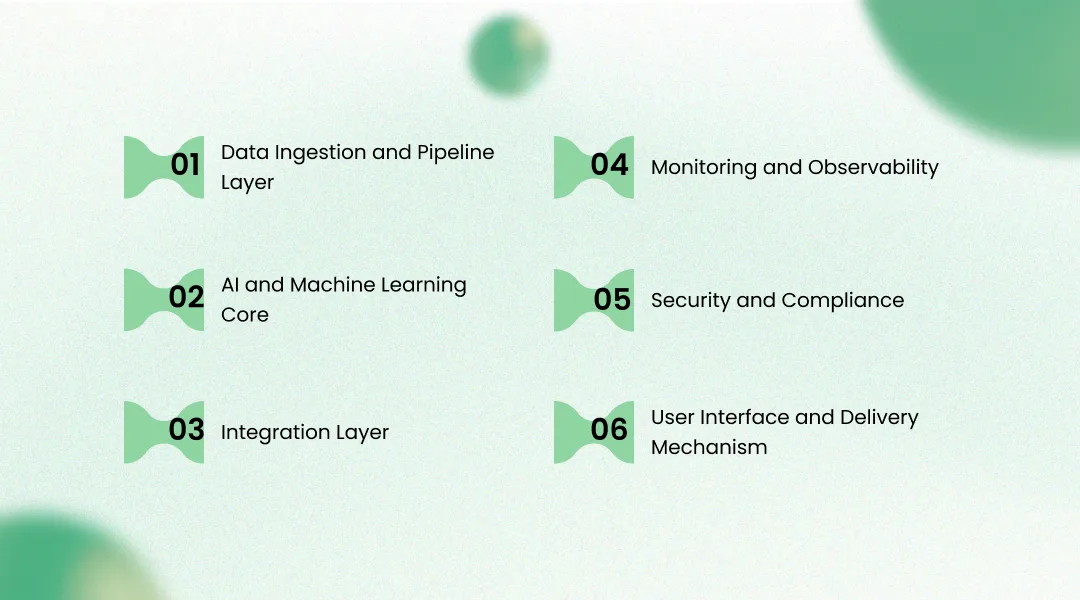
In delivering specialized telecommunications technology solutions, building a resilient ingestion layer is the foundation on which everything else depends, resolving legacy schema fragmentation before model training begins. KriraAI built a multi-source ingestion framework using Apache Kafka as the central event streaming backbone. Five vendor telemetry agents were configured to publish to dedicated Kafka topics using a normalised Avro schema enforced at the producer level through a Confluent Schema Registry instance. This schema enforcement prevented malformed events from entering the pipeline and created a clean audit trail of every event received.
Change data capture from the client's CRM and billing systems was implemented using Debezium, writing subscriber state changes to Kafka topics alongside the network telemetry stream. This enabled the platform to react to subscriber events, such as a plan downgrade or a care escalation, in near real time rather than waiting for a nightly batch extract.
Stream processing was handled by Apache Flink jobs that performed entity resolution, joining network events to subscriber identities through a probabilistic matching layer trained on historical linkage data from the client's network inventory system. Temporal feature engineering was performed at this stage, computing rolling window aggregates, session reconstruction from raw packet-level events, and degradation episode detection using a change point detection algorithm applied to the stream. Processed features were written to two destinations: an offline feature store backed by Apache Iceberg tables on object storage for model training, and an online feature store implemented on Redis Cluster for low-latency serving. Apache Airflow managed the pipeline DAGs for batch reprocessing, model evaluation, and scheduled retraining jobs, with Prefect handling the lighter-weight operational monitoring pipelines.
The fault management model is a BERT-architecture transformer encoder pre-trained on a corpus of 6.8 million alarm records and fine-tuned using supervised learning on 340,000 labelled fault sequences drawn from the client's 28-month incident history. Labelling was performed through a combination of automated extraction from incident tickets and a structured review process with senior network engineers who validated root cause attributions. The fine-tuned encoder produces 768-dimensional contextual embeddings for alarm sequences, which are consumed by a multi-task classification and regression head trained jointly to minimise a combined cross-entropy and mean absolute error loss.
The churn propensity model is a heterogeneous graph neural network implemented in PyTorch Geometric. The graph structure encodes subscribers, physical network cells, service plan nodes, and care interaction nodes as distinct node types, with edges encoding spatial proximity, service subscription, and interaction history. As explored in an analysis covering enterprise generative AI services, node feature vectors are computed from the online feature store at inference time to support scalable deep learning architectures. The model uses a graph attention mechanism to weight the relative importance of different neighbourhood types when computing subscriber-level representations, and produces a scalar churn probability score alongside a feature attribution vector that explains which signals drove the prediction. This attribution vector is used downstream to personalise the intervention messaging.
Both models are served via vLLM-compatible model serving infrastructure with INT8 quantisation applied post-training using NVIDIA TensorRT, reducing serving memory footprint by 61 percent without measurable accuracy degradation on the evaluation set.
The platform integrates with the client's existing systems through an event-driven architecture. Fault queue updates are published to a Kafka topic that the client's network operations centre tooling subscribes to, with no direct coupling between the AI platform and the operations system. This decoupling allowed the operating system vendor to implement their consumer at their own pace without blocking the AI platform deployment.
Churn propensity scores are written to a downstream engagement orchestration system through a REST API with versioned endpoints, enabling the client to evolve their campaign logic independently of the scoring platform. The intervention trigger uses a webhook mechanism to notify the engagement system when a threshold-crossing event occurs, with the subscriber feature attribution payload included in the notification body to drive message personalisation. Internal service communication between the scoring API, the feature store, and the model serving layer uses gRPC with Protocol Buffers, providing strongly typed contracts and sub-millisecond serialisation overhead at the request volumes this system handles.
KriraAI implemented a full MLOps observability layer using a combination of Prometheus, Grafana, and a custom model monitoring framework built in Python. Data drift is tracked continuously using the population stability index computed over rolling 24-hour windows against the training distribution baseline. Feature distribution shift alerts are configured to fire when PSI exceeds 0.2 on any of the 47 features in the churn model's input space, triggering an automated evaluation job that assesses whether the drift has caused measurable degradation against a held-out evaluation set.
Model performance is tracked against a continuously updated held-out evaluation set using precision at top decile for the churn model and macro F1 for the fault classification model. Automated retraining is triggered when performance drops below defined thresholds, with the retraining job consuming the most recent 90 days of labelled data. Serving latency is tracked at p50, p95, and p99 percentiles, with alerting configured on p99 exceedances above 200 milliseconds. All monitoring dashboards are accessible to both the KriraAI delivery team and the client's platform operations group through a shared Grafana instance with role-based access controls.
The entire platform is deployed within a private VPC with no public endpoints. All inter-service communication is encrypted in transit using mutual TLS. Model inputs, intermediate feature vectors, and model outputs containing subscriber-identifiable attributes are encrypted at rest using AES-256 with keys managed through a cloud-native key management service. Role-based access control is implemented at the API gateway layer with attribute-level data masking applied to responses delivered to roles that do not hold subscriber data access permissions, ensuring that operations engineers accessing fault queue data cannot retrieve subscriber PII through the same interface.
Audit logging captures every model inference request, including the requesting service identity, the input feature vector hash, and the output score, and writes these logs to an immutable append-only store. This log structure supports the client's regulatory obligations under applicable data protection frameworks and enables full traceability of every AI-driven decision. The platform architecture was reviewed against the client's internal information security standards and received sign-off from their CISO organization prior to production deployment.
The primary interface for the fault management capability is an enhanced operations console delivered as a web application built on React, consuming the fault queue API. The console presents the ranked fault queue with natural language explanations, topology visualisation of the affected network segment, and a confidence indicator derived from the model's output distribution. For the churn capability, no new interface was required. Propensity scores and intervention triggers are consumed by the client's existing CRM and campaign management platforms, making the AI capability invisible to agents who see only the enriched subscriber profile and the pre-selected intervention recommendation.
The technology decisions in this engagement were made against a clear set of constraints: the client's existing cloud infrastructure was primarily AWS with a secondary Azure footprint, the engineering team had Python expertise but limited MLOps experience, and the operational requirement was for a system that the client could maintain and monitor without KriraAI's ongoing involvement after handover.
Data and pipeline layer: Apache Kafka on Confluent Cloud for event streaming, Debezium for change data capture, Apache Flink on AWS managed service for stream processing, Apache Iceberg on S3 for offline feature storage, Redis Cluster on ElastiCache for online feature serving, Apache Airflow on Amazon MWAA for batch pipeline orchestration, and Prefect Cloud for lightweight operational pipeline management. Kafka was chosen over AWS Kinesis because the client's telemetry agent vendors had native Kafka connectors, eliminating a custom integration layer.
AI and ML layer: PyTorch for model development, Hugging Face Transformers for the BERT encoder baseline and fine-tuning utilities, PyTorch Geometric for the graph neural network, NVIDIA TensorRT for post-training quantization, and vLLM-compatible serving infrastructure on GPU-backed EC2 instances. MLflow was used for experiment tracking and model registry management. The decision to use PyTorch Geometric over DGL for the graph model was driven by the superior integration with the broader PyTorch ecosystem and the maturity of its heterogeneous graph support.
Integration and serving layer: Kong API Gateway for external API management with rate limiting and authentication, gRPC with Protocol Buffers for internal service communication, and a FastAPI application layer wrapping the model serving endpoints for the REST-consuming downstream systems. Terraform managed all infrastructure as code, with CI/CD pipelines running on GitHub Actions.
Monitoring and observability: Prometheus for metrics collection, Grafana for dashboards, a custom Python-based model monitoring service publishing drift and performance metrics to Prometheus, and PagerDuty for alert routing.
Security: AWS KMS for key management, HashiCorp Vault for secrets management across the hybrid cloud boundary, and AWS CloudTrail feeding the immutable audit log store.
The engagement ran across five structured phases over 34 weeks from initial discovery to production handover.
Phase 1: Discovery and Data Assessment (Weeks 1 to 6). The first six weeks were spent entirely on understanding the data estate. KriraAI ran structured interviews with network operations leads, data engineering owners, and CRM platform owners to map every data source, its schema, its quality characteristics, and its accessibility. The most significant finding in this phase was that the client's incident postmortem data, which was essential for training the fault classification model, existed in three separate ticketing systems with inconsistent taxonomy. We dedicated two engineers to a data harmonisation effort that produced a unified incident taxonomy and a retrospective labelling pipeline that processed the 28-month historical archive.
Phase 2: Architecture Design and Validation (Weeks 7 to 10). Following systematic frameworks for deploying custom AI solutions for enterprise growth, the architecture design phase produced detailed technical specifications that were reviewed across platform engineering, security, and operations teams. The most consequential decision made in this phase was to build a single shared data foundation for both the fault management and churn propensity capabilities rather than two separate pipelines. This added complexity to the entity resolution layer but eliminated redundant ingestion infrastructure and created a single source of truth for operational and commercial AI use cases going forward.
Phase 3: Development and Model Training (Weeks 11 to 24). Development proceeded in parallel workstreams. The pipeline team built and validated the ingestion, entity resolution, and feature computation layers in the first eight weeks of this phase. The model team worked against a static training dataset during this period, iterating on the encoder architecture and the graph model. The most challenging issue in this phase was the entity resolution accuracy. Initial linkage between network events and subscriber identities achieved 84 percent recall, which was insufficient for the churn model to produce reliable scores for the bottom quartile of the subscriber base where resolution failures were concentrated. We resolved this by training a dedicated neural entity resolution model on 1.2 million manually verified linkage pairs provided by the client, lifting recall to 97.3 percent.
Phase 4: Integration Testing and Validation (Weeks 25 to 30). Integration testing surfaced a schema versioning conflict between the fault queue Kafka topic and the operations console consumer. The client's operations tooling vendor had implemented their consumer against a draft schema that differed from the production schema in three field definitions. This required a two-week rework of the Schema Registry configuration and a coordinated redeployment with the vendor. A shadow mode deployment ran the AI fault queue in parallel with the existing rules engine for three weeks, with operations engineers reviewing both outputs and providing feedback that was used to recalibrate the severity classification thresholds.
Phase 5: Production Deployment and Handover (Weeks 31 to 34). Production deployment used a blue-green strategy with automated rollback triggers. The handover programme included a structured knowledge transfer to the client's platform engineering team, a complete runbook for operational procedures, and a 90-day support agreement during which KriraAI monitored model performance alongside the client team and responded to any performance degradation events.
The results measured over the first 90 days of full production operation established clear before-and-after states across every target metric.
In fault management, the alert volume reaching operations engineers dropped from 22,000 alerts per day to 3,400 meaningful fault notifications, a reduction of 84.5 percent in actionable queue size. Mean time to acknowledge a real fault fell from 47 minutes to 8 minutes. Mean time to resolve fell from 4.2 hours to 68 minutes, bringing the client within the 90-minute SLA window consistently for the first time in three years. The fault classification model achieved 91.2 percent accuracy on the 94-category taxonomy when evaluated against the held-out test set, and 88.7 percent accuracy as measured by operations engineers reviewing actual production classifications over the first 30 days.
In churn prediction, the shift from weekly batch scoring to continuous real-time scoring reduced the average lag between a subscriber's first network degradation event and the generation of a high-propensity score from 6.4 days to under 90 seconds. Retention campaign conversion rates for subscribers identified by the new model increased by 34 percent compared to the campaign conversion rates for subscribers identified by the previous weekly model, measured over the same 90-day period against a held-out control group. The client's modelling team estimated the incremental revenue impact of the improved retention rate at approximately 2.3 percent of the annual contract value of the subscriber segments targeted, which translated to a material seven-figure improvement in annual recurring revenue.
Operationally, the reduction in alert noise freed the equivalent of 2.1 full-time engineers per shift from alarm triage, allowing the client to redeploy those hours toward proactive network improvement initiatives without adding headcount.
Designed and engineered by KriraAI, the platform was built from the beginning to support a strategic technology roadmap that extends well beyond the initial operational use cases. The shared data foundation, the common entity resolution layer, and the online feature store represent infrastructure that can support additional AI capabilities without requiring a rebuild of the underlying architecture.
The most immediate extension the client is planning is a capacity forecasting capability built on the same streaming telemetry pipeline. A temporal fusion transformer model trained on network utilisation time series will produce 72-hour capacity forecasts at the cell level, enabling proactive spectrum reallocation and infrastructure investment decisions driven by predicted demand rather than observed congestion. The offline feature store's Iceberg table format makes the historical utilisation data immediately available for training without any additional pipeline work.
A second planned extension is an AI-assisted field workforce scheduling system that consumes the fault classification model's output and maps predicted fault resolutions to technician skills, availability, and geographic proximity. This capability will use the existing gRPC integration layer to connect the AI platform to the client's workforce management system, again without requiring new data infrastructure.
For other telecommunications operators looking at this architecture, the most transferable insight is the primacy of the entity resolution layer. Every telecom AI use case that involves connecting network events to subscriber experience depends on the ability to make that connection reliably and at low latency. Building the entity resolution capability as a platform-level service rather than embedding it in individual models is what makes a multi-use-case AI programme economically viable. Companies that skip this step build AI capabilities that are accurate in training and unreliable in production, because the data that reaches the model in production is not the same as the clean, pre-linked data that was used to train it.
The architecture also demonstrates that a shared AI intelligence layer can serve both technical operations and commercial functions simultaneously. Telecom operators that treat network AI and commercial AI as separate programmes will build separate data stacks, separate feature engineering pipelines, and separate model serving infrastructures. The result is higher cost, longer delivery timelines, and missed opportunities to combine network signals and commercial signals in ways that neither programme could achieve alone.
Conclusion: Three insights from this engagement stand out as broadly applicable to any telecommunications operator considering a serious AI programme. The technical insight is that the entity resolution layer is not a preprocessing detail. It is core infrastructure, and its quality directly determines the quality ceiling of every AI capability built on top of it. The operational insight is that AI in network operations succeeds when it augments the engineer's decision-making, not when it attempts to replace it. The fault queue delivered by this platform gives engineers better information faster, and the results reflect that. The strategic insight is that network AI and commercial AI are the same data problem approached from different directions, and operators who build them on a shared foundation will achieve better outcomes at lower cost than those who treat them as separate programmes.
KriraAI brings the same engineering rigour and delivery discipline to every client engagement that this telecommunications project received: a real architecture designed for real production workloads, a delivery process honest about what is hard, and a handover that leaves the client genuinely capable of operating what was built. If you are working through an AI challenge in your organisation and want to talk to a team that will engage with the real complexity rather than simplify it away, bring it to KriraAI.
Based on KriraAI's delivery of this engagement for a leading telecommunications enterprise, a full implementation from initial discovery to production go-live for a platform covering both intelligent fault management and real-time churn propensity scoring takes between 30 and 36 weeks for a carrier with a complex multi-cloud data estate. The timeline is not determined primarily by model development, which typically runs 10 to 14 weeks once training data is prepared, but by the data foundation work that precedes it. Entity resolution across distributed telemetry, CRM, and billing systems, schema normalisation across vendor monitoring agents, and historical data labelling for supervised model training account for the majority of the pre-development timeline. Operators with a more consolidated data estate or a pre-existing data platform can reduce this timeline by 20 to 30 percent, while those with highly fragmented or poorly governed data estates should plan for the longer end of the range and invest accordingly in data quality remediation as a first phase activity.
The most effective approach to telecom network fault detection at enterprise scale combines transformer-based sequence modelling for alarm correlation with a structured fault taxonomy built from historical incident data. Purely rule-based approaches fail because the combinatorial space of alarm sequences in a modern hybrid 4G and 5G network exceeds what any static rule set can cover reliably. Machine learning models trained on raw alarm sequences without domain-structured outputs tend to produce classifications that are difficult for operations engineers to act on. The architecture KriraAI delivered uses a BERT-style encoder fine-tuned on 6.8 million alarm records and 340,000 labelled fault sequences, producing both a fault category classification across 94 taxonomy nodes and a time-to-impact estimate for prioritisation. The key design decision is the joint training of classification and regression heads on a shared encoder, which allows the model to learn representations that support both tasks simultaneously and produces better results than two separately trained models sharing no representation.
Traditional weekly batch churn models in telecommunications operate on aggregated historical data, typically monthly billing summaries, quarterly care interaction counts, and plan change events, that is already several weeks old by the time it reaches the model. This creates a fundamental timing problem: the network experience signals that most strongly predict imminent churn, a sequence of dropped calls, repeated handover failures, and elevated packet loss events, are transient phenomena that occur and resolve within hours or days. A model that sees data weekly cannot detect these signals before the subscriber has already made a departure decision. KriraAI's real-time approach computes subscriber-level feature vectors continuously from a streaming telemetry pipeline using Apache Flink, maintains those vectors in a Redis-backed online feature store, and runs a graph neural network scoring pass that produces an updated propensity score within 90 seconds of any qualifying network experience event. The result, as measured across the first 90 days of production operation for the client in this engagement, was a 34 percent improvement in retention campaign conversion rates compared to the weekly model, attributed directly to the improved timing of intervention triggers.
The operating cost of a production telecom AI platform of the scale described in this engagement, covering model serving infrastructure on GPU-backed cloud instances, stream processing on managed Flink clusters, online and offline feature store infrastructure, and observability tooling, typically falls in the range of 1.8 to 2.6 million USD per year in cloud infrastructure costs depending on subscriber base size and telemetry volume. For the client in this engagement, the incremental annual recurring revenue improvement attributable to the churn model alone was estimated at a seven-figure figure representing approximately 2.3 percent of the targeted subscriber segments' annual contract value, which exceeded the full platform operating cost within the first measurement period. The fault management capability contributed additional ROI through SLA breach avoidance and the reallocation of 2.1 full-time engineer equivalents per shift from alarm triage to proactive network improvement, though the client chose not to quantify this as a direct cost saving. Operators evaluating ROI should build separate business cases for each capability domain and prioritise deployment order based on which domain produces the faster measurable return in their specific commercial context.
Network infrastructure in a modern telecom operator evolves continuously. New cell sites are commissioned, radio access technology generations are mixed, vendor software versions are updated, and subscriber behaviour patterns shift with seasonal demand and external events. Each of these changes can cause the statistical distribution of model inputs to drift away from the training distribution, a phenomenon that degrades model performance over time even when the model itself is unchanged. KriraAI addressed this through a continuous monitoring framework that tracks population stability index across all 47 input features of the churn model and all alarm attribute distributions feeding the fault model, computed over rolling 24-hour windows against the training baseline. When PSI exceeds 0.2 on any monitored dimension, an automated evaluation job runs against a held-out evaluation set and compares current performance to the deployment baseline. If degradation is confirmed, an automated retraining job triggers using the most recent 90 days of labelled operational data, ensuring the model stays calibrated to the current network reality. This design means the platform requires no manual intervention to maintain its performance as the network evolves, which was a explicit requirement given the client's limited MLOps staffing at the time of handover.
Ridham Chovatiya is the COO at KriraAI, driving operational excellence and scalable AI solutions. He specialises in building high-performance teams and delivering impactful, customer-centric technology strategies.