
The AI Layoffs Productivity Paradox Nobody Is Talking About
In the first half of 2026, technology companies eliminated jobs at a pace not seen in years, and they reached for the same explanation almost every time. Artificial intelligence, executives said, had made the work obsolete. By mid-June, layoff trackers counted well over 140,000 tech jobs cut this year, with one analysis putting the average at roughly 1,115 cuts per day, nearly double the pace of the year before. On June 15, TechCrunch described the situation bluntly, warning that the AI layoff wave was becoming a powder keg. This is the visible surface of the AI layoffs productivity paradox, and it is the story almost every news outlet is telling.
There is a second story underneath it, and it is the one regular coverage keeps missing. While companies blame AI for the cuts, a growing body of independent research shows that AI is not actually delivering the productivity gains those cuts assume. A Gartner study of 350 firms found that the companies cutting the most jobs showed no improvement in financial returns. MIT research found that 95 percent of enterprise generative AI initiatives produced zero measurable profit and loss impact. The technology being credited with replacing workers is, in most enterprises, not yet earning back what it costs.
That gap between what AI is blamed for and what AI actually does is the real event here. It is not a story about robots taking jobs, and it is not a story about an AI bubble either. It is something more uncomfortable and more useful to understand. AI has become both a genuine force of workforce change and a convenient cover for decisions that have little to do with technology. Separating those two things is the single most valuable thing a business leader can do right now.
This analysis is written for readers who have seen the layoff headlines and want to understand what is really happening at the intersection of AI and the workforce. We will walk through what the 2026 layoff wave actually looks like, why the productivity data contradicts the official narrative, how enterprise AI really works at the level of tasks and roles, why so much AI spending produces so little return, how the public backlash is hardening into regulation, and what serious organizations should do differently. The value is in the intersection, and the intersection is where most coverage stops.
The Layoffs Are Real, But the Story Companies Are Telling Is Not

The layoffs themselves are not in dispute. Through the first half of 2026, the cuts arrived in a steady rhythm across the technology sector and beyond. What makes this wave different from earlier downturns is not the volume alone but the explanation attached to it, and the financial health of the companies doing the cutting.
This section establishes the facts of the event before we examine the AI claim behind them. Understanding the AI layoffs productivity paradox requires getting the basic numbers right first. The figures below come directly from layoff trackers, earnings disclosures, and reporting published during this period.
The Numbers Behind the 2026 Layoff Wave
The scale of the 2026 cuts is best understood through a handful of concrete data points. Each of the following was reported during the first half of the year and grounds the broader pattern in specifics.
Tech layoffs in 2026 surpassed 140,000 jobs by mid-June, with some trackers counting figures approaching or exceeding 184,000 depending on methodology and scope.
The pace reached roughly 1,115 job cuts per day, close to double the rate recorded across the prior year.
Amazon laid off about 16,000 people in January 2026, only months after cutting roughly 14,000 positions in the autumn of 2025.
Cisco eliminated nearly 4,000 positions in May 2026 while describing a pivot toward its fastest-growing business areas.
Cloudflare's chief executive said plainly that AI had made 1,100 jobs obsolete, even as the company reported record revenue up 34 percent year over year.
Citigroup signaled that automation and AI-enabled systems could allow it to operate with roughly 20,000 fewer employees over time.
ServiceNow cut hundreds of roles in June 2026 as it continued to expand its use of artificial intelligence internally.
These are not the actions of failing businesses trying to survive. Many of the firms making the deepest cuts are posting some of the strongest results in their histories. That contradiction is the heart of the matter.
The Paradox at the Center: Record Profits, Record Cuts
The defining feature of this layoff wave is simultaneity. The same companies announcing job cuts are also announcing record profits and record investment in AI infrastructure. Four hyperscalers, namely Amazon, Microsoft, Alphabet, and Meta, committed to a combined 700 billion dollars in capital expenditure for 2026, close to double what they spent the year before. Amazon alone pledged around 200 billion dollars, while Alphabet revised its guidance into the range of 175 to 190 billion dollars.
When a profitable company cuts workers and points to AI, two very different things can be true. The first is that AI genuinely automated some portion of the work, and the role was no longer needed. The second is that the company wanted to reduce headcount for ordinary financial reasons and found AI a more palatable thing to blame. Both happen, often inside the same organization, and the public narrative rarely distinguishes between them.
There is direct evidence that some AI-attributed cuts were not really about AI at all. Block, the financial services company, announced layoffs affecting roughly 4,000 employees while projecting gross profits near 12 billion dollars for 2026. Its leadership indicated that the cuts were not fundamentally driven by artificial intelligence, despite the broader industry framing. When the people cutting jobs quietly admit AI was not the cause, the official story deserves scrutiny.
This is where AI-driven job displacement becomes difficult to measure honestly. The label gets applied to layoffs that AI caused, layoffs that AI merely accompanied, and layoffs that would have happened in any economic cycle. Treating all three as the same phenomenon produces a distorted picture of what the technology is actually doing to work.
[Image placeholder: chart showing 2026 tech layoffs by month alongside hyperscaler AI capital expenditure]
The AI Layoffs Productivity Paradox: What the Data Actually Shows
If AI were delivering the productivity revolution that justifies cutting hundreds of thousands of jobs, the financial returns would show it. This is the analytical center of the entire story, and it is where the official narrative breaks down most clearly. The data on enterprise AI returns does not support the idea that AI is currently replacing workers at scale with comparable output.
The AI layoffs productivity paradox is the contradiction between two claims that cannot both be fully true. Companies say AI is productive enough to replace workers. Independent research says AI is not yet productive enough to show up in the numbers. Understanding why both statements coexist requires looking carefully at the evidence on enterprise AI ROI.
The 95 Percent Problem
The most cited figure in this debate comes from MIT research finding that roughly 95 percent of enterprise generative AI initiatives produced no measurable profit or loss impact. That number is not an argument that AI is useless. It is an argument that deploying AI and capturing value from AI are very different achievements. Most organizations have done the first and not the second.
Other independent measurements point in the same direction. S&P Global found that 42 percent of companies abandoned most of their AI projects in 2025, more than double the prior year. An IBM study of chief executives found only about 25 percent of initiatives delivering the ROI that had been expected, with a majority of leaders reporting no significant financial benefit. Morgan Stanley found that only around 21 percent of companies in the S&P 500 could cite a measurable AI benefit at all.
These findings are striking precisely because they come during a period of enormous AI spending. Average enterprise AI spend is projected to rise roughly 65 percent, from about 7 million dollars in 2025 to around 11.6 million dollars in 2026. Spending is accelerating while proof of return remains scarce. The money is real, and the measurable payoff mostly is not, at least not yet.
When the Cuts Do Not Pay Off
The clearest contradiction of the layoff narrative is that the cuts themselves often fail to improve results. A Gartner study of 350 firms in 2026 found that the companies cutting the most jobs showed no improvement in financial returns. If AI were truly replacing the work, cutting the workers who did that work should have lifted margins. In aggregate, it did not.
This aligns with a broader pattern that researchers have flagged repeatedly. Cutting workers in anticipation of future AI efficiency is not the same as achieving that efficiency. A company can eliminate a role today on the bet that an AI system will cover it tomorrow, and then discover the system covers perhaps 60 percent of what the person did. The remaining work does not disappear. It gets absorbed, deferred, or quietly outsourced, and the savings shrink.
At KriraAI, we see this pattern often when organizations come to us after an AI initiative has stalled. The technology was deployed, the headcount was reduced, and the expected gains never materialized because the work was never fully understood before it was automated. The productivity paradox is rarely a failure of the model. It is almost always a failure to map the actual work the model was meant to replace.
How Enterprise AI Actually Works, and Why It Rarely Replaces a Whole Job
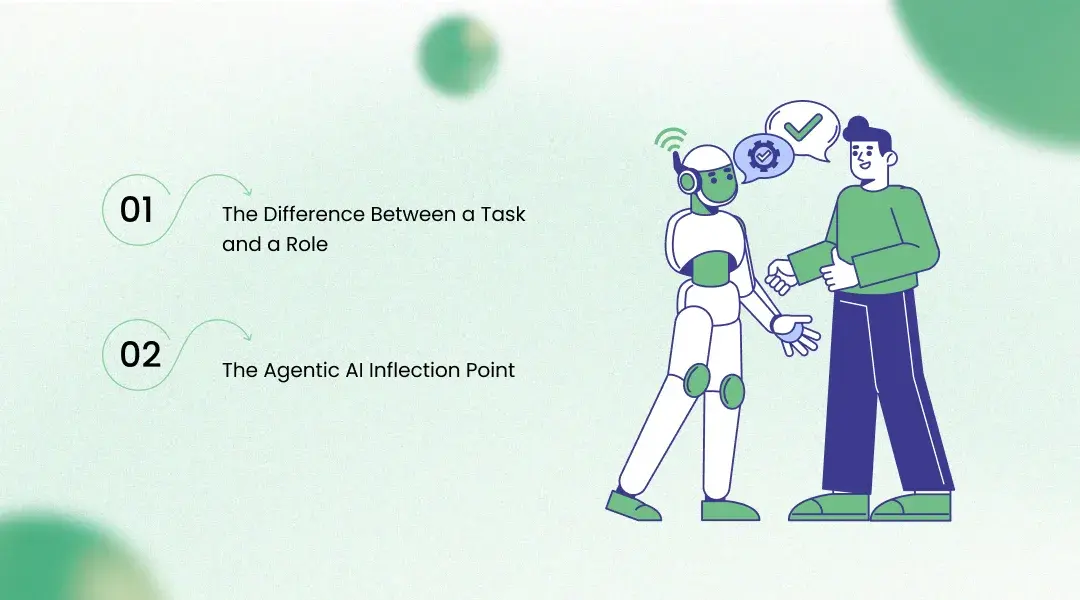
To understand why AI delivers task-level help but seldom whole job replacement, it helps to be precise about what current systems do well. Modern AI is extraordinarily capable at bounded, well-defined tasks with clear inputs and outputs. It is far weaker at the open-ended, context-heavy, accountability-bearing work that fills most actual jobs.
A job is not a single task. It is a bundle of dozens of tasks, plus judgment, relationships, institutional memory, and responsibility for outcomes. AI can take real bites out of that bundle, and those bites are genuine productivity. The mistake is assuming that automating part of a role means the role can be eliminated without consequence.
The Difference Between a Task and a Role
Consider a software engineer, the category most affected by the 2026 cuts. Stanford data showed employment for software developers under the age of 26 fell nearly 20 percent since 2024. AI coding tools are genuinely good at generating functions, fixing bugs, and writing tests. Those are tasks, and AI does them quickly.
The role of an engineer, though, includes far more than writing code. It includes deciding what to build, understanding why the last attempt failed, negotiating tradeoffs with other teams, and owning the consequences when a system breaks at three in the morning. AI can assist with all of these and replace almost none of them outright. When a company removes the junior engineers who would have grown into that judgment, it captures a short-term saving and creates a long-term capability gap.
This is the precise mechanism behind much AI-driven job displacement in 2026. Tasks are being automated, early career roles built mostly of those tasks are being cut, and the senior judgment that those roles were supposed to develop is being quietly starved. The technology is real, the displacement is real, and the strategic cost is being deferred rather than avoided.
The Agentic AI Inflection Point
The newest development complicating this picture is the rise of agentic AI. In Futurum's 2026 survey of 830 IT decision makers, autonomous and agentic AI surged to the top technology priority, growing roughly 31.5 percent year over year and becoming the fastest-growing category. An agentic AI workforce, meaning AI systems that can plan, take actions, and chain multiple steps together, is what many executives now imagine when they justify cuts.
An agentic AI workforce promises that it does not just assist with tasks but executes whole workflows independently. That promise is partly real and partly premature. Agentic systems today can handle structured, repeatable processes with reasonable reliability, but they still struggle with ambiguity, exceptions, and the kind of judgment that defines high-stakes work. Building an agentic AI workforce that genuinely replaces human roles requires far more engineering, governance, and integration than most layoff announcements imply.
The danger is that the word agentic is being used as a justification ahead of the capability. Companies are cutting now and assuming the agentic AI workforce will fill the gap soon. When the gap persists, the productivity paradox deepens, and the people who were let go are not there to do the work the agents cannot.
[Image placeholder: diagram contrasting task automation versus full role replacement across a typical knowledge worker job]
Why So Much AI Spend Produces So Little Return
If individual AI tools genuinely boost productivity, why does enterprise AI ROI remain so elusive at the organizational level? This is one of the most important questions in business technology today, and the answer is not that AI does not work. The answer is that value capture depends on layers of work that most organizations skip.
Research consistently finds that the technology is rarely the bottleneck. Roughly 80 percent of the effort required to move an AI pilot into production is data engineering, governance, workflow integration, and measurement infrastructure. Companies buy the model and skip the plumbing, then wonder why the returns never arrive.
The Pilot-to-Production Gap
Most AI pilots are designed to impress, not to last. They are launched without predefined success criteria, which means there is no way to declare success even if the technology performs perfectly. Usage becomes the metric because usage is easy to count. How many employees logged in, how many hours were spent, hand ow many teams gained access. None of those numbers answers the only question that matters, which is whether the AI produced better outcomes than what it replaced.
This is why so many enterprise AI ROI claims dissolve under scrutiny. A productivity gain of five times for an individual super user is real, but it does not automatically become an organizational return. The gains stay trapped at the individual level because the surrounding processes, incentives, and measurement systems were never rebuilt to compound them.
The companies that do capture returns share a common pattern. They build the data foundation, the governance, and the measurement layer before they scale. KriraAI builds production AI systems for enterprises with exactly this sequence in mind, because the difference between a flashy pilot and a durable return is rarely the model itself.
The Hidden Cost of Ungoverned AI
There is also a cost side to the paradox that rarely makes the headlines. As enterprises moved to token-based billing in 2026, a phenomenon nicknamed AI sticker shock arrived in finance departments. A wave of reporting in late May described corporate leaders confronting ballooning token bills and uncertain productivity gains at the same time.
The cost can spiral quietly. When employees are told to use AI as much as possible, and when the true per-query cost is hidden from them, usage becomes economically irrational. One company reportedly spent 500 million dollars in a single month after failing to set usage limits. Ungoverned consumption, sometimes called tokenmaxxing, turns a promising tool into a runaway expense.
Agentic systems make this worse because they can autonomously trigger additional model calls without a human deciding each one. Without unit economics and governance, an agentic AI workforce can generate costs as fast as it generates output. This is precisely why responsible AI deployment has to include spend governance from the start, not as an afterthought once the bills arrive.
The result is a double squeeze on enterprise AI ROI. Returns are hard to capture, and costs are easy to lose control of. A company can be both underwhelmed by the productivity and overwhelmed by the bill, which is the worst possible position to be in when defending an AI strategy to a board.
The Backlash Is Becoming a Political and Regulatory Force
The AI layoffs productivity paradox is not just an economic story. It is rapidly becoming a political one, and the regulatory consequences are arriving faster than many companies expected. Public sentiment toward AI has turned sharply negative, and policymakers are responding.
The polling is stark. An NBC News survey in June 2026 found that 57 percent of respondents believed the risks of AI outweighed the benefits. A Quinnipiac poll found that around 80 percent of Americans are concerned about AI, 70 percent expect it to reduce job opportunities, and 76 percent say businesses are not transparent enough about how they use it. Across age groups, including younger adults, a clear majority believes AI is moving too fast.
This sentiment is hardening into policy. The following regulatory developments emerged during this period and signal where the rules are heading.
California Governor Gavin Newsom signed Executive Order N-6-26 on May 21, 2026, directing the state's Labor and Workforce Development Agency to review the Worker Adjustment and Retraining Notification Act for AI-driven displacement, with a 180-day deadline.
California's proposed SB 951, the Worker Technological Displacement Act, would require 90 days of advance notice before AI-driven layoffs and specific disclosure of which AI systems were involved.
Colorado's AI Act takes effect on June 30, 2026, requiring employers to guard against algorithmic discrimination in employment decisions.
As of mid 2026, no federal law requires employers to disclose whether AI played a role in a given layoff, leaving a transparency gap that states are now racing to fill.
The political framing is sharpening too. The California Labor Federation's president described catastrophic AI job loss not as inevitable but as a political choice. Meanwhile, prominent technology figures including Jeff Bezos and Elon Musk have floated ideas such as universal high income and universal basic compute to soften the social impact of automation. Critics note that these proposals address public anger without addressing the underlying lack of labor protections, transparency, or limits on deployment.
For businesses, the message is direct. The era in which a company could cite AI for a layoff with no disclosure and no scrutiny is ending. Responsible AI deployment now includes anticipating disclosure requirements, documenting what AI actually does, and being able to defend the claim that a role was genuinely automated rather than simply eliminated.
[Image placeholder: timeline of 2026 AI labor regulations and major public opinion polls]
What Business Leaders Should Actually Do With This Moment
The strategic question for leaders is not whether to use AI. It is how to use it in a way that produces real returns rather than borrowed headlines. The paradox creates a genuine opportunity for organizations willing to do the harder, less glamorous work that most competitors are skipping.
The companies pulling ahead are not buying better models than everyone else. They are building the foundation that turns models into outcomes. Based on the patterns visible across the 2026 data, the following actions separate the organizations capturing enterprise AI ROI from those stuck in the paradox.
Map the actual work before automating it, distinguishing the specific tasks AI can handle from the judgment and accountability that a full role carries.
Define measurable success criteria tied to profit and loss before any pilot launches, so that success or failure can be honestly declared.
Invest in the unglamorous layers of data engineering, governance, and integration, which account for roughly 80 percent of the work between a pilot and a real return.
Install AI spend governance and unit economics from day one, treating token consumption the way mature organizations treat cloud cost.
Protect the early career pipeline, because cutting the junior roles that develop senior judgment trades a small saving today for a capability crisis later.
Be transparent and accurate about where AI is genuinely used, both to build internal trust and to prepare for the disclosure rules now arriving.
None of these steps is about resisting AI. They are about deploying it seriously. The organizations that treat AI as a system to be engineered rather than a story to be told are the ones that will still be standing when the paradox resolves.
This is the work KriraAI does with enterprise clients every day. We help organizations cut through the narrative and answer the only question that matters, which is whether a given AI deployment will actually produce more value than it costs. Responsible AI deployment is not a slogan to us. It is the difference between an AI program that survives a budget review and one that becomes next year's abandoned project.
What Comes Next for AI and the Workforce
The current paradox is unstable, and it will resolve in one of a few directions over the next 18 to 24 months. None of them looks exactly like the present, and understanding the trajectory helps leaders position for what is coming rather than what is being announced.
The most likely path is convergence. As governance, measurement, and integration mature, a portion of the AI productivity that is currently invisible will start showing up in real financial returns. At the same time, the layoffs that were never really about AI will become harder to disguise as disclosure rules take effect. The two stories that are currently tangled together will begin to separate.
The agentic AI workforce will be central to how this plays out. If agentic systems become reliable enough to own whole workflows, the displacement that companies are currently anticipating could become real, and the productivity paradox would narrow from the capability side. If agentic reliability stalls, the gap between what was cut and what can be automated will widen, and some companies will quietly rehire for the judgment they eliminated. Either way, the organizations that built strong foundations will adapt faster than those that simply slashed headcount.
There is also a trust dimension that will shape adoption for years. The public backlash is not primarily about the technology being bad. It is about a future being imposed without consent, transparency, or shared benefit. Companies that deploy AI in ways that are honest, well governed, and genuinely additive will earn the social license to keep going. Those who use AI mainly as a justification for cuts will face rising regulatory friction and falling public trust.
The single safest prediction is that the gap between AI spending and AI proof cannot persist indefinitely. At some point, boards and CFOs stop accepting usage metrics and demand returns. The companies that prepared for that moment by building real enterprise AI ROI will accelerate. The companies that mistook a narrative for a strategy will face a reckoning, and 2026 is when that reckoning began.
Conclusion
Three insights matter most from this analysis, and together they reframe how to think about AI and the workforce in 2026. The first is that the 2026 layoffs are real, but the AI explanation attached to them frequently is not, because companies are blending genuine automation with ordinary cost-cutting under a single convenient label. The second is that the productivity does not yet match the narrative, with MIT finding 95 percent of enterprise AI initiatives producing no measurable return and Gartner finding the biggest job cutters seeing no improvement in results. The third is that the AI layoffs productivity paradox is resolving into regulation and public backlash, making transparency and genuine value capture a business necessity rather than a virtue.
These insights point to a broader truth about AI development and deployment at this moment. The technology is powerful and genuinely transformative at the task level, yet the gap between AI spending and AI proof remains the defining tension of the cycle. Organizations that mistake adoption for value, or narrative for strategy, are accumulating risk they have not yet recognized. Organizations that build real foundations are quietly pulling ahead while the headlines focus elsewhere.
This is exactly the terrain KriraAI was built for. We help organizations understand the AI developments that current events are accelerating and revealing, separating what AI genuinely does from what it is merely being blamed or credited for. KriraAI builds production AI systems designed for the real world with all its complexity, where value depends on data, governance, measurement, and honest accounting rather than on hype. Responsible AI deployment, in our work, means systems that survive a budget review and a regulator's question, not just a launch announcement.
If your organization is navigating the AI landscape that these current events are shaping, and you want to capture real returns instead of repeating the paradox playing out across the industry, we invite you to explore how KriraAI can help you deploy AI that actually works. The companies that read this moment correctly will define the next decade. The advantage belongs to those who understand both the technology and the truth behind the headlines.
FAQs
Both are happening, often within the same company, which is why the AI layoffs productivity paradox is so confusing. In some cases, AI genuinely automated specific tasks and reduced the need for certain roles. In other cases, companies wanted to cut headcount for ordinary financial reasons and found AI a more acceptable explanation than admitting to overhiring or weak demand. Evidence supports this dual reality. Block, for example, cut roughly 4,000 jobs while projecting around 12 billion dollars in gross profit, and its leadership indicated the cuts were not fundamentally about AI. Treating every AI-attributed layoff as genuinely AI-caused produces a misleading picture of what the technology is actually doing to employment in 2026.
Enterprise AI ROI remains elusive because deploying AI and capturing value from AI are very different achievements, and most organizations have only done the first. MIT research found that about 95 percent of enterprise generative AI initiatives produced no measurable profit and loss impact, while S&P Global found 42 percent of companies abandoned most AI projects in 2025. The core issue is rarely the model itself. Roughly 80 percent of the work needed to move from pilot to production is data engineering, governance, workflow integration, and measurement, and companies routinely skip these layers. Without predefined success criteria and the infrastructure to compound individual gains into organizational returns, even genuinely useful AI tools fail to show up in the financial results.
The roles most exposed to AI-driven job displacement in 2026 are those built primarily from bounded, repeatable tasks, particularly early career and entry-level positions. Software development is a clear example, with Stanford data showing employment for developers under 26 falling nearly 20 percent since 2024, because AI coding tools handle many junior-level tasks efficiently. Customer service, data entry, basic content production, and routine middle office work are similarly exposed. The pattern matters more than any single job title. AI takes the largest bites out of roles that are mostly task execution, while roles that center on judgment, relationships, and accountability remain far harder to automate, even when individual tasks within them can be assisted by AI.
Often they do not, at least not as much as expected, which is the most counterintuitive part of the productivity paradox. A 2026 Gartner study of 350 firms found that the companies cutting the most jobs showed no improvement in financial returns. The reason is that cutting workers in anticipation of AI efficiency is not the same as achieving that efficiency. When an AI system covers only part of what a person did, the remaining work gets absorbed, deferred, or outsourced, eroding the projected savings. Costs can also spiral on the AI side, with token billing producing real overruns, including a reported case of 500 million dollars spent in a single month. Without governance and honest measurement, the savings frequently fail to materialize.
Businesses should treat AI as a system to be engineered rather than a story to be told, which means investing in the foundations that most competitors skip. The organizations capturing real enterprise AI ROI map the actual work before automating it, define profit and loss linked to success criteria before launching pilots, and build the data, governance, and measurement layers that convert individual productivity into organizational return. They also install spend governance early to avoid runaway token costs and protect the early career pipeline that develops senior judgment. Responsible AI deployment combines genuine capability with honest measurement and transparency. This is precisely the work KriraAI does with enterprise clients, helping them deploy AI that produces durable value instead of borrowed headlines.
Founder & CEO
Divyang Mandani is the CEO of KriraAI, driving innovative AI and IT solutions with a focus on transformative technology, ethical AI, and impactful digital strategies for businesses worldwide.