
AI in Telecommunications: Why Cautious Operators Lose Ground
The average telecom operator loses somewhere between fifteen and twenty-five percent of annual revenue to a familiar trio. That trio is network inefficiency, subscriber churn, and fraud. Those losses are not accounting noise. They are the gap between a carrier that grows and one that quietly shrinks. This is exactly the gap that AI in telecommunications is now built to close.
AI in telecommunications has moved out of innovation slide decks and into profit and loss statements. The operators pulling ahead are not the ones with the flashiest labs. They are the ones treating artificial intelligence as core infrastructure, not a side experiment. This blog takes a deliberately unfashionable position on the topic. Caution in this sector is now more expensive than action itself.
That claim deserves evidence, not just assertion, so this guide is built to prove it. Below, we break down the current state of the industry and the specific technologies changing it. We cover the measurable business impact, a realistic implementation roadmap, and the honest limitations. We then project where the next three to five years are heading for every operator.
The State of Telecommunications Before AI Enters the Picture
Telecommunications is a strange business. It sells something invisible that everyone assumes will simply work. Margins are thin, capital costs are enormous, and customer patience is thinner still. The industry has spent two decades building networks faster than it has learned to run them efficiently. Operators sit on some of the largest datasets on earth. Every call, session, and cell handover generates a signal. Yet most carriers use only a fraction of that data for real decisions, highlighting the growing need for AI solutions for telecommunications. The information exists, but the insight does not follow automatically. This is the central inefficiency of modern telecom.
Cost pressure makes the problem urgent rather than academic. Building and maintaining networks consumes vast capital every year. Energy alone often accounts for a meaningful slice of total operating cost. Field maintenance, tower visits, and equipment replacement stack on top of that. When a base station fails without warning, the cost is both repair and lost service.
Competitive dynamics have grown harsher over the last decade. Voice and messaging revenue collapsed as over-the-top apps took over communication. Data became the product, and data is close to a commodity. Subscribers now compare carriers on price, coverage, and support with little brand loyalty.
Why Churn Quietly Eats Telecom Margins
Churn is the wound that never fully heals in this sector. Acquiring a new subscriber typically costs five to seven times more than keeping an existing one. Yet many operators still spend more on acquisition than retention. Every lost customer erases months of accumulated margin in a single cancellation.
The traditional response to churn has been reactive and blunt. Retention teams call customers only after they signal an intent to leave. By then, the decision is usually made, and the discount is wasted. Manual analysis simply cannot process millions of behavioral signals in time. This is where the old operating model runs out of road.
How AI in Telecommunications Is Rebuilding the Network
AI in telecommunications is not a single tool. It is a set of technologies, each an AI solution for the telecommunications industry applied to a specific and expensive problem. Organizations investing in these technologies are using machine learning, predictive analytics, and automation to improve network performance and customer experience.
Machine learning handles pattern and prediction problems at scale. Natural language processing (NLP) services handle the flood of human conversation across support channels, enabling AI to understand customer intent, automate responses, and improve support efficiency. Computer vision handles physical inspection of infrastructure. Predictive analytics forecasts demand and failure before either arrives. Generative AI now sits on top of all of these, helping engineers and agents act faster.
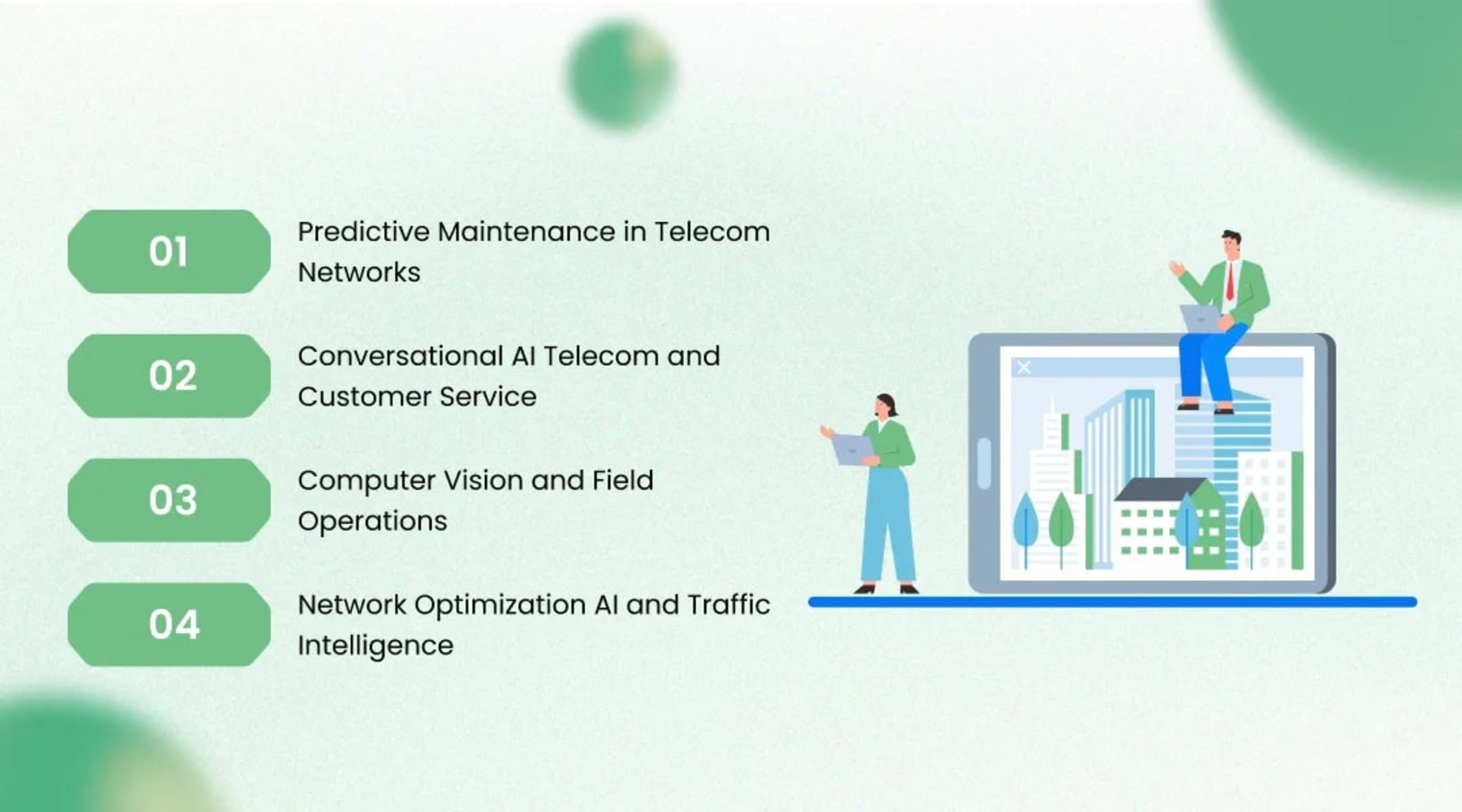
Predictive Maintenance in Telecom Networks
Predictive maintenance in telecom is one of the clearest wins available today. Machine learning models watch equipment telemetry continuously. They learn the normal behavior of a base station or router. When readings drift toward a known failure pattern, the system flags it early. This turns surprise outages into scheduled, low-cost repairs.
The financial logic here is simple and hard to argue with. Predictive maintenance in telecom can cut unplanned network downtime by roughly thirty to forty percent. Fewer emergency truck rolls mean lower field costs and less overtime. Uptime rises, complaints fall, and engineers stop firefighting. That is a compounding operational gain, not a one-time saving.
Conversational AI Telecom and Customer Service
Conversational AI telecom systems now handle the front line of support. Natural language processing lets a virtual agent understand a customer in plain speech. It reads intent, checks account context, and resolves the request without a queue. Modern conversational AI telecom deployments can resolve fifty to seventy percent of routine queries automatically. That frees human agents for the complex cases that actually need judgment.
The point is not to replace people to cut headcount. The point is to remove repetitive load so that quality rises. When wait times shrink, satisfaction climbs, and churn intent softens. This is where customer experience and cost reduction stop competing. They start reinforcing each other instead.
Computer Vision and Field Operations
Computer vision brings physical infrastructure into the AI picture. Drones and cameras capture images of towers, cables, and antennas at scale. Vision models then inspect those images for rust, damage, or misalignment. This replaces slow, risky, and inconsistent manual inspection.
A human inspector might climb a handful of towers in a day. A drone equipped with vision models can survey many more safely. The model flags only the assets that need a real engineer. That focuses expensive labor where it genuinely matters most.
Network Optimization AI and Traffic Intelligence
Network optimization AI is the technology with the widest reach across a carrier. Demand shifts constantly across time, geography, and events. Predictive analytics forecasts traffic before it hits the network. The system can then shift capacity and reroute load automatically.
This is where 5G raises the stakes dramatically. 5G networks are far denser and more complex than 4G ever was. Cell counts multiply, and manual tuning becomes physically impossible. Network optimization AI manages this complexity through so-called self-organizing networks. These systems tune themselves in near real time, which no human team can match. KriraAI builds exactly this class of production-grade optimization systems for enterprise network operators, focusing on measurable throughput and energy gains rather than lab demonstrations.
The Quantified Business Impact of AI Adoption

Executives do not fund technology because it is interesting. They fund it because the numbers move. AI in telecommunications delivers value across three measurable dimensions. Those dimensions are cost, revenue, and experience. Each one shows up in figures a finance team can verify.
On the cost side, the savings are structural rather than cosmetic. Network optimization AI can reduce network energy consumption by fifteen to twenty percent. Given that energy is a major operating expense, that number is large. Predictive maintenance trims field costs by reducing emergency call-outs sharply. Automated support cuts the cost per resolved contact substantially.
On the revenue side, retention is the headline story. Telecom customer churn prediction models identify at-risk subscribers weeks before they leave. Acting on those signals early can lift retention by ten to fifteen percent. Since retention is far cheaper than acquisition, that gain flows straight to margin. Better targeting also raises the success rate of upsell and cross-sell offers.
Where the Numbers Come From
The impact figures above are not magic. They come from removing waste that manual operations could never catch. A model reviewing millions of records finds patterns humans miss. It acts on them at a speed no team can replicate. That combination of scale and speed is the entire source of the return.
There is also a compounding effect worth naming clearly. Fraud detection systems now flag suspicious activity in real time rather than after settlement. Telecom fraud costs the global industry tens of billions of dollars every year. Catching even a fraction of that early protects both revenue and trust. When several AI systems run together, their gains stack rather than merely add.
The Experience Dividend
The third dimension of impact is the hardest to price but the easiest to feel. Customer experience improves when problems are solved before subscribers notice them. Predictive maintenance in telecom prevents the outage that would have triggered an angry call. Network optimization AI keeps speeds steady during peak demand and major events. Conversational AI telecom systems resolve issues in seconds rather than long queues.
Each of these effects reduces the friction that quietly drives people to switch carriers. A subscriber who never experiences a dropped call has less reason to leave. This is why experience and retention are the same story told twice. Better service lowers churn, and lower churn protects the revenue base directly. In a commodity market, experience is often the only durable differentiator left.
A Practical Implementation Roadmap for Telecom Operators
Adopting AI in telecommunications fails most often for one reason. Operators try to boil the ocean instead of proving one use case. A disciplined roadmap avoids that trap. It moves from readiness to pilot to scale in clear, funded stages.
The roadmap below reflects how successful carriers actually sequence their work. Each stage has a defined outcome and a gate before the next. This prevents the endless proof-of-concept loop that wastes budgets. KriraAI structures enterprise AI programs around exactly this staged model, so every phase produces a measurable result before more capital is committed.
Begin with a data and readiness audit across your key systems. This step maps where usable data lives and where it is broken.
Select a single high-value use case with a clear metric. Churn prediction or predictive maintenance is a strong first choice.
Successful pilots should be designed for production from day one rather than remaining isolated experiments, an approach discussed in The Future of Generative AI Development for Enterprises.
Integrate the winning pilot into live operations with proper monitoring. A model that is not monitored will quietly decay over time.
Scale horizontally to adjacent use cases once the first proves value. Reuse the data pipelines and governance you already built.
Establish an ongoing retraining and governance loop as a permanent function. AI is a living system, not a one-time installation.
Common Mistakes and How to Avoid Them
The most common mistake is starting with the technology, not the problem. Teams buy a platform and then hunt for a use case. That order guarantees weak adoption and murky return. Always anchor the first project to a metric your CFO already cares about.
The second mistake is underestimating the data quality effort. Most telecom data is messy, siloed, and inconsistently labeled. Leaders assume the model is the hard part, but the data usually is. Budget serious time for cleaning and integration before expecting results.
A third mistake is ignoring the humans who must use the system. A brilliant churn model is useless if retention teams distrust its scores. Change management is not a soft add-on to the project. It is the difference between a tool that ships and a tool that sits idle.
The final mistake is treating deployment as the finish line. Models drift as customer behavior and network conditions change. Without retraining, accuracy decays, and trust follows it downward. Plan for the maintenance of intelligence, not just its launch.
Challenges and Limitations of AI Adoption in Telecom
Honesty matters more than hype in this section. AI in telecommunications is powerful, but it is not effortless. The obstacles are real, and pretending otherwise sets projects up to fail. Four challenges surface again and again across carriers.
Building reliable machine learning systems begins with trustworthy data pipelines, a topic covered in Exploring the Future of Machine Learning Services. Telecom data lives across billing, network, and support systems that rarely speak the same language. Records conflict, timestamps misalign, and key fields sit empty. A model trained on flawed data will produce confident, useless answers.
The talent gap is the second hard constraint. Engineers who understand both telecom networks and machine learning are scarce and expensive. Many operators cannot hire this profile fast enough internally. This is one reason firms partner with specialists rather than build every capability alone.
Regulatory and privacy constraints form the third challenge. Telecom data is deeply personal, covering who people call and where they go. Data protection rules limit how that information can be used and stored. Any AI program must be designed for compliance from the first day, not retrofitted later.
Integration complexity is the fourth and most underrated barrier. Carriers run vast tangles of legacy systems built over decades. Slotting modern AI into that environment is genuinely difficult engineering. Change management sits alongside this, since staff must trust and adopt the new tools. These barriers are surmountable, but only with realistic planning and expectations.
The Future of AI in Telecommunications
Project forward three to five years, and the divide becomes stark. The gap between AI native carriers and laggards will widen fast. What looks like an advantage today becomes table stakes tomorrow. The operators who wait will not be slightly behind. They will be structurally uncompetitive on cost and experience.
Autonomous networks are the clearest destination on this path. Today, AI assists human engineers with tuning and troubleshooting. Soon networks will heal, optimize, and defend themselves with minimal intervention. The human role shifts from operating the network to supervising the intelligence that runs it.
Generative AI will reshape both operations and customer interaction. Engineers will query the complex network state in plain language. Support experiences will feel genuinely conversational rather than scripted. Personalization will reach a depth that today's segmentation cannot approach.
The competitive consequence follows directly from these shifts. Carriers left behind will face higher costs on every front. Their networks will run less efficiently, and their support will feel dated. Their churn will climb precisely as their margins compress. In a commodity market, that combination is fatal over time. This is the core of the contrarian case: that slow adoption is the real risk, not fast adoption.
Conclusion
Three points matter most from everything above. First, AI in telecommunications is now core infrastructure, not an experiment. Second, the impact is measurable across cost, churn, and network performance. Third, the biggest risk today is moving too slowly, not too quickly. Caution has quietly become the expensive choice in this industry.
The operators who win will treat this as an operating discipline. They will start with one funded use case tied to a real metric. They will fix their data, respect their limitations, and scale what works. That path is practical and proven, but it needs the right execution partner. This is precisely the work KriraAI does for carriers and enterprise network operators. KriraAI builds practical, production-grade AI systems that are measurable, compliant, and built to scale across a business.
If your organization is weighing where to begin, the sensible next step is a focused conversation. Reach out to KriraAI to explore an AI roadmap designed around your network, your data, and your numbers. The cost of waiting compounds every quarter, so the best time to start is now.
FAQs
AI in telecommunications is used across four main areas that touch cost and revenue directly. Network optimization AI forecasts traffic and tunes capacity automatically, especially across dense 5G networks. Predictive maintenance in telecom monitors equipment health and flags failures before outages occur. Telecom customer churn prediction identifies subscribers likely to leave so retention teams can act early. Conversational AI telecom systems handle routine customer queries without human agents, cutting wait times and support costs. Together, these applications turn the enormous data a carrier already collects into measurable operational and financial gains rather than unused noise.
Yes, AI can meaningfully reduce customer churn in telecom by making retention proactive instead of reactive. Telecom customer churn prediction models analyze usage patterns, billing behavior, complaints, and network experience together. They flag at-risk subscribers weeks before those customers actually decide to leave. Retention teams can then intervene with the right offer at the right moment. Operators that act on these predictions commonly see retention improve by ten to fifteen percent. Because keeping a subscriber costs five to seven times less than acquiring one, that improvement flows almost directly into protected margin and healthier lifetime value.
AI improves network performance mainly through network optimization AI and predictive maintenance in telecom working together. Network optimization AI forecasts demand across time and geography, then shifts capacity to where it is needed. In dense 5G environments, this self-organizing behavior manages complexity that no human team could tune manually. Predictive maintenance in telecom watches equipment telemetry and catches failures before they cause outages. This can reduce unplanned downtime by roughly thirty to forty percent while lowering field costs. The combined effect is a network that runs more efficiently, consumes less energy, and delivers a steadier experience to every subscriber.
The main challenges of adopting AI in telecommunications are data quality, talent scarcity, regulation, and integration complexity. Telecom data is spread across billing, network, and support systems that rarely align cleanly. Poor data produces confident but unreliable models, so cleaning it consumes serious effort. Engineers who understand both networks and machine learning are rare and costly to hire. Privacy rules tightly govern how sensitive subscriber data can be used and stored. Legacy systems built over decades make integration genuinely difficult engineering work. These barriers are all surmountable, but only with honest planning, realistic timelines, and the right implementation partner.
AI in telecommunications is often more valuable for smaller operators, not less, because they cannot absorb waste. A single high-value use case, such as telecom customer churn prediction, can pay for itself quickly. Smaller carriers do not need to boil the ocean or rebuild everything at once. They should start with one problem, prove the return on real data, then scale. Reusing the same data pipelines across new use cases keeps later projects cheaper. Cloud-based tools and specialist partners remove much of the upfront capital burden. The real risk for a small operator is falling behind larger AI native rivals on cost.
Founder & CEO
Divyang Mandani is the CEO of KriraAI, driving innovative AI and IT solutions with a focus on transformative technology, ethical AI, and impactful digital strategies for businesses worldwide.