
How AI in Security Is Reshaping Threat Detection and Defense in 2026
The global AI in security market reached a valuation of approximately $29.64 billion in 2025 and is projected to grow at a compound annual growth rate of nearly 19% through 2035. That number alone signals something fundamental: organizations worldwide are not merely experimenting with artificial intelligence for security purposes, they are investing at scale because the alternative is unacceptable risk. The cybersecurity skills gap has widened to 4.8 million unfilled roles globally, a 19% year over year increase, while the cost of cybercrime is projected to hit $10.5 trillion annually. Traditional security operations, built on manual analysis and rule based detection, cannot keep pace with adversaries who now use generative AI to craft phishing attacks, automate reconnaissance, and morph malware in real time.
AI in security is no longer a competitive advantage reserved for Fortune 500 companies. It is becoming the baseline requirement for any organization that handles sensitive data, operates critical infrastructure, or serves customers online. The convergence of expanding attack surfaces, chronic workforce shortages, and increasingly sophisticated threat actors means that security teams without AI augmentation are fighting a losing battle. This blog examines the current state of the security industry, maps the specific AI technologies transforming it, quantifies the measurable business impact, provides a practical implementation roadmap, confronts the real challenges head on, and projects where the industry is heading over the next three to five years.
The Current State of the Security Industry
To understand why AI has become essential, you first need to appreciate the scale of pressure bearing down on security teams today. The threat landscape has evolved far beyond the viruses and worms of two decades ago. Modern adversaries include nation state actors, organized criminal syndicates, and lone operators armed with commercially available hacking toolkits. Each of these groups operates with increasing sophistication, speed, and financial motivation.
The volume of data that security teams must monitor has grown exponentially. A typical enterprise now generates millions of log events per day across cloud workloads, endpoints, network devices, identity systems, and SaaS applications. Security Operations Center (SOC) analysts are expected to triage alerts from multiple detection platforms, correlate events across disparate data sources, investigate potential incidents, and respond to confirmed breaches, all while managing a queue that grows faster than they can process it. The result is alert fatigue: a well documented phenomenon where analysts become desensitized to the sheer volume of notifications and begin missing genuine threats buried in the noise.
Staffing this workload has become nearly impossible through traditional hiring alone. The cybersecurity workforce gap hit a record 4.8 million unfilled positions in 2025, and 67% of organizations report being short on staff. More critically, the 2026 SANS GIAC Cybersecurity Workforce Report found that 60% of organizations say skills gaps, not headcount, are their primary workforce challenge. Even when organizations can fill seats, the people in those seats often lack the specialized skills needed for cloud security, AI defense, and advanced incident response. Cybersecurity roles take 21% longer to fill than standard IT positions, and the strongest demand exists for mid level roles requiring two to ten years of experience, which also have the lowest supply relative to demand.
Regulatory pressure compounds the challenge. Frameworks like GDPR, HIPAA, DORA, NIS2, and the SEC cybersecurity disclosure rules require organizations to demonstrate robust security postures, report breaches within tight timelines, and maintain auditable compliance records. In 2026, 95% of organizations reported that regulatory directives were affecting their hiring practices, a 55 percentage point surge from the prior year. Non compliance carries severe consequences: NIS2 enforcement alone has flagged approximately 19,000 companies as non compliant, with fines reaching up to 2% of global turnover.
Against this backdrop, the economics of cybersecurity are strained. While global security spending is projected to reach $240 billion in 2026, budgets as a share of overall IT spending actually declined slightly from 11.9% to 10.9%. Organizations are being asked to defend more with proportionally less, and that equation simply does not work without AI.
How AI in Security Is Transforming Threat Detection and Response
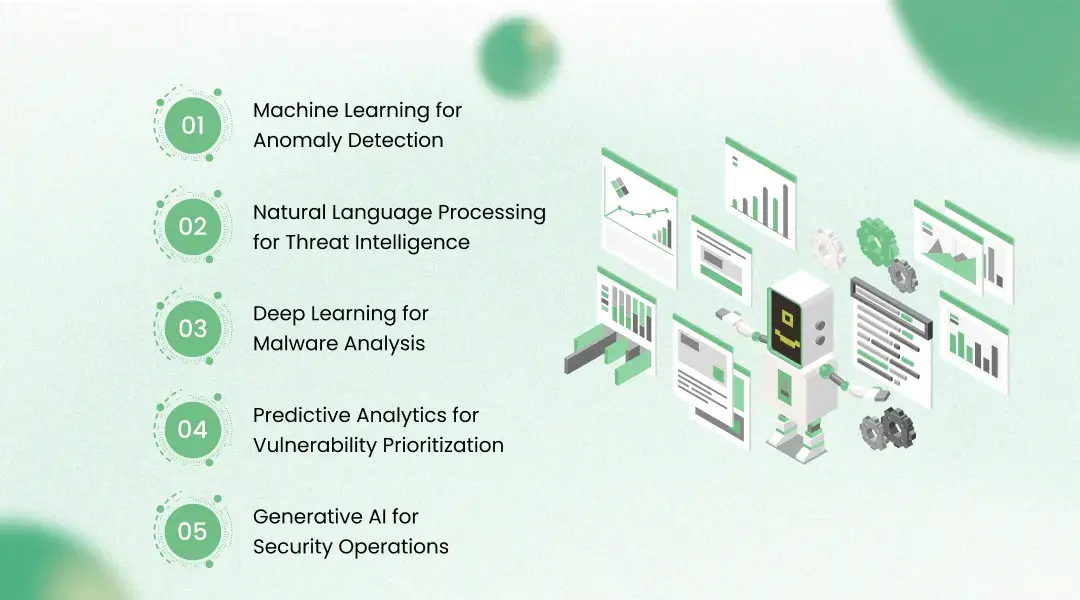
The phrase "AI in security" covers a broad spectrum of technologies, each addressing a different layer of the defense stack. Understanding which AI technology solves which problem is essential for making informed investment decisions. Here is how the major AI disciplines map to specific security challenges.
Machine Learning for Anomaly Detection
Machine learning models trained on baseline network behavior can identify deviations that would be invisible to rule based systems. Unlike signature based detection, which only catches known threats, ML models flag novel attack patterns by recognizing statistical outliers in traffic volume, packet structure, login behavior, and data access patterns. This capability is particularly critical for detecting zero day exploits and advanced persistent threats that deliberately evade traditional defenses. Organizations deploying ML based anomaly detection report threat identification rates exceeding 95% accuracy, including for previously unseen malware variants.
KriraAI builds machine learning pipelines specifically designed for enterprise security environments where the volume and velocity of data demand models that can operate in real time without generating excessive false positives. The key differentiator in effective ML security systems is not the algorithm itself but the quality and relevance of the training data, the feature engineering pipeline, and the feedback loop that continuously refines detection accuracy based on analyst decisions.
Natural Language Processing for Threat Intelligence
Natural language processing enables security platforms to ingest, parse, and correlate threat intelligence from unstructured sources such as dark web forums, vulnerability advisories, security researcher blogs, and incident reports. NLP models extract indicators of compromise, map threat actor tactics to frameworks like MITRE ATT&CK, and generate contextualized alerts that tell analysts not just what happened but why it matters and who is likely behind it. This automation transforms threat intelligence from a manual, labor intensive research function into a continuous, real time capability.
Deep Learning for Malware Analysis
Deep learning, particularly convolutional neural networks, has proven highly effective at classifying malware based on behavioral signatures rather than static file hashes. These models analyze execution patterns, API call sequences, memory allocation behaviors, and network communication attempts to determine whether a file or process is malicious. The advantage over traditional antivirus is profound: deep learning models can identify malware with 95% to 99% accuracy, including polymorphic variants that change their code structure with every execution. This makes deep learning indispensable for endpoint security platforms that need to stop threats at the device level before they propagate across the network.
Predictive Analytics for Vulnerability Prioritization
Not all vulnerabilities are created equal, and security teams cannot patch everything simultaneously. Predictive analytics models assess vulnerability severity by combining CVSS scores with contextual factors such as asset criticality, exploit availability in the wild, network exposure, and historical attack patterns. This risk based prioritization ensures that the most dangerous vulnerabilities are remediated first, reducing the window of exposure for the threats most likely to be exploited. Companies leveraging AI driven vulnerability prioritization report significant reductions in mean time to remediate, often cutting patching cycles from weeks to days for critical assets.
Generative AI for Security Operations
The latest frontier in AI cybersecurity solutions is the application of large language models to security operations workflows. Generative AI copilots can draft incident reports, summarize complex alert chains, generate investigation playbooks, translate between technical and executive audiences, and even write detection rules based on natural language descriptions of threat behaviors. These tools do not replace analysts but dramatically accelerate their productivity. SOC teams using generative AI assistants report that analysts can process alerts and complete investigations substantially faster, freeing capacity for proactive threat hunting rather than reactive triage.
Quantified Business Impact of AI Driven Security Platforms
The business case for AI in security is no longer theoretical. Organizations that have deployed AI driven security platforms are reporting measurable improvements across every key performance indicator that matters to CISOs and CFOs alike.
The most compelling metric is breach cost reduction. Organizations with extensive use of AI and automation in their security operations experience average breach costs that are $1.8 million lower than organizations without these capabilities. Companies save an average of $2.2 million by deploying AI and automation across their cybersecurity functions. For context, the global average cost of a data breach stands at $4.44 million, which means AI adoption can reduce breach costs by approximately 40% to 50%. That alone represents a return on investment that justifies most AI security deployments within the first year.
Speed is the second critical dimension. Organizations with extensive AI features discovered and contained data breaches nearly 100 days faster on average than organizations that did not use these technologies. In high stakes environments like financial services and healthcare, those 100 days can mean the difference between a contained incident and a catastrophic regulatory event. AI based threat detection systems identify cyberattacks up to 85% faster than traditional tools, and companies using AI driven platforms report threat detection speed improvements of 60% or more.
Operational efficiency gains are equally significant. Extensive use of AI and automation in prevention reduced mean time to identify and mean time to contain breaches by 43% and 33% respectively. SOC teams report that AI has reduced the number of individual tools they need for threat detection and response by up to 75%, consolidating workflows and eliminating the tool sprawl that has plagued security operations for years. AI based SOAR platforms have demonstrated 70% reductions in average incident response time while simultaneously freeing analysts to focus on higher complexity threats that genuinely require human judgment.
KriraAI's approach to automated security operations focuses on delivering these measurable outcomes through phased deployments that prioritize the highest impact use cases first. Rather than attempting to automate everything at once, KriraAI works with security teams to identify the specific workflows where AI will deliver the fastest time to value, whether that is alert triage, log correlation, vulnerability prioritization, or compliance reporting.
The revenue protection dimension is harder to quantify but equally important. Organizations that can demonstrate strong security postures win more enterprise contracts, maintain customer trust, and avoid the reputational damage that follows public breaches. In regulated industries, AI powered compliance automation also reduces audit preparation costs and minimizes the risk of fines that can reach into the hundreds of millions of dollars.
The Implementation Roadmap for AI in Security
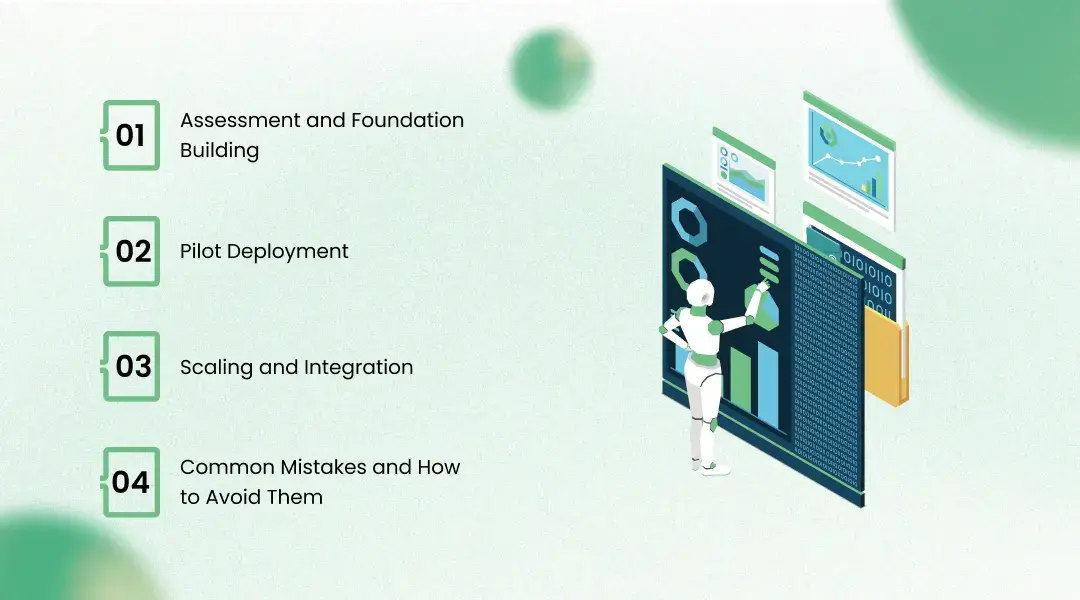
Deploying AI in security is not as simple as purchasing a platform and flipping a switch. Successful implementations follow a structured progression that accounts for organizational readiness, data quality, team capability, and change management. The following roadmap reflects best practices drawn from enterprises that have successfully scaled AI across their security operations.
Phase 1: Assessment and Foundation Building
The first phase focuses on understanding where you are and what you need. This involves conducting a comprehensive audit of your current security architecture, data sources, detection capabilities, and team workflows. Key activities include the following:
Inventory all data sources, including logs, network flows, endpoint telemetry, identity events, and cloud audit trails, to determine data completeness and quality.
Map existing detection rules and playbooks to identify coverage gaps against frameworks like MITRE ATT&CK.
Baseline current performance metrics such as mean time to detect, mean time to respond, false positive rates, and analyst workload distribution.
Assess data infrastructure readiness, including storage capacity, ingestion pipelines, and API integration capabilities.
Identify quick win use cases where AI can deliver measurable improvements within 90 days.
This phase typically takes four to eight weeks and produces a prioritized roadmap that aligns AI investments with the organization's specific risk profile and operational bottlenecks.
Phase 2: Pilot Deployment
The pilot phase involves deploying AI capabilities against one or two high priority use cases in a controlled environment. Common starting points include AI powered alert triage to reduce false positives, ML based user and entity behavior analytics (UEBA) for insider threat detection, or automated log correlation for faster incident investigation. The goal is not to replace existing tools but to augment them, allowing the AI system to learn from your specific environment while analysts validate its outputs.
During this phase, it is critical to establish feedback loops where analyst decisions are fed back into the model to improve accuracy over time. Models trained on generic data will underperform in your environment. Models fine tuned on your environment's specific traffic patterns, user behaviors, and application architectures will deliver substantially better results.
Phase 3: Scaling and Integration
Once pilot results demonstrate clear value, the third phase involves expanding AI capabilities across additional use cases and integrating them deeply into existing workflows. This includes connecting AI outputs to SOAR platforms for automated response, embedding AI driven risk scores into vulnerability management processes, and extending behavioral analytics across cloud and hybrid environments. Organizations in this phase also begin training their teams on how to work alongside AI tools effectively, shifting analyst roles from manual triage toward AI supervised investigation and threat hunting.
Common Mistakes and How to Avoid Them
The path to AI powered security is littered with avoidable mistakes that delay value and erode organizational confidence. Here are the most common pitfalls and how to sidestep them:
Deploying AI without clean data is the single most common failure mode. AI models are only as good as the data they ingest, and organizations that skip the data quality assessment phase inevitably end up with models that produce unreliable outputs.
Attempting to automate too many workflows simultaneously leads to integration complexity, team resistance, and diluted focus. Start with one or two high impact use cases and expand deliberately.
Treating AI as a replacement for human analysts rather than an augmentation tool creates cultural resistance and misses the point. The goal is to amplify human expertise, not eliminate it.
Failing to establish clear success metrics before deployment makes it impossible to demonstrate ROI and justify continued investment. Define what success looks like in quantitative terms before the pilot begins.
Ignoring change management means that even technically successful deployments fail to achieve adoption. Analysts who do not trust AI outputs will simply ignore them, negating the investment entirely.
Challenges and Limitations of AI Cybersecurity Solutions
Honest assessment of AI's limitations is essential for setting realistic expectations and planning effective deployments. Despite the impressive statistics, AI in security is not a silver bullet, and organizations that treat it as one will be disappointed.
Data quality remains the foundational challenge. Machine learning models require large volumes of labeled, representative data to train effectively. Many organizations lack comprehensive historical incident data, have inconsistent logging practices across different platforms, or maintain data in silos that are difficult to integrate. Without addressing these data gaps, AI models will produce high false positive rates that frustrate analysts rather than helping them.
The talent gap creates a circular problem. While AI is positioned as a solution to the cybersecurity workforce shortage, deploying and managing AI security systems itself requires specialized skills that are in short supply. The 2026 SANS report found that 34% of organizations are now hiring AI and ML security specialists and 32% are adding AI security engineer roles, but these are new categories that barely existed three years ago. Organizations need people who understand both security operations and machine learning, and that intersection of expertise is exceptionally rare.
Adversarial AI represents a fundamental and evolving risk. Just as defenders use AI to detect threats, attackers use AI to evade detection. AI generated phishing emails are more convincing than human crafted ones. AI can be used to probe defensive models and find blind spots. Deepfake technology enables sophisticated social engineering attacks. This creates an ongoing arms race where defensive AI must continuously evolve to keep pace with offensive AI, and 29% of enterprises deploying AI powered defenses still experienced breaches in 2025.
Integration complexity is frequently underestimated. Most enterprises operate heterogeneous security stacks with tools from multiple vendors, legacy systems that predate modern API standards, and custom applications with non standard logging formats. Integrating AI across this environment requires significant engineering effort, and 65% of companies report at least some difficulty integrating AI security solutions with legacy systems.
Regulatory uncertainty adds another layer of complexity. The EU AI Act is establishing comprehensive requirements for AI systems, including those used in security contexts, and organizations must navigate evolving compliance obligations around algorithmic transparency, bias testing, and data governance. These requirements vary by jurisdiction and change frequently, creating compliance overhead that can slow deployment timelines.
The Future of AI in Security: What the Next Three to Five Years Will Bring
The trajectory of AI in security points toward a fundamentally different operating model for cybersecurity by 2029 to 2030. Several developments that are currently emerging will mature into mainstream capabilities within this timeframe, reshaping both the competitive landscape and the nature of security work itself.
Autonomous security operations will move from concept to reality. Today's AI tools augment human analysts. Within three to five years, AI agents will handle end to end incident response for the majority of routine security events without human intervention. This does not mean eliminating security teams but rather shifting their focus entirely toward strategic threat hunting, red team exercises, and governance functions that require human judgment. Organizations that have invested in building robust AI foundations will operate with leaner, more specialized teams that are dramatically more effective per person.
AI will become the primary interface for security management. Rather than navigating complex dashboards and writing detection queries, security leaders will interact with their security stack through natural language interfaces. They will ask questions like "show me all lateral movement attempts in our cloud environment over the past 72 hours" and receive synthesized, actionable answers in seconds. This shift will democratize security operations, enabling smaller organizations to achieve sophisticated detection and response capabilities that were previously only accessible to enterprises with large, specialized teams.
The companies that will be left behind are those that treat AI adoption as a future project rather than a current imperative. The gap between AI augmented security teams and traditional teams is already measured in hundreds of days of faster breach detection and millions of dollars in reduced costs. As AI capabilities compound and adversaries accelerate their own AI adoption, this gap will widen into a chasm. Organizations that delay will find themselves unable to hire talent that increasingly expects AI tooling, unable to meet regulatory requirements that assume AI capabilities, and unable to defend against threats that evolve faster than manual processes can track.
KriraAI is positioned at the center of this transformation, helping organizations build the AI security foundations today that will define their defensive capabilities for the next decade. By focusing on practical, measurable deployments rather than theoretical capabilities, KriraAI ensures that enterprises can navigate this transition with confidence and clear return on investment.
Conclusion
Three themes emerge clearly from this analysis of AI in security. First, the threat landscape has evolved beyond the capacity of manual security operations to manage effectively, making AI augmentation a practical necessity rather than an optional enhancement. Second, the measurable business impact of AI security deployment is compelling and well documented, with organizations achieving breach cost reductions exceeding $2 million, detection speed improvements of up to 85%, and operational efficiency gains that fundamentally change the economics of security operations. Third, successful implementation requires a structured, phased approach that prioritizes data quality, starts with high impact use cases, and invests deliberately in change management and team enablement.
KriraAI helps companies across the security industry implement AI solutions that are practical, measurable, and built for scale. Rather than selling technology for its own sake, KriraAI partners with enterprise security teams to identify the specific workflows where AI delivers the fastest and most measurable value, then designs phased deployment roadmaps that build organizational capability alongside technical capability. Whether you are beginning to explore AI for alert triage or ready to scale autonomous security operations across your entire infrastructure, KriraAI's team brings the domain expertise and implementation discipline to turn AI's potential into operational reality. Visit KriraAI to explore how their solutions can strengthen your organization's security posture and prepare your team for the challenges ahead.
FAQs
AI improves threat detection by analyzing vast volumes of security data in real time and identifying patterns that would be impossible for human analysts to spot manually. Machine learning models establish baselines of normal behavior across networks, endpoints, and user activity, then flag deviations that may indicate compromise. Unlike traditional rule based detection systems that only catch known threat signatures, AI models can identify novel and previously unseen attack patterns, including zero day exploits and advanced persistent threats. Organizations using AI driven threat detection report accuracy rates exceeding 95% and identification speeds up to 85% faster than traditional tools. The technology also reduces false positive rates by 60% to 80%, which directly addresses the alert fatigue problem that overwhelms SOC teams and causes genuine threats to be overlooked in the noise of irrelevant notifications.
The return on investment for AI in security operations is substantial and well documented. Organizations with extensive AI and automation deployment experience average breach costs that are $1.8 million lower than those without, and companies save an average of $2.2 million overall by integrating AI across their cybersecurity functions. Beyond direct cost savings, AI reduces mean time to identify and contain breaches by up to 100 days compared to organizations without AI capabilities. Operational efficiency gains include 70% reductions in incident response time and significant consolidation of security tooling, with analysts reporting that AI has reduced the number of tools they need by up to 75%. When factoring in regulatory compliance savings, reduced audit preparation costs, and the revenue protection value of stronger security postures, most organizations achieve positive ROI within twelve months of deployment. The key to maximizing ROI is starting with high impact use cases such as alert triage or vulnerability prioritization rather than attempting comprehensive deployment from the outset.
The biggest challenges fall into five categories: data quality, talent, adversarial threats, integration complexity, and change management. Data quality is the most fundamental issue, as AI models trained on incomplete, inconsistent, or poorly labeled data will produce unreliable results that erode analyst trust rather than building it. The talent challenge is particularly acute because effective AI security deployment requires professionals who understand both machine learning and security operations, an intersection of expertise that remains extremely rare. Adversarial AI creates an ongoing arms race where attackers use AI to evade detection, generate sophisticated phishing content, and probe defensive models for weaknesses. Integration complexity is frequently underestimated, with 65% of organizations reporting difficulties connecting AI solutions to legacy security infrastructure. Finally, change management remains critical because even technically excellent deployments fail when analysts do not trust or adopt the AI tools, requiring deliberate investment in training, feedback loops, and cultural alignment around human plus AI workflows.
AI addresses the cybersecurity talent shortage through augmentation rather than replacement. By automating routine tasks such as log analysis, alert triage, false positive filtering, and initial incident investigation, AI frees existing security professionals to focus on higher value activities that require human judgment, creativity, and contextual understanding. The global cybersecurity workforce gap stands at 4.8 million unfilled positions, and organizations cannot realistically hire their way out of this deficit. AI effectively multiplies the productivity of each analyst, enabling a team of ten to achieve what previously required twenty or more. Generative AI copilots further accelerate this multiplier effect by helping analysts draft reports, generate detection rules, and summarize complex incident chains in seconds rather than hours. However, AI also creates new talent demands, with 34% of organizations now hiring AI and ML security specialists and over 64% of cybersecurity job listings requiring AI or automation skills. The net effect is a shift in the talent profile rather than a reduction in total demand, with organizations needing fewer entry level triage analysts and more professionals who can build, manage, and interpret AI driven security systems.
Financial services, healthcare, government, retail, and critical infrastructure operators derive the greatest measurable benefit from AI driven security platforms. Financial services organizations benefit most directly because they face the highest volume of targeted attacks, handle the most sensitive transaction data, and operate under the most stringent regulatory frameworks. The fraud detection segment alone accounted for nearly 30% of the AI in the cybersecurity market in 2026. Healthcare organizations benefit from AI's ability to protect patient data while ensuring compliance with HIPAA and similar regulations, particularly as telehealth and connected medical devices expand the attack surface. Government and defense agencies leverage AI for protecting classified information and critical national infrastructure against nation state adversaries. Retail and e-commerce companies use AI to combat credential stuffing, payment fraud, and bot attacks that can cause immediate revenue loss. However, any organization with significant digital operations, sensitive data assets, or regulatory compliance obligations will benefit from AI security deployment, as the underlying challenges of alert volume, threat sophistication, and workforce constraints are universal across sectors.
Founder & CEO
Divyang Mandani is the CEO of KriraAI, driving innovative AI and IT solutions with a focus on transformative technology, ethical AI, and impactful digital strategies for businesses worldwide.