The global AI in manufacturing market was valued at approximately $8.57 billion in 2025 and is projected to surge past $287 billion by 2035, growing at a compound annual rate of over 42%. That trajectory is not driven by hype. It is driven by plant managers, operations directors, and CFOs who have watched a single AI deployment recover its full investment cost within a single fiscal quarter. When a mid-sized automotive parts manufacturer installs vibration sensors on ten critical machines, connects them to a machine learning model, and avoids one catastrophic bearing failure that would have cost $400,000 in lost production, the business case stops being theoretical. AI in manufacturing has crossed the threshold from promising experiment to operational necessity, and the companies still debating whether to start are now competing against companies that started two years ago. This blog examines exactly how AI technologies are reshaping factory operations, the measurable financial results that early adopters are reporting, the practical steps required to implement AI on a real production floor, and the honest challenges that remain unsolved. Whether you run a single plant or oversee a global manufacturing network, the analysis that follows will give you the specific knowledge you need to make informed decisions about your own AI strategy.
Manufacturing in 2026 operates under a combination of pressures that would have seemed extreme a decade ago. Global supply chains, once optimized for cost efficiency through lean inventory models, now require resilience and redundancy that directly conflict with margin targets. Raw material costs remain volatile, with industrial metals, polymers, and rare earth elements subject to geopolitical tensions, tariff shifts, and climate disruptions that make cost forecasting unreliable. Labor markets in every major manufacturing economy continue to tighten, with skilled machine operators, quality inspectors, and maintenance technicians in critically short supply. The average age of a skilled manufacturing worker in the United States now exceeds 44, and the pipeline of replacements is not keeping pace with retirements.
These structural pressures are compounded by customer expectations that have fundamentally changed. Buyers across automotive, aerospace, electronics, consumer goods, and industrial equipment sectors now expect shorter lead times, higher customization, tighter quality tolerances, and full traceability. The era of producing a million identical units and shipping them to warehouses is giving way to demand driven production where lot sizes shrink, changeovers increase, and the cost of any quality escape multiplies because the reputational damage travels instantly through digital channels.
Operational inefficiency remains pervasive despite decades of lean manufacturing, Six Sigma, and continuous improvement programs. Unplanned downtime alone costs industrial manufacturers an estimated $50 billion annually worldwide, with median per incident costs exceeding $125,000 per hour across industries. Quality failures, including scrap, rework, warranty claims, and recalls, consume between 5% and 30% of gross revenue for manufacturers that have not modernized their inspection processes. Energy costs continue to rise, and regulators in every major market are tightening sustainability requirements, forcing manufacturers to document, reduce, and report their carbon footprints with a specificity that most legacy systems cannot support.
The fundamental problem is not a lack of data. Modern factories generate enormous volumes of sensor data, machine logs, quality records, maintenance histories, and production schedules. The problem is that this data sits in disconnected silos, is analyzed retrospectively rather than in real time, and is interpreted by humans whose attention, experience, and availability are finite. This is the gap that artificial intelligence is uniquely positioned to close.
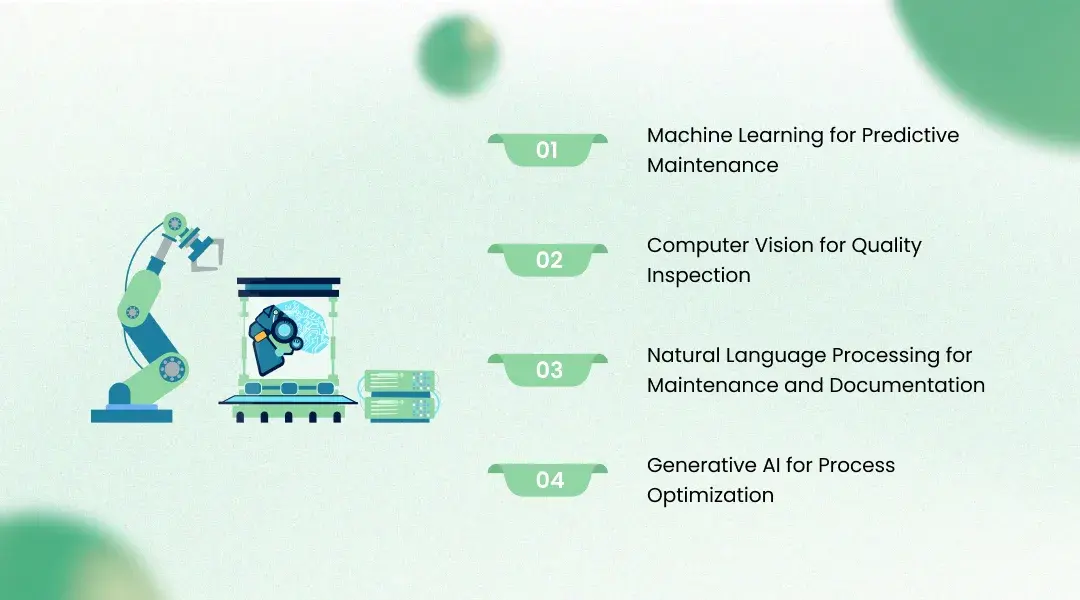
The term "AI" encompasses a broad set of technologies, and understanding which technologies apply to which manufacturing problems is essential for making sound investment decisions. The most impactful AI applications in manufacturing today fall into several distinct categories, each addressing a specific operational challenge.
Predictive maintenance AI represents the most mature and widely deployed application of machine learning on the factory floor. The technology works by collecting continuous streams of data from sensors measuring vibration, temperature, acoustic emissions, current draw, and pressure on critical equipment. Machine learning algorithms, particularly time series analysis and anomaly detection models, learn the normal operating signature of each machine and identify deviations that indicate developing failures. These models can detect equipment degradation 14 to 60 days before a failure occurs, giving maintenance teams enough lead time to schedule repairs during planned downtime windows rather than reacting to catastrophic breakdowns. According to the U.S. Department of Energy, predictive maintenance delivers a 70% to 75% decrease in equipment breakdowns and a 35% to 45% reduction in unplanned downtime, with organizations regularly achieving a return of roughly 10 times the initial investment cost.
AI quality control manufacturing systems use convolutional neural networks trained on thousands of images of both defect free and defective products. These systems inspect every unit on the production line in real time, achieving detection rates above 99% on defects that human inspectors catch only about 80% of the time. Unlike human inspectors, AI vision systems do not fatigue, do not lose concentration across shifts, and perform identically at 3 AM as they do at 9 AM. Manufacturers implementing AI driven visual inspection report defect reductions of up to 50% and inspection cycle acceleration of 30% to 50% compared to manual methods. The technology is particularly valuable in industries with tight tolerances, such as semiconductor manufacturing, medical devices, and aerospace components, where a single undetected defect can trigger recalls worth millions.
NLP models are increasingly being deployed to extract actionable information from unstructured maintenance logs, work orders, operator notes, and technical manuals. In many manufacturing environments, decades of institutional knowledge are trapped in handwritten logbooks, inconsistent digital records, and the memories of veteran technicians approaching retirement. NLP systems can parse these records, identify patterns in equipment failures, and surface insights that would take human analysts weeks or months to compile. These systems also power conversational interfaces that allow operators to query machine status, request maintenance histories, or report anomalies using natural language rather than navigating complex software menus.
The integration of generative AI into manufacturing operations is a more recent development that is already showing significant promise. Generative models can create synthetic datasets that simulate rare failure scenarios, overcoming the data scarcity problem that has historically limited machine learning model accuracy for uncommon but catastrophic events. Beyond simulation, generative AI is being used to optimize production schedules, generate toolpath designs for CNC machining, and create adaptive recipes for process industries where slight adjustments in temperature, pressure, or chemical composition can yield meaningful quality and efficiency improvements. KriraAI, which builds practical AI solutions for enterprises, has observed that manufacturers combining generative AI with traditional predictive models achieve materially faster time to insight compared to those relying on conventional machine learning alone.
The financial case for AI adoption in manufacturing is no longer built on projections. It is built on documented results from thousands of deployments across industries and geographies. Understanding these results in specific, quantified terms is what separates informed decision making from speculative investment.
Predictive maintenance alone generates five distinct savings streams that compound over time. Emergency repairs cost three to five times more than planned maintenance on the same asset, so shifting to condition based maintenance reduces repair spend by 25% to 30%. Equipment lifespan extends by 20% to 40% when maintenance is performed at the optimal time rather than on a fixed schedule or after a failure, deferring capital expenditure on replacements. Spare parts inventory drops by 15% to 30% through just in time ordering based on predicted demand rather than precautionary stockpiling. Maintenance labor requirements decrease by 18% to 25% through optimized scheduling that eliminates unnecessary preventive tasks and reduces overtime. And production throughput increases because machines spend more time running and less time broken. A 2023 IoT Analytics study found that 95% of organizations implementing predictive maintenance reported positive ROI, with 27% achieving full payback within 12 months.
Quality improvements generate their own compounding returns. Manufacturers deploying AI driven visual inspection report waste reductions of up to 40% through early defect detection that prevents rework and scrap. Warranty claim costs decrease as fewer defective products reach customers. Customer satisfaction scores improve, leading to higher retention and increased order volumes. One widely cited example in the semiconductor industry shows annual savings of $2 million from a single AI vision system deployment.
Smart factory automation that integrates AI across production planning, scheduling, and execution delivers productivity gains of 15% to 30% within the first few years of deployment. Energy optimization through AI driven controls reduces the carbon footprint of energy intensive operations by approximately 10% in sectors like steel production, while cutting water usage in textile manufacturing by up to 28%. These sustainability improvements are not just ethical achievements. They translate directly to reduced utility costs, regulatory compliance, and eligibility for green financing instruments that lower the cost of capital.
The timeline for manufacturing AI ROI has compressed significantly. While early adopters in 2018 and 2019 often waited 18 to 24 months for payback, the combination of lower sensor costs, cloud based AI platforms, and pretrained models means that pilot programs in 2026 regularly demonstrate positive returns within three to six months. KriraAI works with manufacturing clients to structure these pilot programs around the highest ROI use cases first, ensuring that early wins fund subsequent expansion.
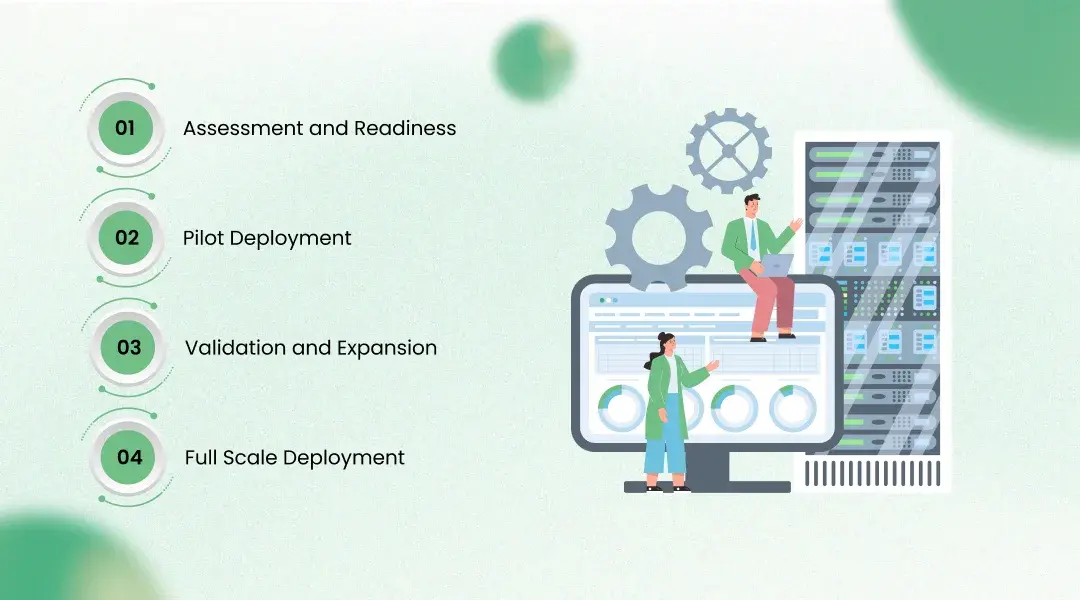
Implementing AI in a manufacturing environment is not a software installation. It is an operational transformation that requires careful planning, realistic expectations, and a structured approach. The following roadmap reflects the pattern that successful manufacturers consistently follow.
The first step is an honest audit of your current state across three dimensions.
Data infrastructure. Identify what sensors, PLCs, SCADA systems, MES platforms, and ERP systems you already have. Catalog the data they produce, its format, its quality, and its accessibility. Many manufacturers discover they already have 60% to 70% of the data infrastructure they need but have never connected it.
Use case prioritization. Map your most expensive operational problems, including downtime, defects, energy waste, changeover delays, and supply chain disruptions, and rank them by financial impact and data readiness. The best first AI project is the one where you have reasonably clean data and a clearly quantifiable cost to reduce.
Organizational readiness. Assess whether you have internal talent who can champion and support the initiative, whether your IT and OT teams can collaborate effectively, and whether leadership is committed to sustained investment beyond the pilot phase.
A well structured pilot focuses on five to ten critical assets and one clearly defined use case, most commonly predictive maintenance or quality inspection. During this phase, sensors are installed or existing sensor data is connected to an AI platform. Machine learning models begin learning equipment baselines, and first anomaly alerts typically begin within two to four weeks. The pilot should be structured to produce measurable results within 90 days, which provides the business case evidence needed to justify broader investment.
With pilot results confirmed, the next phase expands coverage to additional assets and introduces a second use case. This is also when integration with existing enterprise systems, such as ERP, CMMS, and MES, becomes critical. The AI system must not operate as a standalone tool. It must feed insights into the workflows your teams already use.
Full deployment extends AI coverage across the plant or across multiple plants. Models improve continuously as they accumulate more data, and accuracy exceeds 90% for most predictive use cases. This phase typically includes deploying digital twins, which are virtual replicas of physical assets that simulate failure modes, test maintenance scenarios, and optimize performance without risking actual equipment. Over half of large industrial facilities had deployed at least one digital twin for maintenance simulation by 2025.
The most frequent mistake is starting too large. Companies that attempt to deploy AI across an entire plant simultaneously almost always encounter integration failures, data quality issues, and change management resistance that derail the project. The second most common mistake is treating AI as a technology project rather than a business initiative, assigning it to IT without involving operations, maintenance, and quality leaders who understand the problems being solved. A third critical error is neglecting data quality. AI models are only as reliable as the data they learn from, and many manufacturers discover that their sensor data contains gaps, outliers, and formatting inconsistencies that must be cleaned before models can produce trustworthy outputs. Finally, underestimating change management is a consistent source of failure. Operators and maintenance technicians who feel that AI threatens their roles will resist adoption. Successful implementations invest in training and communication that positions AI as a tool that makes skilled workers more effective rather than a replacement for them.
Honest assessment of the difficulties involved in manufacturing AI adoption is essential for setting realistic expectations and avoiding costly mistakes. The challenges are real, and pretending otherwise serves no one.
Data quality remains the single largest obstacle. A survey of 300 manufacturing professionals found that only 20% of manufacturers feel fully prepared to use AI at scale, with data readiness cited as the primary gap. Manufacturing data is inherently messy. Sensors drift, calibrations vary between machines, operators record information inconsistently, and legacy systems store data in formats that resist integration. Fifteen percent of manufacturers identify unstructured data as their biggest hurdle to AI scaling, and the true percentage is likely higher because many companies do not yet fully understand the scope of their data problems.
The talent gap presents a structural challenge that cannot be solved quickly. Manufacturing plants need people who understand both the technology and the operational context, a combination that is rare and expensive. Demand for AI specialists across all industries outstrips supply dramatically, and manufacturing competes for this talent against higher paying sectors like finance and technology. Small and medium enterprises are 30% less likely than large firms to have a dedicated AI strategy, largely because they cannot attract or afford the necessary expertise. This is one reason many manufacturers choose to partner with specialized AI consultancies like KriraAI rather than building internal capabilities from scratch, as a partner model provides access to deep technical expertise without the overhead and hiring risk of a permanent AI team.
Regulatory and compliance constraints add complexity in heavily regulated industries. Aerospace, pharmaceutical, automotive, and food manufacturing all operate under certification frameworks that require documented validation of any change to production processes. Introducing AI into a validated environment requires extensive documentation, testing, and regulatory approval that can add months or years to deployment timelines. The "black box" nature of some machine learning models creates additional challenges, as regulators increasingly demand explainability in AI driven decisions that affect product safety.
Integration complexity should not be underestimated. Most manufacturing environments run a patchwork of equipment from different vendors, different eras, and different communication protocols. Connecting a 1990s vintage PLC to a modern cloud based AI platform requires middleware, protocol translation, and cybersecurity measures that add cost and complexity. The promise of plug and play AI remains largely unfulfilled in brownfield manufacturing environments.
The next three to five years will see a fundamental shift in how manufacturing plants operate, driven by advances in AI capabilities that are already visible in early stage deployments. Understanding these trends is not speculation. It is strategic planning.
Agentic AI will move from concept to reality on the factory floor. Current AI systems detect anomalies and alert humans. The next generation will take autonomous action within defined parameters, automatically generating work orders, rescheduling maintenance, adjusting production sequences, and optimizing energy consumption without waiting for human approval on routine decisions. A recent industry study found that 74% of manufacturing executives expect AI agents to manage 11% to 50% of routine production decisions by 2028. This shift will not eliminate human roles, but it will transform them. Operators will spend less time monitoring dashboards and more time supervising outcomes, setting strategy, and managing exceptions that require human judgment.
Digital twin technology will become ubiquitous. Every significant manufacturing asset, from individual machines to entire production lines to complete factories, will have a continuously updated virtual replica. These twins will simulate thousands of scenarios per day, optimizing everything from maintenance timing to production scheduling to energy usage. The manufacturers who invest in digital twin infrastructure now will have a compounding data advantage that late adopters will find extremely difficult to close.
AI driven sustainability tracking and optimization will become a competitive requirement rather than a voluntary initiative. Fifty percent of global manufacturers are expected to use AI based sustainability tracking by 2026, and the percentage will only increase as carbon border adjustment mechanisms, ESG reporting mandates, and customer procurement policies make environmental performance a prerequisite for doing business.
The competitive divide between AI adopters and non adopters will widen into a chasm. Companies that deploy smart factory automation will achieve cost structures, quality levels, and delivery speeds that conventionally operated plants simply cannot match. This will trigger consolidation in many manufacturing subsectors, as AI enabled companies acquire or displace competitors who delayed too long. The 98% of manufacturers currently exploring or considering AI driven automation signals that the industry understands the stakes. The 80% who are not yet fully prepared represent both a challenge and an opportunity, and the winners will be those who move from exploration to execution most effectively.
Three conclusions stand out from this analysis. First, the financial case for AI in manufacturing is proven and documented, with predictive maintenance alone delivering returns of up to ten times the initial investment and quality inspection AI reducing defect rates by up to 50%. Second, successful implementation requires a structured, phased approach that starts with high impact pilot projects, validates results within 90 days, and scales based on evidence rather than ambition. Third, the competitive consequences of inaction are accelerating, with the gap between AI adopters and non adopters widening in ways that will reshape industry structure over the next three to five years.
For manufacturers ready to move from exploration to execution, KriraAI builds practical AI solutions designed specifically for manufacturing environments, from predictive maintenance systems that deliver measurable ROI within a single quarter to AI quality control manufacturing platforms that integrate with existing production lines without disrupting operations. KriraAI's approach prioritizes measurable business outcomes over technology for its own sake, ensuring that every deployment is built for scale and delivers the cost reductions, quality improvements, and operational efficiencies that justify continued investment. If you are evaluating AI for your manufacturing operations, explore how KriraAI can help you build an implementation roadmap that matches your specific challenges, infrastructure, and business objectives.
AI reduces manufacturing costs through multiple interconnected mechanisms that compound over time. Predictive maintenance alone cuts maintenance spending by 18% to 30% by eliminating unnecessary preventive tasks and preventing expensive emergency repairs that cost three to five times more than planned interventions. AI driven quality inspection reduces scrap and rework by catching defects earlier in the production process, with manufacturers reporting waste reductions of up to 40%. Production scheduling algorithms optimize machine utilization, changeover sequencing, and labor allocation to extract more output from existing capacity without capital investment. Energy optimization models reduce electricity and utility costs by adjusting equipment operation to avoid peak demand charges and minimize waste. Inventory management algorithms reduce carrying costs by improving demand forecasting accuracy by 20% to 30%, allowing manufacturers to hold less safety stock while maintaining service levels. These savings are not theoretical. They are being documented by manufacturers ranging from small job shops to global industrial enterprises, with most reporting total cost reductions between 10% and 25% within two years of initial deployment.
Predictive maintenance AI is a system that uses machine learning algorithms to analyze real time data from sensors installed on manufacturing equipment, detecting patterns that indicate developing failures before those failures cause unplanned downtime. The sensors measure variables such as vibration frequency, operating temperature, acoustic emissions, electrical current draw, and lubricant condition. These data streams are fed continuously into machine learning models that have been trained on historical equipment data to recognize the difference between normal operating conditions and the early signatures of mechanical degradation, bearing wear, motor imbalance, or seal deterioration. When the model detects a developing anomaly, it generates an alert with a predicted time to failure, allowing the maintenance team to schedule a repair during a planned downtime window. The model accuracy improves over time as it accumulates more data specific to each piece of equipment. Typical results documented across industries include a 70% to 75% reduction in breakdowns, a 35% to 45% reduction in unplanned downtime, and equipment lifespan extension of 20% to 40% compared to time based preventive maintenance schedules.
The timeline for manufacturing AI ROI has shortened significantly over the past several years as technology has matured and implementation methodologies have improved. In 2026, most manufacturers running well structured pilot programs see initial positive returns within three to six months of deployment. The fastest payback typically comes from predictive maintenance use cases, where a single prevented catastrophic failure can recover the entire first year cost of the AI platform in a single event. For context, unplanned downtime in manufacturing carries a median cost exceeding $125,000 per hour across industries, so preventing even a few hours of unexpected shutdown generates substantial savings immediately. Quality inspection AI projects typically show ROI within six to twelve months, while broader smart factory automation initiatives that integrate AI across planning, scheduling, and execution systems generally achieve full payback within 12 to 18 months. A study by IoT Analytics found that 95% of organizations implementing predictive maintenance reported positive ROI, with 27% achieving full payback within the first 12 months. The key variable is not the technology itself but the quality of the implementation, including use case selection, data readiness, and organizational commitment to acting on AI generated insights.
The biggest challenges of implementing AI in manufacturing are data readiness, talent availability, organizational change management, and integration with legacy systems. Data quality is consistently cited as the primary barrier, with only 20% of manufacturers reporting they feel fully prepared for AI at scale. Manufacturing data is inherently complex, coming from diverse sensors, machines of different ages and manufacturers, and multiple disconnected software systems. Cleaning, normalizing, and integrating this data is often more time consuming and expensive than the AI development itself. The talent gap is structural because manufacturing needs professionals who combine AI technical skills with deep operational domain knowledge, a rare combination. Small and medium manufacturers face this challenge most acutely and are 30% less likely than large enterprises to have a formal AI strategy. Change management resistance from operators and technicians who fear job displacement can undermine adoption even when the technology performs well. Successful implementations address this through transparent communication and training programs that demonstrate how AI augments human capabilities rather than replacing them. Finally, integrating modern AI platforms with legacy equipment, control systems, and enterprise software requires careful planning, middleware development, and robust cybersecurity measures.
AI will not replace manufacturing workers wholesale, but it will fundamentally change the nature of manufacturing work. The evidence from early adopters consistently shows that AI creates new roles while transforming existing ones. Research indicates that 69% of manufacturing leaders believe AI will create new job opportunities rather than simply eliminating positions. The roles most affected are those involving repetitive visual inspection, routine data entry, and manual monitoring, tasks where AI can perform faster, more consistently, and at lower cost. However, these same AI systems create demand for new skills: sensor technicians who install and maintain monitoring equipment, data analysts who interpret AI outputs and refine models, automation specialists who integrate AI with existing factory systems, and process engineers who use AI insights to redesign workflows. The manufacturers achieving the best results from AI are those that invest in reskilling their existing workforce rather than replacing them. The human capabilities that remain essential, including judgment in ambiguous situations, creative problem solving, relationship management with customers and suppliers, and strategic decision making, are precisely the capabilities that current AI cannot replicate. The future manufacturing workforce will be smaller in some traditional roles but larger in higher skilled positions, with AI handling the data intensive, repetitive, and hazardous tasks while humans focus on oversight, improvement, and innovation.
Ridham Chovatiya is the COO at KriraAI, driving operational excellence and scalable AI solutions. He specialises in building high-performance teams and delivering impactful, customer-centric technology strategies.