Financial institutions lose an estimated $485 billion globally each year to fraud, operational inefficiency, and poor risk decisions made without adequate analytical infrastructure. That figure, drawn from aggregated financial crime and operational cost reporting across North American and European banking sectors, understates the full cost when regulatory penalties, reputational damage, and lost customer lifetime value are included. The uncomfortable reality for every bank, insurer, asset manager, and fintech operating today is that the data required to make better decisions already exists inside their systems. What most organizations lack is the analytical architecture to extract insight from it at the speed and scale that modern financial operations demand.
AI in financial services is not a speculative technology for the next decade. It is a deployable, measurable capability that is actively reducing fraud losses by 40% to 60%, cutting loan underwriting cycle times from days to minutes, and generating compliance documentation at a fraction of the cost of manual processes at institutions that have committed to structured implementation. This blog covers the structural pressures facing the financial sector, the specific AI technologies being applied at each function, the quantified business impact being documented in real deployments, a practical implementation roadmap, the genuine challenges of adoption, and a five-year outlook for where competitive advantage will be won and lost.
The financial services industry enters the second half of the 2020s carrying a structural burden that no amount of additional headcount can resolve. Regulatory complexity has compounded continuously since the 2008 financial crisis, with institutions in the United States, European Union, and United Kingdom now operating under overlapping frameworks including Basel III capital requirements, the EU's Anti-Money Laundering Directives, DORA for operational resilience, and a growing body of consumer protection legislation that varies by jurisdiction. Compliance teams at mid-size banks are routinely spending 15% to 20% of total operating budgets on regulatory adherence, a proportion that has grown every year for the past decade without a corresponding improvement in detection outcomes.
Customer expectations have shifted in ways that legacy infrastructure cannot accommodate. Digital-native neobanks and embedded finance platforms are offering account opening in under three minutes, credit decisions in seconds, and 24-hour customer service without human agents. Traditional banks with core banking systems implemented in the 1990s and 2000s are competing for the same customers while carrying technology debt that makes real-time decisioning architecturally difficult. The average large bank in North America spends more than 70% of its technology budget maintaining existing systems, leaving less than 30% for innovation and modernization.
Credit risk management remains systematically underpowered at most institutions below the top-tier global banks. Traditional credit scoring models built on FICO scores, income verification, and debt-to-income ratios were designed for a world where customer financial behavior could be summarized by a small number of variables reviewed on a quarterly basis. The reality of modern financial life, including gig economy income, multi-currency digital wallets, buy-now-pay-later exposure, and crypto asset positions, generates financial complexity that three-variable scorecard models were never designed to capture.
Talent competition is intensifying the structural challenge. Data scientists, machine learning engineers, and quantitative analysts command compensation packages that place them out of reach for many regional banks and credit unions, concentrating advanced analytical capability at a small number of large institutions. This is not a temporary labor market condition but a structural shift reflecting the demand for these skills across every sector of the economy simultaneously.
Fraud losses are rising despite increased investment in traditional rule-based detection systems. Synthetic identity fraud, account takeover attacks using stolen credential combinations, and first-party fraud schemes are outpacing the rule updates that fraud operations teams can implement manually. A rule-based system requires a human analyst to identify a pattern, write a rule, test it, and deploy it, a cycle that takes days to weeks. Fraudsters operating at scale adapt within hours.
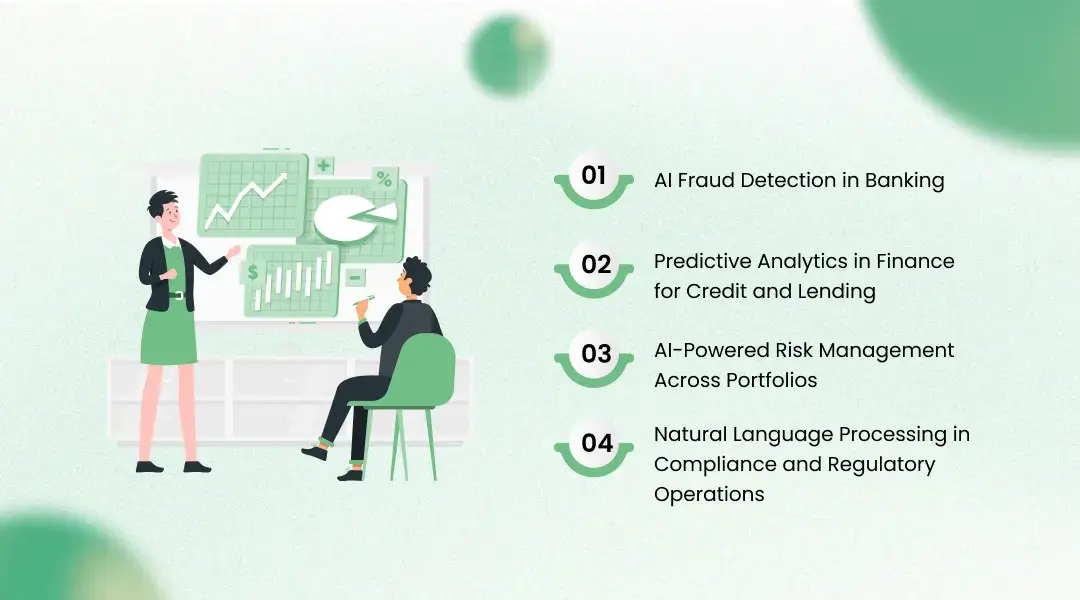
AI in financial services does not arrive as a single platform that replaces existing systems. It arrives as a set of technologies, each precisely mapped to a specific operational problem, and the institutions achieving the strongest results are those that make this mapping explicit before selecting any technology.
AI fraud detection in banking is the most mature and highest-returning application of machine learning in the financial sector. Traditional rule-based fraud systems flag transactions based on static thresholds, such as a transaction over a certain dollar amount in a new geography or a card used more than five times in an hour. These rules generate high false-positive rates, often between 90% and 95% of flagged transactions being legitimate, which creates friction for genuine customers and consumes analyst capacity reviewing alerts that produce no fraud findings.
Machine learning models trained on transaction sequences identify fraud by detecting behavioral anomaly rather than threshold breach. A neural network monitoring account activity learns the individual behavioral signature of each account holder, including typical merchants, transaction timing, device characteristics, and geographic patterns. A transaction that is unremarkable by any static rule but that is out of pattern for this specific account at this specific time generates a risk signal that the model surfaces for review. This approach reduces false positives by 50% to 70% at institutions that have replaced rule-based systems with ML-based behavioral models, while simultaneously improving detection rates for novel fraud patterns that no rule had yet been written to catch.
Machine learning in lending decisions is changing the credit underwriting function in ways that simultaneously improve financial inclusion and reduce default rates. Traditional models use a narrow variable set that systematically disadvantages credit-invisible populations, including recent immigrants, young adults, and those who primarily operate in cash. Machine learning models trained on alternative data sources including utility payment history, rental payment data, bank transaction patterns, and device usage metadata can assess creditworthiness for populations that traditional scoring frameworks cannot adequately evaluate.
The operational impact is equally significant. Predictive analytics in finance has compressed the small business loan underwriting cycle from an industry average of 14 to 21 days down to under 24 hours at institutions using ML-powered decisioning, and to under five minutes at fintech lenders operating fully automated credit pipelines. For a bank processing 10,000 small business applications per year, this acceleration translates directly into revenue capture from applicants who would otherwise accept competitive offers while waiting.
AI-powered risk management in portfolio-level credit and market risk moves institutions from quarterly snapshot analysis to continuous monitoring. Traditional credit risk frameworks assess portfolio concentration, sector exposure, and counterparty risk on monthly or quarterly cycles. Between assessments, conditions change without triggering any internal alert. A retail sector concentration that was within policy limits in January may have crossed a risk threshold by March if a major retail borrower has shown early stress indicators that the quarterly review would not catch.
Machine learning models consuming continuous data streams, including borrower financial filings, news sentiment, supply chain indicators, and market pricing signals, identify portfolio stress in near real time. KriraAI, which builds enterprise-grade AI solutions for regulated industries including financial services, has implemented portfolio monitoring architectures that reduce the time between a risk signal emerging and reaching a risk committee from weeks to hours, fundamentally changing the operational tempo of risk management.
Natural language processing is automating the compliance workflows that consume the largest portions of compliance operating budgets. Know Your Customer documentation review, Suspicious Activity Report drafting, regulatory change monitoring, and contract analysis are all document-intensive processes that have historically required trained analysts to read, categorize, and act on large volumes of text.
NLP models trained on financial regulatory language extract relevant entities and relationships from KYC documents, draft SAR narratives from structured transaction data, and flag material changes in regulatory guidance as published. A bank that previously assigned three to five analysts full-time to regulatory change monitoring can now handle the same function with one analyst reviewing and approving AI-generated summaries. The labor savings are significant, but the accuracy improvement is equally important: NLP systems do not develop attention fatigue reading the fourteenth policy document of the day.
The business case for AI in financial services is no longer built on projected future value. It is being built on audited results from deployments that are already operational.
On AI fraud detection in banking, institutions that have deployed machine learning behavioral models report fraud loss reductions of 40% to 60% within 12 months of full deployment. For a bank with $50 million in annual fraud losses, a 50% reduction represents $25 million in direct bottom-line recovery. The same deployments report false-positive rate reductions of 50% to 70%, which translates into reduced friction for genuine customers and a measurable improvement in card retention rates among customers who previously churned following false fraud blocks.
Machine learning in lending decisions is delivering equally documented returns. Several regional banks that have implemented ML-powered underwriting report 25% to 35% improvements in credit loss rates within the first 18 months, driven by the model's ability to identify early stress indicators that manual underwriting misses. Simultaneously, auto-decisioning rates have increased from industry averages of 40% to 50% for consumer credit up to 75% to 85% at institutions with mature ML pipelines, cutting cost per application significantly.
AI-powered risk management implementations at mid-size banks report that portfolio stress events are identified an average of 6 to 8 weeks earlier than they were under quarterly review cycles. For a bank with significant commercial real estate exposure, identifying a concentration risk 6 weeks earlier can be the difference between an orderly position reduction and an emergency write-down.
Compliance cost reductions through NLP-driven automation are among the most immediate returns in financial AI. Institutions implementing AI-assisted KYC review report 60% to 70% reductions in the analyst hours required per customer file, bringing per-case processing costs from $50 to $200 per file down to $15 to $40 per file at institutions with large compliance workforces. SAR drafting automation reduces the average time from investigation completion to filing from 3 to 5 days down to 4 to 8 hours at institutions where NLP systems generate the narrative draft for analyst review and approval.
KriraAI's work with enterprise clients in regulated industries consistently demonstrates that the institutions achieving the strongest AI returns treat the business case documentation as an ongoing operational process rather than a one-time justification. Establishing baseline metrics before deployment and measuring against them monthly through the first year of operation produces returns that are both more accurately reported and more defensible to regulators and boards.
Implementing AI in financial services requires a structured approach that respects the regulatory, technological, and organizational complexity of the sector. The institutions that achieve measurable results within 12 months share one distinguishing characteristic: they complete a rigorous operational and data readiness assessment before selecting any technology vendor or initiating any pilot program.
The implementation process for a financial institution moves through five connected stages:
Data and regulatory readiness assessment: A systematic audit of data availability, data quality, regulatory permissions for model use, and existing governance frameworks. This stage produces a clear picture of which use cases are immediately viable, which require data remediation before they can be pursued, and which present regulatory considerations that require pre-deployment legal review. This stage should take four to eight weeks.
Model governance and explainability framework: Financial institutions operate under regulatory requirements, including the Equal Credit Opportunity Act, Fair Housing Act, and in Europe the General Data Protection Regulation, that require AI models influencing credit or risk decisions to be explainable and auditable. Establishing the model governance framework before any model is trained is not optional in regulated financial services. It determines which model architectures are permissible and what documentation must accompany each deployment.
Focused pilot program on a single high-impact use case: The fraud detection function is typically the best pilot starting point for retail banks because it generates measurable results within 90 days, it does not involve regulatory approval for model outputs in the same way credit models do, and the baseline metrics are clearly defined. A 90-day pilot with clearly defined success criteria produces a business case for scaling that is grounded in the institution's own operational data rather than vendor projections.
Evaluation, adjustment, and phased scaling: A structured post-pilot review assessing model performance, operational integration, and staff adoption against the baselines established in Stage 1. Scaling should add one deployment at a time rather than launching five simultaneous use cases. The operational and governance burden of managing multiple parallel AI deployments without a mature MLOps function typically produces worse results than sequential scaling.
MLOps infrastructure and continuous monitoring: AI models in financial services require continuous performance monitoring because the data distributions they were trained on shift over time. A fraud detection model trained before a major fraud pattern change will degrade in accuracy without automated drift detection and retraining protocols. Building the MLOps infrastructure to monitor, retrain, and redeploy models as a managed operational process is the difference between an AI deployment that delivers sustained value and one that delivers strong initial results followed by degradation.
The most frequent failure mode in financial AI implementation is initiating a pilot without establishing regulatory compliance for the intended model use. A credit decisioning model that is deployed without an explainability framework, an adverse action notice protocol, and a disparate impact testing process can generate significant regulatory and legal exposure, and several US banks have paid material penalties for precisely this failure.
A second common mistake is underinvesting in data governance before training models. A fraud model trained on transaction data that has not been standardized across legacy system migrations will encode historical data artifacts as signal, producing confident predictions on patterns that reflect data quality issues rather than genuine behavioral patterns.
A third mistake, which KriraAI's implementation teams observe consistently across financial sector engagements, is treating AI deployment as a technology project rather than an organizational change program. Risk officers, compliance analysts, and underwriters whose judgment is being supplemented or replaced by model outputs need structured onboarding to understand how model outputs should inform their decisions. Without this, model recommendations are ignored by the people who receive them, and the institution absorbs the deployment cost without capturing the operational benefit.
Implementing AI in financial services involves genuine obstacles that any honest implementation strategy must address directly without minimizing their significance.
Data quality in financial institutions is systematically worse than most technology project sponsors expect when they begin an AI initiative. Core banking systems that have undergone multiple migrations, acquisitions, and product launches carry data inconsistencies that are invisible during routine operations but become visible when a machine learning model attempts to train on them. Transaction category codes that were applied differently before and after a 2014 system migration produce a discontinuity in training data that the model interprets as a behavioral pattern shift. Resolving these issues before model training is essential, and the time required is routinely underestimated by a factor of two to three.
Model explainability requirements create a genuine tension between regulatory compliance and model performance. The most accurate fraud detection and credit risk models are often deep neural networks whose internal decision logic cannot be articulated in terms that satisfy adverse action notice requirements or regulatory examination. Institutions must choose between a more accurate but less explainable model and a somewhat less accurate but fully interpretable model, and the right choice depends on the regulatory context of the specific use case.
Talent scarcity affects financial AI implementation in ways that are structurally different from other sectors. Financial institutions require AI engineers who understand both the technical architecture of machine learning systems and the regulatory constraints governing their use. This combination is scarce. Hiring a machine learning engineer from a technology company who does not understand the Bank Secrecy Act, the Model Risk Management Guidance SR 11-7, or the Fair Credit Reporting Act creates regulatory risk that technical competence alone cannot mitigate.
Vendor due diligence adds timeline and cost to every deployment. Regulated financial institutions cannot deploy third-party AI systems without conducting technology due diligence, legal review of data processing agreements, and regulatory pre-approval in some jurisdictions. This process adds four to twelve weeks to deployment timelines for each new vendor engagement, making the total cost of ownership for point solutions significantly higher than their licensing costs suggest.
Change management in financial services is complicated by the deeply specialized nature of risk judgment. Senior credit officers, fraud analysts, and compliance directors have built their professional reputations on the quality of their judgment, and model outputs that contradict that judgment are frequently dismissed rather than investigated. Framing AI systems as tools that augment and document expert judgment rather than replace it produces meaningfully higher adoption rates in financial services than in sectors where the work is less judgment-intensive.
Looking ahead to 2029 and 2030, AI in financial services will have progressed from solving specific operational problems to orchestrating the core decisioning infrastructure of financial institutions at every level of the market.
[Icon Point Image Title: The Future of AI in Financial Services 01: Autonomous Credit Decisioning 02: Real-Time Portfolio Rebalancing 03: Proactive Regulatory Compliance 04: Hyper-Personalized Financial Advice 05: Agentic Fraud Response]
Autonomous credit decisioning is the nearest-term structural shift. Within three years, the majority of consumer credit and small business lending decisions at well-capitalized institutions will be made by AI systems operating within governance frameworks that require human review only for edge cases and appeals. The competitive advantage will shift entirely from decision quality to decision speed and personalization quality, as the accuracy of ML models at scale exceeds what human underwriting can achieve for standard credit profiles.
Agentic AI systems will begin to appear in treasury and portfolio management functions by 2027. These systems will not simply generate recommendations for human review but will execute defined categories of decision autonomously within parameters set by investment policy statements and risk mandates. The distinction between a model that recommends a trade and an agent that executes it within a defined authorization framework will reshape the regulatory conversation around AI accountability in financial services.
Regulatory compliance will evolve from a document-intensive reactive function to a continuously monitored, AI-managed operational control. By 2028, leading institutions will have compliance architectures that monitor every transaction, customer communication, and employee activity against an AI-maintained regulatory rule library, flagging potential violations in real time rather than discovering them in periodic audits. The institutions that have not built this capability by 2028 will face a structural disadvantage in regulatory examination outcomes that translates directly into capital requirement differentials.
Predictive analytics in finance will extend from institutional portfolios to individual customer financial health. Banks that can accurately model a customer's financial trajectory, including projected income volatility, upcoming large expenditures, and retirement savings adequacy, will deliver financial guidance that drives meaningfully higher product engagement and customer lifetime value than institutions offering generic product recommendations. The competitive divide between AI-capable and AI-absent institutions will be visible in customer retention metrics by 2027.
Three conclusions from the evidence deserve clear restatement. First, AI in financial services is delivering auditable, quantified returns today: 40% to 60% fraud loss reductions, 25% to 35% credit loss improvements, and 60% to 70% compliance processing cost reductions are documented at institutions that have executed structured implementations rather than opportunistic pilots. Second, the difference between implementations that scale and those that stall is consistently found not in the technology but in the quality of the data governance, regulatory compliance framework, and organizational change program built around it. Third, the competitive window for differentiated advantage through AI is narrowing: by 2028, these capabilities will be operational requirements rather than competitive differentiators, and the institutions without them will be explaining their underperformance to boards and regulators rather than enjoying a first-mover advantage.
KriraAI works with financial institutions at every stage of this journey. As a company that builds practical, enterprise-grade AI solutions designed for the specific regulatory and operational constraints of financial services, KriraAI brings both the technical capability to deploy production-quality AI systems and the domain understanding to navigate the governance, compliance, and change management requirements that make financial sector deployments fundamentally different from other industries. The approach begins with a structured data and regulatory readiness assessment that produces a clear, prioritized roadmap grounded in an institution's specific data assets and operational context rather than a generic capability overview. If your institution is ready to move from evaluating AI to deploying it with measurable accountability, contact KriraAI to begin that conversation.
AI in financial services is currently deployed across six major functional areas. In fraud prevention, machine learning models analyze transaction sequences to identify behavioral anomalies that indicate fraud, reducing losses by 40% to 60% at institutions that have replaced rule-based systems. In credit underwriting, ML models process alternative data sources alongside traditional financial variables to produce more accurate creditworthiness assessments and compress underwriting cycles from weeks to minutes. In regulatory compliance, natural language processing systems automate KYC document review, SAR drafting, and regulatory change monitoring at a fraction of the analyst hours previously required. In portfolio risk management, continuous monitoring models identify emerging credit stress 6 to 8 weeks earlier than traditional quarterly review cycles. In customer service, conversational AI handles between 60% and 80% of routine customer inquiries at institutions with mature deployments. In algorithmic trading and portfolio management, predictive models and execution algorithms optimize trade timing and portfolio rebalancing across asset classes.
AI fraud detection in banking delivers measurable benefits across three dimensions simultaneously. First, it reduces direct fraud losses by 40% to 60% through behavioral anomaly detection that identifies novel fraud patterns without requiring a human analyst to first observe and codify them as rules. Second, it reduces false-positive rates by 50% to 70% compared to rule-based systems, eliminating the customer friction and analyst burden associated with reviewing flagged legitimate transactions. Third, it reduces the time to detect and block an active fraud event from hours to seconds by operating in real time on each transaction rather than on batch processing cycles. For a large retail bank with $100 million in annual fraud exposure, these three combined improvements can generate a net financial benefit well in excess of the system's total cost of ownership within the first operational year, making it among the highest-returning AI applications in the financial sector.
Predictive analytics in finance improves credit decisions by expanding the variable set that informs credit assessment beyond the narrow traditional framework of credit score, income, and debt-to-income ratio. Machine learning models can incorporate bank transaction patterns that reveal income volatility, spending behavior, and financial resilience in ways that static income verification cannot capture. They can process utility and rental payment history that demonstrates payment discipline for credit-invisible populations. They can identify early stress signals within existing loan portfolios by monitoring business financial data in near real time rather than relying on annual reviews. The operational result is a reduction of 25% to 35% in credit loss rates at institutions with mature ML underwriting, combined with approval rate improvements for previously underserved segments, producing both risk and revenue benefits from the same capability investment.
The biggest challenges of implementing AI in financial services are data quality, regulatory compliance for model use, talent scarcity, and organizational change management. Data quality problems arise because core banking systems carry years of migration artifacts, inconsistent coding conventions, and historical data discontinuities that become visible only when training machine learning models. Regulatory compliance challenges are specific to financial services: credit models must satisfy explainability requirements under fair lending laws, fraud models must not produce discriminatory outcomes, and any model influencing a material decision requires governance documentation that satisfies SR 11-7 model risk management standards. Talent scarcity is compounded in financial services because the required combination of machine learning expertise and regulatory domain knowledge is extremely rare in the labor market. Change management is uniquely difficult in an industry where professional identity is closely tied to expert judgment, making AI adoption frameworks that position models as tools augmenting expert decision-making more effective than those framed as automation of human roles.
AI will change the future of banking and financial services by shifting competitive advantage from the scale of capital and branch networks to the quality of data infrastructure and analytical capability. Within three to five years, credit decisioning, fraud prevention, and compliance monitoring at competitive institutions will be primarily AI-managed, with human expertise concentrated on governance, exception handling, and strategic judgment. Financial advice will become genuinely personalized at scale, with AI systems modeling individual customer financial trajectories and proactively recommending interventions rather than reactively responding to product inquiries. Institutions that have not built foundational AI capability by 2028 will face structurally higher operating costs, higher regulatory examination risk, and lower customer retention rates than AI-capable competitors, making the investment decision no longer a question of strategic aspiration but of operational viability.
Founder & CEO
Divyang Mandani is the CEO of KriraAI, driving innovative AI and IT solutions with a focus on transformative technology, ethical AI, and impactful digital strategies for businesses worldwide.