AI in Education Case Study: Cutting Student Dropout Risk
This AI in education case study begins with a pattern that was both predictable and expensive. A learner would drift out of a course somewhere between weeks three and five. Nobody noticed until the withdrawal had already been filed and processed. For a leading online higher education provider serving more than 180,000 active learners, that silence was costing millions each term.
The provider was not short on data. Every click, every video scrub, every late submission was captured somewhere. The problem was that none of it reached a decision maker in time to matter. Advisors were reacting to withdrawals rather than preventing them.
KriraAI was engaged to close that gap between signal and action, applying our machine learning for student success practice to a problem the client had tried and failed to solve with static reporting. We are an AI solutions company that builds and operates production-grade systems for enterprise clients. This post walks through the exact problem we solved, the system we designed, the architecture we shipped, and the measured results the client saw within two academic terms.
The Problem KriraAI Was Called In To Solve
The operational reality was a retention process built entirely on hindsight. Advisors reviewed static spreadsheets exported from the learning management system every two weeks. By the time a name appeared on a watch list, the learner had often already disengaged for ten or more days. Reducing student dropout rates was a stated institutional goal, yet the workflow guaranteed that intervention arrived late.
The data existed but was fragmented across systems that never spoke to each other. Clickstream telemetry lived in the LMS. Enrollment and demographic records live in the student information system. Assignment history lived in a third database with its own identifiers.
No single team held a unified view of a learner. Entity resolution across these systems was done manually, inconsistently, and only when someone had time. As a result, the same student could appear as three different people depending on which report you read.
The second broken workflow was feedback. Instructors were grading open-ended assignments by hand on an enormous scale. Turnaround averaged six to nine days across most courses. Feedback quality varied widely between instructors and even between assignments from the same instructor on a heavy week.
Slow feedback compounded the retention problem directly. Learners who waited a week for a comment often disengaged before the comment arrived. The teaching staff knew this but had no way to act on it. Every additional assignment simply widened the backlog.
The costs accumulated across three fronts at once. Lost tuition from preventable withdrawals was the largest line item. Instructor overtime on grading was second. The advisor's effort spent chasing already lost learners was the third.
Competitive pressure made the status quo untenable. Rival providers were publishing completion rates as a marketing asset. Accreditation reviews were placing growing weight on learner outcomes. The client could not defend a manual, reactive process against competitors moving toward predictive intervention.
What KriraAI Built
KriraAI designed and delivered a production AI student retention system that unified learner signals, scored risk daily, and generated rubric-aligned feedback drafts for instructor review. The platform replaced the biweekly spreadsheet ritual with a continuously updated intelligence layer. It augmented instructors rather than replacing their judgment.
The system does three things end-to-end. First, it ingests every meaningful learner event and resolves it to a single canonical identity. Second, it predicts which learners are drifting toward withdrawal and explains why. Third, it drafts formative feedback on open-ended work so instructors can review and release comments in hours rather than days.
At the core sit two distinct model families working in concert. The at-risk engine is a transformer-based sequence encoder trained on ordered streams of learner events. It reads behavior over time the way a language model reads a sentence, learning the temporal patterns that precede disengagement. This is machine learning for student success applied to raw behavioral sequences rather than static snapshots.
The feedback engine is a retrieval-augmented generation pipeline built on a fine-tuned open-weight large language model. It grounds every comment in the specific rubric and course material for the assignment. A contrastive learning stage aligns learner submission embeddings with rubric criterion embeddings so retrieval surfaces the right standard, not a generic one.
Data flows through the system in a deliberate sequence. Events stream in continuously and are transformed into features in near real time. Those features feed the risk model, which emits a calibrated score and a ranked list of contributing factors for each learner every day. Advisors receive a prioritized outreach queue rather than an undifferentiated spreadsheet.
Decisions reach the people who act on them through the tools they already use. Risk scores and explanations appear inside the advisor console and the instructor dashboard. Feedback drafts appear directly in the grading view, pre-populated and clearly marked for human review. Nothing is released to a learner without an instructor approving it.
A third component decides how to intervene once risk is detected. KriraAI implemented a contextual bandit that selects among intervention types such as an automated nudge, a peer study prompt, or a live advisor call. The bandit learns which intervention works for which learner segment over time. This closes the loop between prediction and measurable outcome.
The result is a system that turned dormant data into timely action. What was once a lagging report became a leading indicator. The client moved from explaining withdrawals to preventing them.
Solution Architecture Behind This AI in Education Case Study
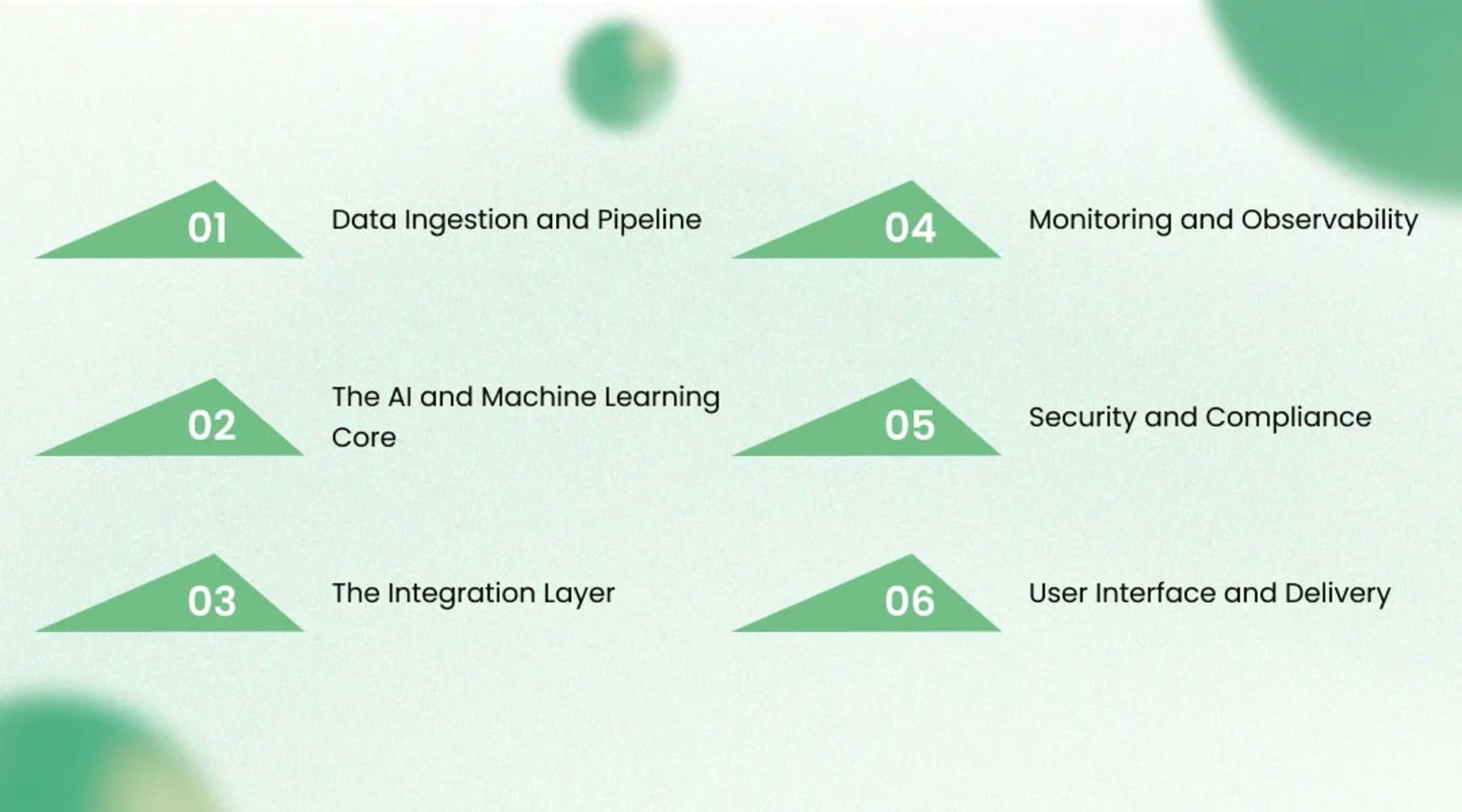
The architecture in this AI in education case study was designed as a hardened production platform, not a proof of concept. Every layer was chosen to handle roughly 40 million learning events per day at predictable latency. The sections below walk through each layer, the decisions we made, and the engineering rationale behind them.
Data Ingestion and Pipeline
Ingestion had to reconcile three fundamentally different data velocities. Operational records were captured through change data capture from the LMS PostgreSQL databases using Debezium. Those change events were published onto Apache Kafka topics as the system of record for downstream consumers. This gave us an ordered, replayable log rather than brittle nightly extracts.
Behavioral telemetry arrived as a high-volume event stream. The LMS emitted xAPI and Caliper events for every learner interaction. Apache Flink consumed these streams and computed windowed features such as session gaps, submission velocity, and video completion ratios in near real time. Batch extraction from the student information system was orchestrated separately through Apache Airflow DAGs.
Transformation logic did the heavy reconciliation work. We built an identity resolution stage that mapped conflicting learner keys across the LMS, the SIS, and the assignment store into one canonical graph. Schema normalization and temporal feature engineering ran inside dbt models over the warehouse. Embedding generation for submissions happened at ingestion time, so retrieval never waited on it later.
A feature store unified the offline and online paths. KriraAI deployed Feast with an offline store on Snowflake for training and an online store on Redis for low-latency scoring. This guaranteed that the features used in training matched the features served at inference. Eliminating that training and serving skew was a non-negotiable design goal.
The AI and Machine Learning Core
The at-risk model is a transformer-based sequence encoder rather than a tabular classifier. Learner event sequences are tokenized and passed through self-attention layers that capture long-range temporal dependencies. Training used supervised fine-tuning on labeled outcomes from prior cohorts. We handled severe class imbalance with a cost-sensitive loss and post hoc probability calibration.
Explainability was built in, not bolted on. Every score is accompanied by SHAP-based attributions,s so advisors see the specific behaviors driving the risk. Distributed training ran across a multi-GPU cluster using PyTorch with data parallelism. Retraining is scheduled and also triggered automatically when evaluation metrics degrade.
The feedback model is a fine-tuned open-weight large language model in the Llama 3 family. We adapted it with QLoRA on a curated corpus of exemplar instructor feedback and rubrics. A direct preference optimization stage aligned tone and specificity to the institution's standards. Retrieval-augmented generation grounds each draft in the exact rubric and reading material for that assignment.
Serving was engineered for throughput and cost. The language model runs on vLLM with quantized weights for high-concurrency batching. Retrieval uses a vector index with HNSW graphs for fast approximate nearest neighbor search. This core is machine learning for student success,s expressed as two specialized models sharing one feature and embedding foundation.
The Integration Layer
The integration layer connected the AI outputs to the client's existing operational tools. Internal services communicated over gRPC for low-latency scoring calls between the feature store, the model servers, and the orchestration service. External and partner-facing contracts were exposed through versioned REST and GraphQL APIs. Versioning was mandatory so the LMS could evolve without breaking the scoring service.
The whole system was event-driven at its core. Kafka topics carried risk scores and feedback-ready signals to downstream consumers. Webhook-based triggers pushed flags and drafts into the instructor dashboard the moment they were produced. Integration with the LMS itself used the LTI 1.3 standard,d so the experience sat natively inside existing courses.
Monitoring and Observability
Observability treated model quality as a first-class production concern. Data drift was tracked continuously using a population stability index and KL divergence on incoming feature distributions. Model performance was measured against held-out evaluation sets, with the at-risk model watched on the area under the precision-recall curve. When performance crossed a defined threshold, an automated retraining pipeline was triggered.
Operational telemetry ran alongside model telemetry. Latency was tracked at p50, p95, and p99 across the scoring and generation paths. Prometheus and Grafana handled metrics and dashboards while OpenTelemetry provided distributed tracing. Evidently powered drift reporting, and MLflow served as the model registry and experiment tracker.
The feedback model carried extra guardrails because it generates language. Groundedness checks verified that each draft was supported by retrieved rubric context. A sampled human review loop and an automated evaluator flagged any output that drifted off the rubric. Hallucinated or off-standard drafts were caught before an instructor ever saw them.
Security and Compliance
Student data demanded strict controls from the first design session. The platform was built for FERPA compliance and for GDPR obligations covering international learners. Role-based access control governed every read, with attribute-level masking applied to personally identifiable fields. Learner records were de-identified before any language model ever processed them.
Infrastructure was locked down by default. The system ran inside a private VPC with no public endpoints and private connectivity between services. Model inputs and outputs were encrypted in transit and at rest under managed keys. Every access and decision was written to an immutable, append-only audit store for accreditation and review.
User Interface and Delivery
Delivery mattered as much as prediction because unused insight has no value, a lesson that echoes what we've seen building voice AI in online learning tools for the same kind of learner. Advisors received a prioritized outreach console showing risk cohorts, SHAP explanations, and recommended interventions. Instructors received feedback drafts inside their existing grading view, clearly labeled and editable. Every high-stakes action required a human to approve it before it reached a learner.
The Technology Stack Behind the Platform
Every technology in this stack was selected against the client's real constraints of scale, latency, and existing environment. The choices below were deliberate, and each was weighed against credible alternatives.
Apache Kafka was chosen as the ingestion backbone because the client needed a replayable, ordered event log rather than fragile batch jobs. It also gave every downstream consumer a single consistent source of truth.
Apache Flink handled stream processing because feature freshness of seconds, not hours, was required for daily scoring. A pure batch approach would have reintroduced the very lag we were hired to remove.
Debezium provided change data capture so we could mirror operational databases without adding load through polling. This kept the client's transactional systems fast and untouched.
Feast was selected as the feature store specifically to guarantee parity between offline training features and online serving features. That parity removed an entire class of silent production bugs.
A Llama 3 family open-weight model was chosen over a closed API so student data never left the client's private environment. Self-hosting also gave us full control over fine-tuning and serving costs.
vLLM was used for model serving because its batching and quantized inference delivered the concurrency the feedback workload demanded. Alternative servers could not match the throughput per GPU at our target latency.
An HNSW vector index was selected for retrieval because it offered the best balance of recall and query speed at the corpus size involved. This kept the grounded generation responsive under load.
Snowflake and Redis paired the analytical depth of a warehouse with the millisecond reads of an in-memory store. This split let the same features serve both training and real-time scoring cleanly.
How We Delivered It: The Implementation Journey
This AI implementation in higher education, part of our broader work in education technology solutions, ran from the first workshop to full production in roughly seven months. KriraAI structured the engagement into six deliberate phases, so risk was retired early, and value arrived incrementally. We favored shadow deployment over big bang cutover at every step.
The delivery phases proceeded in the following order:
Discovery and requirements ran for the first four weeks and covered a full data audit, stakeholder interviews, and agreement on how withdrawal risk would be labeled.
Architecture design followed, where we finalized the layered platform, the feature contracts, and the security model with the client's information security team.
Development spanned the core build of the ingestion pipelines, the two model families, and the integration layer against the live LMS.
Testing and validation put the risk model into a shadow mode that scored learners without acting, so predictions could be backtested against real outcomes.
Deployment rolled out the platform department by department rather than all at once, which contained risk and let us tune per program.
Handover delivered runbooks, retraining automation, and hands-on training so the client's own team could operate the system confidently.
The real challenges appeared during development, as they always do. Data quality was the first obstacle. Event schemas differed across course templates, and timestamps arrived in inconsistent time zones. We resolved this with a canonical event schema and a normalization stage that standardized every timestamp before feature computation.
Entity resolution was harder than anticipated. The same learner carried different identifiers in the LMS and the SIS, which corrupted early training labels. KriraAI built an identity graph that reconciled these keys deterministically, and label quality improved sharply once it was in place.
The first at-risk model also missed its target in a revealing way. Recall was high, but precision was low, which flooded advisors with false alarms and threatened alert fatigue. We retrained with a cost-sensitive loss, added calibrated probabilities, and engineered richer temporal features. Precision climbed to 0.81, and advisor trust followed.
The feedback model needed its own correction. Early drafts occasionally strayed from the assignment rubric into generic advice. We tightened retrieval grounding, constrained generation to the retrieved rubric context, and gated everything behind instructor approval. Off-rubric drafts effectively disappeared after that change.
Results the Client Achieved
The measured results confirmed the investment within two academic terms of go-live. KriraAI tracked outcomes against clear before-and-after baselines for the intervention cohorts. The numbers below reflect confirmed production performance, not projections.
The headline outcomes were as follows:
Preventable withdrawals fell by 27 percent across the intervention cohorts compared with the prior baseline terms.
Course completion rose from 68 percent to 79 percent for programs running the full retention workflow.
At-risk learners were surfaced about 19 days earlier than the previous biweekly spreadsheet process allowed.
Learners who received a timely intervention re-engaged at 31 percent, against an 11 percent baseline for unaddressed disengagement.
The feedback engine delivered a parallel operational win. Feedback turnaround dropped from an average of seven days to under 12 hours. Instructor grading load fell by 43 percent because drafts arrived pre-written for review. Instructors accepted 78 percent of drafts with only light edits, which validated the grounding approach.
Reliability held up under real load throughout. Risk scoring sustained a p95 latency under 400 milliseconds at roughly 40 million daily events. This combination of retention gains, faster feedback, and stable performance is how reducing student dropout rates translated into retained tuition and defensible outcomes.
What This Architecture Makes Possible Next
The platform was engineered to grow without a rebuild, which is where its long-term value lies. Because ingestion runs on Kafka and Flink, rising event volume is absorbed by scaling consumers horizontally rather than re-architecting anything. The feature store already separates compute from storage, so heavier workloads add capacity, not complexity.
New use cases extend the existing foundation directly. The same event streams and feature store can power course recommendation, workload balancing, or credential pathway guidance with new model heads. Adding a use case means training against features that already exist, not building a fresh pipeline. This is the compounding advantage a well-designed platform creates.
The client's roadmap for the next two to three years builds squarely on this base. Planned additions include a learner-facing study assistant grounded in the same retrieval layer and predictive capacity planning for instructor staffing. Each new capability inherits the security, monitoring, and identity resolution already in production. That inheritance is what makes further AI implementation in higher education fast and safe for this client.
Other institutions can apply the same principles even with different tooling. The durable lessons are to unify identity first, to store features once for both training and serving, and to keep a human in the loop on every high-stakes output. Any provider that adopts those three patterns can turn dormant learning data into timely, trustworthy action.
Conclusion
Three insights defined this engagement. The technical insight was that learner behavior is a sequence, and modeling it as one with a transformer encoder unlocked predictions that static reports never could. Grounding every generated comment in a specific rubric was what made automated feedback trustworthy at scale.
The operational insight was that prediction is worthless until it reaches the person who acts. Value appeared only when risk scores and feedback drafts landed inside the tools instructors and advisors already used. The strategic insight was that a unified data and feature foundation turns each new AI use case into a fast extension rather than a fresh project.
KriraAI brings this same engineering rigor and delivery discipline to every client we work with, the kind you'll also find in our AI fraud detection case study for a banking client. We design production systems with real monitoring, real security, and a human in the loop where it counts, because that is what separates a durable platform from a demo. This AI in education case study reflects how we approach machine learning for student success and every other hard problem our clients face. If you are carrying an AI challenge of your own, bring it to KriraAI and let us build the system that solves it.
FAQs
AI predicts student dropout by modeling each learner's behavior as an ordered sequence of events over time rather than as a static snapshot. In this AI in education case study, a transformer-based sequence encoder reads signals such as session gaps, submission velocity, and video completion to learn the temporal patterns that precede disengagement. The model emits a calibrated daily risk score alongside SHAP explanations that show advisors exactly which behaviors are driving the concern, so intervention can happen while it still matters.
Yes, AI improves student retention when predictions reach the right people early enough to act. For the provider in this engagement, an AI student retention system cut preventable withdrawals by 27 percent and lifted course completion from 68 percent to 79 percent within two academic terms. The gain came from surfacing at-risk learners about 19 days sooner than the old biweekly review, then routing each learner to the intervention most likely to re-engage them through a contextual bandit that learns over time.
An AI student retention system uses behavioral, academic, and enrollment data unified under a single canonical learner identity. In this case study, KriraAI ingested LMS clickstream telemetry through xAPI and Caliper events, operational records through change data capture, and student information system records through scheduled batch extraction. All personally identifiable fields were masked and de-identified before any model processing, and features were computed in near real time so risk scoring reflected current behavior rather than data that was already several days old.
AI-generated feedback is accurate when it is grounded in the specific rubric for the assignment and kept under human review. In this deployment, a retrieval-augmented generation pipeline drafted comments anchored to the exact rubric and course material, and instructors approved every draft before release. Instructors accepted 78 percent of drafts with only light edits, and turnaround fell from seven days to under 12 hours. Grounding, a human approval gate, and automated off-rubric checks together kept quality high and hallucinations out of learner-facing feedback.
A production AI implementation in higher education typically takes several months when it is engineered as a hardened system rather than a pilot. KriraAI delivered this platform from first workshop to full production in roughly seven months across six phases covering discovery, architecture, development, validation, deployment, and handover. The timeline included shadow mode testing, so predictions were backtested against real outcomes before any action was taken, plus a phased rollout by department that contained risk while the models were tuned per program.
Founder & CEO
Divyang Mandani is the CEO of KriraAI, driving innovative AI and IT solutions with a focus on transformative technology, ethical AI, and impactful digital strategies for businesses worldwide.