
AI in e-commerce is no longer a competitive advantage reserved for Amazon and Alibaba. According to McKinsey, AI-driven personalization alone can lift e-commerce revenues by 10 to 15 percent, and retailers that fail to adopt intelligent systems are already losing measurable ground to those that have. By 2026, global e-commerce sales are projected to exceed 7.4 trillion dollars, yet average cart abandonment rates remain stubbornly above 70 percent, conversion rates hover between 1 and 4 percent across most categories, and customer acquisition costs have risen over 60 percent in the past five years. The gap between what shoppers expect and what most e-commerce operations can deliver is widening fast.
This blog covers the specific AI technologies being deployed across e-commerce today, the quantified results companies are achieving, a practical implementation roadmap for retailers at any stage, the honest challenges that adoption brings, and where the industry is heading over the next three to five years. Whether you operate a mid-market brand or a large retail enterprise, investing in robust machine learning development over the next 12 months will define your competitive position for the decade ahead.
To understand why AI has become structurally necessary in e-commerce, you need to understand the operating environment retailers are navigating today. It is one of the most demanding cost and complexity environments in modern commerce, and it is getting harder, not easier.
Customer acquisition has become the central financial burden of online retail. Paid social and search advertising costs have climbed sharply as platforms consolidate and competition intensifies. For many direct-to-consumer brands, customer acquisition cost now exceeds first-order lifetime value, meaning profitability depends entirely on repeat purchase rates that most brands cannot reliably predict or engineer. The average return on ad spend across e-commerce categories has declined steadily, while attribution has become increasingly difficult as tracking restrictions tighten.
Logistics and fulfillment represent another compounding pressure. Consumer expectations for delivery speed were permanently shifted by Amazon Prime, and most retailers now operate under the assumption that two-day or same-day delivery is a baseline requirement rather than a premium feature. This expectation forces significant investment in warehousing, last-mile logistics, and inventory positioning, yet demand volatility makes it extremely difficult to position inventory correctly without sophisticated forecasting. Overstock and stockout costs combined represent an estimated 1.75 trillion dollars in lost value globally each year across retail.
Returns have evolved into a structural cost center that many brands struggle to control. In fashion and apparel, return rates online routinely exceed 30 percent. Each return generates a reverse logistics cost, a restocking cost, and often a markdown cost when the returned item cannot be resold at full price. The aggregate financial impact of returns on gross margin is severe, and most e-commerce platforms have only rudimentary tools for predicting or reducing return likelihood at the moment of purchase.
On the demand side, customer expectations for relevance have shifted dramatically. Shoppers increasingly expect that an e-commerce site will know what they want before they search for it, surface products that match their style and budget without browsing friction, and resolve service issues instantly without human intervention. Generic product grids and basic keyword search are no longer sufficient to meet this expectation. The operational infrastructure of most e-commerce businesses, built on legacy platforms and siloed data systems, was not designed for this level of personalization at scale.
Competitive dynamics have also intensified through marketplace fragmentation. Sellers must now manage presence across their own direct-to-consumer site, Amazon, TikTok Shop, Google Shopping, and emerging social commerce platforms simultaneously. Each channel has different inventory requirements, pricing dynamics, and customer behavior patterns. Managing multi-channel e-commerce without intelligent automation creates enormous operational complexity and creates data silos that prevent a unified view of customer behavior.
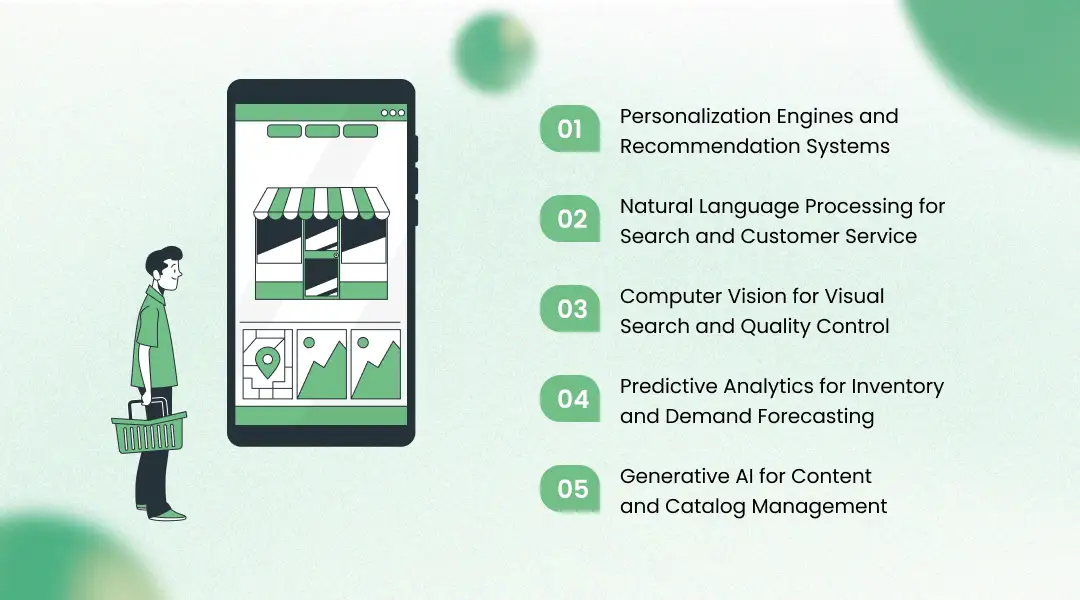
AI addresses the structural problems described above not through general automation but through a specific set of technologies mapped to specific problems. Understanding which technology solves which problem is essential for making intelligent investment decisions.
Ecommerce personalization AI is the most commercially mature application of machine learning in retail. Collaborative filtering and deep learning models analyze behavioral signals including browse history, purchase frequency, time-on-page, search queries, and cart interactions to predict which products a specific user is most likely to purchase next. These systems operate in real time and update with every click, enabling product recommendation carousels, personalized email campaigns, and dynamic homepage layouts that reflect individual intent rather than aggregate popularity.
The practical application extends beyond product recommendations. Personalization AI now powers dynamic pricing displays that show different promotional offers to different user segments based on purchase likelihood scores, price sensitivity signals, and loyalty status. It also powers search ranking, ensuring that when a customer types "running shoes," they see results ranked by their personal preference signals rather than by global sales rank. For clients leveraging tailored AI in retail and e-commerce, building robust personalization infrastructure that connects behavioral data across channels is consistently one of the highest-ROI interventions available.
Standard keyword search fails e-commerce customers in two ways. It cannot interpret the intent behind ambiguous queries, and it cannot handle the natural language descriptions that customers actually use when they do not know precise product terminology. Natural language processing transforms site search into a semantic system that understands queries like "something warm for a winter wedding" and maps them to relevant product attributes, even when no product description contains exactly those words.
AI customer service in e-commerce represents the second major NLP application. Conversational AI systems trained on product catalogs, order management data, and FAQ knowledge bases can now resolve 60 to 80 percent of inbound customer service contacts without human intervention. These systems handle order status inquiries, return initiations, product questions, and complaint resolution with response times measured in seconds rather than hours. The quality gap between AI-handled and human-handled contacts has narrowed significantly as large language model technology has matured.
Computer vision enables shoppers to upload a photo of a product they have seen elsewhere and find a visually similar item within a retailer's catalog. This capability is particularly powerful in fashion, home decor, and furniture categories where customers often discover products through social media images and struggle to translate visual inspiration into text queries. Retailers using visual search report meaningful increases in conversion rates from users who engage with the feature compared to those using text search alone.
In warehouse and fulfillment operations, computer vision systems inspect products for damage, verify pick accuracy, and automate quality control steps that previously required human visual inspection. These systems operate at machine speed, reducing inspection bottlenecks and catching defect rates that human checkers would typically miss at volume.
Retail automation AI applied to demand forecasting uses machine learning models trained on historical sales data, promotional calendars, weather patterns, social trend signals, and macroeconomic indicators to generate item-level demand forecasts significantly more accurate than traditional statistical methods. These forecasts feed directly into purchasing, warehouse slotting, and fulfillment routing decisions.
The downstream impact on working capital is substantial. When inventory is positioned correctly based on accurate forecasts, carrying costs fall, stockout rates drop, and markdown frequency decreases. KriraAI has implemented predictive inventory systems for e-commerce operators that reduced excess inventory by over 25 percent while simultaneously reducing stockout incidents, a combination that traditional planning processes struggle to achieve simultaneously.
Catalog management and content creation have been transformed by generative AI in ecommerce applications, enabling rapid copy generation and automated SKU enrichment. Writing product descriptions at scale is a resource-intensive process for any retailer managing thousands of SKUs. Generative AI systems trained on a brand's style guide, product attributes, and SEO requirements can produce optimized product descriptions, category page copy, and meta content at a fraction of the cost of manual production. Retailers managing large catalog refreshes or operating across multiple languages gain disproportionate efficiency from this capability.
The business case for AI in e-commerce is not theoretical. Across documented deployments, the performance improvements are specific, measurable, and consistent enough to establish reliable benchmarks for planning purposes.
Ecommerce personalization AI delivers some of the most well-documented returns in the category. Retailers implementing dynamic personalization across the homepage, search results, and email report average revenue per visitor increases of 15 to 30 percent. Segmented email campaigns powered by behavioral prediction models consistently outperform broadcast campaigns, with personalized email sequences generating up to 6 times higher transaction rates than generic campaigns in A/B test conditions.
AI-powered product recommendations directly influence basket size and session value. Amazon's recommendation engine is estimated to drive approximately 35 percent of total revenue, a figure that illustrates the commercial ceiling of the capability when deployed at full maturity. Mid-market retailers implementing recommendation engines report average order value increases of 10 to 20 percent within 90 days of full deployment, with improvements continuing to compound as models accumulate behavioral data.
Inventory optimization through predictive analytics produces some of the most tangible cost savings in e-commerce operations. Companies deploying machine learning demand forecasting report inventory carrying cost reductions of 20 to 35 percent. Stockout reduction rates of 30 to 50 percent are commonly reported, which directly protect revenue that would otherwise be lost to out-of-stock events during peak demand periods.
AI customer service systems in e-commerce deliver documented cost reduction alongside measurable customer satisfaction improvements when implemented correctly. Retailers handling 50,000 or more customer service contacts per month have achieved cost per contact reductions of 40 to 60 percent by automating resolution of tier-one inquiries through conversational AI. Critically, first-contact resolution rates in well-tuned AI systems exceed those of human agents for structured inquiry types such as order status and return processing.
Retail automation AI in logistics and fulfillment, including picking route optimization and warehouse slotting driven by machine learning, has produced throughput increases of 20 to 40 percent in documented fulfillment center deployments. For e-commerce operations running their own fulfillment, this throughput improvement translates directly into capacity expansion without proportional headcount growth, materially improving the unit economics of order fulfillment.
Return rate reduction through AI-driven fit prediction and purchase probability scoring is a newer but rapidly maturing application. Fashion retailers using fit recommendation models and purchase intent scoring have documented return rate reductions of 15 to 25 percent in controlled implementations, which at scale represents significant gross margin recovery given that each return typically costs between 15 and 30 dollars in total logistics and restocking expenses.

Implementing AI in e-commerce requires a structured approach that begins with honest capability assessment rather than with technology selection. Most failed AI projects in retail begin with the wrong sequence: selecting a vendor or platform before understanding the data foundation required to make it work.
The first question every e-commerce operator must answer before any AI investment is whether the underlying data infrastructure can support it. AI systems require clean, connected, and sufficient data to produce reliable outputs. An audit should assess:
Customer data unification across channels, including whether behavioral data from your website, mobile app, email platform, and marketplace accounts is connected to a single customer record.
Product catalog data completeness, including whether attribute data, image quality, and categorization are consistent enough to train recommendation and search models.
Historical transaction depth, specifically whether you have at minimum 12 to 24 months of clean order history across enough SKUs to support meaningful demand forecasting.
Event tracking implementation, confirming that your analytics infrastructure captures behavioral signals at the granularity AI models require.
Most e-commerce businesses at the mid-market level have significant data hygiene work to complete before AI deployment will produce reliable results. Skipping this stage is the single most common reason AI pilots fail to scale.
With a clear data picture, the next stage is selecting a narrow, high-value use case for a time-bounded pilot. A well-designed pilot has a specific hypothesis, a measurable success metric, a clear control condition, and a defined duration. Attempting to implement multiple AI capabilities simultaneously in the first phase creates attribution problems and makes it impossible to understand which intervention is driving results.
Strong first pilot candidates for most e-commerce operators include:
Personalized email recommendation campaigns, because the test is easy to set up, results are measurable within weeks, and the data requirements are manageable.
On-site search improvement through NLP, because search interaction data provides an immediate signal, and conversion impact is directly trackable.
Demand forecasting for a defined product category, because the accuracy improvement against your existing forecast method is directly comparable.
Moving from a successful pilot to full deployment requires integration with core operational systems, including your e-commerce platform, warehouse management system, ERP, and customer service platform. This integration work is where many projects stall. Organizations working with partners like KriraAI, which specializes in building practical AI systems that connect to existing enterprise infrastructure rather than requiring platform replacement, consistently achieve faster time to value than those attempting greenfield implementations.
The following mistakes appear consistently across failed or underperforming AI implementations in e-commerce:
Treating AI as a plug-and-play product rather than a system that requires data preparation, configuration, and ongoing model maintenance.
Setting unrealistic timelines. Most production AI systems in e-commerce require three to six months from data audit to reliable output at scale.
Neglecting change management. AI systems that change how merchandising, customer service, or operations teams work require structured training and adoption support to deliver their designed value.
Measuring AI performance against the wrong benchmarks. AI models should be compared against your existing process performance, not against case study figures from dissimilar businesses.
An honest assessment of AI in e-commerce must acknowledge the real difficulties that organizations encounter, because underestimating them leads to failed projects and misallocated budgets.
Data quality is the most pervasive challenge and the one that surprises the most organizations. The theoretical power of AI models is contingent on the quality and completeness of the data they are trained on. In practice, e-commerce businesses frequently discover that their customer data is fragmented across platforms, their product attribute data is inconsistently structured, and their historical transaction data contains significant gaps or errors. These issues do not automatically resolve when an AI platform is installed, and they require dedicated data engineering work that is often underestimated in project scoping.
Talent gaps represent a genuine constraint, particularly for mid-market retailers. Building and maintaining AI systems requires data scientists, ML engineers, and data engineers who are expensive, scarce, and in high demand across industries. Most e-commerce businesses cannot compete for this talent against technology companies, which is why working with specialized implementation partners rather than attempting to build internal capability from scratch is the more realistic path for most organizations.
Regulatory complexity is increasing for e-commerce AI specifically. Data privacy regulations, including GDPR, CCPA, and emerging national frameworks, constrain how behavioral data can be collected, stored, and used to train personalization models. Retailers operating across multiple geographies must navigate different regulatory regimes simultaneously. Compliance is not optional, and building AI systems that are privacy-compliant by design rather than patching compliance onto existing systems adds complexity and cost.
Integration with legacy platforms is a structural challenge for retailers on older e-commerce platforms or ERP systems. Many AI capabilities require real-time data exchange with core systems, and legacy architectures were not built for this. API limitations, data latency, and system performance constraints can severely limit what AI capabilities can realistically be deployed without significant infrastructure investment.
Change management is consistently underweighted in AI project planning. Merchandising teams whose judgment is being augmented or replaced by algorithmic recommendations, customer service teams whose workflows are being automated, and operations teams whose decisions are being driven by machine forecasts all represent human adoption challenges that no amount of technical quality can automatically resolve.
The capabilities that will define e-commerce competition between 2027 and 2030 are already visible in early-stage deployments today. Understanding where the technology is heading allows retailers to make infrastructure and capability investments now that will compound in value over time.
Autonomous commerce agents represent the most transformative near-term development. AI agents capable of managing the full purchase journey on behalf of a consumer, from intent detection through product selection, price negotiation, and post-purchase service, will increasingly mediate the relationship between brands and shoppers. Retailers whose systems are not agent-accessible through structured APIs will become invisible in this emerging channel, much as retailers without mobile-optimized sites lost relevance in the mobile era.
Hyper-personalization at the individual session level will become the baseline standard rather than a differentiator. Today's personalization engines optimize at the segment or cohort level with individual signals as input. The next generation will generate truly individual experiences: unique product rankings, unique pricing presentations, unique content formats, and unique service interactions calibrated to each user's specific context in real time.
Predictive supply chains will close the loop between demand sensing and supply execution. AI systems that can detect demand signals from social media, search trend data, and behavioral patterns up to 12 weeks before they materialize in transaction data will enable e-commerce operators to position inventory ahead of demand rather than responding to it. This capability will fundamentally shift competitive advantage toward operators with the best data infrastructure and the most sophisticated forecasting models.
Companies that delay AI adoption for two or more years face a compounding disadvantage. AI systems improve as they accumulate data. Organizations that begin building behavioral data assets and training models now will have systems in 2028 that are measurably more capable than systems started then, because the data history will be absent. The competitive moat created by AI in e-commerce is, in significant part, a data moat, and it begins accumulating from the first day of deployment.
Three points from this analysis are worth carrying forward as organizing principles for any e-commerce AI decision. First, the ROI from AI in e-commerce is documented, specific, and available to businesses well below the scale of Amazon or Walmart, provided the investment begins with data infrastructure rather than with technology selection. Second, the competitive moat created by AI in e-commerce accumulates over time through data, meaning that every month of delay is a month of advantage transferred to competitors who have already started. Third, the implementation path is navigable for mid-market and enterprise retailers, but it requires structured execution, honest capability assessment, and a partner who understands both the technology and the operational realities of e-commerce.
This is precisely the domain where KriraAI focuses its work. KriraAI builds practical AI solutions for e-commerce and retail enterprises, with a specific emphasis on connecting AI capabilities to existing operational systems rather than requiring disruptive platform replacement. The team at KriraAI has implemented AI personalization, demand forecasting, and customer service automation for e-commerce businesses across categories, with a consistent methodology that begins with a data readiness assessment and ends with measurable business outcomes. For retailers evaluating where to start or how to accelerate an existing AI program, KriraAI's approach is built on the principle that AI should deliver visible commercial results within a defined timeframe, not serve as a multi-year infrastructure project with deferred value.
If you are ready to explore what AI adoption could look like for your e-commerce business specifically, contact KriraAI to discuss a structured assessment and roadmap built around your current capabilities and commercial priorities.
AI in ecommerce refers to the application of machine learning, natural language processing, computer vision, and generative AI technologies to automate, optimize, and personalize the operations and customer experiences of online retail businesses. These systems work by ingesting data from customer behavior, product catalogs, transaction histories, and external signals, then using statistical models to generate predictions, recommendations, and automated decisions. A personalization engine, for example, builds a model of each customer's preferences based on their click and purchase history, then uses that model to rank which products to show them next. The AI does not follow explicit rules but learns patterns from data, which means its outputs improve as more data accumulates. For ecommerce businesses, the practical applications span merchandising, inventory management, customer service, fraud detection, and marketing optimization.
The cost of implementing AI in ecommerce varies significantly based on the scope of deployment and the existing data infrastructure. A focused pilot program targeting a single use case such as personalized email recommendations or NLP site search can be initiated for between 20,000 and 80,000 dollars depending on integration complexity and vendor selection. Full-scale AI transformation covering personalization, forecasting, and customer service automation for a mid-market retailer typically requires investment in the range of 150,000 to 500,000 dollars over 12 to 18 months. The ROI timeline for well-scoped implementations is typically 6 to 12 months from deployment to measurable payback, with personalization and customer service automation consistently delivering the fastest returns. Organizations that invest in data infrastructure before deployment consistently see faster and higher returns than those that attempt to bypass this foundational work.
An ecommerce business needs three categories of data to support effective AI deployment. First, customer behavioral data including browsing history, search queries, product page engagement, cart interactions, and purchase history connected to persistent customer identifiers across sessions and channels. Second, product catalog data with consistent, complete attribute tagging across the full SKU range, including category, price, brand, material, size, and any product-specific attributes relevant to the business category. Third, transaction history covering at minimum 12 months of order data at the line-item level, including returns, cancellations, and promotional conditions. Most ecommerce businesses have some version of all three categories but find that data quality, consistency, and connectivity across systems requires significant remediation before AI models can be trained reliably. The quality of input data is the single greatest determinant of AI output quality in retail applications.
The most significant risks of AI adoption in ecommerce fall into four categories. First, data privacy risk, where personalization systems that collect and process behavioral data must comply with applicable privacy regulations and can expose businesses to regulatory liability if consent frameworks, data storage, and processing are not compliant by design. Second, model bias risk, where AI recommendation and pricing systems trained on historical data can perpetuate or amplify existing biases in what products are shown to which customers, potentially creating discriminatory outcomes or limiting catalog diversity. Third, over-dependence risk, where heavy reliance on AI-driven decisions in inventory, pricing, or merchandising without human oversight can amplify errors at scale, particularly when models encounter conditions outside their training distribution such as sudden demand shocks or supply disruptions. Fourth, implementation failure risk, which typically stems from insufficient data preparation, unrealistic expectations, or inadequate change management rather than from the technology itself.
AI customer service in ecommerce is fundamentally changing the economics and performance of support operations by enabling resolution of the majority of customer contacts without human intervention. Modern conversational AI systems trained on product data, order management APIs, and return policies can handle order status inquiries, delivery updates, return initiations, product questions, and complaint acknowledgment with accuracy and response times that meet or exceed human agent performance for structured inquiry types. The operational impact is a significant reduction in cost per contact, typically 40 to 60 percent for businesses processing high contact volumes, while simultaneously enabling 24-hour support availability without proportional staffing costs. The customer experience impact is positive when AI systems are designed with clear escalation paths to human agents for complex or emotionally sensitive contacts, and negative when escalation paths are absent or difficult to access. Successful AI customer service implementations in ecommerce treat the AI as the first line of resolution rather than a complete replacement for human judgment.
Founder & CEO
Divyang Mandani is the CEO of KriraAI, driving innovative AI and IT solutions with a focus on transformative technology, ethical AI, and impactful digital strategies for businesses worldwide.