Every week, a team of 40 computational chemists and biologists at a leading biotechnology enterprise manually reviewed approximately 12,000 candidate molecular compounds across three active therapeutic programs. The review process relied on a patchwork of legacy QSAR models built in the early 2010s, spreadsheet-based scoring matrices maintained by individual researchers, and a series of disconnected assay databases that had never been consolidated into a single queryable source. On average, it took 14 months from initial target identification to shortlisting viable lead compounds, a timeline that placed the organisation at a severe competitive disadvantage in an industry where the first credible candidate to reach Phase I trials often captures the market.
When KriraAI was brought in to assess the situation, the problem was not that the science was weak. The researchers were talented, and the underlying biological hypotheses were sound. The problem was that the data infrastructure and decision support tooling surrounding those researchers had calcified into a workflow that could not keep pace with the volume and velocity of modern high throughput screening data, the exact gap a machine learning company like KriraAI is built to close. This blog covers the complete story of what KriraAI built, how the architecture was designed at every layer, what challenges arose during delivery, and the measurable outcomes the client achieved within eight months of the system going live. It is written for technical leaders and decision makers evaluating AI in biotechnology as a strategic investment.
The client operated three concurrent drug discovery programs targeting oncology, autoimmune disorders, and rare metabolic diseases. Each program generated screening data from multiple sources, including biochemical assays, cell-based phenotypic screens, ADMET profiling panels, and in silico docking simulations run against crystallographic protein structures. The total data volume across these programs exceeded 9 terabytes, spread across an Oracle relational database, a legacy LIMS system, flat CSV exports from plate readers, and several thousand PDF reports from contract research organisations.
The fundamental issue was fragmentation. No single system could answer the question: for compound X, what do we know about its binding affinity, selectivity profile, metabolic stability, cytotoxicity, and structural novelty relative to the existing patent landscape? Answering that question required a researcher to manually query four separate systems, cross-reference results in Excel, and apply subjective judgment informed by institutional knowledge that lived in the heads of senior scientists. When those scientists were unavailable, decisions stalled. When they were available, their time was consumed by data wrangling rather than scientific reasoning.
The scoring methodology itself had become unreliable. The legacy QSAR models had been trained on datasets that were no longer representative of the client's current chemical library, which had expanded by over 300% since the models were last retrained. The models produced confidence scores that researchers had learned to distrust, leading to a paradox where the organisation had invested in computational tools that its own scientists routinely overrode with manual judgment. The net effect was that every compound progressing to lead optimisation had been evaluated through an inconsistent blend of outdated computational predictions and ad hoc expert opinion, with no systematic way to audit how decisions were made or learn from past successes and failures.
Cost pressure compounded the urgency. Each month of delay in lead identification translated to approximately $2.3 million in extended overhead for laboratory operations, CRO fees, and staff costs. Over the prior three years, two programs had been terminated after late-stage discovery failures that retrospective analysis suggested could have been flagged earlier if the right data had been surfaced at the right time. The competitive landscape was shifting rapidly, with several rival firms publicly disclosing AI-driven discovery partnerships, and the client's board had made it clear that the organisation needed to modernise its discovery infrastructure or risk losing its position in all three therapeutic areas.
The data quality challenges were substantial. Assay results from different CROs used inconsistent units, naming conventions, and reporting formats. Compound identifiers were duplicated across databases with conflicting stereochemistry annotations. Temporal metadata, such as when a compound was first synthesised versus when it was first screened, was incomplete in roughly 30% of records. Any AI solution that ignores these data quality realities would produce outputs that scientists would reject immediately.
KriraAI designed and delivered an end-to-end AI drug discovery solution called MoleculeRank, a multimodal compound prioritisation and insight platform that replaced the client's fragmented manual workflow with an integrated, auditable, and continuously learning system. MoleculeRank ingests data from every source in the client's discovery ecosystem, constructs a unified molecular knowledge graph, applies a battery of specialised deep learning models to score and rank compounds across multiple dimensions, and delivers prioritised recommendations to researchers through an interactive interface that exposes the full reasoning chain behind every score.
At its core, MoleculeRank operates on a graph neural network (GNN) architecture that represents each candidate compound as a molecular graph, with atoms as nodes and bonds as edges, enriched with features derived from quantum mechanical descriptors, pharmacophore fingerprints, and experimentally measured bioactivity data. The GNN was trained using a contrastive learning objective that aligned molecular representations with their corresponding biological activity profiles, enabling the model to learn structure-activity relationships that generalise across the client's three therapeutic programs rather than overfitting to any single target class.
A second model component, a transformer-based encoder fine-tuned on the client's proprietary assay corpus, processes unstructured data from CRO reports, internal experimental notes, and published literature. This natural language processing module extracts structured facts, such as observed toxicity signals, solubility issues, or synthesis challenges, and links them to the corresponding compound nodes in the knowledge graph. The combination of the GNN for molecular structure reasoning and the transformer for textual evidence extraction gives MoleculeRank a multimodal understanding of each compound that no single model architecture could achieve alone.
KriraAI built the inference pipeline to return results in under 400 milliseconds per compound query, enabling researchers to explore compound libraries interactively rather than waiting for overnight batch runs. The system generates a composite prioritisation score for each compound, decomposed into interpretable sub-scores for predicted efficacy, selectivity, ADMET liability risk, synthetic accessibility, and patent freedom to operate. Every sub score is accompanied by an evidence panel showing the specific data points, model features, and textual references that contributed to it, giving scientists the transparency they need to trust and interrogate the system's recommendations.
The platform replaced three legacy workflows entirely: manual compound triage meetings that consumed 20 hours of senior scientist time per week, ad hoc QSAR scoring that produced inconsistent results across programs, and the laborious process of manually assembling compound dossiers for lead optimisation review committees. KriraAI also built an active learning loop into MoleculeRank, where researcher feedback on recommended compounds, accepted, rejected, or flagged for further investigation, is captured and used to continuously refine model weights through periodic supervised fine-tuning cycles.
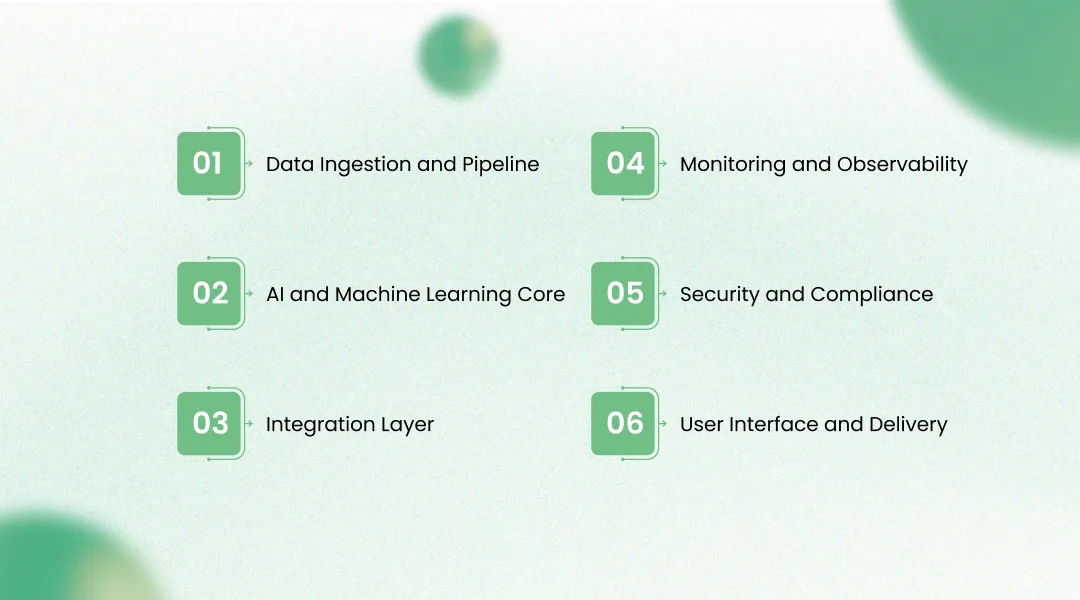
The architecture of MoleculeRank was designed to handle the specific demands of the biotechnology industry, where data is heterogeneous, regulatory auditability is non negotiable, and model outputs must earn the trust of domain experts who hold PhD level scientific judgment. KriraAI structured the system across six architectural layers, each with clearly defined responsibilities and interfaces.
Data flows into MoleculeRank through three ingestion pathways. Structured assay data is captured via change data capture (CDC) from the client's Oracle database using Debezium connectors, streaming row-level changes into Apache Kafka topics partitioned by therapeutic program. Flat file exports from plate readers and CRO deliverables land in an S3 staging bucket monitored by AWS Lambda triggers that validate file schemas against a registry of known formats before routing them to the appropriate parsing pipeline. Unstructured documents, including PDFs and Word files from CRO reports, are ingested through a dedicated document processing pipeline that uses Apache Tika for format normalisation, followed by a fine-tuned layout-aware transformer (based on LayoutLMv3) for structured extraction of tables, figures, and annotated text.
All ingestion pipelines feed into Apache Flink for stream processing, where incoming records undergo schema normalisation, unit conversion (standardising all activity measurements to pIC50 or percentage inhibition at a fixed concentration), entity resolution against the client's compound registry using InChIKey matching with stereochemistry-aware canonicalisation, and temporal feature engineering that computes time since first synthesis, screening velocity, and program stage progression indicators. Pipeline orchestration is managed by Dagster, which provides lineage tracking, asset materialisation observability, and a declarative framework for defining the dependency graph between raw data assets and transformed features. KriraAI chose Dagster over Airflow for its superior support for data asset-aware orchestration, which aligned better with the materialisation patterns required by the knowledge graph construction process.
The ML core consists of three model families served behind a unified inference gateway. The primary GNN model uses a message-passing neural network (MPNN) architecture with edge attention, implemented in PyTorch Geometric, trained on the client's proprietary screening dataset of 1.4 million compound activity pairs augmented with public ChEMBL data filtered for target family relevance. Training was distributed across a cluster of four NVIDIA A100 GPUs using PyTorch's DistributedDataParallel, with mixed precision training via torch.cuda.amp to reduce memory footprint and accelerate convergence. The contrastive learning objective uses an NT-Xent loss that pulls together molecular representations of compounds with similar activity profiles while pushing apart structurally similar but biologically distinct molecules.
The NLP module is a DeBERTa v3 base model fine-tuned on 180,000 annotated passages from the client's CRO report archive using supervised sequence labelling for entity and relation extraction. The ADMET risk predictor is an ensemble of gradient-boosted trees (XGBoost) operating on a curated feature set of 267 physicochemical descriptors, trained with stratified cross-validation to handle the severe class imbalance inherent in toxicity prediction datasets. All three model families are served using NVIDIA Triton Inference Server with TensorRT optimisation for the neural network models, providing batched inference with p99 latency under 50 milliseconds. Model artifacts are versioned and tracked in MLflow, with each production deployment tied to a specific experiment run, dataset snapshot, and evaluation metric record.
MoleculeRank integrates with the client's existing systems through an event-driven architecture. Compound prioritisation events are published to Kafka topics consumed by downstream systems, including the client's electronic lab notebook (ELN) system via a REST API adapter, their project portfolio management tool via webhook callbacks, and a custom Slack integration that alerts program leads when high-priority compounds are identified. KriraAI built all external-facing APIs as versioned RESTful services behind an AWS API Gateway, with OpenAPI 3.0 specifications generated automatically from the codebase. Internal service communication between the inference gateway, knowledge graph query engine, and feature store uses gRPC with Protocol Buffers for type-safe, low-latency inter-service calls. The integration layer also includes a bidirectional sync with the client's SAP-based procurement system to surface compound sourcing costs and vendor lead times directly within MoleculeRank's recommendation interface.
KriraAI deployed a comprehensive MLOps monitoring stack built on Prometheus and Grafana for infrastructure metrics, with custom model performance dashboards tracking prediction accuracy against a held-out evaluation set refreshed monthly. Data drift detection runs daily using the population stability index (PSI) computed over the input feature distributions of the GNN and ADMET models, with automated alerts triggered when PSI exceeds 0.2 on any feature group. Concept drift is monitored by comparing model predictions against experimentally validated outcomes as they become available, with KL divergence computed between the predicted and observed activity distributions. Latency is tracked at p50, p95, and p99 across all inference endpoints, with automatic scaling policies triggered when p95 latency exceeds 200 milliseconds. An automated retraining pipeline, orchestrated through Dagster, triggers a full model refresh when performance degradation crosses predefined thresholds on the evaluation set, with human-in-the-loop approval required before any retrained model is promoted to production.
The entire MoleculeRank platform operates within a dedicated AWS VPC with no public endpoints. All data in transit is encrypted via TLS 1.3, and data at rest is encrypted using AWS KMS with customer-managed keys. Access is governed by role-based access control (RBAC) with attribute-level data masking, ensuring that researchers in one therapeutic program cannot access raw screening data from another program unless explicitly authorised. All model inputs, outputs, and user interactions are logged to an immutable, append-only audit store built on Amazon QLDB, providing a tamper-evident record that satisfies the client's internal data governance requirements and supports regulatory submissions under FDA 21 CFR Part 11 electronic records guidelines. KriraAI also implemented data residency controls to ensure that all compound data remains within the client's designated AWS region, with no cross-region replication.
The front end is a React-based single-page application served behind the client's existing SSO infrastructure (Okta), providing researchers with an interactive compound exploration dashboard. The interface includes a compound search and filtering module backed by Elasticsearch, a knowledge graph visualisation powered by D3.js that lets scientists explore relationships between compounds, targets, and assay results, and a recommendation feed that surfaces the top-ranked compounds for each program with full explainability panels. KriraAI designed the interface in close collaboration with the client's computational chemistry team to ensure that every element mapped to an existing mental model from their research workflow.
The technology stack for MoleculeRank was selected to align with the client's existing AWS infrastructure, their team's Python and JavaScript competencies, and the specific performance and compliance requirements of pharmaceutical drug discovery.
Apache Kafka and Debezium were chosen for real-time data ingestion because the client's Oracle database required CDC without schema modifications, and Debezium's Oracle connector provided exactly this capability without requiring log miner privileges that the DBA team was unwilling to grant.
Apache Flink was selected over Spark Structured Streaming for stream processing because Flink's event time semantics and watermarking model handled the out-of-order arrival patterns common in CRO data deliveries more gracefully.
Dagster replaced a legacy cron-based orchestration system because its asset-aware DAG model allowed the KriraAI team to express the dependency between raw data, transformed features, and knowledge graph updates as first-class concepts rather than implicit task orderings.
PyTorch Geometric was the natural choice for the GNN given its mature support for heterogeneous graph architectures and its active research community in molecular machine learning.
NVIDIA Triton Inference Server was chosen over a custom Flask-based model serving because it provided batched inference, dynamic batching, model ensemble pipelines, and TensorRT integration out of the box, reducing the inference infrastructure engineering effort by approximately 60%.
Amazon QLDB was selected for audit logging because its cryptographically verifiable transaction log provided the immutability guarantees required for FDA compliance without the operational complexity of managing a dedicated blockchain infrastructure.
MLflow was chosen for experiment tracking and model registry because it integrated cleanly with the client's existing Databricks environment and provided the model versioning and staging workflow needed for human-in-the-loop deployment approval.
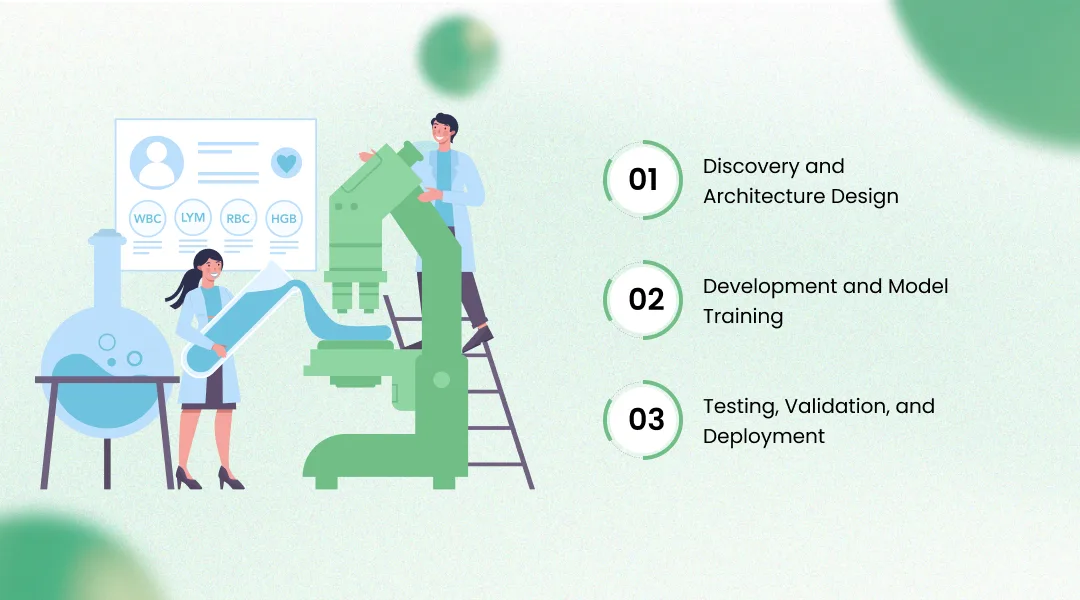
The engagement began with a four-week discovery phase in which KriraAI embedded a team of two ML engineers and one data engineer with the client's computational chemistry group. The goal was not to design a solution in isolation but to understand the actual decision-making process that researchers followed when evaluating compounds, including the shortcuts, heuristics, and tribal knowledge that no documentation captured. This phase produced a detailed data audit covering all seven source systems, a decision process map validated by 14 senior scientists, and a technical architecture document that was reviewed and approved by the client's IT security and enterprise architecture teams before any code was written.
Development proceeded in three-month sprints, with the data pipeline and knowledge graph construction completed in the first sprint, the GNN and NLP model training in the second, and the integration layer and front end in the third. KriraAI's engineering team encountered several significant challenges during development. The most consequential was the compound entity resolution problem: approximately 18% of compound records across the client's databases contained conflicting stereochemistry annotations, meaning the same physical molecule was represented differently depending on which system had registered it. KriraAI resolved this by implementing a canonicalisation pipeline using RDKit that normalised all molecular representations to canonical SMILES with explicit stereochemistry, followed by a fuzzy matching step using Tanimoto similarity on Morgan fingerprints to identify and merge near-duplicate records.
A second challenge arose during GNN training, where the model initially showed strong performance on the oncology program data but degraded significantly on the rare disease program, which had far fewer training examples. KriraAI addressed this through a multi-task learning formulation that shared the GNN encoder across all three programs while using program-specific prediction heads, combined with a focal loss function that upweighted rare disease examples during training. This architecture improved rare disease prediction accuracy by 23% without degrading oncology performance.
Validation was conducted as a prospective evaluation over a six-week period in which MoleculeRank ran in shadow mode alongside the existing manual workflow. Researchers continued to make decisions using their established process while MoleculeRank independently generated recommendations. At the end of the evaluation, KriraAI and the client's science leadership compared the two sets of decisions. MoleculeRank agreed with expert decisions in 91% of cases, and in the 9% where it disagreed, retrospective analysis showed that the AI's recommendation would have been the better choice in 64% of those instances.
Deployment followed a blue-green pattern on AWS ECS, with the shadow mode infrastructure promoted to the production traffic path after the validation period concluded. KriraAI conducted three days of on-site training with the client's research teams and delivered comprehensive runbooks for the operations team. A four-week hypercare period followed go-live, during which KriraAI engineers were available for immediate incident response and performance tuning.
The results measured over the first eight months of production operation confirmed the value of the AI drug discovery solution across every metric that mattered to the client.
Lead identification timeline decreased from 14 months to 4.5 months, a 68% reduction, measured across two programs that completed full discovery cycles during the evaluation period.
Compound triage time dropped from 20 hours per week of senior scientist time to 3 hours per week, freeing approximately 880 hours of expert capacity annually for higher-value scientific work.
Prediction accuracy for ADMET liability flags reached 89%, compared to 61% for the legacy QSAR models, reducing late-stage compound failures attributable to ADMET issues by 42%.
Data integration overhead was eliminated entirely, as researchers no longer needed to manually query and cross-reference four separate systems to assemble a complete compound profile.
Cost savings in the first year were estimated at $8.7 million, driven by reduced CRO fees from earlier elimination of non viable compounds and reallocation of senior scientist time from data wrangling to scientific decision-making, a pattern explored further in our practical ROI guide for midsize biotech companies.
The client's Chief Scientific Officer noted that MoleculeRank did not replace scientific judgment but amplified it, giving researchers access to a unified, continuously updated, and fully transparent view of every compound in the pipeline for the first time in the organisation's history.
MoleculeRank was deliberately architected for extensibility. The knowledge graph schema supports the addition of new entity types and relationship classes without schema migration, enabling the client to incorporate new data modalities such as spatial transcriptomics, cryo-EM structural data, or real-world evidence from clinical databases as those data sources become available. The GNN encoder's multi-task architecture means that adding a new therapeutic program requires only training a new prediction head while reusing the shared molecular representation layer, reducing the time to deploy a new program from months to weeks.
The client's AI roadmap for the next two years includes three planned extensions. The first is a generative molecular design module that uses a variational autoencoder conditioned on the GNN's learned representations to propose novel compounds optimised for specific target profiles. The second is integration with the client's clinical data warehouse to create a continuous feedback loop from Phase I trial outcomes back into the discovery prioritisation models. The third is the deployment of a federated learning framework that enables collaboration with partner organisations on shared therapeutic targets without exposing proprietary compound data.
Other biotechnology companies evaluating AI implementation in pharma, a shift covered in depth in our guide on how AI in biotechnology is accelerating drug discovery, can draw several transferable lessons from this architecture. The most important thing is that the AI system must be designed around the decision process it supports, not around the data it consumes. KriraAI's investment in understanding how researchers actually evaluate compounds, before writing a single line of model code, was the single most consequential decision in the entire engagement. The second lesson is that explainability is not a feature to add later; it must be embedded in the architecture from day one, because scientists will not adopt a system whose recommendations they cannot interrogate and challenge.
Three insights from this engagement stand out as the most consequential for any organisation considering AI in biotechnology. The technical insight is that multimodal AI architectures, combining graph neural networks for molecular structure with transformer-based NLP for unstructured evidence extraction, produce compound prioritisation quality that no single model approach can match. The operational insight is that the greatest efficiency gains came not from faster computation but from eliminating the fragmentation that forced scientists to spend their time on data assembly rather than scientific reasoning. The strategic insight is that the organisations that will win in modern drug discovery are those that treat their data infrastructure as a competitive asset rather than a cost centre.
KriraAI brings this same depth of engineering rigour, domain engagement, and delivery discipline to every client partnership. From architecture design through production deployment and ongoing optimisation, our team works as an embedded extension of your organisation's technical capability. If your biotechnology company is facing the kinds of data fragmentation, workflow inefficiency, or competitive pressure described in this case study, we invite you to bring that challenge to KriraAI and explore what a purpose-built AI solution can achieve for your discovery pipeline.
The timeline for implementing a production grade AI system in drug discovery depends on the complexity of the existing data landscape, the number of therapeutic programs being supported, and the maturity of the organisation's data infrastructure. In this engagement, KriraAI delivered MoleculeRank from initial discovery through production deployment in approximately nine months, structured across a four week discovery phase, three development sprints of one month each, a six week shadow mode validation, and a four week hypercare period. Organisations with cleaner data environments and fewer integration requirements may achieve shorter timelines, while those with significant data quality challenges or regulatory constraints should plan for twelve months or more.
Biotech AI ROI varies based on the specific use case and the baseline efficiency of the existing workflow. In this case study, the client achieved $8.7 million in first year cost savings primarily through earlier elimination of non viable compounds and reallocation of senior scientist time. The 68% reduction in lead identification timeline represents an even larger strategic value, as compressing time to IND filing by several months can translate to years of additional patent protected market exclusivity for a successful drug. Companies should evaluate ROI across both direct cost savings and strategic timeline acceleration, as the latter often dwarfs the former in long term value.
A successful AI implementation in biotechnology does not require a perfectly clean data environment as a precondition, but it does require a realistic assessment of data quality issues and a willingness to invest in remediation as part of the project. The minimum requirements include accessible source systems with programmatic query or export capabilities, a compound registration system with canonical identifiers, and sufficient historical screening data to support model training, typically at least 100,000 compound activity pairs for robust GNN training. KriraAI's approach builds the data pipeline and quality remediation into the implementation itself, resolving issues like entity duplication, unit inconsistency, and missing metadata as part of the engineering work rather than treating them as blockers.
Interpretability in AI drug discovery systems requires a multi layered approach that goes beyond simple feature importance scores. In MoleculeRank, every compound recommendation is accompanied by a decomposed score showing the contribution of predicted efficacy, selectivity, ADMET risk, synthetic accessibility, and patent landscape analysis. Each sub score links to the specific data points, molecular features, and textual evidence that influenced it, displayed through an interactive evidence panel. This transparency is essential because pharmaceutical researchers operate under regulatory frameworks that require documented rationale for compound progression decisions, and because adoption depends on scientists being able to interrogate and challenge the system's reasoning using their domain expertise.
Integration with existing LIMS, ELN, and enterprise systems is a core requirement for any production AI drug discovery solution, not an optional enhancement. KriraAI's architecture for MoleculeRank was designed around event driven integration patterns, using Apache Kafka as the central message bus to decouple the AI platform from downstream systems. This approach enables real time bidirectional data flow without requiring modifications to the client's existing systems. Specific integrations included CDC based ingestion from Oracle databases, REST API adapters for ELN connectivity, webhook callbacks to project management tools, and gRPC based internal service communication. The key architectural principle is that the AI platform should adapt to the client's system landscape rather than demanding that existing systems be redesigned to accommodate the AI.
Ridham Chovatiya is the COO at KriraAI, driving operational excellence and scalable AI solutions. He specialises in building high-performance teams and delivering impactful, customer-centric technology strategies.
