Nearly one-third of all food produced globally is lost or wasted before it ever reaches a consumer, and a significant share of that loss happens well before harvest, driven by pest outbreaks, irrigation failures, and yield decisions made on guesswork rather than data. has moved from an experimental concept discussed at agritech conferences to a working necessity for any farm operation that wants to remain profitable under rising input costs and unpredictable weather patterns. The farms and agribusinesses that have adopted machine learning, satellite imagery, and predictive analytics are no longer just growing more efficiently; they are making decisions in days that used to take entire growing seasons to validate. Meanwhile, operations that have delayed adoption are discovering that the gap between data-driven farms and traditional ones widens every single season, not gradually but compoundingly.
This blog will walk through the real state of agriculture today, the specific AI technologies reshaping the sector, the measurable financial impact these technologies are delivering, a practical roadmap for implementation, the genuine challenges that come with adoption, and where the industry is heading over the next several years. By the end, the case for acting now rather than later should be difficult to argue against.
Agriculture today operates under a set of pressures that did not exist in this combination even fifteen years ago. Input costs for seeds, fertilizer, and fuel have climbed steadily while commodity prices remain volatile and often disconnected from those rising costs. Farmers are essentially running businesses where the largest expenses are locked in months before anyone knows what the final revenue will look like, and that mismatch alone explains why margins in many farming operations have thinned to levels that would be unacceptable in almost any other industry.
Labor availability compounds the problem. Rural workforces are aging and shrinking in many regions, including large parts of India where younger generations are migrating to urban centers for non-farm work, leaving fewer hands available for labor-intensive tasks like manual pest scouting, irrigation checks, and harvest timing. At the same time, climate volatility has made the historical rules of thumb that farmers relied on for generations far less reliable, with rainfall patterns, pest cycles, and temperature extremes shifting in ways that older seasonal knowledge simply cannot predict anymore.
Land fragmentation adds another layer of difficulty, particularly in countries like India where the average landholding size is small, and farmers often lack the capital or scale to access the kind of agronomic expertise that larger commercial operations take for granted. Supply chains remain fragmented too, with multiple intermediaries between farm and market, each adding cost and reducing the price signal that actually reaches the grower. The result is an industry under constant financial pressure, working with less predictable weather, a shrinking labor pool, and information asymmetry at nearly every stage of the value chain.
AI in agriculture is not a single tool; it is a collection of distinct technologies, each solving a specific, previously unsolvable problem in the farming process. Understanding what each technology actually does, rather than treating AI as a vague catch-all term, is the first step toward evaluating where it fits into a real operation.
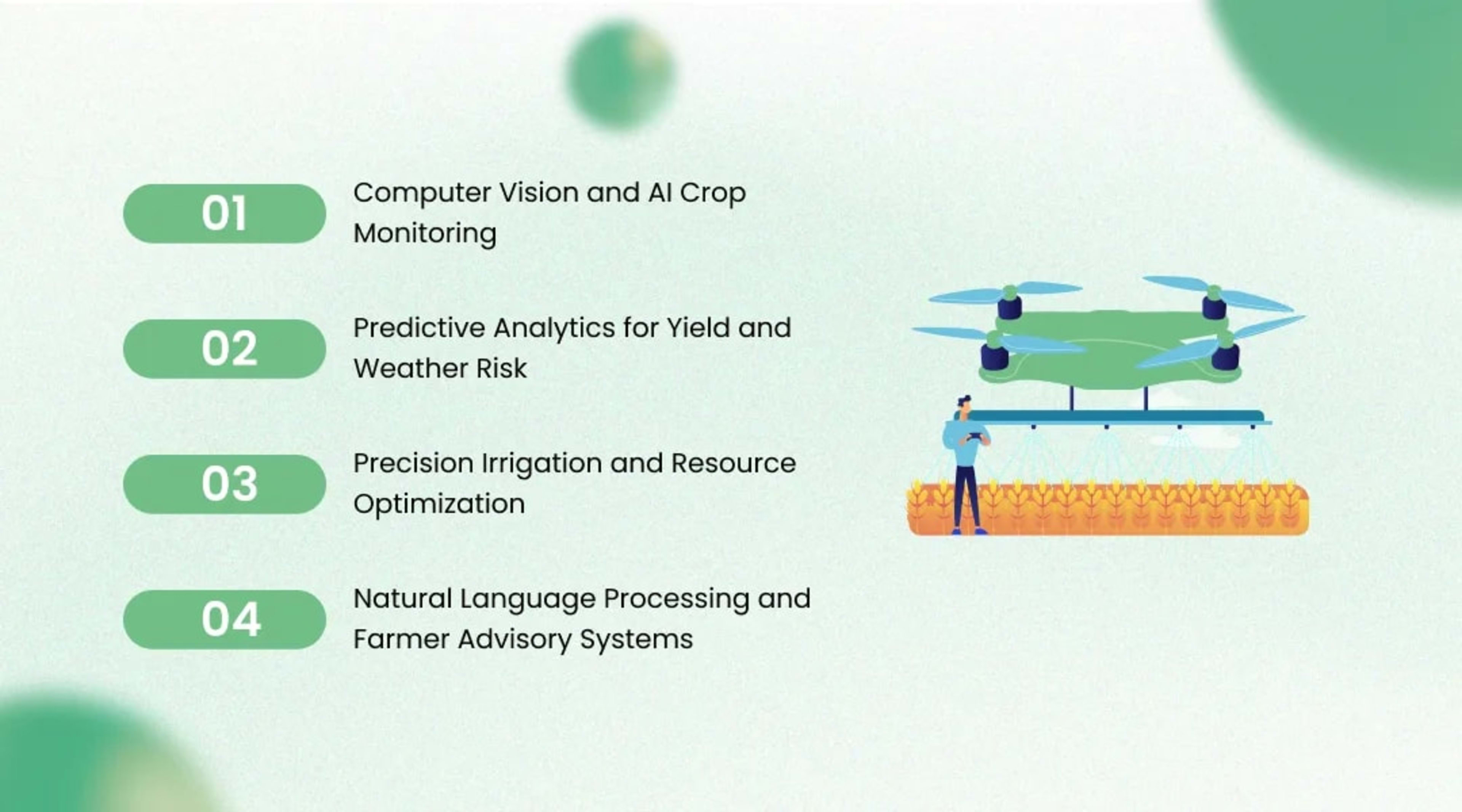
Computer vision AI solutions, often deployed through drones or fixed field cameras, analyze crop imagery to detect early signs of disease, nutrient deficiency, and pest infestation long before those problems are visible to the human eye. This form of AI crop monitoring can identify stress patterns in plant leaves days or even weeks before symptoms become apparent to a field scout walking the same rows. In practical terms, this means a fungal outbreak that might have spread across an entire field before manual detection can now be caught and contained while it is still isolated to a small section, saving both the crop and the cost of a full field treatment.
Machine learning models trained on historical yield data, soil composition, and localized weather patterns can now forecast expected yield with a level of precision that was simply not achievable through manual estimation. These predictive analytics models also power more accurate weather risk assessments, helping farmers time planting and harvesting windows around forecasted rainfall or frost events rather than relying on generalized regional averages. This directly affects decisions around crop insurance, storage planning, and even forward contracts with buyers, because a farmer who can forecast yield within a tight margin has significantly more negotiating leverage than one working from rough estimates.
Precision farming AI systems integrate soil moisture sensors, weather data, and crop water requirement models to automate irrigation scheduling down to the individual field zone rather than treating an entire farm as a single unit. This targeted approach to water and fertilizer application, often called variable rate application, reduces waste significantly because inputs are applied only where and when the crop model indicates they are actually needed. Given that water scarcity is an escalating concern across major agricultural regions including much of India, this application of AI is not just a cost-saving measure; it is increasingly a matter of long-term operational viability.
Natural language processing is enabling a new generation of farmer advisory tools, including AI-powered chatbots that can answer agronomic questions in regional languages and dialects, a critical feature in a country as linguistically diverse as India. These systems allow a smallholder farmer to ask a question about pest identification or fertilizer dosage in their native language and receive an answer grounded in localized agronomic data rather than generic advice. Generative AI is also being used to synthesize satellite data, weather forecasts, and market prices into simple, actionable daily recommendations, effectively giving smaller farms access to the kind of decision support that was previously only available to large commercial operations with dedicated agronomists on staff.
The financial case for AI in agriculture becomes clear once the results are quantified rather than described in general terms. Farms using AI-powered agriculture solutions for pest and disease detection have reported reductions in crop loss from undetected infestations of between 20 and 30 percent, largely because early detection allows for targeted treatment rather than reactive, whole-field intervention after damage has already spread. This single category of improvement often justifies the cost of adoption within a single growing season for medium and large-scale operations.
Precision irrigation systems have documented water usage reductions in the range of 15 to 25 percent while maintaining or even improving yield outcomes, a combination that directly addresses both cost pressure and sustainability requirements that are increasingly tied to export market access. Fertilizer optimization through variable rate application has shown input cost reductions of roughly 10 to 18 percent in documented pilot programs, since inputs are matched precisely to what each zone of a field actually requires rather than applied at a uniform rate across variable soil conditions.
Yield forecasting accuracy improvements are equally significant. Farms using predictive analytics models have reported forecast accuracy improvements that reduce planning error by a wide margin compared to traditional estimation methods, which directly improves storage planning, contract negotiation, and financing decisions. Labor efficiency gains from automated monitoring systems have allowed some operations to reduce manual field scouting hours by 30 to 40 percent, freeing up limited labor for higher value tasks. When these categories are combined, operations that have implemented smart farming technology across even two or three of these use cases commonly report overall margin improvements in the range of 12 to 20 percent within the first two years of adoption, a figure that compounds as data accumulates and models improve with more seasons of localized training data.
Implementing AI in agriculture successfully requires a structured approach rather than a single large technology purchase, because farms that skip the assessment phase and jump straight to deployment tend to see poor adoption and disappointing results. The following stages represent a realistic path from initial evaluation to full deployment.
Readiness assessment: Before selecting any tool, an operation needs to audit what data it already collects, including yield records, soil tests, and irrigation logs, since AI models are only as useful as the data available to train and calibrate them.
Problem prioritization: Rather than attempting to adopt AI across every function simultaneously, the most successful operations identify the single highest cost or highest risk problem, such as pest loss or water waste, and target that first.
Vendor and technology selection: This stage involves evaluating whether off-the-shelf platforms fit the specific crop types and regional conditions involved, or whether a more customized solution is needed, which is where working with an experienced AI implementation partner becomes valuable.
Pilot deployment: A single field or a small percentage of total acreage should be used to test the chosen technology for at least one full growing season before any farm-wide rollout, since agricultural cycles do not allow for the rapid iteration common in other industries.
Data validation and model calibration: Results from the pilot need to be compared against actual outcomes to confirm the model's predictions are holding up in real field conditions, not just in the vendor's marketing materials.
Full deployment and integration: Once validated, the technology is expanded across the full operation and integrated with existing farm management software so that data flows into a single system rather than living in disconnected tools.
Continuous monitoring and retraining: AI models in agriculture need to be retrained as new seasonal data comes in, since a model trained on three years of weather and yield data becomes more accurate with each additional season it learns from.
The most frequent mistake operations make is purchasing a technology platform before establishing clean, consistent data collection practices, which results in models that produce unreliable outputs regardless of how sophisticated the underlying algorithm is. Another common error is attempting a full-scale rollout without a pilot phase, which leaves no opportunity to catch calibration issues before they affect an entire season's crop. Farms also frequently underestimate the change management component, assuming that field staff will adopt new tools automatically without dedicated training, when in reality the human adoption curve is often the actual bottleneck rather than the technology itself.
Finally, many operations select generic, one-size-fits-all platforms rather than solutions calibrated for their specific crop types, soil conditions, and regional climate, which significantly reduces the accuracy and usefulness of the resulting recommendations. This is precisely the gap that KriraAI addresses, building AI-powered agriculture solutions that are calibrated to the specific crops, regions, and operational realities of each client rather than deploying a generic model and hoping it fits.
Honest conversations about AI in agriculture need to address the real barriers, because overselling the ease of adoption ultimately damages trust in the technology when farms encounter friction. Data quality remains the single largest obstacle, since many farming operations, particularly smaller ones, have historically kept records in paper logs or fragmented spreadsheets that are difficult to digitize and standardize into a format usable by machine learning models. Without at least two to three seasons of reasonably consistent data, even the best AI models will produce forecasts with wide margins of error, and farms need to be realistic about this ramp-up period rather than expecting immediate precision.
Talent gaps present a second serious challenge, since the skill set required to manage, interpret, and act on AI-generated recommendations is different from traditional agronomic training, and there is currently a shortage of professionals who understand both farming operations and data science well enough to bridge the two. Regulatory and data privacy constraints are also becoming more relevant as farm data, including yield figures and land use information, becomes commercially valuable, raising legitimate questions about who owns that data and how it can be shared with third-party AI vendors.
Integration complexity is a further practical concern, particularly for larger operations that already run multiple software systems for accounting, equipment management, and supply chain logistics, since AI tools that do not integrate cleanly with existing infrastructure end up creating more manual work rather than less. Change management within farm teams, especially in operations with a multigenerational workforce where some staff have decades of experience relying on intuition rather than dashboards, requires patience and clear communication about why the new tools are being introduced rather than simply mandating their use.
Over the next three to five years, the technologies currently considered advanced will become baseline expectations rather than differentiators. Autonomous machinery, including self-driving tractors and robotic harvesters guided by computer vision, will move from pilot programs at large commercial farms into more widespread use, including among mid-sized operations that previously could not justify the cost of specialized equipment. Hyperlocal weather and pest prediction models, trained on increasingly granular satellite and sensor data, will make forecasting accurate enough to shift decisions from a farm level to an individual field zone level, meaning two adjacent fields on the same property could receive entirely different treatment recommendations based on subtle variations in soil and microclimate.
Generative AI advisory tools will likely become the primary interface between smallholder farmers and complex agronomic data, particularly in regions like India where linguistic diversity and varying literacy levels have historically limited access to technical farming guidance. Supply chain AI will increasingly connect yield forecasts directly to buyer demand signals, allowing farmers to make planting decisions based on projected market conditions months in advance rather than reacting to prices after harvest.
The competitive gap between AI-adopting farms and traditional operations will widen considerably during this period, not because the technology itself becomes dramatically more powerful each year, but because data compounds. A farm that has been collecting and training models on five seasons of localized data will consistently outperform a competitor just beginning that process, even if both eventually adopt similar tools. Operations that delay adoption into the later part of this decade will find themselves starting from a significant data disadvantage relative to competitors who began building their data foundation years earlier, and in commodity agriculture, where margins are thin, that gap translates directly into who remains profitable and who does not.
The evidence is clear that AI in agriculture is no longer a speculative investment but a measurable driver of yield, cost savings, and competitive positioning, and the three points that matter most from everything covered here are straightforward. First, the specific technologies, from computer vision to predictive analytics to precision irrigation, each solve distinct, quantifiable problems rather than functioning as a vague catch-all solution. Second, the financial results already being documented, including double-digit reductions in crop loss and input waste, make a strong case that adoption pays for itself well within the first two seasons. Third, the competitive gap between farms that adopt now and those that wait continues to widen because AI models improve with accumulated data, meaning delay carries a real and growing cost rather than simply postponing a decision.
This is exactly where KriraAI fits into the picture. KriraAI builds practical, production-grade AI solutions for enterprises, including agribusinesses and farming operations that need technology calibrated to their specific crops, regions, and existing infrastructure rather than a generic platform that was never designed with their conditions in mind. From readiness assessments through pilot deployment and full-scale integration, KriraAI works alongside agricultural operations to implement AI in agriculture in a way that is measurable, scalable, and genuinely built around how that specific farm or agribusiness actually operates. If your operation is weighing whether to start this transition, reaching out to KriraAI is a reasonable next step toward building a data foundation before the competitive gap widens any further.
AI in agriculture is currently used for crop monitoring through computer vision and drone imagery, predictive analytics for yield and weather forecasting, precision irrigation and fertilizer optimization through variable rate application, pest and disease early detection, and natural language advisory tools that help farmers get agronomic guidance in their local language. These applications are already deployed across commercial and mid-sized farms globally, with adoption accelerating fastest in regions facing acute water scarcity or labor shortages, since those are the areas where AI delivers the most immediate and measurable return on investment.
Precision farming AI refers to the use of machine learning models combined with sensor data, satellite imagery, and weather forecasting to make farming decisions at a granular, field zone level rather than treating an entire farm uniformly. Traditional farming methods typically rely on generalized seasonal knowledge and uniform application of water, fertilizer, and pesticides across an entire field, whereas precision farming AI tailors these inputs to the specific conditions of each smaller zone within that field, reducing waste and improving both yield consistency and input efficiency significantly.
AI adoption has become considerably more accessible for small and mid-sized farms over the past several years, largely due to the rise of subscription-based platforms and mobile-first advisory tools that do not require large upfront hardware investment. While enterprise-scale AI-powered agriculture solutions still involve meaningful cost, many entry-level applications such as pest detection apps and irrigation scheduling tools are now available at price points that make sense even for smaller operations, and the return on investment through reduced crop loss and input savings often justifies the cost within a single growing season.
The biggest risk of delaying AI adoption in agriculture is falling behind on the data accumulation that makes these systems increasingly accurate over time, since farms that start earlier build a multi-season data advantage that is difficult for late adopters to close quickly. Beyond the data gap, non-adopting farms continue absorbing avoidable losses from undetected pest outbreaks, inefficient water use, and inaccurate yield forecasting, all of which directly affect profitability in an industry already operating on thin margins, making delayed adoption a compounding financial disadvantage rather than a neutral choice.
Most farms implementing AI crop monitoring and related precision farming AI tools begin seeing measurable results within a single growing season, particularly in categories like pest detection and irrigation efficiency where the feedback loop between action and outcome is relatively short. However, the full financial benefit of AI adoption typically compounds over two to three seasons as models are calibrated with more localized data and as farm teams become more comfortable acting on AI-generated recommendations rather than defaulting to intuition, meaning early results are meaningful, but the strongest returns tend to appear after the initial adoption period.
Founder & CEO
Divyang Mandani is the CEO of KriraAI, driving innovative AI and IT solutions with a focus on transformative technology, ethical AI, and impactful digital strategies for businesses worldwide.