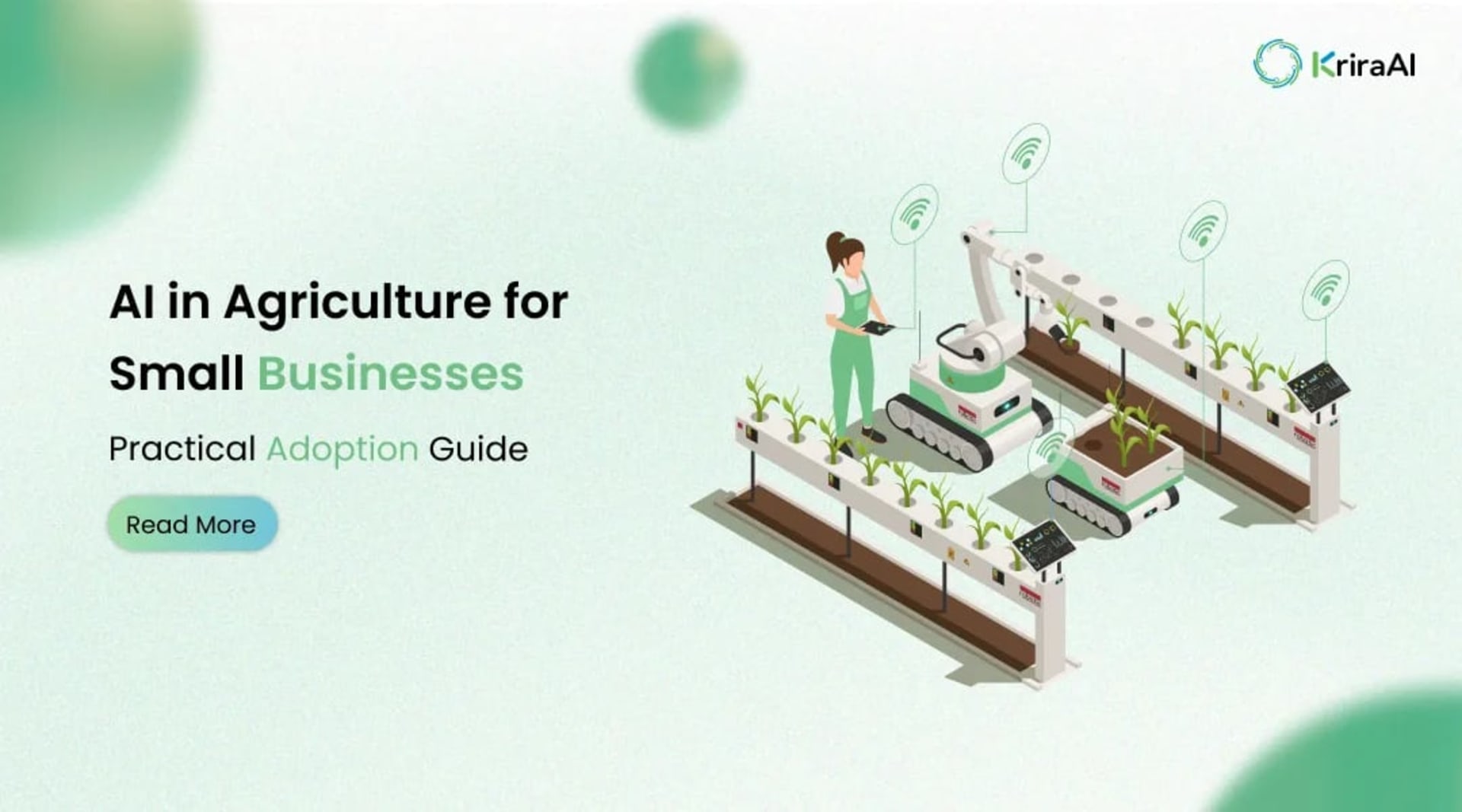
Across India and similar agricultural economies, farms with 10 to 50 employees contribute nearly 35 percent of regional crop output, yet fewer than 18 percent of these businesses have adopted any form of AI driven technology. This gap is not due to lack of interest but due to uncertainty around cost, complexity, and real returns. If you run or manage a small agricultural business, you are likely balancing operational efficiency, unpredictable weather, labor shortages, and tight margins all at once. The idea of implementing AI might feel either too expensive or too complicated to justify.
This blog on AI in agriculture for small businesses is written specifically for operations like yours. Not for large agribusiness corporations with dedicated tech teams, and not for solo farmers experimenting with basic tools. It focuses on the unique middle ground where you have some structure, some budget, and real pressure to scale efficiently. You will learn which AI applications actually make sense, what they cost, how to implement them step by step, and what measurable outcomes you can expect within 6 to 12 months.
Small agricultural businesses with 10 to 50 employees operate in a very specific environment that is often misunderstood by both technology vendors and policymakers. You likely have a mix of permanent staff and seasonal labor, with one or two individuals handling multiple roles such as operations, procurement, and sales. Decision making is fast but constrained by immediate cash flow realities rather than long term experimentation budgets.
Your typical technology stack is basic but functional. You may already be using spreadsheets for crop planning, WhatsApp for communication, and simple accounting software. However, advanced data systems, IoT infrastructure, or integrated farm management platforms are usually missing. This creates both a challenge and an opportunity.
Budget allocation for innovation in this segment is usually between 2 percent to 5 percent of annual revenue. For a farm generating ₹2 crore annually, that translates to ₹4 lakh to ₹10 lakh available for technology investments. This is significantly lower than mid market or enterprise players but still enough to implement targeted AI solutions with clear ROI.
The pressure points are also very specific:
Labor inefficiency leads to 15 percent to 25 percent productivity loss during peak seasons
Crop yield variability can swing revenues by 20 percent year over year
Input costs such as fertilizers and pesticides have increased by over 12 percent annually in recent years
Decision delays due to lack of data insights result in missed opportunities for optimization
Unlike large enterprises, you cannot afford long experimentation cycles. Unlike solo operators, your scale demands structured processes. This is exactly where practical AI adoption becomes critical.
AI adoption is not a one size fits all process, and nowhere is this more evident than in agriculture. A Fortune 500 agribusiness may spend millions on satellite analytics and proprietary AI models. A solo farmer might use a free weather prediction app. Your business sits in between these extremes.
For small agricultural businesses, the approach must be modular, cost controlled, and outcome focused. You cannot afford custom built AI systems, but you also cannot rely solely on generic tools that do not scale with your operations.
The differences are clear when you look at key factors:
Large enterprises invest ₹5 crore or more annually in digital transformation. Small businesses typically invest under ₹10 lakh. This means solutions must deliver ROI within one cropping cycle, not over several years.
Enterprise AI projects often take 12 to 24 months to deploy. Small businesses need solutions that can be implemented within 4 to 12 weeks. Anything longer disrupts operations and ties up limited resources.
You are not looking for global consulting firms. You need specialized providers like KriraAI that build practical, scalable AI solutions designed specifically for real business constraints. These solutions must integrate with existing workflows without requiring a complete overhaul.
You likely do not have a data scientist on your team. AI tools must be usable by operations managers or farm supervisors with minimal training. If a solution requires advanced technical expertise, it will not be sustainable.
For small businesses, AI farming ROI must be visible within one or two harvest cycles. A realistic expectation is a 10 percent to 20 percent improvement in efficiency or yield within the first year.
This is why blindly copying enterprise AI strategies is a mistake. The right approach is targeted, incremental adoption that aligns with your operational reality.
Not all AI solutions are worth your investment. The focus should be on applications that solve immediate problems and deliver measurable returns.
AI powered crop monitoring uses satellite imagery and sensors to track plant health and predict issues before they become visible. For small businesses, this typically costs between ₹50,000 and ₹2 lakh annually depending on farm size.
The problem it solves is delayed decision making. By the time you notice crop stress manually, it is often too late to take corrective action. AI systems can detect issues up to 10 days earlier, leading to yield improvements of 8 percent to 15 percent.
Smart irrigation uses AI to optimize water usage based on soil conditions, weather forecasts, and crop requirements. Initial setup costs range from ₹1 lakh to ₹3 lakh, but water savings can reach 30 percent within the first year.
For regions facing water scarcity, this is not just a cost saving tool but a sustainability necessity. It also reduces labor dependency for manual irrigation management.
Using mobile apps or camera systems, AI can identify pests and diseases in real time. These tools are part of affordable AI tools for farming and usually cost under ₹50,000 annually.
The key benefit is reducing pesticide usage by up to 20 percent while improving crop health. Early detection allows targeted treatment rather than blanket spraying.
AI models can analyze historical data, weather patterns, and soil conditions to predict yields with up to 85 percent accuracy. This helps in better planning for sales, storage, and logistics.
The cost is relatively low, often bundled within broader farm management platforms. The impact is significant, reducing overproduction losses and improving market timing.
AI driven scheduling systems can optimize labor allocation based on tasks, crop cycles, and worker availability. These systems typically cost ₹30,000 to ₹1 lakh annually.
They can improve labor efficiency by 15 percent to 25 percent, which is critical during peak seasons when every hour counts.
KriraAI specializes in implementing these exact solutions in a way that fits small agricultural businesses. Instead of overwhelming you with options, they focus on 2 to 3 high impact use cases that align with your immediate needs.
The impact of AI in agriculture for small businesses is not theoretical. It is measurable and immediate when implemented correctly.
A small farm with 25 employees that adopts smart irrigation and crop monitoring can reduce water usage by 25 percent within 6 months. This translates to savings of ₹1.5 lakh annually in water and energy costs alone.
Labor optimization tools can save up to 40 hours per week during peak seasons. For a team of 20 workers, this is equivalent to adding 2 to 3 full time employees without increasing payroll.
AI based pest detection can reduce crop losses by 10 percent to 18 percent. For a farm generating ₹2 crore in revenue, this means an additional ₹20 lakh to ₹36 lakh in retained value.
Yield forecasting improves sales timing, leading to price gains of 5 percent to 12 percent. This is particularly important in markets where prices fluctuate daily.
Most importantly, the payback period for these investments is typically under 12 months. This makes AI not just a technological upgrade but a financially sound decision.
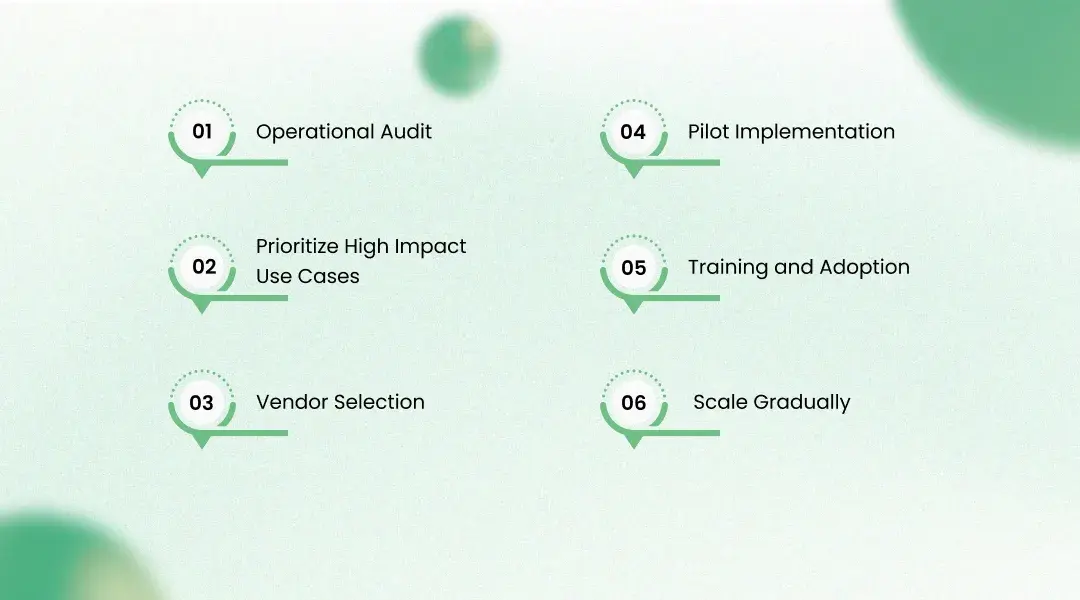
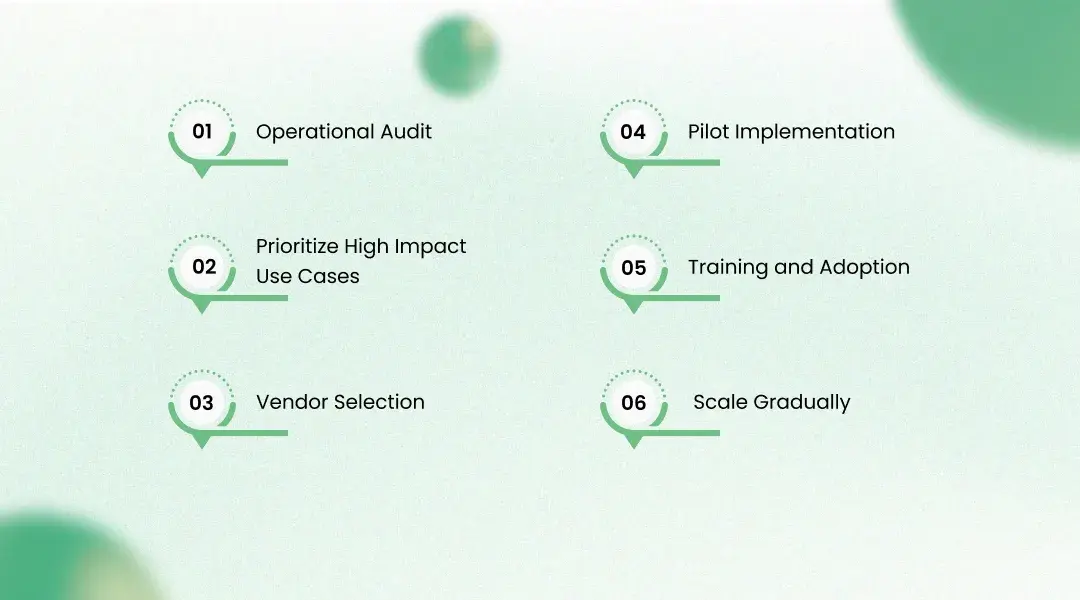
Implementing AI does not require a massive transformation. It requires a structured approach.
Start by identifying your biggest inefficiencies. Is it water usage, labor management, or crop health monitoring. This step should take 1 to 2 weeks and involve your core team.
Select 2 or 3 applications that offer the highest ROI. Avoid trying to implement everything at once. Focus on quick wins.
Choose partners like KriraAI that understand small business constraints. Look for solutions that are modular, easy to deploy, and require minimal training.
Run a pilot on a small section of your farm. This reduces risk and allows you to measure results before scaling. A pilot phase typically lasts 4 to 8 weeks.
Ensure your team understands how to use the tools. Training should be simple and practical, not theoretical.
Expand the implementation based on pilot results. This phased approach ensures sustainability.
Small businesses often get excited and invest in multiple tools at once. This leads to confusion and poor adoption. Focus on 1 to 2 high impact solutions first.
Even the best tools fail if your team does not use them properly. Allocate time for hands-on training.
Low cost tools may lack reliability and support. It is better to invest slightly more in a proven solution with clear ROI.
KriraAI helps businesses avoid these mistakes by guiding them through a structured implementation process tailored to their scale.
Small agricultural businesses face unique challenges when adopting AI.
The first challenge is limited capital flexibility. Even if ROI is clear, upfront investment can feel risky. This requires careful financial planning and phased implementation.
The second challenge is resistance to change. Workers who have followed traditional methods for years may be hesitant to adopt new technologies. This requires clear communication and demonstration of benefits.
The third challenge is integration with existing processes. Unlike startups, you already have established workflows. AI solutions must fit into these workflows rather than disrupt them.
The fourth challenge is vendor overload. The market is filled with tools claiming to be the best. Without proper guidance, it is easy to choose the wrong solution.
These challenges are real but manageable with the right approach and the right partners.
The next 3 to 5 years will redefine competition in agriculture. Small businesses that adopt AI early will gain a compounding advantage.
By 2028, farms using smart farming solutions for small farms are expected to achieve 20 percent higher productivity compared to those relying on traditional methods. This gap will continue to widen.
Early adopters will have better data, better forecasting, and better resource management. This leads to more stable revenues and higher profitability.
Late adopters will struggle with rising costs and unpredictable yields. They will be forced to compete on price rather than efficiency.
The winners in this segment will not be the largest farms but the smartest ones. AI will be the key differentiator.
AI in agriculture for small businesses is no longer an experimental concept. It is a practical tool for improving efficiency, reducing costs, and staying competitive. The most important takeaway is that you do not need enterprise level budgets or teams to benefit from AI. You need a focused approach that targets your biggest challenges first.
Second, the right applications such as smart irrigation, crop monitoring, and labor optimization can deliver measurable results within one year. Third, a structured implementation roadmap ensures that adoption is smooth and sustainable.
KriraAI plays a critical role in helping small agricultural businesses navigate this journey. As a company that builds practical, scalable AI solutions designed for real business constraints, KriraAI focuses on implementations that fit your budget, your team, and your growth stage. If you are ready to explore how AI can transform your farm operations, connect with KriraAI to discover solutions tailored specifically for your business.
AI in agriculture for small businesses refers to the use of machine learning and data driven tools to optimize farming operations at a manageable scale. It works by analyzing data such as weather patterns, soil conditions, and crop health to provide actionable insights. For small businesses, these tools are usually delivered through mobile apps or simple dashboards that do not require technical expertise. The goal is to improve efficiency, reduce costs, and increase yields without adding complexity to daily operations.
The cost of implementing AI in a small farm typically ranges from ₹50,000 to ₹5 lakh depending on the solutions chosen. Basic tools like pest detection apps are on the lower end, while systems like smart irrigation require higher investment. Most small businesses recover these costs within 6 to 12 months through savings and increased productivity. The key is to start with high impact applications rather than investing in multiple tools at once.
The best affordable AI tools for farming include crop monitoring platforms, pest detection apps, and irrigation optimization systems. These tools are designed specifically for small scale operations and do not require advanced infrastructure. They offer immediate benefits such as reduced input costs and improved crop health. Choosing the right tool depends on your specific challenges, whether it is water management, labor efficiency, or yield optimization.
You can implement AI in agriculture without technical expertise by choosing user friendly solutions and working with experienced providers. Most modern tools are designed with simple interfaces that can be used by farm managers or supervisors. Partnering with companies like KriraAI ensures that the implementation process is guided and tailored to your needs. Training is usually completed within a few days, making adoption practical even for non technical teams.
Small agricultural businesses can expect ROI in the range of 10 percent to 30 percent improvements in efficiency and productivity within the first year. This includes savings in water usage, reduced labor costs, and increased crop yields. The exact ROI depends on the applications implemented and the scale of operations. Most importantly, the benefits are cumulative, meaning the value of AI increases over time as more data is collected and analyzed.
Ridham Chovatiya is the COO at KriraAI, driving operational excellence and scalable AI solutions. He specialises in building high-performance teams and delivering impactful, customer-centric technology strategies.