Agriculture is undergoing one of the most significant technological transformations in its history, and the catalyst is artificial intelligence. Recent industry estimates suggest that farms using AI driven systems have increased crop yields by up to 25 percent while reducing input costs by nearly 20 percent within just two growing seasons. This shift is not incremental. It is foundational. The pressure to feed a global population projected to reach 9.7 billion by 2050 is forcing agriculture to evolve faster than ever before.
AI in agriculture is no longer an experimental concept limited to large agribusiness corporations. It is becoming a core operational layer across farms of all sizes, from smallholder farms in developing regions to industrial scale farming operations. Farmers today are expected to manage unpredictable weather patterns, rising input costs, soil degradation, and fluctuating market prices, all while maintaining consistent output quality. Traditional methods alone cannot meet these demands.
This blog explores how AI in agriculture is transforming the industry at every level. It covers current industry challenges, specific AI technologies in use, measurable business impact, practical implementation strategies, limitations, and what the future holds for farming in the next five years.
Agriculture remains one of the most resource intensive industries in the world, yet it operates with a high degree of uncertainty. Farmers rely heavily on experience and intuition, but environmental variability often disrupts even the most informed decisions. Rainfall patterns have become less predictable, and extreme weather events have increased by more than 30 percent over the past two decades, directly impacting crop cycles.
One of the most pressing challenges is inefficiency in resource usage. Water consumption in agriculture accounts for nearly 70 percent of global freshwater use, yet a significant portion is wasted due to outdated irrigation methods. Fertilizer application is another area where inefficiency is evident. Overuse not only increases costs but also damages soil health and leads to environmental pollution.
Labor shortages are also intensifying across agricultural markets. In many regions, the agricultural workforce has declined by more than 15 percent over the last decade. This has made it increasingly difficult to manage large scale operations manually. At the same time, market volatility continues to create pricing uncertainty, making it harder for farmers to predict revenue and manage risk effectively.
Supply chain inefficiencies add another layer of complexity. Post harvest losses in developing countries can reach up to 40 percent due to poor storage, logistics, and demand forecasting. Even in developed markets, mismatches between supply and demand lead to waste and lost revenue opportunities.
These challenges highlight a fundamental reality. Agriculture needs a system that can process large volumes of data, adapt to changing conditions in real time, and optimize decision making at scale. This is precisely where AI in agriculture begins to create measurable change.
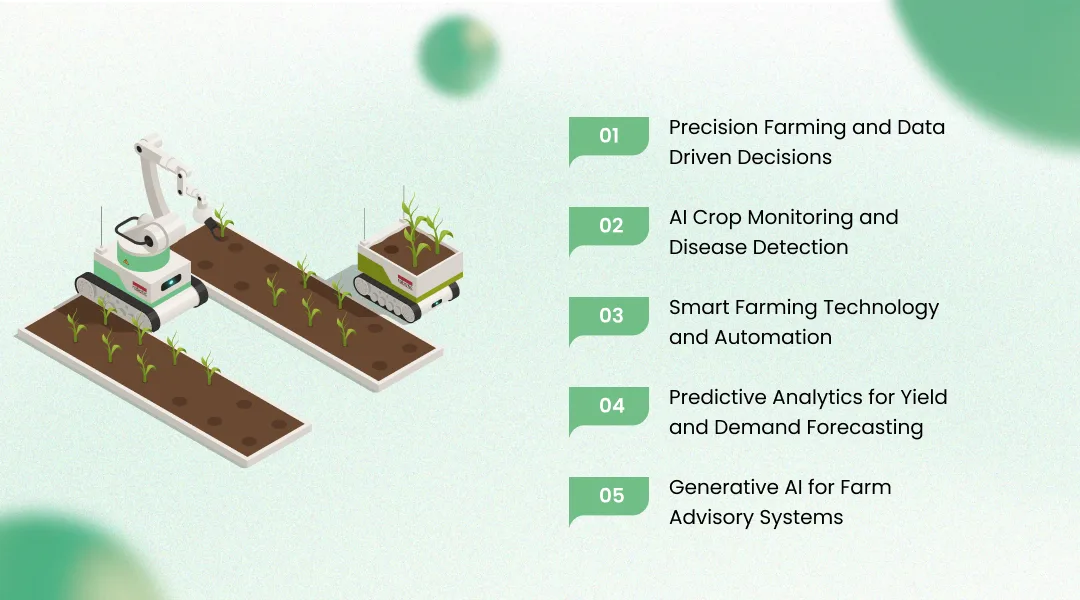
AI in agriculture is not a single technology but a combination of multiple advanced systems working together. These include machine learning models, computer vision, predictive analytics, and natural language processing. Each of these technologies addresses specific problems within the farming lifecycle.
Precision farming AI enables farmers to make highly accurate decisions based on real time data. Sensors placed in fields collect information about soil moisture, nutrient levels, and temperature. Machine learning algorithms analyze this data to recommend optimal irrigation schedules and fertilizer application rates.
This approach reduces input waste and increases efficiency. For example, farms using precision farming AI have reported up to 30 percent reduction in water usage while maintaining or improving yield levels. This is particularly valuable in regions facing water scarcity.
AI crop monitoring systems use computer vision and drone imagery to detect crop health issues early. High resolution images are analyzed to identify signs of disease, pest infestation, or nutrient deficiency. These systems can detect problems up to 10 days earlier than manual inspection.
Early detection allows for targeted intervention, which minimizes crop loss and reduces the need for widespread pesticide use. In some cases, farms have reduced pesticide application by 40 percent through precise targeting enabled by AI crop monitoring tools.
Smart farming technology integrates AI with robotics and automation systems. Autonomous tractors, robotic harvesters, and automated irrigation systems are becoming increasingly common. These technologies reduce reliance on manual labor and improve operational consistency.
For example, automated harvesting systems can operate continuously with minimal human supervision. This increases harvesting efficiency by up to 20 percent and reduces the risk of crop damage due to delays.
Predictive analytics models analyze historical data, weather patterns, and market trends to forecast crop yields and demand. These insights help farmers plan planting schedules, optimize inventory, and negotiate better pricing.
Accurate forecasting reduces uncertainty and enables better financial planning. Farms using predictive analytics have reported up to 15 percent improvement in revenue predictability.
Generative AI systems are now being used to provide real time advisory support to farmers. These systems can answer questions about crop management, recommend best practices, and even simulate different farming scenarios.
Companies like KriraAI are building practical AI solutions that integrate these capabilities into user friendly platforms. KriraAI focuses on delivering scalable AI systems that farmers and agribusinesses can use without requiring deep technical expertise.
The impact of AI in agriculture is measurable across multiple dimensions, including cost savings, productivity improvements, and revenue growth. These outcomes are not theoretical. They are already being realized by farms that have adopted AI driven systems.
Farms implementing precision farming AI have reduced fertilizer costs by up to 25 percent while maintaining optimal soil health. This reduction is achieved through targeted application based on real time soil data rather than uniform distribution.
Water efficiency has improved significantly as well. Smart irrigation systems powered by AI have reduced water usage by 30 to 50 percent in regions with advanced adoption. This not only lowers operational costs but also supports long term sustainability goals.
Labor efficiency is another major area of improvement. Automated systems have reduced manual labor requirements by up to 40 percent in certain operations. This is particularly valuable in regions facing labor shortages.
Yield improvements are among the most compelling outcomes. AI driven crop monitoring and predictive analytics have increased yields by 15 to 25 percent across various crop types. These gains are achieved through better timing of interventions and optimized resource allocation.
Revenue growth is closely tied to improved forecasting and market alignment. Farms using AI in agribusiness platforms have reported up to 20 percent increase in profit margins due to better pricing strategies and reduced waste.
KriraAI has worked with agribusiness clients to implement AI solutions that deliver measurable results within the first 12 months. These implementations focus on practical use cases such as yield prediction, supply chain optimization, and real time crop monitoring.
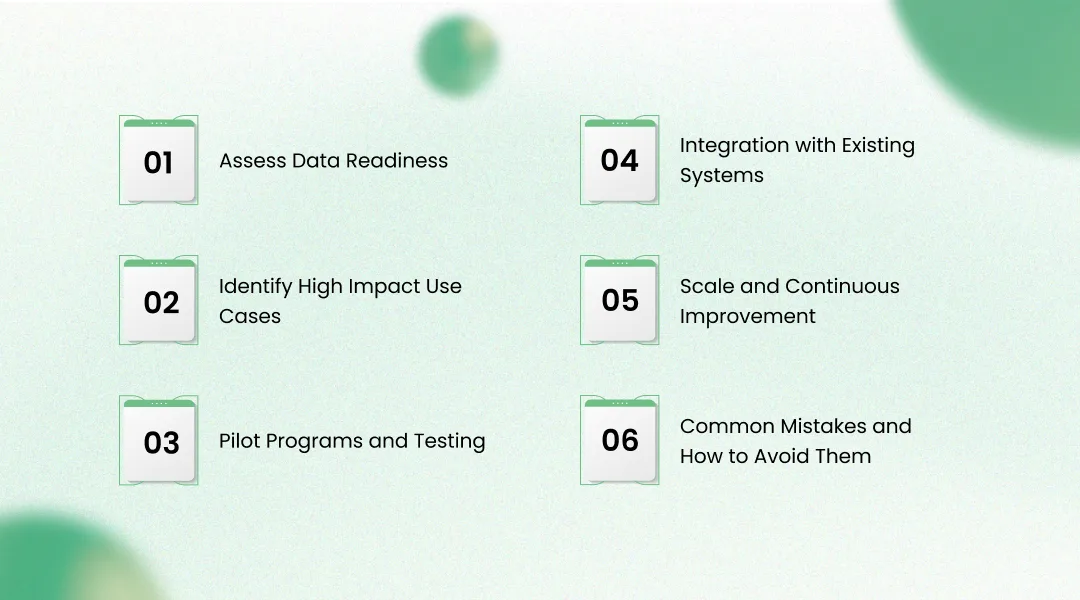
Adopting AI in agriculture requires a structured approach. It is not simply about deploying technology but about integrating it into existing workflows in a way that delivers measurable value.
The first step is to evaluate the availability and quality of data. Farms need to collect data on soil conditions, weather patterns, crop performance, and operational activities. Without reliable data, AI models cannot deliver accurate insights.
Not all AI applications will deliver equal value. It is important to identify use cases that address the most critical challenges. These may include irrigation optimization, disease detection, or yield forecasting.
Before full scale deployment, pilot programs should be conducted. These pilots allow farms to test AI solutions in a controlled environment and measure their impact. A typical pilot may run for one growing season.
AI solutions must be integrated with existing farm management systems. This ensures seamless data flow and avoids duplication of effort. Integration also improves user adoption by maintaining familiar workflows.
Once the pilot proves successful, the solution can be scaled across operations. Continuous monitoring and refinement are essential to maintain performance and adapt to changing conditions.
Many AI initiatives fail due to avoidable mistakes. Understanding these pitfalls can significantly improve the chances of success.
Over investing in technology without clear use cases leads to low return on investment. Focus on solving specific problems first.
Ignoring data quality issues results in inaccurate predictions and poor decision making. Data validation must be a priority.
Lack of training and change management reduces user adoption. Farmers and operators must be trained to use AI tools effectively.
Attempting full scale deployment without pilot testing increases risk. Always validate solutions in smaller environments first.
Underestimating integration complexity can delay implementation. Plan integration early in the process.
KriraAI supports agribusinesses through each stage of this roadmap. Their approach focuses on practical implementation, ensuring that AI solutions deliver measurable outcomes rather than theoretical benefits.
Despite its potential, AI in agriculture faces several challenges that must be addressed. These challenges are both technical and organizational in nature.
Data availability remains a major issue, especially for small and medium sized farms. Many farms do not have the infrastructure to collect and store data consistently. This limits the effectiveness of AI models.
Another challenge is the high initial investment required for AI systems. While costs are decreasing, technologies such as drones, sensors, and automation equipment still require significant capital. This can be a barrier for smaller operations.
Integration complexity is also a concern. Many farms use legacy systems that are not designed to work with modern AI platforms. Integrating these systems requires technical expertise and careful planning.
Regulatory constraints can impact the adoption of certain technologies, particularly those involving data sharing and automation. Compliance requirements vary by region and can slow down implementation.
Change management is often underestimated. Farmers who have relied on traditional methods for decades may be hesitant to adopt new technologies. Building trust and demonstrating value is essential for successful adoption.
KriraAI addresses these challenges by designing solutions that are adaptable to different levels of data maturity. Their systems are built to integrate with existing infrastructure while minimizing disruption to daily operations.
The next five years will redefine what is possible in agriculture. AI will move from being a competitive advantage to a baseline requirement for efficient farming operations.
Autonomous farming systems will become more advanced and widely adopted. These systems will manage entire farming cycles with minimal human intervention, from planting to harvesting. This will significantly reduce labor dependency and increase consistency.
Real time decision making will improve as AI models become more sophisticated. Farmers will be able to adjust strategies instantly based on changing conditions. This level of responsiveness is not possible with traditional methods.
Supply chains will become more integrated and transparent. AI in agribusiness platforms will connect farmers directly with buyers, reducing intermediaries and improving pricing efficiency.
Climate resilience will be a major focus. AI models will help farmers adapt to changing environmental conditions by providing predictive insights and adaptive strategies. This will be critical for maintaining food security.
Companies that fail to adopt AI will struggle to compete. The gap between AI enabled farms and traditional farms will continue to widen. Efficiency, cost structure, and output quality will all be impacted.
KriraAI is actively working on next generation AI solutions that focus on scalability and real world impact. Their vision is to make advanced AI accessible to farms of all sizes, ensuring that the benefits of technology are widely distributed.
AI in agriculture is transforming farming from a reactive process into a proactive and data driven system. The first key takeaway is that AI enables precise decision making, which reduces waste and improves efficiency across all operations. The second is that measurable business impact is already being achieved, with significant improvements in yield, cost savings, and revenue. The third is that successful implementation requires a structured approach that includes data readiness, pilot testing, and continuous improvement.
KriraAI plays a critical role in helping agribusinesses navigate this transformation. As a company that builds practical AI solutions for enterprises, KriraAI focuses on delivering systems that are scalable, measurable, and aligned with real world farming needs. Their expertise in integrating AI into existing operations ensures that businesses can adopt technology without unnecessary complexity.
If you are looking to implement AI in agriculture and achieve measurable results, exploring solutions from KriraAI is a practical next step.
AI in agriculture refers to the use of artificial intelligence technologies to optimize farming operations. It works by collecting data from various sources such as sensors, drones, and weather systems, then analyzing this data using machine learning models. These models generate insights and recommendations that help farmers make better decisions. For example, AI can determine the optimal time to irrigate crops or detect early signs of disease. The goal is to improve efficiency, reduce costs, and increase productivity.
AI improves crop yield and quality by enabling precise management of resources and early detection of issues. It analyzes data related to soil health, weather conditions, and crop performance to optimize farming practices. For instance, AI crop monitoring systems can identify nutrient deficiencies before they become visible to the human eye. This allows farmers to take corrective action quickly, which prevents yield loss. Over time, these improvements lead to more consistent and higher quality produce.
AI in agriculture is becoming more affordable as technology costs decrease and new business models emerge. Many solutions are now offered as subscription based services, which reduces the need for large upfront investments. Additionally, governments and organizations are providing subsidies and support programs to encourage adoption. While initial costs may still be a barrier for some farmers, the long term benefits in terms of cost savings and productivity often justify the investment.
The biggest challenges include data availability, high initial costs, and lack of technical expertise. Many farms do not have the infrastructure needed to collect and manage data effectively. Integration with existing systems can also be complex and time consuming. Additionally, there may be resistance to change among farmers who are accustomed to traditional methods. Addressing these challenges requires a combination of technology, training, and support from solution providers.
AI is not intended to completely replace human labor but to augment it. Automation can handle repetitive and labor intensive tasks, allowing farmers to focus on strategic decision making. For example, autonomous machines can perform planting and harvesting, while AI systems provide insights for crop management. This combination improves efficiency and reduces the physical burden on workers. In most cases, AI enhances human capabilities rather than replacing them entirely.
Founder & CEO
Divyang Mandani is the CEO of KriraAI, driving innovative AI and IT solutions with a focus on transformative technology, ethical AI, and impactful digital strategies for businesses worldwide.