AI for Small Security Companies: A Practical Adoption Guide for 2026
Roughly 15.5 percent of small and midsize businesses entered 2026 without any cybersecurity or technology strategy in place, even as AI-powered threats reshape the landscape of physical and digital security. For small security companies operating with 10 to 50 employees, that statistic is not just about the clients they protect. It is about their own survival. The physical security services market is accelerating toward $235 billion by 2033, yet margins for guard companies continue to tighten as wage inflation pushes labor costs up 17 percent since 2022 and guard turnover exceeds 40 percent annually. Enterprise clients are demanding digital patrol verification, AI-validated incident reports, and measurable performance data as standard SLA requirements. The gap between what clients expect and what a small security operation can deliver without AI is widening every quarter.
This blog is written specifically for owners and operators of security companies with 10 to 50 employees, the companies running 5 to 25 client sites with a mix of guards, mobile patrols, and monitoring services. The companies your size that adopt the right AI tools in 2026 will reduce costs, win larger contracts, and scale without proportional headcount growth. Those that do not will find themselves competing on price alone, which is a race to the bottom in an industry with already thin margins. This guide walks you through how to approach AI adoption at your scale with AI Consultancy Services, what to prioritize, what to avoid, and what results you can realistically expect.
The Operational Reality of a 10 to 50 Employee Security Company
Before selecting any technology, it helps to be honest about what daily life looks like inside a small security operation. Most companies at this size have a working owner or a small management team of two to three people who handle everything from client acquisition to scheduling to payroll. There is rarely a dedicated IT role. The "technology stack" is often a scheduling spreadsheet or basic workforce management software, a handful of surveillance cameras at client sites that may or may not be cloud-connected, and an incident reporting process that relies heavily on guard initiative and supervisor review.
The Core Pressures That Define This Segment
Small security companies face a specific combination of pressures that larger firms and solo operators do not encounter. Client expectations are rising because enterprise security buyers now benchmark every vendor against national firms like Allied Universal and Securitas. They want GPS-verified patrols, digital incident documentation, and real-time visibility into guard coverage. A 2025 Security Magazine survey found that 68 percent of Fortune 500 security directors require digital patrol verification in their contracts. These expectations trickle down to mid-tier commercial clients too, and KriraAI’s finance solutions are a useful reference for security, compliance, and automation.
At the same time, the labor economics are punishing. Hiring, training, and retaining guards at this scale means every vacancy has an outsized impact. When a 30-guard operation fails to fill a shift at one of ten client sites, that represents a 10 percent service failure that threatens the entire client relationship. Scheduling conflicts, overtime costs, and certification tracking consume management hours that should be spent on growth.
Why AI Adoption Looks Different at This Scale
The conversation about AI in security is dominated by two extremes. Enterprise white papers describe deploying AI analytics across thousands of cameras with dedicated security operations centers and seven-figure budgets. Micro-business content focuses on free AI tools for solo security consultants. Neither applies to a security company with 15 guards, 8 client sites, and a technology budget measured in the low five figures annually.
Budget Realities and Vendor Options
For a company of this size, the AI budget is not about allocating millions to a custom platform. It is about finding SaaS tools that cost between $200 and $2,000 per month and deliver measurable operational improvements within 60 to 90 days. The good news is that the vendor landscape has shifted dramatically. In 2024, AI-powered security management tools were priced almost exclusively for enterprise buyers. By 2026, platforms like Guard Owl, OfficerApps, and several cloud-native video analytics providers have introduced pricing tiers built specifically for operations managing 10 to 500 guards. KriraAI has observed this shift across multiple industries and emphasizes that small companies benefit most when they select AI tools designed for their operational scale rather than stripped-down enterprise solutions.
The implementation complexity also differs fundamentally. A large enterprise deploys AI through a months-long procurement process involving IT teams, security architects, and integration partners. A small security company needs tools that a non-technical owner can configure in an afternoon, ideally with onboarding support included. The timeline to see returns must be compressed too. Where an enterprise might accept a 12 to 18 month ROI timeline, a small company owner needs to see tangible results within one billing cycle. If the scheduling software does not reduce overtime costs within the first month, the subscription gets canceled. This is not impatience. It is the financial reality of operating with limited reserves.
Internal Skill Requirements
The internal skill gap matters differently at this scale too. A large enterprise can hire AI specialists or engage consulting firms. A small security company needs tools that work within the existing team's capabilities. The owner or a senior supervisor becomes the AI implementation lead by default. This means the technology must require minimal training, integrate with existing workflows rather than replacing them, and produce results that the team can understand without a data science background.
The Right AI Applications for Small Security Companies
Not every AI application that makes headlines belongs in a small security company. The hype around autonomous robots and fully automated threat detection can create the impression that meaningful AI adoption requires capabilities far beyond what a company of this size can manage. The reality is that the highest-impact AI applications for this segment are surprisingly practical, focusing on the operational bottlenecks that consume the most management time and create the most client-facing risk.
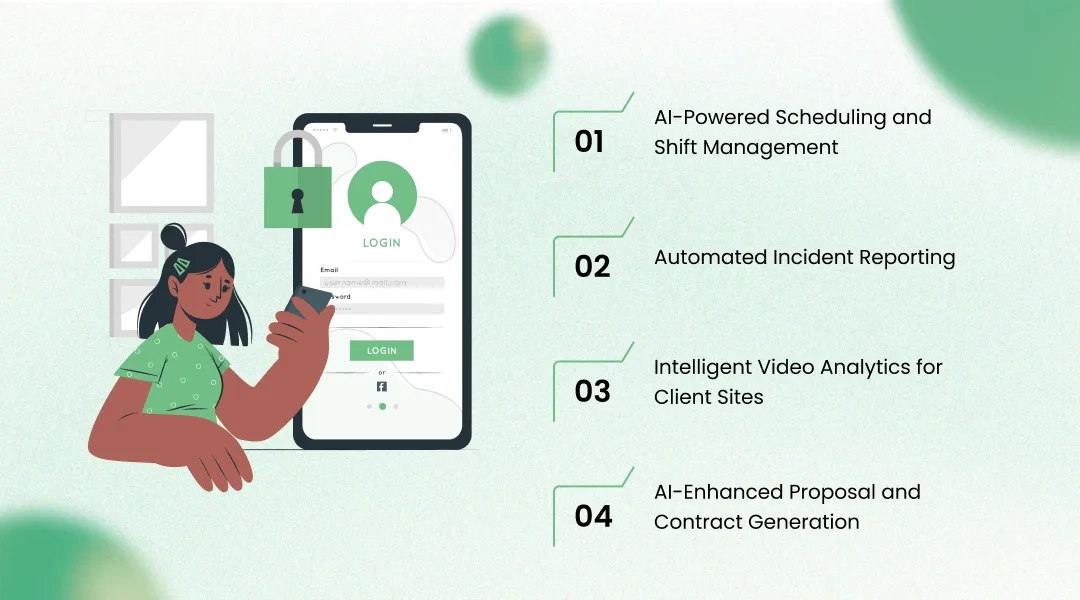
AI-Powered Scheduling and Shift Management
Scheduling is the single largest administrative burden for small security companies, and it is where AI delivers the fastest, most measurable return. AI-powered scheduling platforms automatically detect conflicts, flag certification mismatches, identify overtime risks, and fill open shifts through intelligent matching. For a company managing 20 to 40 guards across multiple sites, this capability alone can save 10 to 15 hours per week of management time. At current operating costs, that translates to roughly $25,000 to $40,000 in annual productivity savings. These platforms typically cost between $300 and $800 per month for an operation of this size, producing a return within the first four to six weeks.
Automated Incident Reporting
Guard-written incident reports are one of the most common sources of client dissatisfaction. Reports are often inconsistent, incomplete, or delayed. AI-powered reporting tools allow guards to input raw notes, voice recordings, or basic observations, and the system generates professional, standardized reports that meet client expectations, much like the workflow discipline shown in Government AI Implementation Case Study: 85% Faster Cases. Supervisors who previously spent two to three hours daily reviewing and editing reports can reduce that time by 60 to 70 percent. The client-facing impact is equally significant: consistent, well-structured reports become a competitive differentiator when bidding for contracts against larger firms.
Intelligent Video Analytics for Client Sites
Cloud-based AI video surveillance is now accessible at price points that work for small security companies, particularly those managing surveillance as part of their service offering. Camera-agnostic AI platforms can connect to existing cameras and add behavioral detection, false alarm filtering, and natural language video search without requiring hardware replacement. For a company managing cameras across 8 to 15 client sites, the ability to reduce false alarms by 70 to 90 percent transforms the economics of monitoring. Operators spend time on verified events rather than chasing noise that makes up over 95 percent of traditional alarm activations.
AI-Enhanced Proposal and Contract Generation
Winning new contracts requires professional proposals, and small security companies often lose bids not because their services are inferior but because their proposals look less polished. AI writing tools can help operations managers produce customized, professional proposals in a fraction of the time. KriraAI works with small businesses across industries to identify exactly these kinds of high-leverage AI applications that deliver disproportionate value relative to their cost.
Quantified Business Impact: What the Numbers Look Like at This Scale
Understanding AI's impact requires grounding the numbers in the reality of a small operation. Industry benchmarks from early AI adopters in the security sector paint a clear picture when calibrated to a 10- to 50-employee company.
A company with 30 guards and 10 client sites that implements AI-powered scheduling can expect to reduce overtime costs by 18 to 25 percent, which at typical guard billing rates represents $30,000 to $50,000 in annual savings. The same company deploying automated incident reporting can reduce supervisor administrative time by approximately 12 hours per week, freeing that capacity for client relationship management or site inspections that directly support retention and growth.
On the revenue side, companies at this scale that deploy AI video analytics as a service offering report winning 15 to 20 percent more contract bids because they can demonstrate technology capabilities that clients previously associated only with national firms. When clients receive real-time digital patrol verification and professional automated reports, satisfaction scores improve measurably. Early adopter data from AI-integrated guard companies shows client renewal rates improving by 15 to 19 percentage points compared to pre-adoption baselines.
The compound effect matters most at this scale. A small security company that saves $50,000 in operational costs, wins two additional contracts worth $120,000 annually, and retains one client who would have churned has added $250,000 in effective value from AI tools costing $12,000 to $18,000 per year in total subscriptions. That kind of return is transformative for a company generating $1 million to $3 million in annual revenue.
Implementation Roadmap for AI Adoption in Small Security Companies
Adopting AI at this scale does not require a digital transformation consultant or a six-month project plan. It requires a structured but lean approach that respects the reality of running a small operation where the person making technology decisions is also the person signing payroll checks.
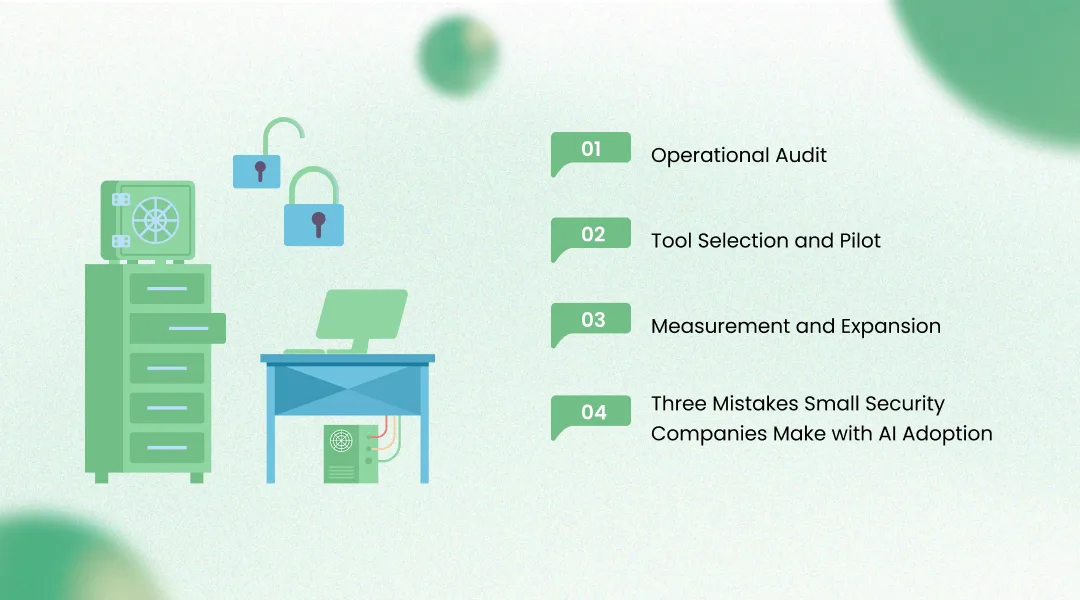
Phase One: Operational Audit (Weeks 1 to 2)
Before purchasing any tool, spend two weeks documenting where management time actually goes. Track hours spent on scheduling, report review, client communication, and incident response. Identify the top three time sinks and the top three sources of client complaints. A simple daily log maintained by the owner and operations manager is sufficient. The goal is to match AI tools to real bottlenecks, not to implement technology for its own sake.
Phase Two: Tool Selection and Pilot (Weeks 3 to 6)
Select one AI tool that addresses the number one bottleneck identified in Phase One. Most small security companies will start with either scheduling automation or reporting automation. Evaluate no more than three vendors, request demos, and verify that pricing matches your operation. Deploy the tool at two to three client sites initially, not across the entire operation. This limits risk and creates a controlled environment for measuring impact.
Phase Three: Measurement and Expansion (Weeks 7 to 12)
After four to six weeks of pilot operation, measure results against your baseline, following the same phased rollout mindset discussed in AI Implementation in Financial Services: What Actually Works. Compare overtime costs, supervisor hours, report quality, and client feedback before and after deployment. If the results justify the investment, expand across all sites and begin evaluating the second AI tool. KriraAI recommends that small businesses follow this phased approach because it builds internal confidence, creates measurable proof of value, and avoids the trap of over-investing before the team is ready.
Three Mistakes Small Security Companies Make with AI Adoption
The first mistake is starting with the most complex application instead of the most impactful one. Video analytics with behavioral detection is impressive, but if scheduling errors are costing you clients, fix scheduling first. Complexity without urgency leads to abandoned implementations.
The second mistake is choosing enterprise-grade tools because they seem more "professional." A platform built for companies managing 5,000 guards has a learning curve, feature set, and pricing structure that will overwhelm a 30-guard operation. Purpose-built tools for your scale will always deliver better results than general-purpose platforms with features you will never use.
The third mistake is failing to involve frontline guards in the adoption process. Guards who feel that AI is being imposed on them will resist using mobile reporting tools and digital workflows. Companies that explain how the tools reduce paperwork and simplify their shifts see dramatically higher adoption rates.
Challenges Specific to Small Security Companies Adopting AI
Honesty about the difficulties is essential because glossing over them leads to disappointment and wasted investment. Small security companies face challenges that do not appear in enterprise case studies or startup success stories.
Data quality is a persistent issue. AI tools perform best when they can learn from clean, consistent historical data. Most small security companies have years of scheduling done in spreadsheets, incident reports in inconsistent formats, and client information scattered across email threads. The initial data migration and cleanup is tedious but necessary. Expect to invest 10 to 20 hours of administrative work preparing existing data before an AI tool can function properly.
Vendor reliability is another concern. The market for AI tools targeting small security companies is still maturing. Before committing, verify the vendor's stability, ask about data portability to ensure you can export your data if you switch providers, and confirm that the platform has a track record with companies of your size.
Cash flow timing creates a third challenge. Even affordable AI subscriptions represent a new recurring expense, and for companies operating on 30- to 60-day client payment cycles, adding $500 to $1,500 per month before savings materialize can strain working capital. Plan for a minimum of two months of subscription costs before AI tools generate enough savings to become self-funding.
Future Competitive Landscape: Where AI Separates Winners from Losers
The security industry is undergoing a structural shift that will reshape competition at every level over the next three to five years. For small security companies, the question is not whether AI will become standard but whether you will be an early adopter who shapes the new landscape or a late follower who struggles to catch up.
By 2028, client RFPs for security contracts will routinely require AI-powered reporting, digital patrol verification, and data-driven performance analytics as baseline capabilities. Companies that build these competencies now will have three to four years of operational data, refined workflows, and trained teams. Late adopters will be implementing these systems under competitive pressure, paying higher costs with steeper learning curves while losing contracts during the transition. The compounding advantage of early AI adoption is particularly powerful at the small company scale. A small security company that uses AI to reduce administrative overhead by 30 percent can reallocate those hours to business development without hiring additional staff. Over three years, that capacity advantage compounds into a market position difference that becomes extremely difficult for competitors to close.
Building Your AI Advantage Before the Window Closes
Three core insights should guide every small security company's approach to AI in 2026. First, the right AI tools for your size are not the ones making headlines but the ones that solve your specific operational bottlenecks at a price point that pays for itself within one quarter. Second, implementation at your scale should be phased, measured, and grounded in real baseline data, not driven by hype or fear of missing out. Third, the competitive window is narrowing. Companies that build AI capabilities now will have an entrenched advantage within two to three years that late movers will struggle to overcome.
KriraAI helps small security companies with 10 to 50 employees navigate this transition with practical AI solutions designed for their actual budget, team structure, and growth stage. Rather than offering enterprise platforms that require scaling down or startup tools that need scaling up, KriraAI focuses on implementations that match the operational reality of growing security businesses. If you are running a security company at this scale and considering where AI fits into your next phase of growth, exploring what KriraAI offers is a practical first step toward building the operational advantage that will define your competitive position in the years ahead.
FAQs
AI implementation for a small security company typically costs between $400 and $2,000 per month in total software subscriptions, depending on which tools are adopted and how many guards are covered. Scheduling automation platforms generally run $300 to $800 per month for operations managing 10 to 50 guards. Automated reporting tools add $100 to $400 per month. AI video analytics ranges from $200 to $1,000 per month depending on camera feeds and features required. Most companies begin with one tool and add others over six to twelve months. The total first-year investment, including setup time and data migration, typically falls between $6,000 and $25,000, delivering measurable ROI within three to four months for most operations.
AI does not replace security guards at small companies. It augments their effectiveness and reduces the administrative burden on management. The core value of a security guard company is human judgment, physical presence, and client relationships, capabilities that AI cannot replicate. What AI does replace is the manual, repetitive work that consumes management time without adding value: formatting incident reports, resolving scheduling conflicts, reviewing hours of uneventful surveillance footage, and manually tracking certifications. For a small operation where every guard and every manager is essential, AI makes each person more productive rather than making anyone redundant. The companies seeing the best results from AI adoption at this scale are not reducing headcount. They are growing their client base without proportionally growing their overhead.
The best starting point for most small security guard companies is AI-powered scheduling and workforce management software, because scheduling problems directly impact both operational costs and client satisfaction. For a company with 15 to 40 guards, scheduling conflicts, missed shifts, and overtime overruns represent the largest controllable cost. AI scheduling tools detect these issues before they become client-facing problems, typically reducing overtime expenses by 18 to 25 percent and cutting administrative scheduling time by 50 to 60 percent. If your primary pain point is report quality rather than scheduling, then an AI-powered incident reporting tool is the better first investment. The key principle for companies at this scale is to start with the single tool that addresses your most expensive operational bottleneck, prove the ROI, and then expand.
Small security companies that implement AI tools correctly typically see measurable return on investment within 30 to 90 days. Scheduling automation produces the fastest results because the reduction in overtime costs and time saved on manual schedule management are immediately quantifiable. Companies report seeing impact within two to three pay cycles. Automated reporting tools take approximately 30 to 45 days, as ROI combines direct time savings with indirect benefits like improved client satisfaction. Video analytics tools have the longest payback period at this scale, generally 60 to 120 days, because they require configuration and tuning. The critical factor is choosing tools with free trial periods or month-to-month contracts so the company is not locked into commitments before value is proven.
Small security companies do not need dedicated technical staff to manage modern AI tools designed for their segment. Current AI platforms for the security industry feature guided setup processes, visual dashboards, and mobile-first interfaces that guards and supervisors can learn in a single training session. The owner or operations manager typically handles initial setup, which takes between two hours and two days depending on the platform. Ongoing management requires 15 to 30 minutes per day, primarily reviewing AI-generated insights and approving automated recommendations. Most vendors targeting this market segment include onboarding support at no additional cost. KriraAI also supports small businesses with implementation guidance tailored to operations where the person managing the technology is also managing the business.
Ridham Chovatiya is the COO at KriraAI, driving operational excellence and scalable AI solutions. He specialises in building high-performance teams and delivering impactful, customer-centric technology strategies.