AI for Small Farms: What It Costs and Returns at 10 to 50 Staff
Farms that employ 10 to 50 people sit in the hardest seat in agriculture. They grow a large share of the fresh produce, dairy, and specialty crops that reach regional markets. Yet AI for small farms remains rare at this scale, adopted at a fraction of the rate seen on large operations. Most on-farm technology studies show that farms above 1,000 acres or 100 staff move first. The farm with 10 to 50 employees watches from the sidelines, unsure whether the cost is justified.
This blog is written only for that farm. It is not for the hobby grower running a free phone app on a few acres. It is not for the 5,000-person agribusiness with a data science team and a seven-figure software budget. If you run a real operation with a handful of full-time staff and a crowd of seasonal hands, this is written for you. We will cover what AI actually costs at your scale, what it returns, and which tools earn their keep first. Every number here is calibrated to a farm your size, not scaled down from an enterprise pitch.
[Suggested visual: Aerial photo of a midsize vegetable or fruit operation with fields, a packing shed, and a few staff vehicles, captioned "The 10-to-50 employee farm: too big for apps, too small for enterprise ag tech"]
The Operational Reality of a 10-to-50 Employee Farm
A farm with 10 to 50 employees runs on a very specific structure. There is usually an owner or family who makes the final calls. Below that sits a farm manager or two, a small core of year-round staff, and a large seasonal crew at harvest. Nobody in that group carries the title of IT lead. One person is simply known as the one who is good with computers.
Budgets at this scale are tight and seasonal. Capital is locked in land, machinery, seed, and inputs long before revenue arrives. Net margins often sit in the single digits, and a bad weather year can wipe them out. Cash is plentiful after harvest and thin before it, which shapes every buying decision.
The technology stack is usually a patchwork. Many of these farms already use basic GPS guidance on their tractors and keep records in a mix of spreadsheets and notebooks. Coordination often happens over WhatsApp or text between the manager and crew leads. Data exists, but it is scattered across phones, paper, and one overworked laptop.
Decision-making is fast in one sense and cautious in another. The owner can approve a purchase in a single conversation, with no procurement committee. At the same time, a wrong bet stings personally, so trust and peer proof matter more than glossy demos. These owners buy what their neighbor down the road has already proven works.
The pressures are relentless and specific. Labor is scarce and getting more expensive every season. Input costs for fuel, fertilizer, and seed swing wildly year to year. Buyers and retailers demand traceability, food safety records, and consistent quality. Water is constrained in more regions each year. This is the daily reality that any useful technology, including AI, has to fit into.
Why AI Adoption Looks Different at This Scale
AI adoption on a 10- to 50-employee farm looks almost nothing like what a Fortune 500 agribusiness does. A global producer spends millions building custom models, hiring data scientists, and integrating sensors across thousands of acres. A solo grower on the other end buys a free app and calls it done. Your farm lives in the gap between those two extremes, and that gap defines everything.
Start with the budget. A large enterprise treats a 500,000-dollar AI project as a rounding error. A solo operator will not spend more than a few dollars a month. A 10- to 50-employee farm has real money to invest, but it must show a return within a season or two. The cost of AI in agriculture at your scale is measured in hundreds or low thousands per month, not in capital projects.
Implementation complexity is the next divide. Enterprises build. You buy and configure. You do not have the staff to maintain custom software or clean messy data pipelines. What you need is a tool that works within a week and does not require a specialist to babysit it. That single constraint rules out most of what large operations deploy.
Vendor options also change at your scale. Enterprise vendors ignore you because your contract is too small to matter to them. Consumer apps underserve you because they are built for a backyard plot, not a payroll. The right partner sizes the solution to a real team and a real budget. This is exactly the gap KriraAI was built to close, since KriraAI builds practical AI systems for small operations rather than enterprise platforms in disguise.
Internal skill requirements are lighter than the headlines suggest. You do not need a data scientist. You need one motivated staff member who can learn a dashboard and act on what it shows. The timeline to see returns is also shorter at your scale, because you can act on an insight the same day. There is no committee between the alert and the action.
Choosing the Right AI for Small Farms With Limited Staff
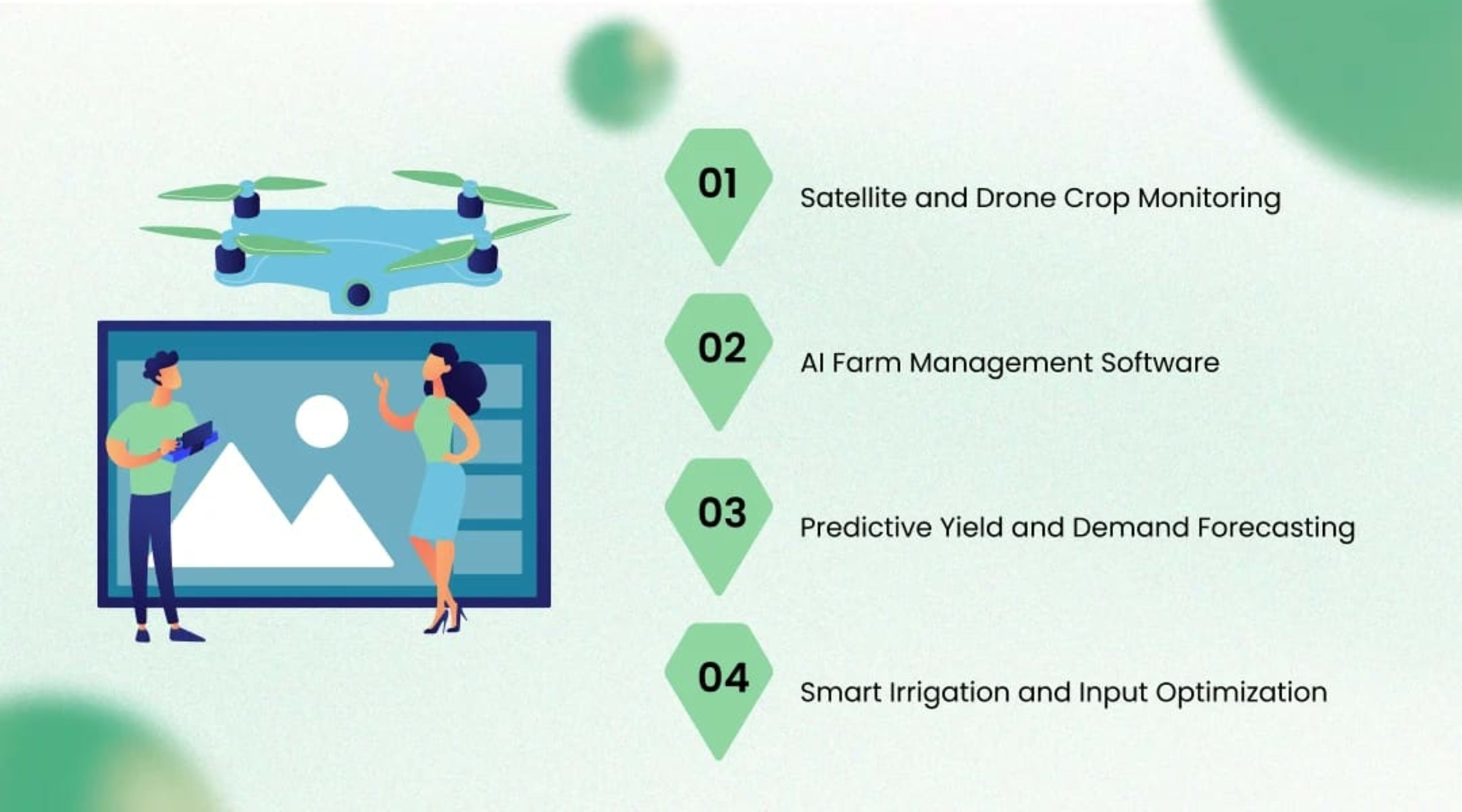
The best AI for small farms is not the most advanced technology available. It is the technology with the fastest, clearest payback for a small team. Below are the applications that consistently earn their place on a 10- to 50-employee operation. Each one solves a real problem, fits a small budget, and works without a technical hire.
Satellite and Drone Crop Monitoring
AI crop monitoring for small farms is usually the single best place to start. Satellite-based services scan your fields every few days and flag stress, disease, or irrigation problems early. Built on the same AI-driven crop monitoring systems used in precision agriculture, the AI compares imagery over time and highlights the exact zones that need a human to walk out and check. This turns days of scouting into a targeted 20-minute visit.
The cost fits your scale cleanly. Satellite crop monitoring commonly runs between 2 and 10 US dollars per acre per year. Adding a drone brings hardware in the range of 1,500 to 5,000 dollars plus software. The realistic result is earlier problem detection, which matters because late-caught disease can cost 10 to 30 percent of a field's yield.
AI Farm Management Software
AI farm management software replaces the tangle of spreadsheets, notebooks, and group chats. It centralizes field records, input logs, labor tracking, and compliance documents in one place. The AI layer forecasts tasks, flags overdue work, and prepares food safety and traceability reports automatically. For a farm with 10 to 50 staff, this alone can recover many hours each week.
Pricing sits within reach for this segment, following a similar right-sized AI playbook for gyms built for another underserved mid-scale operator. Most capable platforms cost between 50 and 500 dollars per month, depending on acreage and features. The value is not just tidy records. It is the manager who stops spending Sunday nights reconstructing the week from memory.
Predictive Yield and Demand Forecasting
Predictive tools forecast both what your fields will produce and what your buyers will want. Yield forecasting helps you plan harvest labor, storage, and cash flow weeks in advance. Demand forecasting helps direct sales operations avoid overplanting or underplanting a crop. For a farm selling to regional buyers or farmers' markets, this reduces waste and missed sales.
These features are often bundled inside farm management platforms at no extra cost. A custom forecasting project, if you need one, typically runs from 5,000 to 25,000 dollars. KriraAI often builds exactly this kind of targeted model, sized to one farm's crops and one farm's buyers rather than a generic industry template.
Smart Irrigation and Input Optimization
Smart irrigation uses soil sensors and weather data to water only when and where it is needed. The AI decides timing and volume, which cuts both water use and pumping energy. Variable rate systems apply fertilizer only where the soil and crop actually need it. On a small operation, both directly attack two of your highest variable costs.
The economics are favorable at this scale. A sensor and controller setup for a small operation often lands between 5,000 and 20,000 dollars total. Smart irrigation commonly reduces water use by 15 to 30 percent, and variable rate application can trim fertilizer spend by 10 to 20 percent. Those savings often cover the investment within two seasons.
[Suggested visual: Split screen showing a soil moisture sensor in a field beside a simple dashboard with irrigation recommendations, captioned "Smart irrigation: AI decides timing and volume so you save water and energy"]
Quantified Business Impact at This Scale
The numbers behind AI on a small farm only make sense when you read them at your scale. A 15-hour weekly time saving means something very different on a 20-person farm than on a 5,000-person agribusiness. On your farm, that saving is not trimmed overhead buried in a spreadsheet. It is nearly half of a full-time role handed back to your best manager.
Consider labor and management time first. Farms that adopt AI farm management software commonly recover 10 to 20 hours per week previously lost to paperwork and manual scouting. On a small team, that is time your manager can spend on agronomy, buyers, or crew training. Over a full season, it adds up to hundreds of hours of higher-value work.
Now consider input and water savings. Smart irrigation cutting water use by 15 to 30 percent is real money on a farm that pays for every unit pumped. A farm spending 60,000 dollars a year on water and energy could save 9,000 to 18,000 dollars annually. Variable rate fertilizer trimming input spend by 10 to 20 percent adds another meaningful line to that total.
Yield protection is often the largest and least visible gain. AI crop monitoring for small farms catches disease and stress before they spread across a block. Preventing a single 15 percent loss on a high-value crop can be worth more than the entire annual software cost. For a farm operating on single-digit margins, protecting one block can protect the whole year.
Put together, the payback picture is clear. A small farm typically sees measurable returns within one to two growing seasons of adopting well-chosen tools. The gains compound because the data improves every year the system runs. That is why the cost of AI in agriculture, at this scale, is better understood as an investment with a season-length payback than as an expense.
How to Implement AI on a Small Farm
Knowing how to implement AI on a small farm is mostly about sequence and restraint. You do not roll out five systems at once. This mirrors the same phased rollout approach mid-market companies use in other industries: solve your single most expensive problem first, prove the return, then expand. The process below reflects how a resource-constrained farm actually moves from idea to full adoption.
Run a short internal audit of where money and time leak most, whether that is labor, water, inputs, or spoilage.
Pick one problem with a clear dollar value and choose a single tool that targets it directly.
Select a vendor or partner who sizes the solution for a small team and offers real onboarding support.
Run a pilot on one field, one crop, or one process for a single season before committing further.
Measure the result against the baseline you recorded in the audit, using real numbers, not impressions.
Expand to the next problem only after the first tool has clearly paid for itself.
The internal resources needed are lighter than the owners fear. You need one staff member willing to own the dashboard and act on it. You do not need to hire anyone new. What you can outsource is the setup, integration, and model tuning, which is where a partner like KriraAI handles the technical work so your team simply acts on clear recommendations.
The timeline is realistic for a busy farm. A focused pilot can be run within two to four weeks of choosing a tool. A full season provides the proof you need before expanding. Most farms reach confident, wider adoption within 12 to 18 months of their first pilot.
The Three Mistakes Small Farms Make and How to Avoid Them
Small farms tend to repeat the same three errors when adopting AI. Each one is avoidable once you name it. Watch for these before you spend a rupee or a dollar.
Buying enterprise software scaled down, which is too complex and too expensive for your team, so choose tools built for small operations instead.
Trying to automate everything at once overwhelms your staff, so solve one costly problem, prove it, then move on.
Skipping the baseline measurement leaves you unable to prove the return, so record your current numbers before the pilot begins.
[Suggested visual: Simple six-step roadmap graphic from audit to full adoption, with a season-length timeline running underneath]
Challenges Specific to a Farm of This Size
The challenges a 10- to 50-employee farm faces with AI are genuinely different from those of an enterprise or a solo grower. Your friction points come from being stuck in the middle. You have too much complexity for a simple app but too little budget for a custom build. Naming these clearly helps you plan around them.
Data fragmentation is the first real hurdle. Your records live across paper, spreadsheets, phones, and several people's memories. Before any AI can help, someone has to consolidate that history, and nobody on your team has spare hours. The fix is choosing tools that start capturing clean data going forward, rather than demanding a painful cleanup first.
Staff bandwidth is the second constant challenge. During planting and harvest, every hand is fully committed, so a rollout timed badly will simply fail. New tools must launch in a quieter window and demand almost no learning curve. If a system needs a manual and a week of training, it will not survive your busy season.
Vendor trust is the third and most underrated challenge. Large vendors do not return your calls because your contract is small. Consumer apps ignore the realities of a real payroll and a real buyer list. You need a partner who understands a farm your exact size and will answer the phone in March. Honest guidance from someone who has worked with operations at your scale matters more than any feature list.
The Future Competitive Landscape for Small Farms
Look three to five years ahead, and the gap between adopters and holdouts becomes stark. The farms that start now build a data advantage that compounds every season. Their models get sharper, their forecasts get tighter, and their input decisions get more precise. The farm that waits will be starting from zero while its neighbor is in its fourth year of learning.
The compounding advantage is the part most owners underestimate. AI improves with the history it holds, so an early mover's system is far better by year four than a late starter's system in year one. That difference shows up as lower input costs, less spoilage, and steadier yields. Over several seasons, those margins separate the farms that thrive from the ones that merely survive.
Buyer expectations will widen the gap further. Retailers and regional buyers increasingly reward consistent quality, reliable volume, and clean traceability records. Farms with AI-driven monitoring and automated compliance will meet those demands effortlessly. Farms without them will lose contracts to competitors of the same size who moved earlier.
The winners at your scale will not be the biggest farms. They will be the small farms that adopted focused, affordable AI early and let it compound. The capability that separates them will be simple discipline, not a huge budget. That is the entire argument for starting now rather than next year.
Conclusion
Three points matter most for a farm your size. First, AI for small farms is now affordable, with software in the hundreds per month and payback within one to two seasons. Second, you should solve your single most expensive problem first, prove it, then expand with discipline. Third, the farms that start now build a data advantage that compounds and separates winners from holdouts.
The hard part is picking the right tools and sizing them to your real budget, team, and growth stage, which is the core of how KriraAI approaches every engagement. This is where KriraAI works specifically with farms of 10 to 50 employees. KriraAI builds practical, scalable AI solutions designed for real constraints, not enterprise platforms scaled down or consumer apps scaled up. The goal is a system your existing team can run, tuned to your crops, your buyers, and your margins.
If you run a farm at this scale and want a clear, honest starting point, reach out to KriraAI to explore an implementation built for your operation. You do not need a data scientist or a large budget to begin. You need one focused pilot, one measurable result, and a partner who understands a farm exactly your size.
FAQs
For a farm with 10 to 50 employees, most useful AI runs between 50 and 500 dollars per month for software, with sensor or drone hardware adding a few thousand dollars once. Targeted custom projects usually cost 5,000 to 25,000 dollars.
Yes, for most operations at this scale, AI pays back within one to two growing seasons. The largest gains come from recovered management time, reduced water and fertilizer spend, and earlier disease detection that protects high-value blocks from serious yield loss.
The best AI for small farms with limited staff is satellite crop monitoring, AI farm management software, and smart irrigation. These require no data scientist, work within weeks, and target your three highest costs, which are labor, water, and inputs, directly and affordably.
Yes, precision agriculture is now affordable for small farms because satellite monitoring costs only 2 to 10 dollars per acre per year. You no longer need expensive equipment to get field-level insights, since the data arrives through a subscription rather than a capital purchase.
A small farm typically sees a running pilot within two to four weeks and measurable results within a single growing season. Full, confident adoption across the operation usually happens within 12 to 18 months of the first successful pilot.
Ridham Chovatiya is the COO at KriraAI, driving operational excellence and scalable AI solutions. He specialises in building high-performance teams and delivering impactful, customer-centric technology strategies.