AI Consulting Services for Startups: From Idea to Working AI Product
Building an AI product sounds simple when the idea is still on a whiteboard.
You want to add an AI assistant to your SaaS product. Automate customer support. Analyze documents. Build an AI agent. Add predictive intelligence. Personalize recommendations.
Then the real questions start:
Is AI actually the right solution for this problem?
What should we build first?
Is our data ready?
Should we use an existing AI API, RAG, fine-tuning, machine learning, or an AI agent?
How much should we invest before we know the idea works?
How do we turn a prototype into something customers can actually use?
Who will maintain the system after launch?
This is where AI consulting services for startups become valuable.
The goal of startup AI consulting should not be another strategy presentation that ends up sitting in a shared drive. It should help you move from idea → validation → AI strategy → MVP → production → continuous improvement.
This guide explains how that process works, what to evaluate before investing in AI, and how to choose an AI partner that can help you turn an idea into a working product.
What Are AI Consulting Services for Startups?
AI consulting for startups combines business strategy, technical decision-making, product planning, and AI engineering to help a company identify where AI can create measurable value and determine how to implement it.
A strong engagement can cover the entire journey, including:
AI opportunity discovery
AI readiness assessment
Use-case prioritization
AI strategy and roadmap
Technical architecture
Model and technology selection
MVP planning
AI development
Product integration
Testing and evaluation
Deployment
Monitoring and optimization
The most important distinction is between deciding what to build and actually building it.
A startup may have an excellent AI idea but lack the data, architecture, evaluation process, or engineering resources required to turn it into a reliable product.
That is why the most useful AI consulting engagements connect strategy with execution.
AI consulting vs. AI development vs. startup AI advisory
These services overlap, but they solve different problems.
Need | AI Consulting | AI Development | Startup AI Advisory |
Identify AI opportunities | Yes | Sometimes | Yes |
Prioritize use cases | Yes | Sometimes | Yes |
Assess AI readiness | Yes | Sometimes | Yes |
Create AI roadmap | Yes | Sometimes | Yes |
Design architecture | Yes | Yes | Sometimes |
Build AI MVP | Usually through delivery partner | Yes | No |
Integrate AI into product | Sometimes | Yes | No |
Ongoing strategic guidance | Yes | Sometimes | Yes |
For an early-stage startup, the right model may change over time.
You might start with an AI readiness assessment, move into AI strategy consulting, and then work with the same team on MVP development and production deployment.
When Should a Startup Hire an AI Consultant?
Not every startup needs an AI consultant from day one.
But external expertise can make a significant difference when the cost of choosing the wrong technical direction is high.
You have an AI idea but don't know what to build
Many founders start with technology rather than a business problem:
“We want to build an AI agent.”
The better question is:
“Which workflow should the AI agent improve, and what measurable result should it produce?”
An AI consultant can help convert a broad AI idea into a specific use case with defined users, workflows, data requirements, constraints, and success metrics.
Your engineering team is experimenting but not reaching production
A prototype can prove that an AI concept is possible without proving that it is commercially viable.
Your team may have a working demo but still face issues with:
inconsistent outputs
hallucinations
slow response times
rising inference costs
poor data retrieval
weak evaluation
difficult integrations
security concerns
unreliable user workflows
This is where startup AI advisory and technical consulting can help bridge the gap between experimentation and production.
You need AI expertise without building a full AI team
An early-stage startup may not need a large internal AI organization.
What it may need is focused expertise for a particular strategic or product challenge: selecting the right architecture, validating a use case, building an MVP, or integrating AI into an existing product.
Your team needs to decide between multiple AI approaches
Should you use an API?
A retrieval-augmented generation system?
A fine-tuned model?
Traditional machine learning?
An AI agent?
A multimodal architecture?
The correct decision depends on the problem, data, performance requirements, budget, and product workflow—not simply on which technology is currently popular.
AI Readiness Assessment: Is Your Startup Ready to Build AI?
Before choosing a model, framework, or vendor, assess whether the business is actually ready to deploy AI.
An AI readiness assessment helps identify the gaps that could slow down or derail an AI project before significant engineering resources are committed.
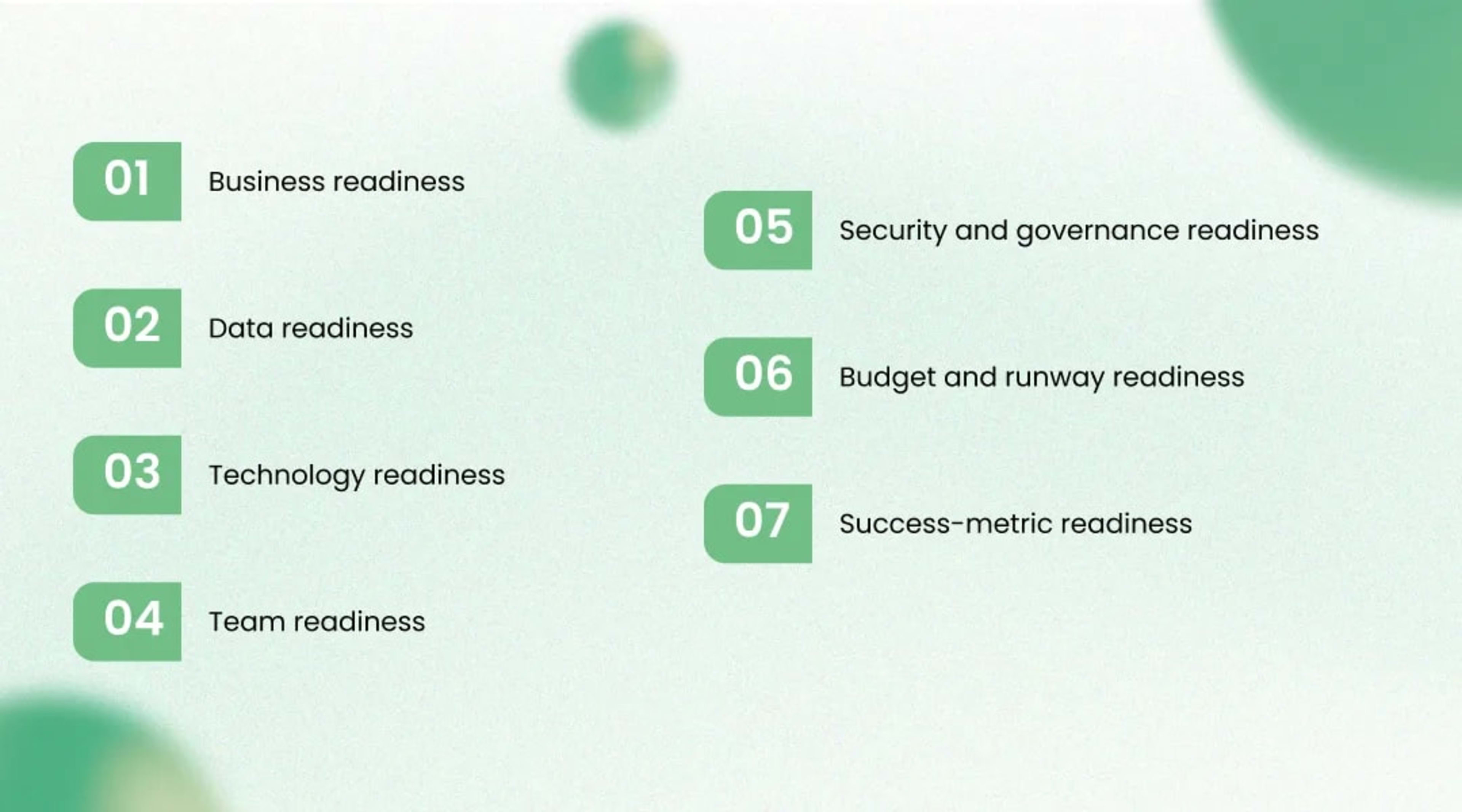
1. Business readiness
Start with the business problem.
Ask:
What problem are we solving?
Who experiences it?
How often does it happen?
What does the problem currently cost?
What would improve if AI solved it?
How will we measure success?
A technically impressive AI system is still a weak investment if it does not solve an important customer or operational problem.
2. Data readiness
AI systems depend heavily on the quality, availability, structure, and accessibility of data.
Assess:
where the data lives
who owns it
how clean it is
how frequently it changes
whether it can be accessed securely
whether it needs labeling or transformation
whether the available data is sufficient for the intended use case
Data problems often become engineering problems later, so identifying them early matters.
3. Technology readiness
Review the current technical environment.
Consider:
existing application architecture
APIs and integrations
databases
cloud infrastructure
identity and access controls
observability
deployment process
expected traffic and latency
The AI layer should fit the product rather than become a disconnected experiment.
4. Team readiness
Someone needs to own the AI system after launch.
That may include responsibilities for:
product decisions
data management
model evaluation
prompt and workflow changes
monitoring
security
cost management
ongoing optimization
A production AI system needs an owner.
5. Security and governance readiness
Depending on your product and industry, you may need to think about:
sensitive information
permissions
data retention
model access
auditability
human review
compliance requirements
These considerations should influence architecture from the start rather than being added after the product is already built.
6. Budget and runway readiness
The cost of AI is more than the initial development project.
You may also have ongoing expenses for:
model or API usage
infrastructure
storage
monitoring
evaluation
data processing
maintenance
human review
A good AI roadmap considers both development cost and operating cost.
7. Success-metric readiness
Before development starts, define what success looks like.
For example:
reduction in manual processing time
faster response times
higher conversion
lower support workload
improved prediction accuracy
higher task completion
increased product engagement
The exact KPI depends on the product.
The important part is that the AI system is evaluated against a business outcome—not just whether the demo looks impressive.
AI Strategy Consulting: Turn an AI Idea Into a Clear Roadmap
AI strategy consulting helps founders answer a critical question:
What should we build, why should we build it, and what should happen next?
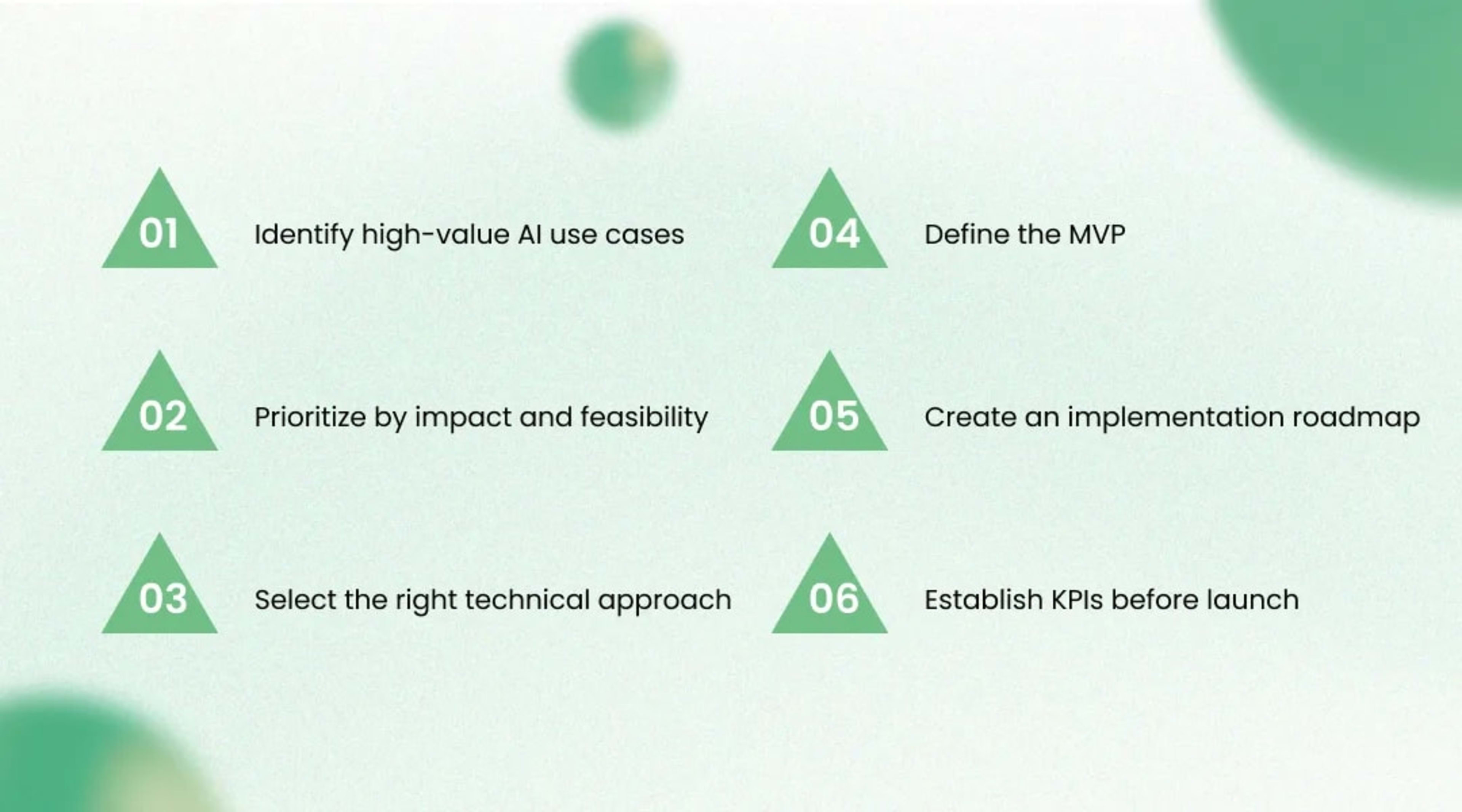
A practical strategy process can follow six stages.
Step 1: Identify high-value AI use cases
Start with workflows that are repetitive, expensive, slow, data-rich, or difficult to scale.
Examples include:
customer support
document processing
sales qualification
forecasting
internal knowledge retrieval
workflow automation
personalization
quality inspection
Step 2: Prioritize by impact and feasibility
Not every potential AI use case deserves immediate investment.
A simple framework is to evaluate:
Business impact × Technical feasibility × Time to value
A use case with high impact but extremely difficult implementation may belong later on the roadmap.
A moderate-impact use case that can be launched quickly may be a better MVP candidate.
Step 3: Select the right technical approach
Different problems require different architectures.
You might choose:
an existing AI API
RAG
traditional machine learning
fine-tuning
an AI agent
a custom model
a hybrid architecture
The objective is not to use the most advanced technology.
The objective is to use the technology that best satisfies the product requirement.
Step 4: Define the MVP
The MVP should answer one important question:
What is the smallest version of this AI product that can prove meaningful value?
Define:
core user
core workflow
essential AI capability
required integrations
data sources
acceptance criteria
success metrics
what will deliberately be excluded from version one
Step 5: Create an implementation roadmap
The roadmap should connect business outcomes to engineering milestones.
A typical sequence may look like:
Discovery → Readiness → Architecture → MVP → Evaluation → Integration → Production → Optimization
Step 6: Establish KPIs before launch
Decide how the solution will be measured before the product goes live.
Without predefined evaluation criteria, teams can end up judging AI performance based on subjective impressions.
From AI Idea to Working AI Product: The 7-Step Startup Process
The biggest difference between an AI concept and a real AI product is execution.
Here is a practical path.
Step 1: Validate the AI use case
Before writing production code, verify that the problem is worth solving.
Talk to users.
Review the workflow.
Identify the most expensive or repetitive steps.
Define the expected result.
Then ask whether AI is actually the best way to achieve that result.
Step 2: Run an AI readiness assessment
Next, assess the data, systems, team, security requirements, and operational constraints.
This is where many projects uncover hidden dependencies.
It is far cheaper to discover a missing data source during planning than after weeks of development.
Step 3: Choose the right AI architecture
Architecture should follow requirements.
For example, a knowledge assistant may require a retrieval pipeline. A complex workflow may benefit from tool calling and agent orchestration. A prediction problem may require a machine learning model rather than a generative AI system.
The architecture should consider:
accuracy
latency
scalability
security
cost
maintainability
integration requirements
Step 4: Scope the AI MVP
The goal is not to build everything at once.
A focused MVP allows the startup to validate:
user adoption
technical feasibility
output quality
business impact
operating cost
Keep the first release narrow enough to learn quickly.
Step 5: Build and integrate
Once the architecture and scope are clear, development can begin.
Depending on the product, this may include:
application development
AI model integration
RAG pipelines
data processing
AI agents
backend APIs
authentication
dashboards
workflow automation
CRM or business-system integrations
This is where strategy becomes software.
Step 6: Test and evaluate
AI needs more than conventional functional testing.
Evaluate:
output quality
accuracy
edge cases
hallucination or error patterns
latency
cost per task
security
failure handling
user experience
A system can appear excellent in a handful of demonstrations and still fail when exposed to real-world inputs.
Step 7: Deploy, monitor, and improve
Production is not the finish line.
Once users interact with the system, you can learn where it succeeds and where it fails.
That feedback should drive:
Monitoring → Evaluation → Improvement → New release
This continuous loop is especially important for AI products because models, user behavior, business rules, and data can all change over time.
Build vs. Buy vs. Partner: What Should a Startup Choose for AI?
One of the most important early decisions is whether to build AI internally, use an existing solution, or work with an external AI partner.
Use an existing AI tool when:
the problem is generic
the workflow does not create competitive differentiation
an existing product already solves the requirement
customization is not important
Use an AI API when:
you need a specific AI capability
speed to market matters
your product can be built around an external model
your differentiation is in the workflow or customer experience
Build a custom AI solution when:
AI is central to your product
your workflow is highly specialized
your data creates differentiation
the product requires custom integrations
control over the experience matters
Work with an AI consulting and development partner when:
your team lacks specialized AI expertise
the problem is technically complex
you need strategic validation before committing engineering resources
you want to move from idea to MVP quickly
your prototype needs to become production-ready
The right answer is not universal.
For many startups, the practical path is a combination: use existing foundation models or APIs while building custom workflows, retrieval, integrations, evaluation, and product logic around them.
What Does a Production-Ready AI Product Actually Need?
A prototype proves the possibility.
A production system needs reliability.
That means thinking beyond the model itself.
Reliable data pipelines
The system needs predictable access to the information it depends on.
Evaluation
You need repeatable ways to measure whether outputs are good enough.
Security and access control
Not every user should necessarily have access to every data source or AI capability.
Human oversight
Some workflows need escalation or approval when the AI is uncertain or the consequences of an error are high.
Monitoring
Track failures, performance, latency, usage, and cost.
Cost control
AI costs can grow with adoption. Architecture should account for expected usage rather than only prototype traffic.
Scalability
The system should be able to handle increased users, data, and workflows without becoming unnecessarily expensive or fragile.
Continuous improvement
The strongest AI products create a feedback loop between real-world usage and product improvement.
AI Use Cases Startups Can Build With the Right AI Strategy
The best use case depends on your business model, data, customer workflow, and growth stage.
Common opportunities include:
AI customer support
AI assistants can answer routine questions, retrieve relevant information, summarize conversations, and route more complex requests.
Sales and lead automation
AI can help qualify leads, summarize interactions, recommend next actions, and automate repetitive sales workflows.
Workflow automation
Repetitive internal processes can often be transformed into AI-assisted or AI-agent workflows.
Knowledge assistants and RAG
A knowledge assistant can connect users to information from internal documents, product knowledge, policies, and other approved data sources.
Document intelligence
AI can extract, classify, summarize, compare, and analyze large volumes of business documents.
Personalization and recommendations
AI can help tailor experiences based on user behavior, preferences, and business rules.
Predictive AI
Machine learning can support forecasting, anomaly detection, classification, and other predictive workflows.
AI-powered product features
AI can become part of the product itself, creating new experiences rather than simply automating internal work.
The important decision is not which AI feature looks impressive.
It is which AI capability creates measurable value for your customers or your business.
How Much Do AI Consulting Services for Startups Cost?
There is no single price for AI consulting because project complexity varies significantly.
The cost usually depends on:
scope
AI architecture
data readiness
integrations
required security controls
model/API usage
MVP vs. production requirements
development and testing effort
ongoing support
Common engagement models
AI strategy engagement
Useful when you need help validating ideas, prioritizing use cases, and creating a roadmap.
AI readiness assessment
Useful when you are not sure whether your data, systems, team, and workflows are ready.
AI MVP engagement
Useful when the use case is already defined and you want to validate the product with a focused implementation.
End-to-end AI product development
Useful when you need strategy, architecture, engineering, integration, testing, and deployment under one engagement.
Ongoing AI advisory and optimization
Useful when AI becomes an important part of your product and requires continuous technical and strategic input.
Instead of choosing an AI partner based only on the lowest initial quote, compare what is included in the engagement.
A cheaper prototype that requires a complete rebuild later can cost more than a properly scoped MVP from the beginning.
How to Choose an AI Consulting Partner for Your Startup
Choosing a consultant is ultimately about reducing execution risk.
Before hiring an AI partner, ask:
Can they understand the business problem before proposing technology?
A strong partner should ask about users, workflows, KPIs, constraints, data, and commercial goals—not immediately recommend a particular model.
Can they explain the architecture clearly?
You should understand why a specific approach is being recommended and what trade-offs it introduces.
Can they handle production, not just prototypes?
Ask about deployment, testing, monitoring, security, cost management, and ongoing support.
Do they understand startup constraints?
A startup needs to balance speed, quality, runway, experimentation, and scalability.
The solution should match your current stage rather than solving problems you do not have yet.
Can they show relevant work?
Look for evidence of real AI implementations and measurable outcomes, not only screenshots of demos.
You can also explore KriraAI AI case studies to see examples of AI projects across different business and operational workflows.
What happens after launch?
Ask who will handle:
monitoring
improvements
bug fixes
model changes
performance optimization
scaling
future integrations
The post-launch phase should be part of the conversation before the contract starts.
Why Work With KriraAI for Startup AI Consulting and Development?
At KriraAI, the objective is to connect AI strategy with practical engineering.
That means starting with the business problem, understanding the available data and workflows, choosing an appropriate architecture, building the solution, testing it, and helping move it into production.
Our AI consulting approach can cover areas such as:
AI opportunity discovery
technology assessment
strategic roadmapping
AI architecture
custom AI software
AI agents
generative AI
machine learning
RAG
integrations
testing
deployment
optimization
Rather than treating consulting and development as two disconnected activities, the process can continue from discovery through implementation.
You can explore KriraAI AI consulting services to see the broader consulting capabilities and engagement approach.
For startup founders and CTOs, the practical benefit is simple: you can evaluate the AI opportunity before committing significant engineering resources, then continue into development once the direction is validated.
Ready to Turn Your AI Idea Into a Working Product?
You do not need to have the entire solution figured out before starting a conversation.
Bring your idea, product context, current challenges, and goals.
We can help you understand:
whether AI is the right fit
which use case to prioritize
whether your startup is AI-ready
what architecture makes sense
what an MVP should include
what the next implementation step should be
Book a free AI strategy call and discuss your AI product idea with the KriraAI team.
FAQs
An AI consultant helps a startup identify valuable AI opportunities, evaluate technical feasibility, assess readiness, select an appropriate architecture, create an implementation roadmap, and guide the business toward deployment and optimization.
A startup can benefit from consulting when it has an AI idea but lacks a clear use case, when an AI prototype is stuck, when technical decisions carry significant risk, or when the team needs specialized AI expertise for an MVP or production system.
An AI readiness assessment evaluates whether a startup has the data, technology, workflows, people, security controls, budget, and measurable goals needed to implement an AI solution successfully.
AI strategy consulting can include use-case discovery, prioritization, AI readiness assessment, technical architecture, build-vs-buy decisions, MVP scoping, roadmap creation, KPI definition, and implementation planning.
The timeline depends on scope, data readiness, integrations, architecture, and testing requirements. A narrowly defined MVP can move much faster than a complex production system with multiple integrations and security requirements.
The cost depends on the engagement type and technical complexity. Strategy, readiness assessment, MVP development, full product development, and ongoing advisory require different levels of work and resources.
It depends on the use case. Existing APIs can accelerate development, while custom components may be justified when the workflow, data, product experience, or performance requirements require greater control.
Yes. A suitable AI consulting and development partner can help move beyond the prototype by addressing architecture, integration, evaluation, security, deployment, monitoring, and optimization.
Founder & CEO
Divyang Mandani is the CEO of KriraAI, driving innovative AI and IT solutions with a focus on transformative technology, ethical AI, and impactful digital strategies for businesses worldwide.