Let me start with something uncomfortable.
Most businesses don’t have a customer experience problem. They have a response problem pretending to be a strategy problem.
I’ve seen it too many times.
Fancy dashboards. Multiple support tools. Automated emails. And still… customers waiting. Complaining. Leaving.
Here’s the real question: If your customer needs help right now, how long do they actually wait?
Not what your system says. What your customer feels.
That gap? That’s where AI changes everything.
And no—I’m not talking about hype. I’m talking about systems I’ve personally built as part of an AI development company in India, where the goal wasn’t “innovation”… it was survival.
Before we built anything, we listened.
What we found wasn’t surprising. It was… predictable.
Support teams drowning in tickets. Customers waiting hours. Sometimes days.
By then, the damage is already done.
Hiring more agents felt like the only solution. But scaling humans is expensive. And slow.
Every response felt the same. Scripted. Cold. Forgettable.
Customers notice. Quickly.
Growth created chaos.
More users → more queries → more pressure → worse experience.
A system that works for 1,000 users breaks at 10,000.
And here’s the part most leaders don’t say out loud:
“We’re reacting to customers… not actually serving them.”
That’s the difference. The Solution: How an AI Company in India Stepped In
When we stepped in at KriraAI, we didn’t start with tools.
We started with one question:
Where exactly is the experience breaking?
We mapped the entire customer journey.
From first interaction → support request → resolution → follow-up.
Then we inserted AI only where it actually mattered.
Not everywhere. Just the pressure points.
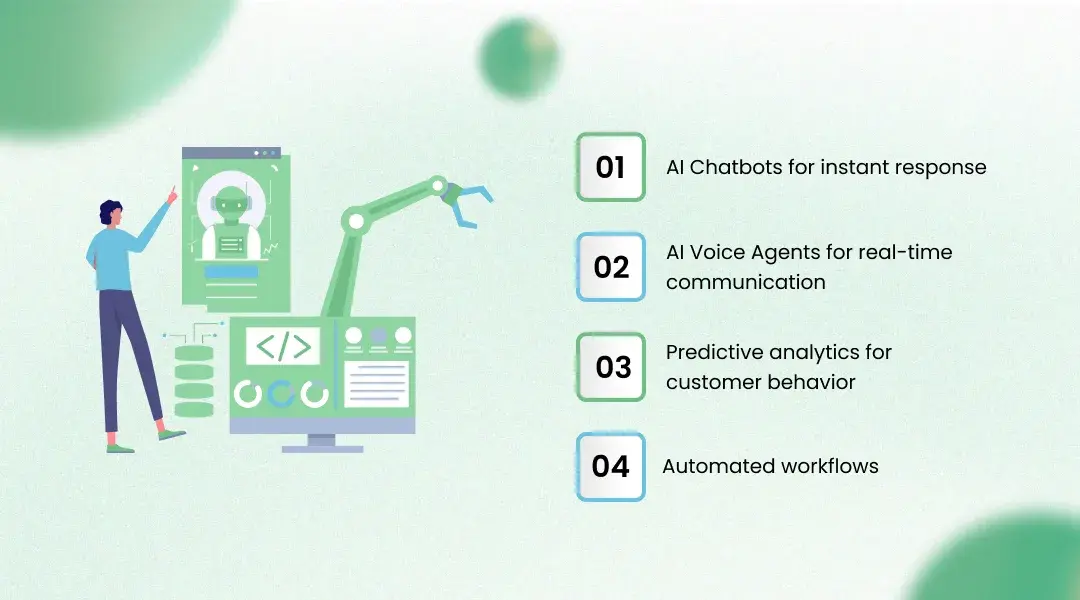
AI chatbots for instant support
Voice AI for real-time conversations
Predictive analytics for behavior tracking
Workflow automation for repetitive tasks
This wasn’t about replacing humans.
It was about removing friction.
Now let’s get specific. Because this is where most articles stay vague.
I won’t.
We built AI customer support automation systems that handled 70–80% of queries instantly.
Not basic bots.
Context-aware systems trained on real business data.
Result? Customers stopped waiting.
Some problems need a voice.
So we implemented AI voice agents that could handle calls, understand intent, and respond naturally.
No IVR frustration. No “Press 1 for this” nonsense.
Just conversation.
Here’s where it gets interesting.
Instead of reacting to problems, the system predicted them.
Churn signals. Frustration patterns. Buying intent.
We weren’t guessing anymore.
Repetitive tasks? Gone.
Refund requests. Ticket routing. Follow-ups.
Handled automatically.
And suddenly… teams had time to think again.
Let’s strip away theory.
Here’s what actually changed.
Response time: 6–24 hours
High operational cost
Inconsistent customer experience
Overloaded support teams
Response time: under 60 seconds
Reduced dependency on large teams
Personalized, consistent interactions
Scalable systems
Pause for a second.
What would happen if your response time dropped to under a minute?
Not tomorrow. Today.
I don’t believe in vague success stories.
So here are real patterns we’ve seen across multiple implementations:
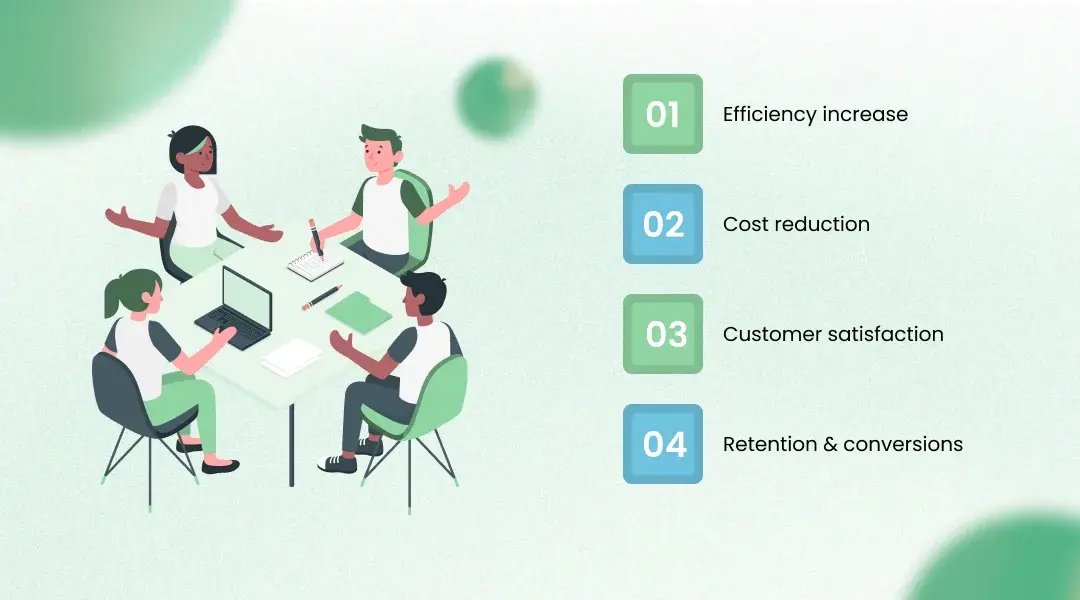
Up to 65% faster resolution times
Around 40% reduction in support costs
Significant improvement in CSAT scores (because people hate waiting more than anything else)
Better experience → more trust → higher retention
It’s not magic.
It’s just… removing friction.
Let’s be honest.
Customers have changed.
They don’t wait. They don’t repeat themselves. And they definitely don’t tolerate bad experiences anymore.
AI-powered customer experience means every interaction feels tailored.
Not generic.
No breaks. No downtime.
Customers get answers when they need them.
Every interaction becomes insight.
Every insight improves the system.
It compounds.
And here’s the shift most people miss:
AI in customer service isn’t about automation. It’s about consistency.
This isn’t limited to one sector.
I’ve personally worked across:
Order tracking. Returns. Recommendations. All optimized with AI customer experience solutions.
Onboarding, support, feature discovery.
Less confusion. More activation.
Patient queries. Appointment scheduling. Follow-ups.
Speed matters here. A lot.
Secure, fast, and accurate support systems.
Trust is everything.
Different industries. Same pattern.
Fix response. Improve experience.
Now this matters more than the tech itself.
Because a bad implementation? Worse than no AI at all.
Do they understand your business—or just AI?
Can they customize solutions?
Do they talk outcomes… or just features?
Ready-made tools are faster.
But they rarely fit perfectly.
Custom solutions take time—but they solve real problems.
At KriraAI, we’ve seen this repeatedly.
And yes, if you’re evaluating a Best AI development Company or any AI Company in India, this is the line that separates real partners from vendors.
I’ll leave you with this.
AI won’t fix your customer experience.
Not by itself.
But the right implementation? At the right moment? With the right understanding?
That changes everything.
I’ve seen businesses go from reactive chaos to controlled clarity.
Not because they added AI. But because they used it correctly.
So the real question isn’t:
“Should you use AI?”
It’s this:
Where is your customer experience breaking right now?
Start there.
AI responds instantly, predicts customer needs, and automates repetitive tasks, reducing delays and improving satisfaction.
Costs vary based on complexity, but scalable solutions often reduce long-term operational expenses significantly.
They provide instant, accurate responses and reduce waiting time, which directly impacts customer satisfaction.
Yes, especially for scaling support without increasing team size. It helps maintain quality as demand grows.
E-commerce, SaaS, healthcare, and finance see strong results due to high customer interaction volumes.
Founder & CEO
Divyang Mandani is the CEO of KriraAI, driving innovative AI and IT solutions with a focus on transformative technology, ethical AI, and impactful digital strategies for businesses worldwide.