Let me be blunt.
Most businesses I talk to don’t have an automation problem. They have a misunderstanding problem.
They think automation is one thing. It’s not.
I’ve sat across founders who proudly say, “We’ve automated everything,” while their systems break the moment a customer behaves… slightly differently. One edge case. That’s all it takes.
So here’s the real question: Are you automating tasks or building systems that can think?
That’s the line between AI Agents vs Traditional Automation. And in 2026, that line matters more than ever.
Traditional automation is rule-based. Fixed logic. If X happens, do Y.
Simple. Predictable. Limited.
You define workflows using:
Scripts
APIs
Predefined rules
Think of it as a flowchart that never changes.
robotic process automation (RPA) bots handling invoices
workflow automation tools for email triggers
business process automation (BPA) in HR onboarding
It’s reliable… until reality gets messy.
(And trust me, reality always gets messy.)
AI Agents are autonomous systems that can make decisions, learn from data, and adapt over time.
Not just “if this, then that.” More like: “Given the situation, what’s the best move?”
They combine:
machine learning automation
natural language understanding
contextual reasoning
And yes… sometimes they surprise you. In a good way.
LLMs (for reasoning and language)
Memory (short-term + long-term context)
Tools (APIs, databases, integrations)
This is where decision-making AI actually becomes practical.
Let’s cut through the noise.
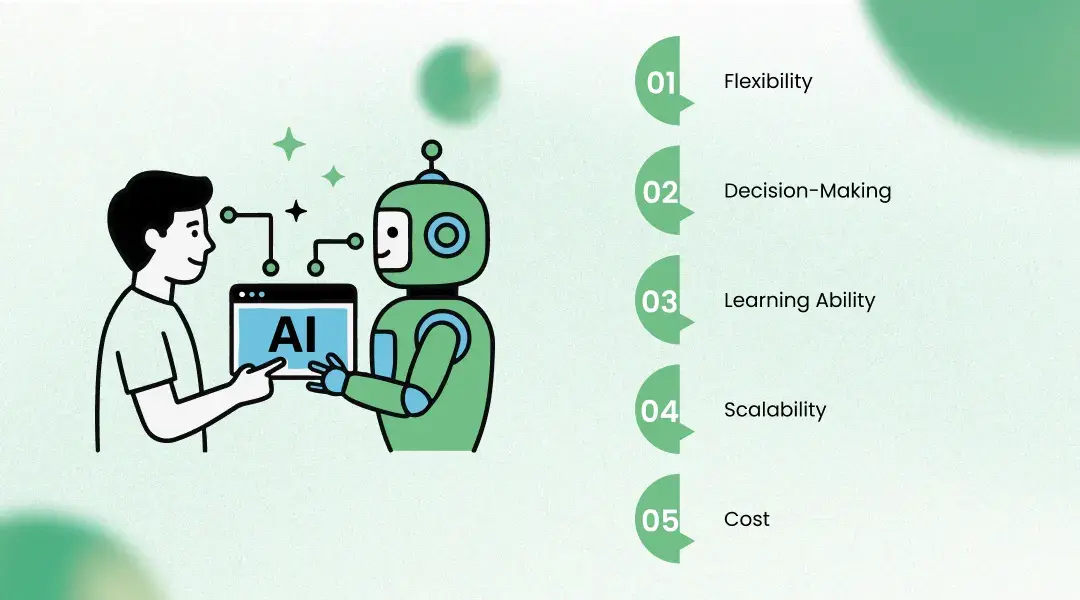
Traditional automation breaks when inputs change. AI Agents adapt.
Traditional = predefined logic AI Agents = dynamic decisions based on context
Traditional systems don’t learn. Ever. AI Agents improve with usage.
Here’s where it gets interesting.
Traditional automation scales tasks. AI Agents scale intelligence.
(Read that again.)
Short-term: Traditional is cheaper Long-term: AI wins by reducing manual fixes
So if your goal is AI to Save Time and Cut Costs, the answer isn’t immediate it’s strategic.
Feature | Traditional Automation | AI Agents |
Logic | Rule-based | Intelligent |
Learning | No | Yes |
Adaptability | Low | High |
Decision Making | Fixed | Dynamic |
Let me ground this in reality.
Traditional: Chatbots with scripts AI Agents: Context-aware assistants that resolve queries end-to-end
Traditional: Email sequences AI Agents: Personalized outreach based on behavior
Traditional: Data entry automation AI Agents: Diagnosis assistance using intelligent systems
Traditional: Transaction processing AI Agents: Fraud detection using autonomous systems
Traditional: Order workflows AI Agents: Dynamic pricing, recommendation engines
Here’s what I’ve seen firsthand:
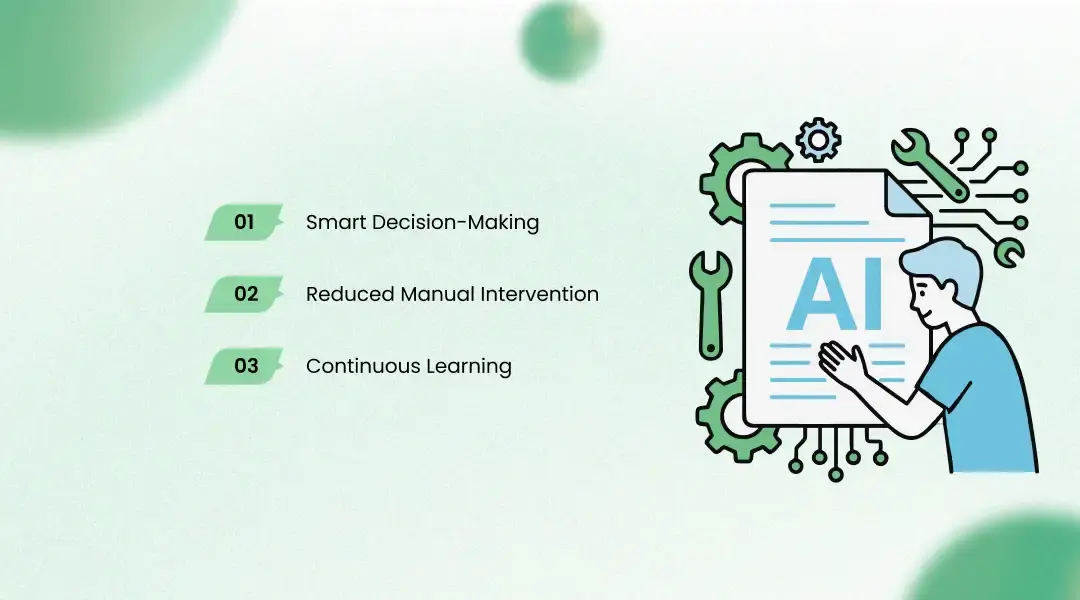
They don’t just execute they choose.
Less firefighting. More control.
Your system gets better every month. Not worse.
Let’s not pretend either is perfect.
Highly repetitive tasks
Low variability workflows
Budget-constrained environments
Higher initial cost
Requires quality data
Needs ongoing monitoring
Quick reality check: If your data is messy, AI won’t save you. It’ll expose you.
This is where most people get stuck.
Start with robotic process automation (RPA). Layer AI gradually.
Hybrid approach: RPA + AI Agents
Go all-in on intelligent automation vs traditional automation
E-commerce → AI Agents
Banking → Hybrid
Healthcare → AI-assisted systems
And if you’re still unsure…
Ask yourself one thing: Do I need efficiency or adaptability?
Let me give you a glimpse of what’s coming.
Systems that run entire workflows independently.
Multiple AI Agents collaborating. (This is where things get wild.)
Not replacement. Partnership.
I’ve seen teams become 3x more productive not because they worked harder, but because they worked smarter.
Alright. Let’s get practical.
Identify repetitive + decision-heavy tasks
Clean your data (seriously, do this first)
Choose the right architecture
Start small (pilot project)
Scale gradually
OpenAI APIs
LangChain
Custom-built solutions
(And yes, this is where working with an experienced AI Agents Company actually matters.)
At KriraAI, we don’t just build tech. We solve business problems. That’s the difference.
Let me leave you with this.
Traditional automation is about control. AI Agents are about capability.
One follows instructions. The other figures things out.
Neither is “better” in isolation.
But if your business operates in a world full of uncertainty and let’s be honest, it does then sticking only to traditional automation is like bringing a calculator to a chess match.
It works. But you’re missing the bigger game
The core difference lies in intelligence. Traditional automation follows predefined rules, while AI Agents use decision-making AI to adapt, learn, and make context-aware decisions.
Not always. Small businesses can start with RPA due to lower cost, then gradually adopt AI Agents as complexity increases and data becomes available.
AI Agents reduce manual intervention, improve efficiency, and minimize errors leading to long-term cost savings even if initial investment is higher.
No. Traditional automation is still ideal for repetitive, rule-based tasks. The best approach is often a hybrid model combining both.
E-commerce, finance, healthcare, and SaaS businesses benefit significantly due to their need for adaptability, personalization, and real-time decision-making.
Founder & CEO
Divyang Mandani is the CEO of KriraAI, driving innovative AI and IT solutions with a focus on transformative technology, ethical AI, and impactful digital strategies for businesses worldwide.