AI Agents vs Chatbots: What’s the Future of Business Automation?
About three years ago, a founder asked me a simple question.
"Can you build us a chatbot?"
Pretty normal request.
They wanted something to answer customer questions automatically. Reduce support tickets. Save money.
But after two meetings, I realized something.
They didn’t actually need a chatbot.
They needed a system that could understand problems, check internal data, make decisions, and complete tasks automatically.
That’s not a chatbot.
That’s an AI agent.
And this confusion happens all the time.
Many companies searching for AI chatbots for business are actually looking for something far more powerful, especially when they need AI-powered chatbot development services that can scale into AI agents in business automation.
So let’s slow down for a moment.
What exactly is the difference between AI agents and chatbots?
And more importantly…
Which one will shape the future of AI agents in business automation?
What Are AI Chatbots?
AI chatbots are software systems designed to simulate conversation with users.
They interact through:
Websites
Messaging platforms
Mobile apps
Customer support portals
Most AI chatbots for business are built to handle repetitive questions.
Things like:
Order tracking
Appointment booking
Basic troubleshooting
Account information
Nothing too complicated.
How Chatbots Work
Traditional chatbots usually rely on:
Predefined rules
Intent recognition
Limited NLP models
In simple terms:
User asks question → chatbot identifies intent → system returns a scripted response.
That’s it.
Sometimes companies add machine learning models to improve responses. But the core structure remains conversation-based automation.
Which works fine… until it doesn’t.
Common Chatbot Use Cases in Business
Across industries, chatbots are widely used for:
Customer support automation
FAQ handling
Lead qualification
Appointment scheduling
Order status updates
For many businesses, this level of automation is perfectly adequate.
But let me ask you something.
What happens when a customer asks a question the chatbot wasn’t trained for?
Exactly.
Things break.
What Are AI Agents?
AI agents are autonomous systems capable of understanding goals, making decisions, and executing tasks across multiple systems.
They don’t just respond.
They act.
This is where AI agents for business become interesting.
Because instead of answering questions…
They solve problems.
How AI Agents Work
An AI agent system typically includes:
Language models
Decision frameworks
Task planning modules
System integrations
Think of it as a digital employee that can:
Understand a request
Decide what needs to happen
Execute the required steps
No scripts.
Just intelligent workflows.
Autonomous Decision-Making Systems
For example:
A customer says:
"My order hasn't arrived, and I need a refund."
A chatbot might say:
"Please contact support."
An AI agent might:
Check shipping status
Verify delivery delays
Process refund
Update CRM
Send confirmation email
All automatically.
Different levels of intelligence.
Different level of automation.
AI Agents vs Chatbots: Key Differences
Let’s simplify the AI Agents vs Chatbots comparison.
Feature
Intelligence Level
AI Chatbots
Limited conversation understanding
AI Agents
Advanced reasoning capabilities
Feature
Automation Capability
AI Chatbots
Responds to questions
AI Agents
Executes tasks
Feature
Learning Ability
AI Chatbots
Often rule-based or limited ML
AI Agents
Adaptive and self-improving
Feature
Decision Making
AI Chatbots
Minimal
AI Agents
Autonomous
Feature
Business Role
AI Chatbots
Customer interaction
AI Agents
Full workflow automation
This is the core difference between AI agents and chatbots.
Chatbots talk.
AI agents work.
And once business leaders understand this difference, their automation strategy usually changes completely.
Limitations of Traditional Chatbots
I’ve worked with many companies that deployed chatbots expecting miracles.
Reality?
Mixed results.
Let’s talk about the limitations.
Rule-Based Automation
Many chatbots still rely heavily on predefined responses.
Which means:
Unexpected question = failure.
Not ideal for complex customer scenarios.
Limited Problem Solving
Chatbots can answer questions.
But they struggle with multi-step tasks.
Example:
Changing subscription plans
Processing refunds
Handling delivery issues
These require decision logic.
Chatbots rarely have that.
Lack of Contextual Understanding
Chatbots often treat every message as an isolated event.
Humans don’t communicate like that.
We reference context. History. Intent.
Without deeper context awareness, chatbot conversations can feel… robotic.
You've probably experienced it.
How AI Agents Transform Business Automation
This is where things get interesting, especially when you compare it with Generative AI Development for Intelligent Chatbots and AI Agents and see how the same logic scales into more advanced automation.
Because AI agents in business automation change the entire equation.
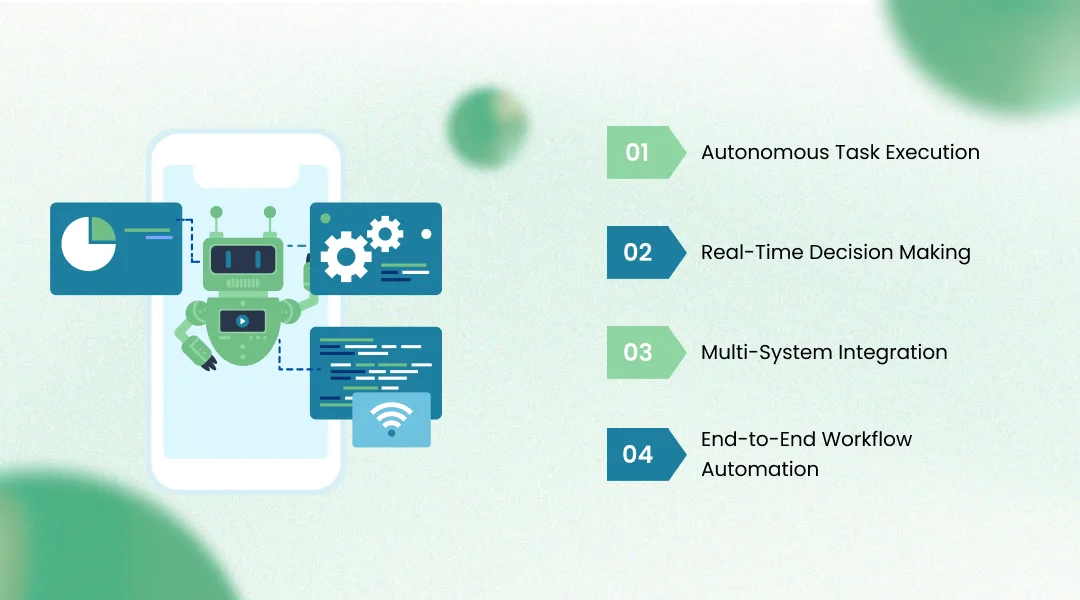
Autonomous Task Execution
Instead of answering questions, AI agents can:
Update databases
Process transactions
Trigger workflows
Manage internal systems
They complete tasks end-to-end.
Real-Time Decision Making
AI agents analyze multiple data sources before acting.
For example:
Customer request → check CRM → check billing system → verify eligibility → execute action.
All in seconds.
Multi-System Integration
“In finance, this becomes even more valuable because teams need secure, automated workflows across CRM platforms, ERP systems, payment gateways, and analytics tools.
End-to-End Workflow Automation
This is the real opportunity.
Instead of automating conversations…
Businesses can automate entire processes.
Support. Sales. Operations.
Everything.
Real-World Use Cases of AI Agents
Let’s look at where AI agents actually work today.
Not theory.
Reality.
Customer Support Automation
AI agents can:
diagnose customer issues
check account details
issue refunds
escalate complex cases
Support teams suddenly become far more efficient, especially when voice channels are part of the stack, as shown in AI Voice Agents: Transforming the Way We Interact.
Sales Automation
AI agents can qualify leads by:
analyzing user behavior
reviewing CRM history
scheduling demos
assigning sales representatives
It’s like having a digital sales assistant.
Business Operations Automation
Operations teams use AI agents for:
order processing
supply chain monitoring
invoice handling
workflow management
Tasks that previously required entire teams.
Data Analysis and Decision Support
AI agents can also analyze internal data to:
detect anomalies
generate reports
suggest operational improvements
Not just automation.
Decision support.
Why AI Agents Are the Future of Business Automation
Let me be blunt.
Chatbots solved yesterday’s problems.
AI agents solve tomorrow's problems.
Here’s why.
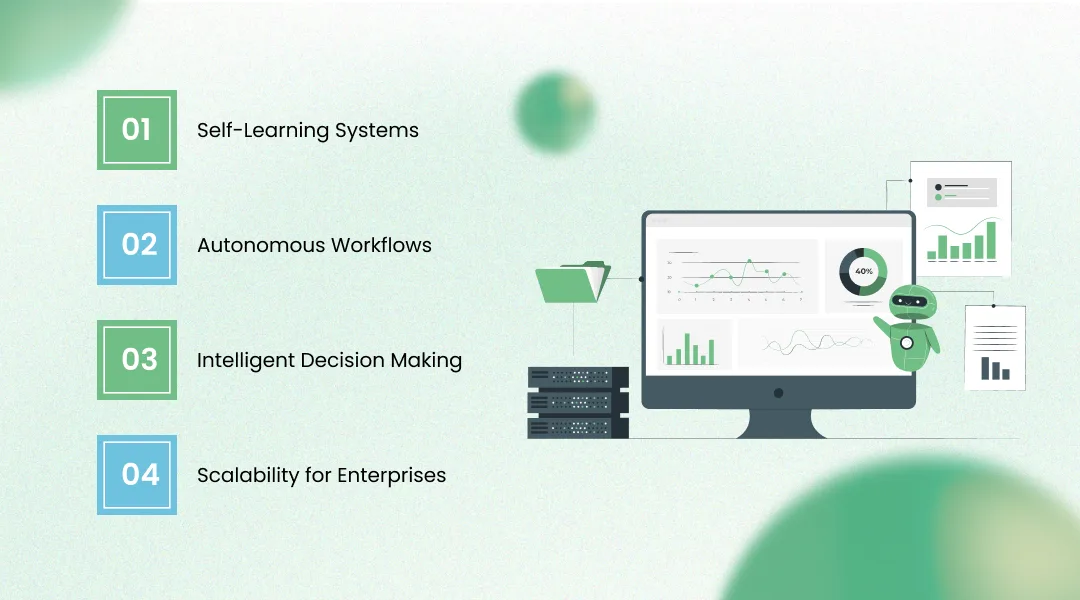
Self-Learning Systems
AI agents improve through feedback and data.
Over time, they become better at completing tasks.
Autonomous Workflows
Instead of micro-automation, companies build fully automated workflows.
Less manual effort.
Fewer operational bottlenecks.
Intelligent Decision Making
AI agents evaluate context before acting.
Which means decisions are data-driven rather than scripted.
Scalability for Enterprises
When businesses grow, operational complexity explodes.
AI agents handle scale far better than traditional automation systems.
Which is why many companies are now looking for the Best AI development Company to implement intelligent agent systems.
How Businesses Can Start Using AI Agents
If you’re considering AI agents for your organization, start here.
Identify Automation Opportunities
Look for processes that involve:
repetitive tasks
data retrieval
multi-step workflows
Those are ideal candidates.
Integrate AI with Existing Systems
AI agents become powerful when connected to:
CRM
ERP
databases
analytics platforms
Integration is everything.
Work With an AI Development Company
Building AI agents requires deep expertise in:
AI architecture
system integrations
workflow automation
Working with an experienced Best AI development Company can significantly reduce implementation risk.
And yes… this is exactly the kind of work we do at KriraAI.
Conclusion
Let’s return to the original question.
AI Agents vs Chatbots - what’s the future of business automation?
Chatbots aren’t disappearing.
They still play an important role in customer interaction and basic support.
But the real transformation is happening with AI agents for business.
Systems that don’t just talk.
They analyze.
They decide.
They act.
And once businesses experience that level of automation at KriraAI, there’s no going back.
There’s no going back.
Trust me.
I’ve seen it happen.
FAQs
Chatbots mainly handle conversations and answer questions. AI agents go further by making decisions and executing tasks across systems, enabling full business automation.
It depends on the use case. Chatbots are useful for basic customer interaction, while AI agents are better suited for complex automation and multi-step workflows.
Not entirely. Chatbots still serve as conversational interfaces, but many businesses now integrate them with AI agents for deeper automation capabilities.
AI agents analyze user requests, access relevant systems, make decisions, and execute tasks automatically, enabling end-to-end workflow automation.
Startups with complex operations or high customer interaction can benefit significantly from AI agents, especially when automation can reduce operational costs and improve efficiency.
Founder & CEO
Divyang Mandani is the CEO of KriraAI, driving innovative AI and IT solutions with a focus on transformative technology, ethical AI, and impactful digital strategies for businesses worldwide.