At 2:13 AM, a production line stops.
No warning. No clear reason. Just… silence.
I’ve seen this happen more times than most people realize. And here’s the uncomfortable truth, factories don’t fail because they lack data. They fail because nothing knows what to do with it.
That’s where AI agents in manufacturing enter the picture.
Not dashboards. Not reports. Not alerts.
Decision-makers.
Let me simplify this.
An AI agent is not just software. It’s a system that observes, decides, and acts—without waiting for human input every single time.
Think of it like a factory supervisor who never sleeps. It watches machines, predicts issues, adjusts schedules, and sometimes fixes problems before you even notice them.
Traditional automation: Follows fixed rules
AI systems: Analyze and suggest
AI agents for manufacturing automation: Analyze, decide, and act
That last part? That’s the shift.
And yes, this is where most companies misunderstand AI in the manufacturing industry.
Let me ask you something.
How many decisions in your factory are still reactive?
Exactly.
Modern factories are not simple pipelines anymore. They’re networks. Machines talking to systems. Systems talking to suppliers.
And humans? Trying to keep up.
Delays today are expensive. Minutes matter. Sometimes seconds.
AI agents for industrial automation don’t wait for meetings.
Skilled operators are harder to find. Costs are rising. Margins are shrinking.
You can’t scale by hiring alone anymore. You scale with intelligence.
Let’s break it down into something practical.
That’s the loop.
Sensors collect data
AI analyzes patterns
Agent makes decisions
System executes actions
Then repeats. Constantly.
This is where things get interesting (and messy, if done wrong).
AI agents plug into:
IoT sensors
ERP systems
MES platforms
That’s how AI-driven manufacturing systems actually function - not in isolation, but as part of your existing stack.
I’ve implemented these. Not theory. Not slides.
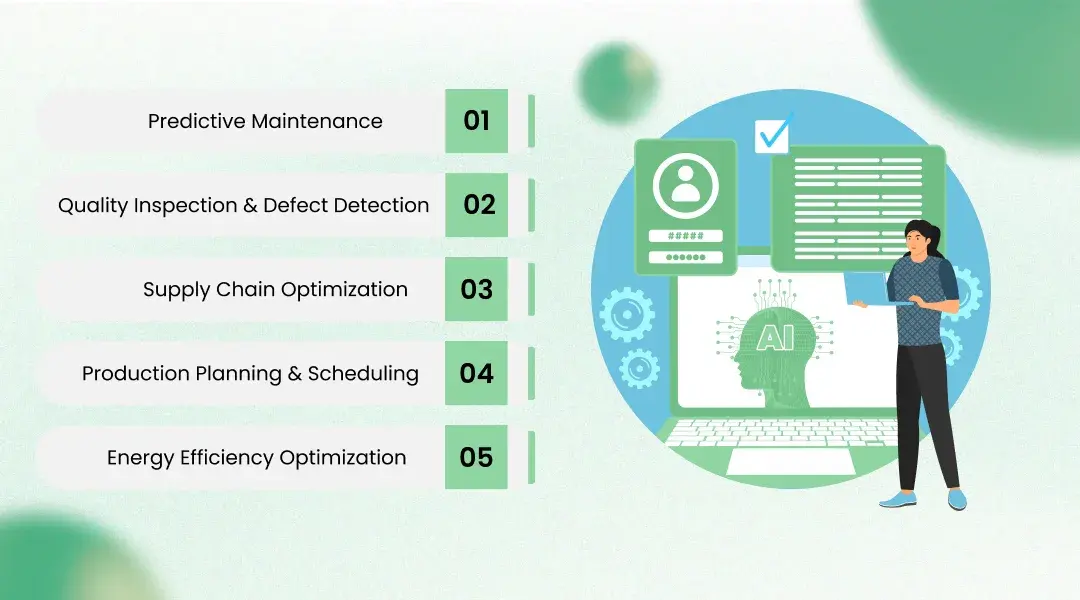
Machines don’t just break. They give signals.
AI agents detect those signals early. Schedule maintenance before failure.
Downtime drops. Panic disappears.
Human inspection misses patterns.
AI doesn’t.
Computer vision agents scan products in real-time, catching defects instantly. This is one of the most impactful AI manufacturing use cases today.
Supply chains are chaos disguised as structure.
AI agents predict delays, adjust sourcing, and optimize inventory, without waiting for weekly reports.
Static schedules don’t survive real-world conditions.
AI agents adapt in real time. Machine down? Demand spike? It adjusts.
This is intelligent automation in manufacturing - not just execution, but adaptation.
Energy costs are rising fast.
AI-powered manufacturing solutions monitor usage patterns and optimize consumption automatically.
Lower cost. Better sustainability.
Let’s keep this grounded.
Less breakdown. Faster recovery.
No waiting. No bottlenecks.
From maintenance to energy to labor, efficiency compounds.
More output. Same or fewer resources.
Consistency improves when decisions improve.
This comparison matters more than most people think.
Traditional Automation | AI Agents |
Rule-based | Adaptive |
Static workflows | Dynamic decisions |
Requires manual updates | Learns continuously |
Traditional systems follow instructions.
AI agents? They figure things out.
Let me show you where this is going.
Factories where machines communicate, predict, and adjust autonomously.
Lines that optimize themselves based on real-time demand and conditions.
This is not theory anymore. This is AI in smart manufacturing happening right now.
(And if you’re still thinking this is only for large enterprises, you’re already behind.)
Let’s not pretend this is easy.
Bad data = bad decisions. Simple.
Connecting old systems with new intelligence takes effort.
Yes, there is a cost.
But here’s the better question, what’s the cost of not evolving?
Now this is where it gets exciting.
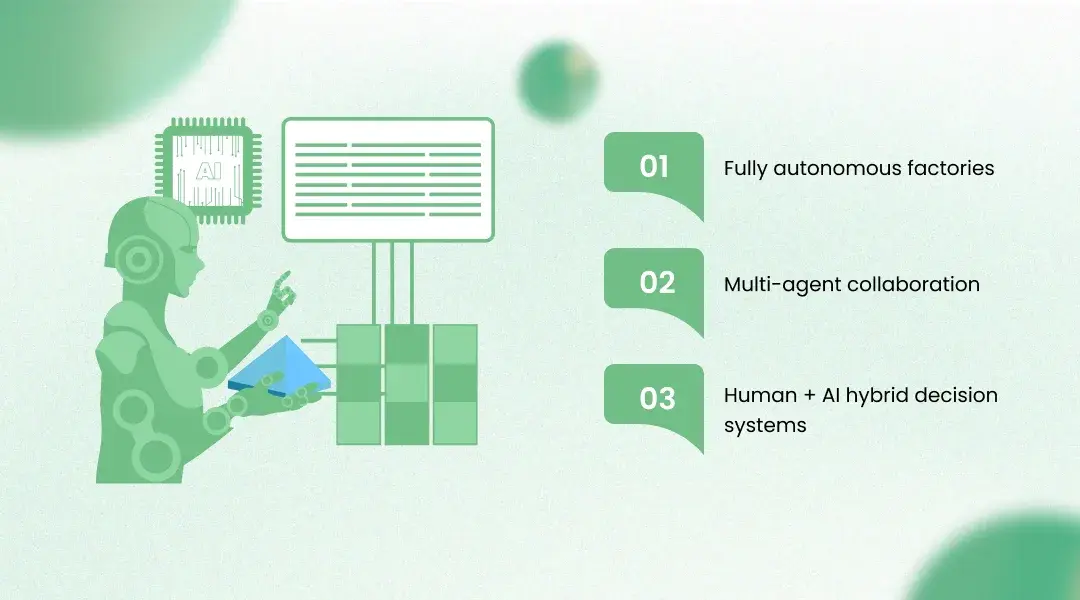
Minimal human intervention. Maximum efficiency.
Different AI agents handling different tasks—working together.
Not replacement. Collaboration.
This is the real future of AI in Industry 4.0.
I’ll be blunt.
Most manufacturing companies don’t fail because they lack technology.
They fail because they hesitate.
AI agents in manufacturing are not some distant concept. They’re already redefining how decisions are made, how systems behave, and how factories operate.
The real question isn’t if you should adopt them.
It’s this
How long can you afford to wait?
They automate decision-making, reduce downtime, and optimize processes in real time, improving overall operational efficiency.
Predictive maintenance, quality inspection, supply chain optimization, and production scheduling are key applications.
Costs vary based on scale, systems, and complexity, but ROI typically comes from efficiency gains and reduced downtime.
Yes. AI agents adapt, learn, and make decisions, unlike static rule-based automation systems.
Absolutely. With the right partner and strategy, even SMEs can implement scalable AI in Manufacturing solutions.
Founder & CEO
Divyang Mandani is the CEO of KriraAI, driving innovative AI and IT solutions with a focus on transformative technology, ethical AI, and impactful digital strategies for businesses worldwide.