A 2025 survey by McKinsey found that 72% of companies with more than 1,000 employees have deployed at least one AI agent in a production workflow, while only 18% of companies with 50 to 500 employees have done the same. That gap is not a technology problem. It is an information problem. Almost every guide, case study, and vendor pitch about AI agents is written for either the solo founder automating their inbox or the Fortune 500 enterprise rebuilding their entire supply chain. The mid-market company, the one with 80 employees, a growing customer base, three overworked IT staff, and a technology budget that demands justification for every dollar, is left reading advice that was never designed for them.
If you run or manage technology at a company with 50 to 500 employees, this blog is written specifically for you. AI agent solutions for mid-market companies require a fundamentally different approach than what works at the extremes. The tools are different, the economics are different, the risks are different, and the implementation path looks nothing like what you read in most AI thought leadership. Every recommendation in this piece is calibrated to your budget, your team size, and your operational reality. This guide will walk you through the realistic landscape of AI agents at your scale, covering which applications actually deliver returns, what implementation looks like when you have real constraints, and how to avoid the specific mistakes that companies of your size make most often.
Mid-market companies occupy the most complex position in the AI agent landscape. They are large enough that manual processes create genuine bottlenecks, but not large enough to hire a dedicated AI team or build custom solutions from scratch. The typical mid-market company in 2026 has between 3 and 12 people in its IT or engineering department, a total technology budget between $500,000 and $3 million annually, and a leadership team that evaluates technology investments on a 6 to 18 month payback window.
The decision-making structure at this scale adds its own layer of complexity. Technology purchases typically need approval from both a technical lead and a C-suite executive, often the CEO or CFO directly. Unlike enterprise procurement, there is no formal vendor evaluation committee. Unlike small businesses, there is no single founder who can swipe a credit card and start experimenting. This means AI agent adoption at the mid-market level requires both a strong technical case and a clear business case, presented simultaneously to people who think very differently about risk.
The technology stack at a typical mid-market company is a patchwork. Most run a core ERP or business management platform, use a CRM like Salesforce or HubSpot, and rely on a collection of SaaS tools accumulated over years of growth. Integration is the central challenge, because AI agents that cannot connect to existing systems are dead on arrival at this scale. KriraAI has observed that the most successful mid-market AI deployments treat integration as the first design requirement, not an afterthought. Staff skill levels vary widely, but domain expertise across teams is typically deep, and that domain knowledge is the raw material AI agents need to be configured effectively.
The enterprise approach to AI agents typically involves a dedicated innovation lab, a 12 to 24 month roadmap, partnerships with major consulting firms, and budgets measured in millions. The solo operator approach involves signing up for a $50 per month tool and seeing results by the end of the week. Neither model works for mid-market companies, and attempting to copy either one leads to the two most common failure modes at this scale: overbuilding or undercommitting.
Overbuilding happens when a mid-market company reads enterprise case studies and tries to replicate them. They hire an expensive consultant, scope a custom AI agent platform, spend six months in development, and end up with a system that costs more to maintain than it saves. Undercommitting is equally destructive: a company signs up for off-the-shelf AI tools, assigns no one to manage them, provides no training, and wonders six months later why adoption is at 15%.
The model that works for enterprise AI agent implementation at the mid-market level is modular deployment with managed support. This means selecting AI agent solutions that can be deployed one workflow at a time, that come with vendor-provided configuration and onboarding, and that include built-in analytics so the business impact is measurable from day one. The budget range for meaningful AI agent deployment at this scale falls between $2,000 and $15,000 per month depending on the number of workflows automated and the complexity of integrations required.
Timeline expectations also differ dramatically by company size. A mid-market company should plan for 4 to 8 weeks from vendor selection to first production deployment, with measurable results visible within 90 days. The ideal vendor for this segment, and the approach that KriraAI takes with its mid-market clients, is one that has built its product and pricing specifically for the 50 to 500 employee range rather than offering a scaled-down enterprise package or a scaled-up startup tool.
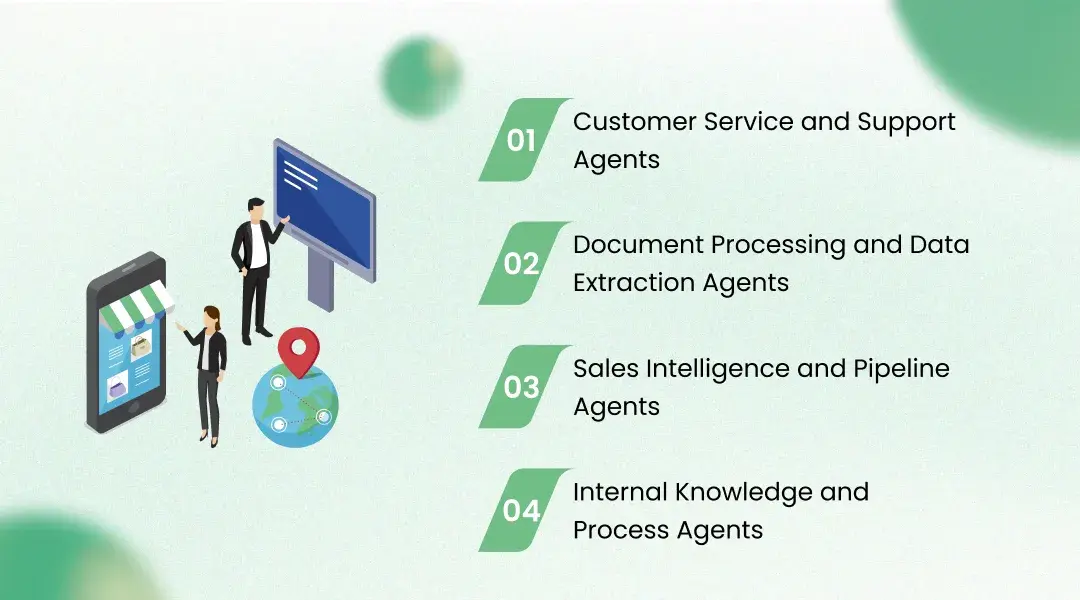
Not every AI agent application makes sense at this scale. The applications below represent the highest-return opportunities based on current technology maturity, typical cost structures, and realistic implementation complexity.
AI agents for customer service represent the single highest-ROI application for mid-market companies. At this level, customer service teams typically have 5 to 30 agents. AI agents handle tier-one inquiries autonomously, prepare context summaries for human agents, and manage after-hours coverage. The cost ranges from $1,500 to $5,000 per month. Companies typically see a 35% to 50% reduction in average first-response time and a 20% to 30% reduction in ticket volume handled by humans, translating to approximately 200 to 350 reclaimed hours of human labor per month for a 15-person support team.
Mid-market companies in insurance, logistics, legal services, and financial services process thousands of documents monthly. AI agents extract structured data from invoices, contracts, and compliance forms with accuracy rates above 95%. Deployment costs range from $800 to $3,000 per month. If a team currently spends 120 hours monthly on document processing and an AI agent reduces that by 70%, the payback period is typically 2 to 4 months.
AI agents that monitor prospect activity, enrich CRM records, score leads, and draft personalized outreach have matured significantly. The measurable outcome most commonly reported is a 15% to 25% improvement in pipeline conversion rates within six months. Costs range from $100 to $300 per sales user per month. For a 20-person sales team, that represents a $2,000 to $6,000 monthly investment against potentially hundreds of thousands in additional closed revenue.
The most underappreciated AI agent application for mid-market companies is the internal knowledge agent. These sit on top of existing documentation, SOPs, and communication tools, providing instant answers to employee questions. Research from Gartner suggests that knowledge workers spend 19% of their time searching for information. Internal knowledge agents at this scale cost $1,000 to $4,000 per month and deliver time savings of 3 to 5 hours per employee per month. Across a 200-person organization, that is 600 to 1,000 hours of recovered productivity monthly.
The numbers that matter at the mid-market level differ from enterprise metrics. For a mid-market company, the meaningful metrics are hours reclaimed per team member, cost savings as a percentage of departmental budget, and months to payback. AI agent ROI for growing businesses in this segment follows a consistent pattern across industries. Customer-facing AI agents deliver results within 60 days. The average mid-market company deploying a customer service AI agent reduces its cost per ticket by 40% to 55% within the first quarter. For a company handling 3,000 support tickets per month at $15 per ticket before AI, this translates to savings of $18,000 to $24,750 per month against a technology cost of $3,000 to $5,000.
Operational AI agents show returns on a slightly longer timeline, with break-even within 3 to 5 months and cumulative savings of 25% to 35% on labor costs for automated workflows by year's end. When compounded across departments, the annual impact for a 200-person company typically ranges from $200,000 to $600,000 in recovered labor value. Revenue-generating AI agents in sales show the highest variance but also the highest ceiling, with mid-market companies reporting revenue increases of 10% to 20% attributable to improved sales efficiency within the first 12 months.
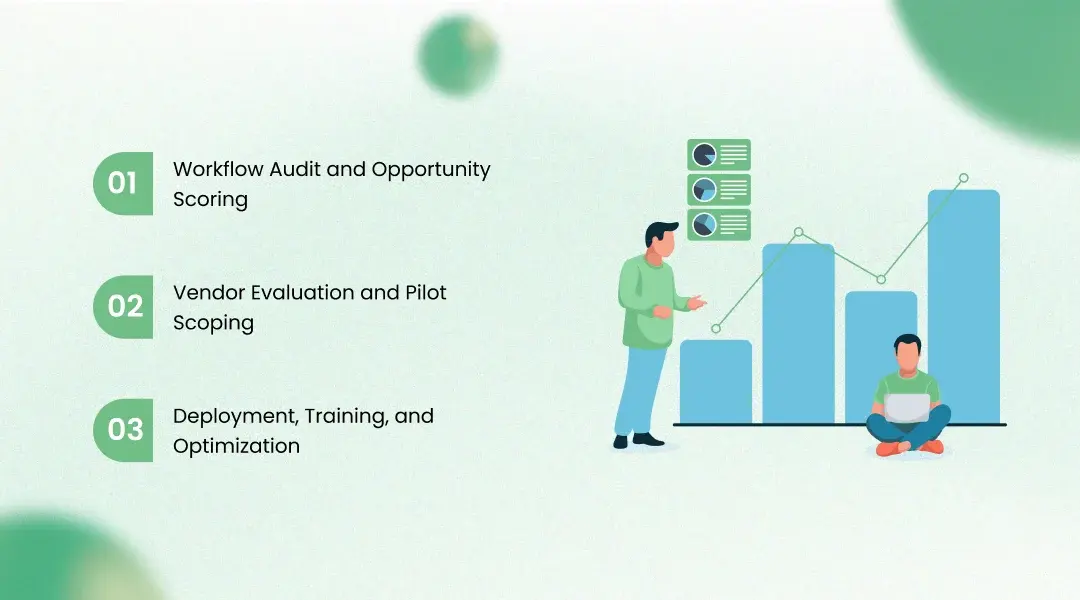
Knowing which AI agents to deploy is only half the challenge. The roadmap below is designed for companies with 50 to 500 employees, limited dedicated AI staff, and technology budgets that require clear justification.
Before selecting any vendor, conduct a structured audit of your highest-cost workflows. Assign your most operationally experienced manager to document the top 10 workflows by labor hours consumed, then score each on three dimensions: volume (how many times this workflow executes monthly), variability (how much each execution differs), and value (the cost of errors or delays). The best candidates are high-volume, low-variability workflows with meaningful error costs. For most mid-market companies, customer support triage, document intake, appointment scheduling, and data reconciliation score highest.
Evaluate vendors using four non-negotiable requirements for mid-market buyers:
Native integration with your existing core systems without requiring custom API development.
Usage-based pricing with monthly costs predictable within a 15% variance.
Configuration interfaces manageable by existing IT staff, with vendor-provided onboarding included.
Built-in analytics showing business outcomes (tickets resolved, hours saved) rather than only technical metrics.
Scope your pilot to a single workflow with a clear baseline measurement. KriraAI structures its mid-market engagements around exactly this kind of bounded, measurable pilot, because proving value in one workflow creates the internal credibility needed to expand.
Deploy the AI agent with parallel human oversight for the first two weeks. Schedule three training sessions: one at deployment covering basic operation, one at week four covering performance review, and one at week eight covering advanced features. Training is not optional.
Three mistakes account for most failed mid-market AI agent deployments.
The first is skipping baseline measurement. Without knowing your current cost per ticket or processing time before deployment, you cannot prove the agent's value afterward, and the project loses executive support at the first budget review.
The second is assigning AI agent management as a side responsibility. Someone needs to own agent performance with 8 to 12 hours per week allocated, not as an addition to a full-time role.
The third is expanding too quickly. A sustainable pace is one new workflow every 6 to 8 weeks. At this rate, a company can have four to six AI agents in production within a year, each fully optimized.
Data readiness is the most common obstacle. Mid-market companies have data, but it is rarely clean or centralized. The solution is not a massive cleanup project before AI deployment but rather selecting AI agents that include data normalization in their ingestion process and committing to incremental quality improvement as an ongoing discipline.
Integration complexity is a specific challenge because the technology stack was built for human users, not for AI agent interoperability. The AI agent cost and integration strategy that works best is to prioritize vendors with pre-built connectors for common mid-market stacks rather than relying on custom integration.
Change management is often underestimated. Employees at mid-market companies have broad roles and deep ownership over their domains. Introducing AI can feel threatening. Successful deployments always include a communication plan framing AI agents as tools that handle repetitive work, not replacements for the role. Companies that get this right see adoption rates above 80% within three months. Those that do not struggle to break 40%.
The mid-market companies that deploy AI agents in 2026 and 2027 will hold a structural advantage that is nearly impossible to close later. This advantage compounds in three ways.
First, AI agents improve with use. A customer service agent that has processed 50,000 tickets understands your product and customers in ways a freshly deployed competitor's agent cannot. A competitor who waits until 2029 will need 12 to 18 months just to reach performance levels you achieved in your first six months.
Second, organizational AI fluency is a competitive asset that develops through lived experience, not through hiring one or two specialists. The mid-market company that has spent three years working alongside AI agents has a workforce that instinctively identifies automation opportunities and collaborates effectively with AI tools. Companies that delay will face both a technology gap and a capability gap in their workforce.
Third, customer expectations are rising at a rate that will make AI-augmented service the baseline within three to five years. Companies that adopt now will meet those expectations naturally. Those that wait will face a sudden, expensive transition under competitive pressure.
Three insights stand above the rest for mid-market companies considering AI agent adoption. First, the technology is ready and the economics are favorable at your scale, but only if you select solutions built for your segment rather than enterprise tools repackaged with a smaller price tag. Second, implementation discipline matters more than technology sophistication, and a well-scoped pilot with clear metrics will outperform a more advanced deployment that lacks organizational commitment. Third, the window for gaining a durable competitive advantage through early adoption is open now but will not remain open indefinitely.
KriraAI works with mid-market companies across industries to design and deploy AI agent solutions that match the real constraints of organizations with 50 to 500 employees. Rather than offering scaled-down enterprise platforms or scaled-up startup tools, KriraAI builds practical implementations around the specific budgets, team structures, and growth trajectories of mid-market businesses. Their approach begins with the workflow audit and measurable pilot methodology described in this guide, ensuring that every deployment proves its value before expansion. If your company is ready to explore how AI agents can reclaim hundreds of hours of labor, improve customer experience, and build a lasting operational advantage, reaching out to the KriraAI team is a practical next step.
The realistic cost for a mid-market company with 50 to 500 employees to deploy its first AI agent ranges from $2,000 to $8,000 per month for a single workflow, including the software subscription and configuration support. Companies should also budget a one-time integration setup cost of $3,000 to $10,000 and 8 to 12 hours per week of internal staff time for monitoring. The total first-year investment typically falls between $35,000 and $100,000, with break-even commonly achieved within 3 to 5 months for high-volume workflows like customer support or document processing.
Mid-market companies generally do not need dedicated AI specialists for initial deployments if they select vendors who offer managed onboarding and configuration support. The skills required are closer to those of a technically competent operations manager than a machine learning engineer. Existing IT staff can learn to manage AI agent dashboards and request configuration changes. What is essential is that someone has this as a defined responsibility, not a side task. For companies planning more than three AI agent deployments, a dedicated AI operations coordinator becomes worthwhile around the 12 to 18 month mark.
The biggest risk is not the technology failing but the implementation being abandoned prematurely. Research indicates that 60% of mid-market AI projects terminated were showing positive trajectory but had not reached the visibility threshold needed for continued executive support. The mitigation is clear: define a specific success metric before deployment, measure your baseline rigorously, and establish a 90-day evaluation window that leadership commits to honoring. Companies that follow this discipline achieve pilot-to-production conversion rates above 75%, compared to under 30% for those without structured evaluation criteria.
Off-the-shelf AI agents handle approximately 70% to 80% of common mid-market workflows, including customer support triage, document extraction, lead scoring, and knowledge retrieval. The remaining 20% to 30% requires configuration rather than custom development. Modern platforms designed for this segment offer configuration layers for customizing behavior, integrating with specific systems, and defining business rules without writing code. Mid-market companies should avoid vendors who require custom development for standard use cases, as this increases cost, timeline, and maintenance burden dramatically.
Mid-market companies deploying AI agents on high-volume workflows typically see measurable ROI within 60 to 90 days of production deployment. This accounts for 2 to 3 weeks of integration, a 2-week parallel-operation phase with human oversight, and 4 to 8 weeks of independent operation. The ROI at this scale is driven by labor hour recovery rather than headcount reduction. A support AI agent handling 40% of tier-one tickets means existing staff redirect that time to complex cases and proactive outreach. For sales intelligence agents, the timeline extends to 4 to 6 months to account for full sales cycle visibility.
Founder & CEO
Divyang Mandani is the CEO of KriraAI, driving innovative AI and IT solutions with a focus on transformative technology, ethical AI, and impactful digital strategies for businesses worldwide.