Let me guess.
You’ve heard the term AI agent thrown around in meetings, blogs, maybe even sales pitches. Everyone sounds confident. No one explains it properly.
Classic.
I’ve spent the last few years actually building these systems- not just talking about them. And here’s the truth:
Most explanations of AI agents are either too technical… or completely useless.
So let’s fix that.
No fluff. No buzzwords. Just clarity.
Let’s start with the obvious question: What is an AI agent?
An AI agent is a system that can observe, decide, and act without needing constant human instructions.
That’s it.
Not magic. Not sci-fi. Just structured intelligence.
If you want the AI agent meaning in one line:
It’s software that takes input from its environment, makes decisions based on logic or learning, and performs actions to achieve a goal.
Think of it like this:
A chatbot answers questions
An AI agent takes action
See the difference?
One talks. The other does.
And in 2026, this distinction matters more than ever.
Now let’s break down how AI agents work without turning this into a textbook.
Every AI agent follows a simple loop:
The agent collects data.
This could be:
User queries
System logs
Sensor data
Business metrics
This is where the intelligence kicks in.
Using rules, models, or learning systems, the agent decides:
“What’s the best action right now?”
(This is where most systems fail, by the way, which is why investing in professional AI development services ensures your core logic drives successful business outcomes.)
The agent executes something.
Not suggests. Executes.
Sends an email
Updates a database
Triggers a workflow
Makes a recommendation
Advanced systems improve over time.
They learn from:
Past decisions
Feedback loops
New data
This entire flow is what we call AI agent architecture.
Simple in theory. Complex in execution.
Not all agents are equal. Some are basic. Some are… borderline impressive.
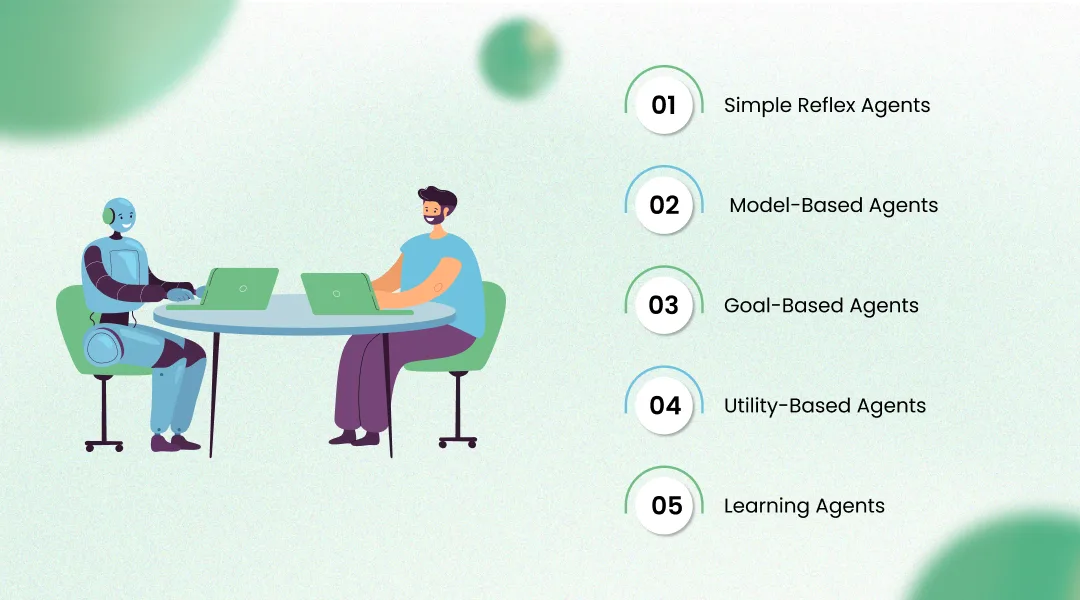
Let’s walk through the main types of AI agents.
The most basic type.
They follow:
IF condition → THEN action
No memory. No learning.
Example:
If a user clicks “Buy,” show checkout page.
Efficient. But limited.
These agents maintain an internal state.
They don’t just react;t they understand context.
Example:
Tracking user behavior across sessions
Now we’re getting somewhere.
These agents make decisions based on a defined goal.
Not just “what’s happening” but:
“What should I achieve?”
Example:
Recommending actions to increase sales
Smarter. More flexible.
Now we introduce preferences.
These agents choose the best possible outcome based on a utility function.
Example:
Optimizing delivery routes for time + cost
This is where business value starts becoming obvious.
The most advanced category.
These agents improve themselves.
They adapt. They evolve. They get better.
These are often referred to as autonomous AI agents, representing a massive evolutionary leap when comparing modern AI capabilities versus traditional machine learning models.
And yes… this is where things get interesting.
Let’s clear this up. Because confusion here is everywhere.
AI Chatbots:
Respond to queries
Scripted or semi-intelligent
Limited scope
AI Agents:
Take actions
Make decisions
Work across systems
Here’s the blunt truth:
If your “AI solution” only replies to messages… You don’t have an agent.
You have a smarter FAQ.
Let’s make this real.
Some practical AI agent examples I’ve worked on or seen:
Customer support agents that resolve tickets end-to-end
Sales agents that qualify leads and schedule meetings
Operations agents that monitor systems and fix issues automatically
Finance agents that detect anomalies in transactions, showcasing the undeniable value of artificial intelligence in the finance industry for security and compliance.
Notice a pattern?
These aren’t tools.
They’re digital workers.
This is where things shift from theory to reality.
In AI agents in 2026, businesses aren’t experimenting anymore.
They’re deploying.
Here are real AI agent use cases:
Automating customer support workflows
Managing SaaS onboarding journeys
Handling internal IT requests
Optimizing supply chains
Monitoring cybersecurity threats
And here’s what I tell every client:
Don’t start with AI. Start with a problem.
The companies winning right now aren’t chasing trends.
They’re solving bottlenecks.
(And yes, this is exactly where a Best AI development Company or an experienced AI Company in India actually matters: execution beats ideas.)
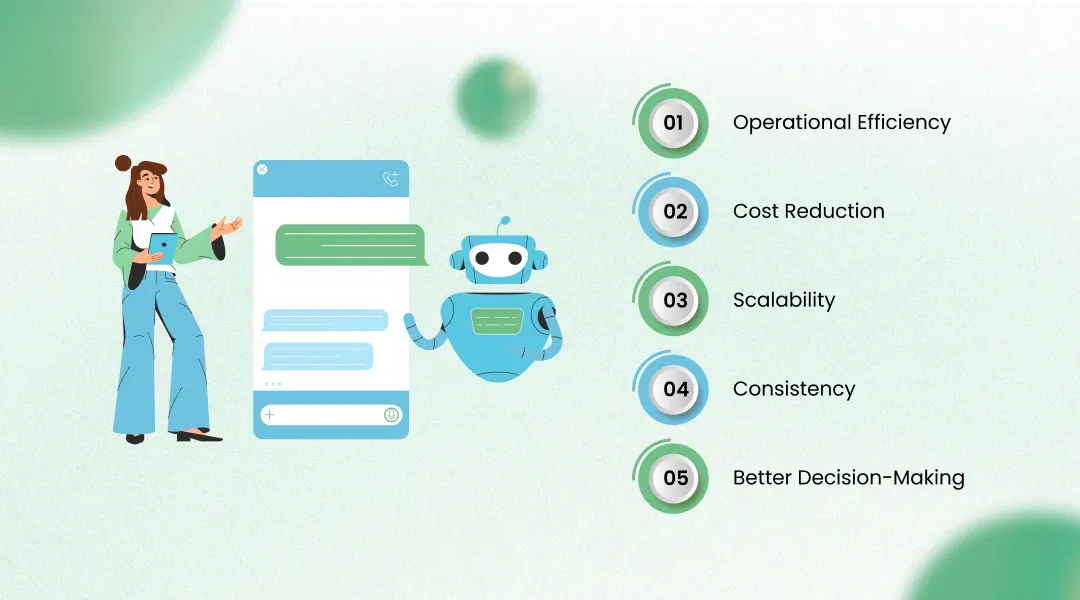
Let’s talk about the real benefits of AI agents.
Not theoretical. Practical.
Tasks that took hours… now take seconds.
Fewer manual processes = lower overhead.
Agents don’t get tired. Or overwhelmed.
No human errors. No mood swings. Just logic.
Data-driven actions instead of guesswork.
But let me ask you something.
Are you solving a problem… or just adding technology?
Because that’s where most implementations go wrong.
Let’s not pretend this is perfect.
It’s not.
Here are the real challenges:
Poor data quality leads to bad decisions
Over-automation can break workflows
High initial setup complexity
Requires continuous monitoring
And the biggest one?
Misalignment with business goals.
I’ve seen companies spend months building systems that… no one uses.
Painful. Avoidable.
Here’s where things get a bit personal.
A few years ago, I was skeptical about all this.
Now?
I’ve seen AI agents replace entire workflows.
Quietly. Efficiently.
The future isn’t about simple standalone tools, but rather fully embracing the future of artificial intelligence in business operations through interconnected ecosystems.
It’s about systems that think and act independently.
We’re moving toward:
Multi-agent ecosystems
Fully autonomous workflows
AI-driven decision layers across organizations
And the scary part?
Most businesses still haven’t started.
So, what is an AI agent?
Not hype. Not magic.
Just a system that observes, decides, and acts.
But when done right?
It changes how businesses operate.
If you take one thing from this guide, let it be this:
AI agents aren’t about technology. They’re about eliminating friction.
Start small, partner with experienced innovators like KriraAI to solve one specific problem, and systematically build your automated ecosystem from there.
That’s how it works.
An AI agent is software that observes data, makes decisions, and performs actions automatically to achieve a specific goal.
They follow a loop of input → decision → action, sometimes improving over time using learning models.
The main types include simple reflex, model-based, goal-based, utility-based, and learning agents.
Yes, because AI agents can take actions and automate workflows, while chatbots mainly respond to queries.
They are used in customer support, operations, sales automation, cybersecurity, and workflow management.
Founder & CEO
Divyang Mandani is the CEO of KriraAI, driving innovative AI and IT solutions with a focus on transformative technology, ethical AI, and impactful digital strategies for businesses worldwide.