The moment most small education business owners hear the words "artificial intelligence," they picture enterprise budgets, dedicated data science teams, and six-month implementation projects that belong to universities with IT departments larger than their entire staff roster. That assumption is costing them. A 2024 survey by EdTech Digest found that small private tutoring centers, independent schools, and specialized learning programs that piloted AI tools with fewer than fifty staff members reported an average of 22 hours per week recovered from administrative tasks alone, which at a loaded labor cost of $28 per hour amounts to over $32,000 in recaptured capacity per year. AI adoption for small education businesses is not a future consideration. It is a present competitive decision, and the businesses getting it right are the ones that stopped waiting for a perfect moment and started with what they actually had: a small, agile team, a genuine relationship with their learners, and the ability to move quickly without committee approvals. This blog covers the specific AI applications, implementation sequence, cost expectations, and common mistakes that apply exclusively to education businesses operating with ten to fifty employees. If you run a larger institution or a solo tutoring practice, much of what follows will not apply to you directly, and that is precisely the point.
Running an education business with ten to fifty staff members is a fundamentally different experience from operating either a solo tutoring practice or an established private school with hundreds of employees. You are large enough to have genuine organizational complexity but small enough that every single person wears multiple hats on any given day. Your lead instructor is probably also your curriculum coordinator. Your operations manager likely doubles as your enrollment counselor. Your founder, if they are still active in the business, is almost certainly still teaching some sessions.
In a typical business of this size, the team structure looks something like this: four to twelve teaching or tutoring staff delivering the core product, one to three administrative staff managing scheduling, billing, and communications, one person handling marketing or social media (often part-time), and a director or owner who oversees everything without a dedicated staff layer beneath them. There is rarely a dedicated technology person, a curriculum development department, or an HR function beyond basic payroll processing.
Budget constraints at this scale are meaningful but not prohibitive. Most education businesses with ten to fifty staff operate on annual revenues between $800,000 and $4 million, with technology budgets that range from $15,000 to $80,000 per year including software subscriptions, hardware, and any contracted IT support. This budget must cover a learning management system, a student information system, communication tools, and any operational software, which means discretionary AI spending typically enters the conversation only when someone can demonstrate it will replace or reduce existing line items rather than add to them.
The technology stack at this scale tends to be mature enough to have accumulated debt. Many small education businesses use three to five disconnected platforms that do not speak to each other: a scheduling tool, a separate billing system, a generic CRM that was adapted for student tracking, and a communication platform that was adopted during the pandemic and never fully replaced. This fragmentation is not a failure of planning. It is the natural result of making pragmatic decisions under resource pressure over several years.
The pressures this segment faces are distinct from both ends of the size spectrum. Unlike a solo operator, a small education business must maintain quality and consistency across multiple instructors, manage parent and student expectations at scale, and ensure that the departure of any one staff member does not collapse a critical function. Unlike a large institution, it cannot absorb the cost of a failed technology initiative, cannot dedicate internal headcount to a lengthy rollout, and must justify every tool on the basis of observable impact within a single academic or fiscal year.
A Fortune 500 company's approach to AI involves dedicated transformation offices, multi-year roadmaps, custom model development, and enterprise contracts with vendors who assign client success managers and charge annual fees that exceed most small education businesses' total revenue. A solo tutor's approach to AI involves downloading an app, experimenting on evenings and weekends, and adopting whatever produces an immediate visible result with no integration requirements. Neither model translates to a ten to fifty person education business, and most of the advice published about AI in education is written for one of those two extremes.
The budget reality for this segment means that custom AI development is off the table. Building a proprietary recommendation engine or a bespoke assessment AI requires six-figure minimum investments and ongoing engineering support that simply does not exist at this scale. Conversely, the operational complexity of a multi-instructor, multi-program education business means that consumer-grade AI apps designed for individual users quickly hit their ceiling. What works for this segment is the middle tier: purpose-built SaaS platforms with AI features embedded, horizontal AI tools with education-specific workflows, and modular automation solutions that connect to existing systems through standard integrations.
The implementation complexity at this scale is real but manageable with the right sequence. A large enterprise typically spends six to eighteen months in vendor selection, procurement, legal review, and integration before any user touches a new AI system. A small education business can evaluate, trial, and deploy a well-chosen AI tool in four to eight weeks. That speed advantage is significant, but it comes with risk if the selection process is skipped. The most common failure mode at this scale is not that the AI does not work technically. It is that the AI was chosen without mapping it to a specific, painful workflow problem, which means adoption stalls because staff do not feel a clear reason to change their habits.
Vendor options available to this segment have expanded substantially since 2022. Platforms like Khanmigo, Synthesis Tutor, Gradescope, Edulastic, and a growing number of AI-enhanced tutoring and administration tools now offer pricing tiers specifically designed for small education businesses, typically in the range of $3 to $15 per student per month or $200 to $800 per month for staff-facing administrative tools. These are meaningful costs but not prohibitive ones when evaluated against the labor hours they replace.
The internal skill requirements for AI adoption at this scale are lower than most small education business owners assume. You do not need an AI specialist, a data scientist, or even a technical project manager. You need one person who can spend two to three hours per week during the implementation period reading documentation, running a pilot, and collecting feedback from the team. In most cases, that person is whoever already manages your learning management system or leads your technology decisions informally.
The timeline to see returns at this scale is typically faster than at either end of the spectrum. A solo operator sees immediate returns because they are the only user. An enterprise sees returns measured in years because implementation spans the organization. A small education business, running a focused pilot with fifteen to thirty staff and students, can typically measure meaningful impact within eight to twelve weeks of deployment.
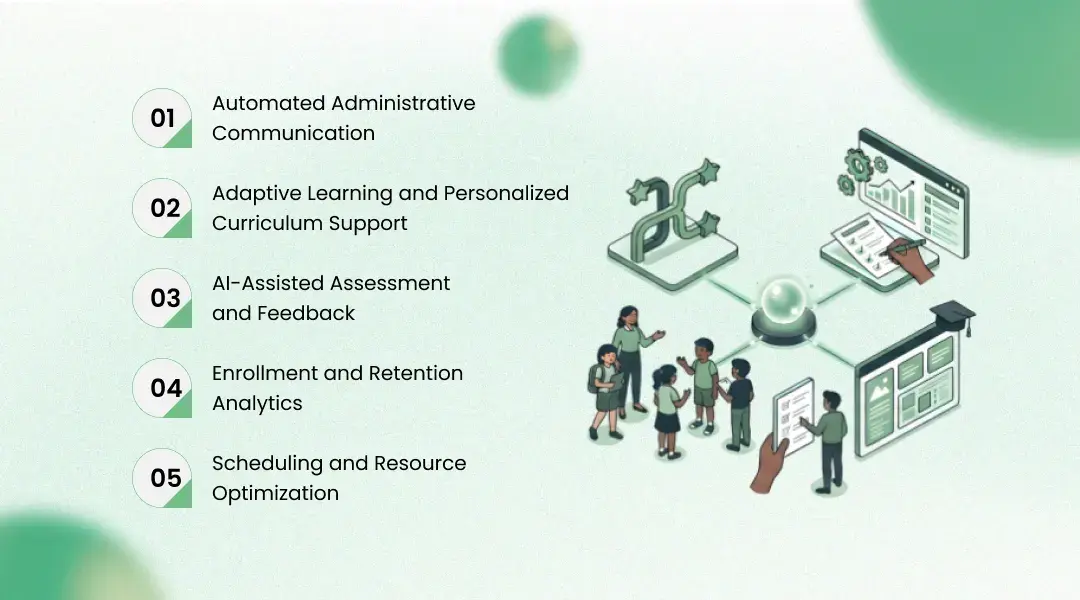
Not every AI application that works brilliantly for a 500-person school district makes practical sense for a 25-person tutoring center. The following applications represent the strongest return for the specific constraints and opportunities of a ten to fifty employee education business.
Communication with parents and students is one of the highest-volume, most time-consuming functions in any small education business, and it is also one of the most amenable to AI automation at this scale. AI-powered communication tools can draft progress update messages, respond to frequently asked questions about schedules and policies, send enrollment reminders, and generate personalized session summaries from instructor notes in minutes rather than hours.
For a business with twenty to thirty enrolled families, a single administrative staff member might spend 8 to 12 hours per week on communications. AI drafting and response tools can reduce that to 2 to 3 hours of review and approval time, recovering 6 to 9 hours weekly for higher-value work. Tools in this category include AI-enhanced CRM features within platforms like HubSpot (which has a small business tier), as well as purpose-built education communication tools with AI capabilities. Costs typically run $150 to $400 per month at this scale.
The pedagogical case for adaptive learning AI is strongest in direct instruction contexts, and small tutoring centers, learning centers, and independent schools are among the best environments to deploy it. AI platforms that adjust content difficulty, pacing, and format based on individual student performance can extend the instructional reach of a small team without requiring each instructor to manually differentiate content for every learner.
At this scale, the practical benefit is not just learning outcomes. It is instructor efficiency. When a student arrives at a session having completed adaptive practice on an AI platform and the instructor can see exactly which concepts the student struggled with, the forty-five minute session can be spent entirely on high-value targeted instruction rather than diagnostic warm-up. This changes the observable value of each session for the parent paying for it. Platforms such as Khanmigo, IXL, and several newer AI tutoring platforms offer per-student pricing between $10 and $20 per month.
Grading and feedback generation consume a disproportionate share of instructor time in most small education businesses, particularly those serving test preparation, writing instruction, or STEM tutoring markets. AI assessment tools can score structured assessments, generate detailed written feedback on student work, flag patterns in error types across multiple students, and produce progress reports that instructors review and approve rather than author from scratch.
A math tutoring center with fifteen instructors each producing two written assessments per student per month can reclaim 60 to 90 hours of collective instructor time per month through AI-assisted feedback generation. At a blended instructor cost of $35 per hour, that represents $2,100 to $3,150 in recovered labor value per month. Tools like Gradescope, MagicSchool AI, and newer generative feedback platforms sit in the $200 to $600 per month range for a business of this size.
Predicting which students are at risk of dropping out, which leads are most likely to convert, and which programs are generating the best student outcomes requires data analysis that most small education businesses never have time to do manually. AI analytics tools embedded within student information systems or layered as lightweight add-ons can surface these insights automatically, flagging at-risk students before they disengage and identifying conversion patterns in enrollment data.
For a business with 80 to 200 active students, even a 5 percent improvement in annual retention translates to meaningful revenue protection. If average annual revenue per student is $3,000, retaining four additional students represents $12,000 in annual recurring revenue. The cost of the analytics tool is almost always recovered within the first retention win.
Matching instructor availability, student schedules, room or platform availability, and program requirements is a genuinely complex optimization problem that consumes significant administrative time in any multi-instructor education business. AI scheduling tools can generate optimal timetables in minutes, handle change requests automatically, and surface conflicts before they become problems. For a business running twenty to forty simultaneous weekly sessions, this alone can recover four to six hours of administrative time per week.
The question every small education business owner asks before committing to any new technology investment is straightforward: what will this actually do for my numbers? The honest answer for AI adoption at this scale, based on outcomes reported by comparable businesses, is more specific than most AI marketing material suggests.
Small education businesses with ten to fifty staff that have implemented AI administrative communication tools report a consistent reduction of 6 to 10 hours per week in administrative labor related to parent and student communications. At a fully loaded cost of $25 to $35 per hour for administrative staff, this represents $7,800 to $18,200 in annual labor value recovered. In a business where administrative overhead is already stretched, that recovered time often flows directly into enrollment conversion work or program quality improvement, creating compounding value rather than simple cost reduction.
Businesses deploying adaptive learning AI report measurable improvements in student outcome metrics within one academic term. Specifically, retention rates among students using AI-supplemented instruction average 15 to 22 percentage points higher than control cohorts in programs that have tracked this comparison. For a small tutoring center with 120 enrolled students at an average annual fee of $2,400, a 15 percent improvement in annual retention represents $43,200 in protected revenue.
Instructor productivity improvements from AI-assisted assessment and feedback generation are consistently reported at 30 to 45 percent time reduction on feedback tasks. For a business where instructors spend an average of four hours per week on written feedback and progress documentation, this frees 1.2 to 1.8 hours per instructor per week. Across a team of twelve instructors, that is 14 to 22 hours per week of recovered instructional capacity, which can either reduce the need for administrative overtime or be redirected to additional billable sessions.
Enrollment conversion rate improvements from AI-powered lead nurturing and follow-up automation are reported at 12 to 18 percent higher conversion compared to manual follow-up processes. For a business receiving 40 new inquiries per month and closing at 35 percent, a 15 percent relative improvement in conversion means approximately two additional enrollments per month. At $2,400 average annual value per student, that is $4,800 in new annual revenue from conversion improvement alone.
The total annual impact for a small education business implementing AI across these four application areas conservatively sits between $60,000 and $110,000 in combined labor recovery, revenue protection, and new revenue generation, against a total annual AI tool investment typically in the range of $8,000 to $20,000. The return on investment calculation for AI adoption for small education businesses at this scale, when implemented with focus and appropriate tool selection, is genuinely compelling.
The most important thing to understand about implementing AI in a ten to fifty person education business is that sequence matters more than speed. The businesses that attempt to deploy multiple AI tools simultaneously almost always see adoption stall because staff feel overwhelmed by change. The businesses that move sequentially, mastering one application before adding the next, see compounding adoption rates and genuine behavior change.
The following roadmap reflects realistic timelines and resource requirements for this segment.
Before selecting any AI tool, map your three highest-volume administrative workflows and calculate how many staff hours they consume each week. In most small education businesses, these are communication management, scheduling coordination, and feedback or report generation. Quantify the current cost. This gives you a ranked list of where AI can deliver the fastest, most measurable return. Identify one internal champion, typically your most technology-comfortable staff member, who will own the pilot. This does not require technical skill. It requires organized follow-through.
Select one AI tool that addresses your highest-priority workflow problem. Negotiate a free trial or a one-month paid pilot rather than committing to an annual contract. Design a clear success metric for the pilot: you are not asking "does this feel useful?" You are asking "did we recover the expected hours, and did staff adoption reach the target threshold within four weeks?" Run the pilot with a subset of your team before full deployment.
Run the pilot with genuine discipline. Track hours spent on the target workflow before and during the pilot. Collect structured feedback from staff at the two-week and four-week mark. Do not extend the pilot indefinitely. Make a clear go or no-go decision at week ten based on the success metrics you set in Phase 2.
If the pilot succeeds, move to full deployment with a structured onboarding session for all staff. This does not need to be a training program. A two-hour demonstration and hands-on session with documentation is sufficient for most AI tools at this scale. Identify common friction points and resolve them in the first two weeks of full deployment.
Only after the first AI tool is genuinely embedded in daily workflow should you begin evaluating the next application. Stacking applications before the first is stable is the single most common way a well-intentioned AI rollout loses organizational momentum.
The first mistake is buying based on features rather than workflow fit. Many small education business owners are sold on AI tools during a compelling demo that shows impressive capabilities with no connection to the specific problem the business needs to solve. Before any purchase, ask: which specific workflow is this replacing, how many hours does that workflow currently cost us, and how will we measure whether the tool has reduced that cost?
The second mistake is skipping staff buy-in. In a ten to fifty person business, any staff member who feels that an AI tool threatens their role or adds complexity without visible benefit can passively undermine adoption by simply not using it consistently. The solution is to involve two or three staff members in the selection process, frame AI tools explicitly as administrative burden reducers rather than replacements, and create early wins that staff can see and feel within the first two weeks.
The third mistake is treating the AI tool as a finished product. Every AI implementation at this scale requires some configuration, prompt refinement, and workflow adjustment in the first four to six weeks. Businesses that deploy a tool and expect it to immediately perform optimally without any iteration almost always underestimate the brief calibration period and conclude the tool is not working when it simply has not been tuned to their specific context.
The challenges that a ten to fifty person education business faces in AI adoption are not the challenges described in most AI thought leadership content, which tends to focus on the concerns of large enterprises navigating governance and compliance frameworks, or the concerns of solo operators worrying about whether an app is worth $20 per month. The challenges at this scale are genuinely distinct.
Data fragmentation is the most pervasive obstacle. Most small education businesses have student data spread across multiple disconnected systems, which means AI tools that depend on integrated data inputs either cannot function at full capacity or require manual data consolidation that defeats part of the efficiency gain. Addressing this before AI deployment, even partially, is worth prioritizing. Moving to a single student information system that covers scheduling, billing, and progress tracking creates the data foundation that makes AI tools far more effective.
Staff capacity for change management is a real constraint. When every person in a small education business is already at close to full capacity, adding any new workflow process, even one that saves time in the long run, creates short-term friction that can kill adoption. The implementation roadmap described above is specifically designed to minimize this friction by keeping the initial investment of staff time very low and making early wins visible quickly.
Vendor reliability at this price point is a legitimate concern. The AI education technology space is evolving rapidly, and several platforms that appeared in this segment two years ago have since pivoted, been acquired, or significantly changed their pricing structures. Small education businesses do not have procurement teams to evaluate vendor stability. The practical mitigation is to avoid tools with no export functionality, ensuring that student data and content created on the platform can always be extracted, and to keep contracts short until a vendor demonstrates multi-year stability.
The challenge of maintaining the human relationship that is the core value proposition of a small education business is also real. Parents and students who choose a small tutoring center or independent learning program over a large institution are often doing so specifically because they value personal connection and individualized attention. Any AI implementation that makes the experience feel more automated or less personalized can damage the competitive positioning that made the business successful. AI should be deployed in back-office and instructor-support contexts first, and any student-facing AI should be positioned explicitly as a tool that gives their instructor more time and information to serve them better.
Looking forward three to five years, the competitive dynamics within the small education business segment will be shaped by a single underlying force: the compounding productivity advantage of early AI adopters. This is not a speculative claim. The pattern is already visible in comparable service business segments where AI adoption began two to three years earlier.
Businesses in this segment that implement AI in administrative workflows, adaptive learning delivery, and assessment support in 2025 and 2026 will by 2028 have accumulated two to three years of student outcome data flowing through AI analytics systems, producing insights about program effectiveness, student risk factors, and enrollment conversion patterns that competitors without those systems cannot replicate quickly. Data advantage compounds over time in a way that marketing spend does not.
The instructors at AI-adopting small education businesses will also have developed genuine AI fluency, the practical skill of integrating AI tools into their daily instructional workflow in ways that improve their effectiveness. This fluency takes six to twelve months to develop fully. A competitor attempting to close the gap in 2028 will not simply be installing software. They will be asking their team to develop habits and capabilities that the early-adopting competitor's team has already internalized.
KriraAI has observed this pattern directly in the small business education clients they support. The gap between AI-adopting and AI-deferring businesses in this segment is not growing linearly. It is growing in stages, because each additional AI application a business deploys makes subsequent applications easier to adopt, more effective to use, and more integrated into the core operation.
[Icon Point Image Title: Future Advantages for AI-Adopting Education Businesses 01: Compounding Student Data Insights 02: Faster Enrollment Conversion 03: AI-Fluent Instructor Teams 04: Scalable Program Delivery]
The capabilities that will separate market leaders from followers in this segment by 2029 are already visible in early form today. Predictive student success modeling, where AI identifies which students need intervention three to four weeks before their engagement drops, is currently available in basic form and will become standard. Personalized learning path generation that adapts not just to student performance but to learning style, session timing, and engagement patterns will move from premium-tier features to standard inclusions in core education platforms. Voice and multimodal AI tutoring supplements that sit alongside human instruction will become an expected component of any competitive tutoring or learning program offering.
The small education businesses that are building their AI foundation now, even with modest initial investments and imperfect first implementations, are the ones that will have the operational fluency and the data infrastructure to deploy these next-generation capabilities as they mature. Waiting for the technology to be "ready" means waiting until the early movers have already converted the advantage into durable customer relationships, higher retention rates, and stronger brand positioning. KriraAI's work with small education businesses consistently shows that the businesses most likely to thrive in a more AI-saturated market are not the ones with the largest budgets but the ones that started building AI habits earliest and most intentionally.
The three most important points from this guide deserve a clear restatement before you close this page. First, AI adoption for small education businesses is not about adopting the most advanced technology available. It is about identifying the specific workflow bottlenecks that are costing your team the most time and applying the right AI tools to those specific problems in the right sequence. Second, the return on investment at this scale is real, measurable, and typically achievable within a single academic year when implementation is done with focus rather than ambition. Third, the competitive advantage of early adoption in this segment is compounding, not linear. Every month of delay is not neutral. It is a month during which a competitor may be building the data foundation and operational fluency that will be very difficult to replicate quickly in two or three years.
KriraAI builds practical, scalable AI solutions designed specifically for the constraints and opportunities of businesses at this scale, not enterprise implementations stripped down to a smaller budget, and not consumer tools patched together for professional use. KriraAI works with small education businesses to identify the highest-return AI applications for their specific program model, team structure, and student population, then supports implementation with the kind of hands-on guidance that makes the difference between a tool that gets adopted and one that sits unused after the first week. If you are running a tutoring center, an independent school, a learning enrichment program, or any education business with ten to fifty staff and you are ready to move from considering AI to actually implementing it, explore what KriraAI offers or reach out directly to begin with a workflow audit that costs nothing and clarifies everything.
For a small education business with ten to fifty employees, meaningful AI adoption does not require a large upfront capital investment. The most effective entry point is a focused SaaS tool in one administrative or instructional workflow category, which typically costs between $150 and $600 per month depending on the number of users and students served. When evaluated against the labor hours recovered, the ROI calculation almost always favors adoption. A $300 per month AI communication tool that recovers six hours of administrative time per week at $28 per hour represents a net monthly gain of $672 in recovered labor value after tool cost. The total annual investment for two to three AI tools serving different workflow areas typically sits between $5,000 and $15,000, well within the discretionary technology budget of most businesses at this scale and far below the threshold that would require board approval or external financing.
Small education businesses with ten to fifty staff can typically measure meaningful results from a well-selected AI tool within eight to twelve weeks of deployment, which is considerably faster than the timelines experienced at larger institutions. The reason is scale: with a smaller team and fewer integration requirements, the configuration and calibration period is shorter, and the feedback loop between implementation decisions and observable outcomes is tighter. Administrative efficiency gains are usually visible within the first two to three weeks as staff begin routing tasks through the new tool. Instructional improvement indicators, such as student performance trends and retention metrics, typically require a full academic term, roughly eight to fourteen weeks, to measure reliably. Setting clear, measurable success criteria before deployment is essential to accurately reading these results and making confident go or no-go decisions about continued investment.
AI is not replacing teachers or administrative staff at small education businesses operating with ten to fifty employees, and the businesses that frame AI this way miss the actual opportunity. The realistic function of AI at this scale is to remove the highest-volume, lowest-cognitive-value tasks from the workload of existing staff, giving them more time to do the work that requires human judgment, relationship, and expertise. An administrative staff member freed from three hours of daily communication drafting does not become redundant. They redirect that capacity into enrollment conversion conversations, parent relationship management, and program quality support that drives revenue and retention. An instructor freed from two hours of weekly feedback writing does not become less necessary. They invest that time in more personalized instruction, curriculum improvement, and the kind of learner relationship that is the primary reason families choose a small education business over a larger institution.
The three most significant risks for small education businesses adopting AI are vendor instability, data fragmentation, and adoption failure from insufficient change management. Vendor instability is managed by maintaining short-term contracts until a vendor demonstrates multi-year market stability, and by selecting tools with full data portability so student records and content can always be exported. Data fragmentation is managed by consolidating student data onto a single integrated platform before layering AI tools on top, which dramatically improves AI tool effectiveness and reduces the manual reconciliation burden. Adoption failure is managed through the implementation sequence described in this article: start with a single, high-priority workflow, run a focused pilot with clear success metrics, involve staff in selection and testing, and move to the next application only after the first is genuinely embedded. None of these risks are unique to AI, and all of them are manageable with the kind of deliberate planning that small education business owners apply to every major operational decision.
The best first AI tool for a small education business just starting out is the one that addresses the highest-volume administrative or instructional task consuming the most staff time right now, not the most impressive or feature-rich tool available. For most businesses in this segment, that first tool falls into one of three categories: AI-assisted communication and CRM tools for managing parent and student communication, AI-powered adaptive learning platforms for supplementing direct instruction, or AI assessment and feedback tools for reducing instructor time on grading and progress reporting. Within each category, the selection criteria should weight integration with existing systems, simplicity of staff onboarding, per-student or per-user pricing transparency, and the availability of a genuine free trial period. KriraAI recommends that small education businesses begin their tool evaluation by documenting the exact workflow they want to improve and the hours currently spent on it, then selecting tools specifically demonstrated to address that workflow, rather than choosing based on general AI capability claims.
Founder & CEO
Divyang Mandani is the CEO of KriraAI, driving innovative AI and IT solutions with a focus on transformative technology, ethical AI, and impactful digital strategies for businesses worldwide.