Small e-commerce businesses running on teams of ten to fifty people account for a significant portion of total online retail transactions globally, yet they receive almost none of the practical AI guidance that actually fits their situation. A 2023 Salesforce report found that while 84 percent of enterprise retailers were piloting AI tools, fewer than 29 percent of small e-commerce businesses had moved beyond exploratory conversations. That gap is not a technology gap. It is a guidance gap. Almost every piece of AI content written for e-commerce is aimed either at solo dropshippers with a Shopify store and a dream, or at companies with dedicated machine learning teams and seven-figure technology budgets. If you are running a focused, growing e-commerce operation with a real team and real customers, you have been largely ignored.
This blog is written specifically for you. If you have between ten and fifty employees, a product catalog of somewhere between one hundred and ten thousand SKUs, and annual revenue in the range of one to fifteen million dollars, then every insight, every recommendation, and every cost figure in this post was calibrated for your reality. Not for Amazon. Not for a side hustle. For a business like yours that is real enough to have operational complexity but small enough that every dollar spent on technology needs to earn its place.
This guide will cover what AI adoption actually looks like for AI for small e-commerce businesses at your scale, which applications produce the fastest returns given your constraints, how to build an implementation roadmap that does not require hiring a data scientist, and what the competitive landscape will look like in three years for businesses that act now versus those that wait.
If you have built an e-commerce business to this size, you know that the challenges you face are not the same as a startup and certainly not the same as a corporation. You have outgrown the tools that worked when it was just you and two friends, but you cannot yet afford the enterprise platforms that your larger competitors use. This middle space is where most AI content fails you completely.
Your team structure typically looks like this: two to five people in operations and fulfillment, two to four in customer service, one to three in marketing, possibly one developer or one technical generalist, and you or a co-founder running strategy across everything. Everyone wears multiple hats. Your customer service manager is also writing email campaigns. Your operations lead is also handling vendor relationships. This is not inefficiency; it is the natural shape of a business that has grown organically and profitably.
Your technology stack is usually a mix of a primary e-commerce platform such as Shopify, WooCommerce, or BigCommerce, connected to an email marketing tool, a basic CRM or customer database, a fulfillment and inventory system, and perhaps a handful of apps that have accumulated over the years solving specific problems. The average small e-commerce business of this size uses between twelve and eighteen software tools. These tools rarely talk to each other as cleanly as you would like.
Your budget for technology runs between two and eight percent of revenue on average. For a business doing three million dollars annually, that means a technology budget of sixty thousand to two hundred and forty thousand dollars per year. That sounds like meaningful money, and it is, but once your platform fees, payment processing, email tools, inventory software, and advertising platforms are accounted for, the discretionary budget available for AI initiatives is often five thousand to twenty thousand dollars per year. That is the real number to plan around.
The decisions you make move fast. Unlike an enterprise that might spend eighteen months evaluating a platform, you can make and implement a decision in weeks. That is a genuine competitive advantage in the current AI landscape. You can move faster than any company larger than you.
The pressures you face are specific. You are competing against marketplaces and brands with AI-powered personalization, dynamic pricing algorithms, and automated customer service that you currently cannot match. Customer acquisition costs have risen sharply across every major channel. Return rates are eating margins. Customer expectations for fast, personalized experiences have been set by companies that have invested hundreds of millions in their customer experience infrastructure. You cannot match their resources. You can, however, match their outputs, if you apply AI intelligently.
The most damaging assumption about AI in e-commerce is that a company of your size simply needs to implement a smaller version of what Shopify or Wayfair does. This is exactly wrong, and acting on it is how small businesses waste money and become disillusioned with AI.
Enterprise AI adoption looks like this: a dedicated data team builds or licenses custom machine learning models, trained on hundreds of millions of customer interactions, integrated with a proprietary technology stack, deployed over twelve to twenty-four months, at a cost of five hundred thousand dollars or more before the first dollar of return is measurable. This model is appropriate for an enterprise. It is completely inappropriate for you.
A solo operator or very small business at the other end of the spectrum uses AI primarily through consumer-facing tools. Chatbots on a basic tier, AI-written product descriptions, perhaps a simple recommendation widget from a free plugin. The scope, the data volume, and the business impact are all limited.
Your segment sits between these two extremes in a zone that is actually the most attractive for current AI technology. You have enough data to get meaningful results from AI personalization. According to a 2023 McKinsey analysis, businesses with at least fifty thousand customer records see AI recommendation engines outperform manual curation by 23 to 35 percent in average order value. A ten-to-fifty-person e-commerce business with two or more years of operation very typically has fifty thousand to five hundred thousand customer records. That is real signal.
You also have enough operational complexity that AI automation creates genuine leverage. When a three-person customer service team is handling four hundred tickets a day, AI deflection of forty percent of those tickets does not just save time. It prevents the business from needing to hire a fourth person at fifty thousand dollars per year in salary and benefits. That single AI deployment, at a cost of perhaps four hundred dollars per month, pays for itself in the first quarter.
The vendor options available at your scale have also changed dramatically in the last two years. Purpose-built AI tools for mid-sized e-commerce businesses are now abundant, affordable, and deployable without a developer. Companies like KriraAI have built AI solutions that are specifically designed for businesses with real operational complexity but without enterprise-level resources, bridging the gap that has historically left small e-commerce businesses choosing between overpriced enterprise tools and underpowered consumer apps.
What you do not need, and should not pay for, is custom model training, dedicated AI infrastructure, or any AI solution that requires a machine learning engineer to operate. For your segment, the right AI tools should be deployable by a technically comfortable non-developer, produce measurable results within sixty days, and cost between two hundred and two thousand dollars per month at your scale.
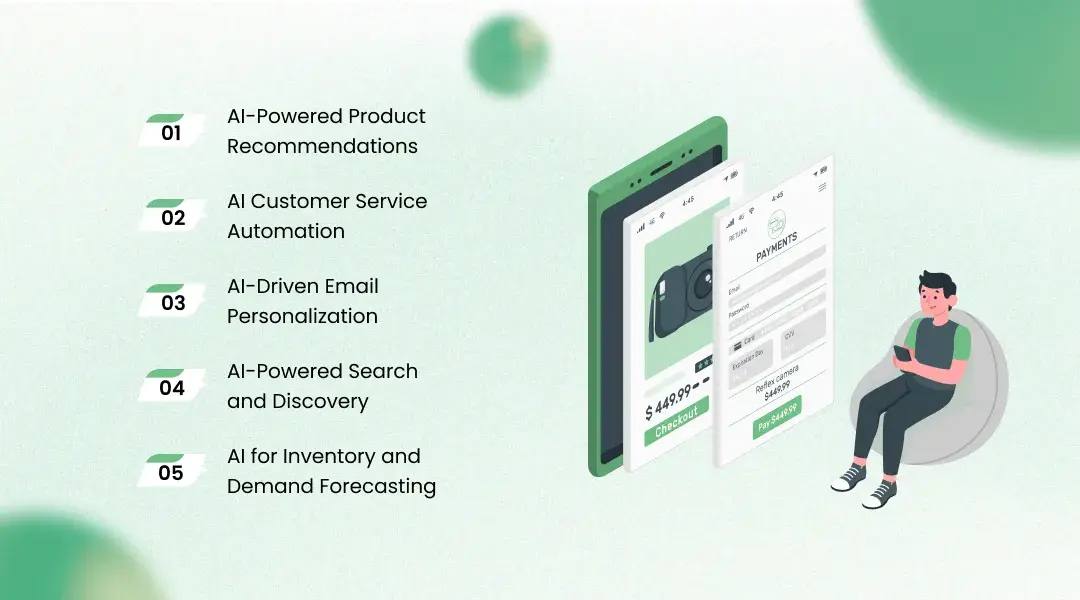
Not all AI applications are equal at your scale. Some are genuinely transformative. Others are expensive distractions. Here is a clear-eyed assessment of what actually works for a ten-to-fifty-person e-commerce business.
This is the single highest-return AI application available to your business right now. AI-powered product recommendations for small stores use collaborative filtering and behavioral data to show each visitor products most likely to result in a purchase, based on browsing history, purchase history, and the behavior of similar customers.
What it does: Analyzes real-time and historical customer behavior to surface personalized recommendations on product pages, cart pages, and email campaigns. What problem it solves: You are almost certainly showing the same static "customers also bought" blocks to every visitor, regardless of their demonstrated interests. This is leaving conversion and average order value on the table. What it costs at your scale: Dedicated recommendation tools like Nosto, LimeSpot, or equivalent solutions run from fifty to five hundred dollars per month depending on your traffic volume. What you can realistically expect: A 12 to 18 percent increase in average order value and a 6 to 10 percent improvement in conversion rate from product pages within ninety days of proper implementation. These are industry-standard figures for businesses with your data volume.
For a team of two to four customer service representatives handling repetitive inquiries about order status, returns, product questions, and shipping, AI automation is the second highest-return investment available.
What it does: Handles tier-one customer service queries automatically through chat or email, using your actual product and policy information as its knowledge base. What problem it solves: Your customer service team is spending fifty to sixty percent of their time on questions that have the same answer every time, leaving less time for complex cases that actually require human judgment. What it costs at your scale: Tools like Gorgias AI, Tidio, or equivalent platforms cost between two hundred and eight hundred dollars per month. What you can realistically expect: Forty to fifty-five percent deflection of incoming tickets, meaning those inquiries are resolved without human involvement, within thirty days of training the system on your product and policy data.
Most small e-commerce businesses send the same email to their entire list, perhaps with basic segmentation by purchase history. AI changes this fundamentally.
What it does: Analyzes individual customer behavior, purchase patterns, and engagement history to determine the right content, send time, and product mix for each subscriber. What problem it solves: Batch-and-blast email campaigns have average open rates of 15 to 20 percent. AI-personalized email campaigns achieve 30 to 45 percent open rates and three to four times higher click-to-purchase rates. What it costs at your scale: Klaviyo's AI features, Omnisend with AI personalization, or comparable tools add approximately one hundred to three hundred dollars per month above basic email platform costs. What you can realistically expect: A 25 to 40 percent increase in email-attributed revenue within the first sixty days of implementation.
If you have more than five hundred SKUs, your on-site search is probably losing you sales every single day. Studies consistently show that customers who use on-site search convert at three to five times the rate of non-search visitors, yet most small e-commerce stores have basic keyword-matching search that fails to understand synonyms, intent, or natural language.
What it does: Replaces keyword-matching search with semantic understanding, so when a customer searches "something for a housewarming gift under fifty dollars," they see relevant, curated results rather than an error page or random keyword matches. What it costs at your scale: Tools like Searchanise, SearchPie, or equivalent AI search tools run from thirty to one hundred and fifty dollars per month. What you can realistically expect: A 15 to 25 percent improvement in search-to-purchase conversion and a measurable reduction in zero-results search sessions, which are direct evidence of lost sales.
Stockouts and overstock are two of the most expensive operational problems for e-commerce businesses at your scale. AI-driven demand forecasting can reduce both.
What it does: Analyzes historical sales data, seasonal patterns, promotional calendars, and external signals to predict future demand at the SKU level. What problem it solves: Manual forecasting at the SKU level is impossible for catalogs of more than a few hundred products, leading to systematic errors in purchasing decisions. What it costs at your scale: Tools specifically built for small to mid-sized e-commerce operations run between two hundred and six hundred dollars per month. What you can realistically expect: A 20 to 30 percent reduction in stockout incidents and a 15 to 25 percent reduction in excess inventory within one to two planning cycles.
The numbers that matter for a ten-to-fifty-person e-commerce business are very different from the headline statistics you see in enterprise AI marketing.
Consider what forty hours of saved customer service time per week actually means at your scale. For a team where a customer service representative earns twenty-five dollars per hour, forty hours per week represents one thousand dollars per week in recovered labor capacity. Over a year, that is fifty-two thousand dollars of labor capacity redirected from answering "where is my order" to handling complex returns, building customer relationships, and supporting upsell conversations. That is not a rounding error in your budget. That is potentially the difference between needing to hire or not.
AI-powered product recommendations, when properly implemented on a store doing two million dollars annually, can add between two hundred forty thousand and three hundred sixty thousand dollars in incremental revenue within twelve months. That estimate assumes the industry-standard 12 to 18 percent improvement in average order value across the portion of revenue influenced by recommendation touchpoints. For a business with your margins, that uplift can represent forty to ninety thousand dollars in additional gross profit from a tool costing six thousand dollars per year. That is a return on investment of six to fifteen times, measured conservatively.
AI email personalization at your scale, for a list of twenty thousand active subscribers, has been shown in independent analyses to increase email-attributed revenue by 25 to 40 percent. If email currently drives fifteen percent of your revenue and you are doing two million dollars annually, that means three hundred thousand dollars in email-attributed revenue. A 30 percent improvement adds ninety thousand dollars in email revenue against a tool cost of approximately three thousand dollars per year. The mathematics of AI investment at your scale are compelling precisely because the baseline costs are low relative to the revenue opportunity.
According to a 2023 Gartner survey, small and mid-sized e-commerce businesses that adopted at least three AI applications saw a median 34 percent improvement in customer lifetime value over an eighteen-month period compared to non-adopters. That figure is specific to this size segment and does not apply uniformly to either larger or smaller businesses. Larger businesses see smaller percentage improvements because they are starting from a higher baseline of operational efficiency. Smaller businesses see less improvement because they lack the data volume needed for AI to find meaningful patterns. Your segment is the sweet spot.
On the cost reduction side, AI-driven inventory forecasting at your scale typically reduces carrying costs by fifteen to twenty percent annually. For a business with two hundred thousand dollars in average inventory, that represents thirty to forty thousand dollars in freed working capital per year.
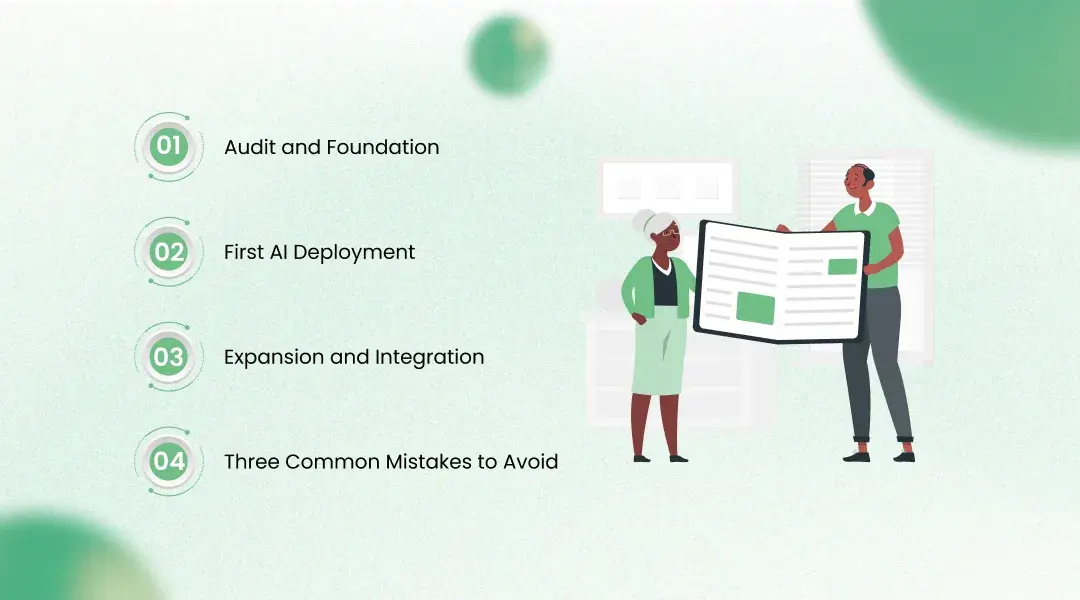
Implementing AI for small e-commerce businesses is not a single project. It is a sequence of decisions that compound over time. Here is how to do it in a way that fits the realistic constraints of your business.
Before selecting any tool, spend two weeks auditing your current situation honestly.
Map every customer touchpoint: site visit, search, product page, cart, checkout, email, post-purchase, and support interaction.
Identify your three highest-volume customer service inquiry types and quantify how many hours per week they consume.
Pull your email campaign performance data for the last twelve months and identify your open rate, click rate, and revenue per email.
Review your on-site search data to find your zero-results rate and your most common search terms.
Assess your customer data quality: how many complete customer records do you have, and are purchase histories accurate?
This audit will tell you exactly where to start. The general principle is to begin with the application that addresses your highest-volume, highest-cost problem first, because this is where AI will produce the fastest and most measurable return.
Select one application from the list above, prioritized by your audit findings. Configure it using your actual data. For customer service AI, this means training it on your actual return policy, shipping times, product FAQ, and common customer scenarios. For recommendations, this means ensuring your product catalog is clean and your customer purchase history data is accessible to the tool. For email personalization, this means connecting your email platform to your customer data and allowing the AI to learn from at least thirty days of behavioral data before evaluating results.
Set a clear sixty-day success metric before deployment. If you are deploying customer service AI, define success as a forty percent reduction in tier-one ticket volume. If deploying recommendations, define success as a ten percent improvement in average order value. If you do not define the metric before you start, you will not know if it is working.
Once your first deployment is generating measurable returns, add a second application. The best sequence for most small e-commerce businesses is customer service automation first, then email personalization second, then on-site recommendations third, then inventory forecasting fourth. This sequence prioritizes cost savings before revenue growth, which is the right order when discretionary AI budget is limited.
During this phase, begin connecting your AI tools to each other where possible. Your recommendation engine should inform your email personalization. Your inventory data should inform your promotional calendar. Integration multiplies the value of each individual tool.
The first mistake is deploying AI on a foundation of bad data. If your product catalog has inconsistent categorization, if your customer records are full of duplicates, or if your order history data is incomplete, AI will amplify those problems rather than solve them. Spend time cleaning your data before any AI deployment, not after. One week spent on data quality will prevent months of poor AI performance.
The second mistake is evaluating AI too quickly. Recommendation engines need four to six weeks of learning before they reach their potential performance. Customer service AI needs two to four weeks of training and correction. Businesses that evaluate after two weeks and declare AI ineffective have simply not given the systems enough time to calibrate. Set your evaluation date at sixty to ninety days and do not change it.
The third mistake is trying to implement too many AI tools simultaneously. The temptation is real, especially after reading about all the applications available. Businesses that try to deploy four AI tools at once typically see all four underperform because they divide the implementation attention needed to configure and train each system properly. One tool, well implemented, beats four tools poorly implemented every single time.
Every company size has its own friction points with AI adoption, and the challenges for a ten-to-fifty-person e-commerce business are meaningfully different from what you will read about in general AI content.
Your most significant challenge is integration complexity without a dedicated technical resource. Enterprise businesses have IT teams that handle integration between new tools and existing systems. Solo operators use simple tools that rarely need integration. You are in the middle: your systems need to talk to each other, but you may not have a developer on staff. The practical consequence is that you should only evaluate AI tools that offer native integrations with your existing platform. A Shopify store evaluating AI tools should only seriously consider tools with Shopify-native integrations. A WooCommerce operation should apply the same filter. Any tool that requires custom API development to integrate with your existing stack is not the right tool for your segment right now.
Your second challenge is bandwidth for implementation and change management. Your team members are already fully deployed. Adding a new AI tool is not just a technology project; it requires someone to own the configuration, training, and ongoing optimization. In a ten-to-fifty-person business, that person likely has other significant responsibilities. Be honest with yourself about this. Budget two to four hours per week of implementation time per active AI tool, and assign that responsibility explicitly to a named person before you sign any contract.
Your third challenge is evaluating vendor stability. The AI tools landscape for e-commerce is evolving rapidly, and some of the most attractive tools at your price point are early-stage companies that may pivot, be acquired, or discontinue their product. Before committing to any AI vendor, verify that they have been operating for at least two years, have publicly verifiable customer references at your revenue scale, and offer contract terms that include data export provisions if you need to leave.
This is where partnerships with established AI solution providers like KriraAI, which works with businesses at your exact revenue and team size stage, become valuable. KriraAI evaluates the landscape continuously and can help identify tools with both the right capability profile and the business stability to be a reliable long-term partner.
The e-commerce competitive landscape in 2028 will look very different from today, and the division between businesses that adopted AI between 2024 and 2026 and those that did not will be stark.
The most important dynamic to understand is compounding. Every month of AI-driven personalization makes your recommendation engine smarter. Every month of AI-assisted customer service creates a larger dataset of resolved interactions that the system learns from. Every month of AI-optimized email campaigns teaches the system more about your specific audience. Early adopters do not just get a head start. They accumulate a data and learning advantage that becomes increasingly difficult for later movers to close.
By 2027, customer personalization in e-commerce will be the baseline expectation rather than a differentiator. The same way customers now expect free shipping without thinking of it as a special benefit, they will expect every touchpoint to reflect their individual preferences and history. Businesses that have not built the AI infrastructure to deliver this will see their conversion rates and customer retention rates systematically underperform compared to competitors that have.
For businesses at your scale, the specific capabilities that will separate winners from losers over this period are as follows. The ability to deliver genuine one-to-one personalization across email, on-site experience, and customer service will determine customer lifetime value. The ability to forecast and respond to demand signals faster than competitors will determine inventory health and margin. The ability to automate repetitive operational work will determine whether you can grow revenue without proportionally growing headcount, which is the difference between a scaling business and one that adds costs at the same rate as revenue.
Businesses that begin AI adoption now will have two to three years of learning advantage by the time competitors in their category begin to act. In a segment where customer acquisition costs are rising and margin pressure is relentless, that advantage will be decisive.
The three most important points from this guide deserve direct restatement. First, AI for small e-commerce businesses is not a scaled-down version of enterprise AI. It is a distinct category with its own tools, its own economics, and its own implementation logic. Understanding this distinction is the prerequisite for making any good AI decision at your scale. Second, the return on investment mathematics for AI adoption at your revenue level are compelling and measurable. Customer service automation, product recommendations, email personalization, and inventory forecasting all have documented payback periods of three to nine months for businesses in your revenue range, and they compound over time. Third, the competitive window for early adoption advantage is real and finite. The businesses in your category that act between 2024 and 2026 will enter 2028 with two to three years of accumulated AI learning advantage that will be increasingly difficult for late movers to close.
KriraAI helps small e-commerce businesses exactly like yours navigate this transition with practical clarity. Rather than selling enterprise AI solutions scaled down or consumer AI tools scaled up, KriraAI builds and implements AI strategies designed specifically for the operational reality of ten-to-fifty-person e-commerce operations, with implementations that fit real budgets, real team structures, and real growth trajectories. Every recommendation KriraAI makes starts with your actual data environment, your actual customer service volume, and your actual margin structure, not with a generic AI adoption template. If you are ready to move from reading about AI to seeing what it can actually do for your specific business, reach out to the KriraAI team to start with a focused audit of where AI can deliver the fastest, most measurable return for you.
For a small e-commerce business with fifteen employees, a realistic AI implementation budget covers three core areas. First, AI-powered customer service automation through a platform like Gorgias AI or Tidio runs between two hundred and five hundred dollars per month depending on ticket volume, typically covering up to five thousand tickets per month. Second, AI product recommendations through a platform like Nosto or LimeSpot add fifty to three hundred dollars per month based on site traffic. Third, AI email personalization features within an existing platform like Klaviyo add approximately one hundred to two hundred dollars per month above standard fees. Total monthly cost for a focused three-tool AI stack for a fifteen-person e-commerce business sits between three hundred and fifty and one thousand dollars per month, or four thousand two hundred to twelve thousand dollars annually. Given the revenue uplifts and cost savings documented in this guide, this investment typically achieves full payback within three to six months for a business doing more than one million dollars in annual revenue.
For AI tools to generate meaningful results in a small e-commerce context, the most critical data requirements are as follows. For customer service AI, you need a documented knowledge base covering your return policy, shipping timelines, product specifications, and your one hundred most common customer questions with approved answers. For product recommendation AI, you need at least six months of purchase history data connected to customer identifiers, and a product catalog with consistent categorization and complete attributes. For email personalization AI, you need a minimum of ten thousand active subscribers with at least three months of behavioral data, including open history, click history, and purchase history linked to email addresses. For inventory forecasting AI, you need at least twelve months of SKU-level sales data and ideally records of promotional events that influenced demand. Data quality matters more than data volume. A clean dataset of fifty thousand customer records will produce better AI performance than a messy dataset of five hundred thousand records.
The timeline for measurable AI results in a small e-commerce business varies by application type. Customer service AI deflection rates are measurable within thirty days of proper deployment because the system begins handling tickets immediately and the deflection percentage is directly observable. Product recommendation improvements are measurable at sixty days because the engine needs four to six weeks of behavioral data before its personalization becomes genuinely differentiated from basic manual rules. Email personalization improvements are measurable at sixty to ninety days because campaigns need to run several cycles before the AI has enough engagement data to meaningfully differentiate content by subscriber behavior. Inventory forecasting accuracy improvements are measured against full demand cycles, meaning you typically need one complete seasonal cycle to validate performance, which can take three to twelve months depending on your business seasonality. The businesses that see the fastest results are those that define success metrics before deployment and give each tool a minimum sixty-day evaluation window before judging performance.
Yes. The current generation of AI tools designed for small and mid-sized e-commerce businesses is specifically built for deployment by non-developers. The majority of leading recommendation engines, customer service AI platforms, and email personalization tools offer native integrations with Shopify, WooCommerce, BigCommerce, and Magento that install in under thirty minutes without code. Configuration is done through graphical interfaces and guided setup wizards. Where a technical resource becomes valuable is in complex integrations between tools that do not have native connectors, or in custom data migration projects when switching platforms. For a standard deployment of the four AI applications described in this guide on a Shopify or WooCommerce store, a technically comfortable team member with no development background can complete full implementation. The time investment is approximately eight to fifteen hours per tool for initial setup, configuration, and training, followed by two to four hours per month for ongoing optimization.
The biggest AI mistake that small e-commerce businesses make is selecting tools based on feature marketing rather than fit for their specific data environment and operational constraints. This manifests in two common patterns. The first pattern is choosing enterprise-grade AI platforms that require dedicated implementation resources and eighteen-month onboarding timelines, leading to expensive projects that never fully deploy. The second pattern is choosing low-cost AI tools designed for solo operators or very small businesses, which lack the capability to handle the data volumes and operational complexity of a ten-to-fifty-person e-commerce operation, producing disappointing results that lead the business to conclude AI does not work when the real problem was tool-market fit. The solution is to select tools that are explicitly designed for businesses at your revenue and team size scale, verified by customer references from businesses of comparable size, and evaluated through a structured pilot before full commitment. Working with an AI solutions partner like KriraAI, which focuses specifically on practical implementations for businesses at this scale, significantly reduces the risk of tool-market mismatch.
Founder & CEO
Divyang Mandani is the CEO of KriraAI, driving innovative AI and IT solutions with a focus on transformative technology, ethical AI, and impactful digital strategies for businesses worldwide.