There is a particular kind of irony sitting at the heart of the mid-market AI services industry right now. Companies with 50 to 500 employees are actively selling AI transformation to their clients, building intelligent automation pipelines, deploying machine learning models, and advising on generative AI strategy, while quietly running their own operations on spreadsheets, manual project tracking, and senior consultants doing repetitive work by hand. A 2025 RSM Middle Market AI Survey found that 91% of middle market executives say their organizations are using AI formally or informally, yet 62% of those same executives admitted that generative AI has been harder to implement than expected. For an AI services firm, that gap between what you sell and how you operate is not just inefficient. It is a competitive liability that compounds every quarter you leave it unaddressed.
This blog is written specifically for mid-market AI services companies, the firms large enough to have genuine delivery complexity but too resource-constrained to absorb enterprise-style transformation programs. If you run a boutique AI consultancy, a data science firm, or a managed AI services provider with somewhere between 50 and 500 people, this analysis was built for your reality. What follows covers why AI adoption at your scale looks different from every other segment, which applications produce the fastest returns, what implementation actually looks like, and what your competitive landscape will look like in three years for firms that act now versus firms that wait.
Understanding the specific conditions under which mid-market AI services firms operate is essential before any discussion of tooling or strategy. A typical firm in this segment employs between 50 and 300 delivery staff organized into project pods or practice areas covering data engineering, machine learning, AI consulting, and sometimes product development. The leadership layer is thin relative to the complexity it manages: a founding CEO or managing director who still participates in key client conversations, one or two practice leads doubling as senior technical contributors, a business development team of three to eight people, and an operations function that often consists of a single person managing resourcing, finance, and HR simultaneously.
Budget cycles are real constraints. Unlike a global enterprise that can absorb a two-million-dollar software contract as a rounding error, a 150-person AI services firm typically operates on total technology and tooling budgets between $200,000 and $800,000 annually. Every new platform purchase competes directly with hiring decisions and the cost of tools that underpin client delivery. The technology stack is almost always a patchwork of tools adopted at different growth stages: Jira for projects, Slack for communication, Google Docs for proposals, Harvest for time tracking, QuickBooks for finance. The data about how the business runs is scattered across these systems with no unified intelligence layer connecting them.
The decision-making speed at this size is theoretically faster than a large enterprise but practically slower than it should be, because the people who make decisions are also the people who deliver work. A practice lead evaluating a new AI-powered estimation tool will find that evaluation competing with a client escalation, a hiring interview, and a proposal deadline in the same week. This is the operating reality that any AI adoption strategy must account for.
The assumption that AI adoption advice is universal is one of the most damaging beliefs in the market right now. When a Fortune 500 company adopts AI, it deploys an internal team of twenty AI engineers, runs an eighteen-month change management program, and accepts that ROI will materialize over a three-year horizon. When a solo operator adopts AI, they sign up for a fifty-dollar-per-month subscription tool and are done in an afternoon. Neither model applies to a mid-market AI services company, and applying either one produces paralysis or failure.
The vendor market is genuinely underserved at this scale. Enterprise AI platforms from Salesforce, ServiceNow, or IBM are priced and architected for organizations ten times the size. At the same time, consumer-grade tools lack the data integration depth and compliance controls that a professional services firm of this size requires. Mid-market AI services companies need solutions that start at a scale fitting a $150,000 to $400,000 annual investment and grow without requiring a rip-and-replace when the company doubles.
The internal skill conflict is a structural problem. The people best equipped to implement internal AI tools are the same senior ML engineers and AI consultants most in demand on client engagements. Every hour they spend configuring an internal platform is an hour of revenue not delivered. Implementation approaches must minimize internal technical labor while achieving meaningful integration with existing systems. This is precisely the kind of constraint-aware approach that KriraAI, which builds practical, scalable AI solutions designed for mid-market operational reality, brings to firms in this segment.
The timeline to returns is the most favorable differentiator for this segment. Mid-market organizations that implement AI in targeted, well-scoped use cases see ROI in 6 to 9 months, compared to the 12 to 18 months that enterprise implementations typically require. That faster return cycle exists because decision-making involves fewer layers, change management is lighter, and the teams deploying tools are the same ones using them.
Choosing the right AI applications is not about adopting the most impressive technology. It is about identifying the use cases where AI produces the clearest, fastest, most measurable return given the constraints described above.
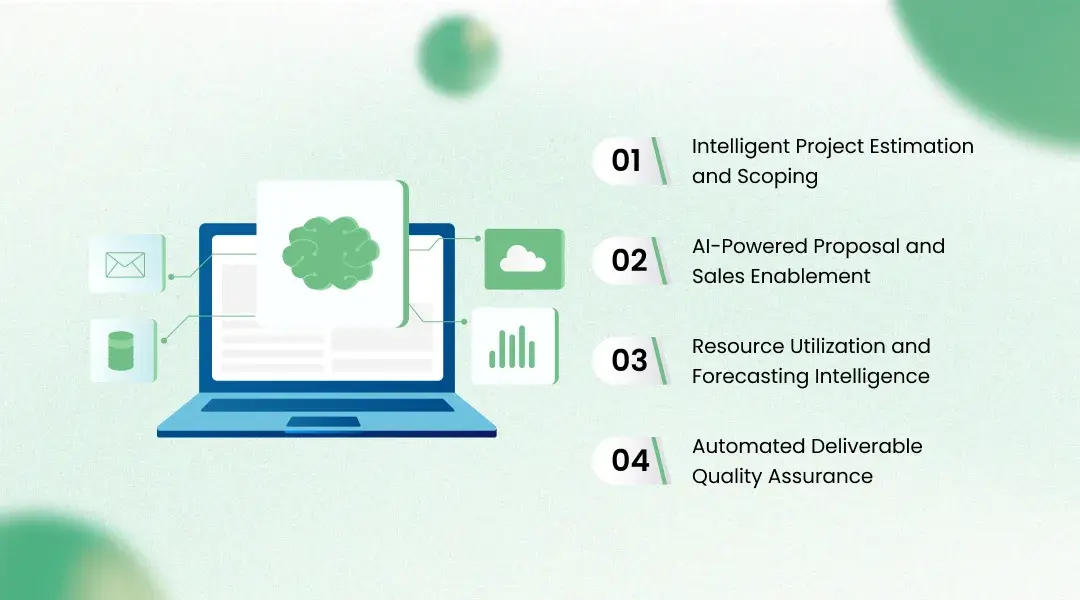
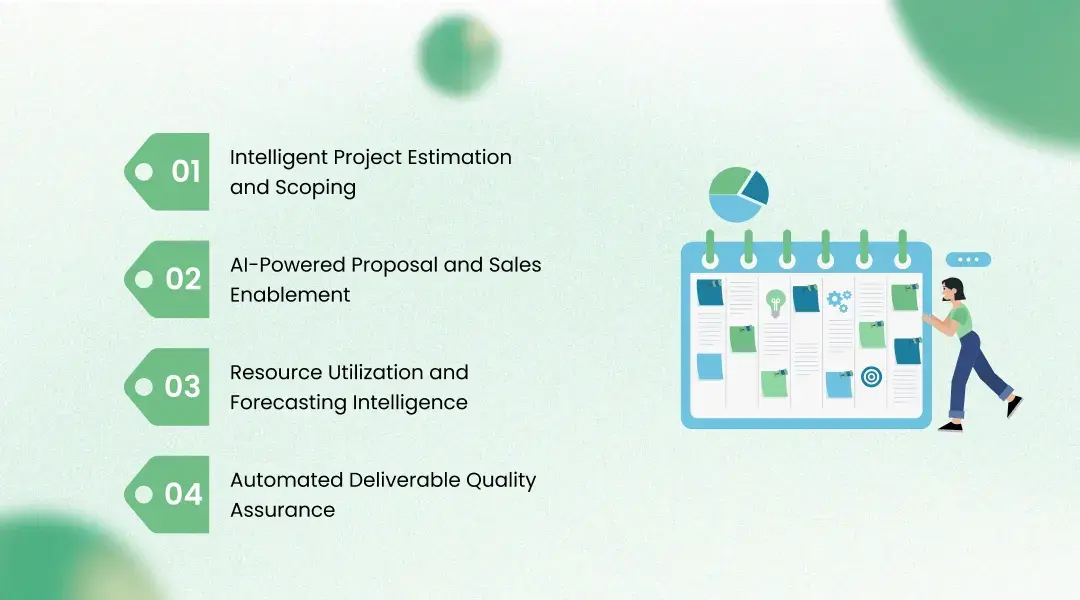
Project estimation is one of the most expensive and least examined sources of financial leakage in an AI services firm. When estimates are wrong, projects either run over budget, triggering uncomfortable client conversations and margin erosion, or they are priced too high, costing the firm the deal. AI-powered estimation tools analyze historical project data across scope, team composition, timeline, and margin outcomes to generate probabilistic estimates significantly more accurate than intuitive judgment. For a mid-market firm, building this capability on top of existing project management and ERP data costs between $30,000 and $80,000. The realistic return is a 15% to 25% improvement in project margin accuracy within six months, which for a $10 million revenue firm translates to $150,000 to $250,000 in recovered margin over twelve months.
Business development in an AI services firm is knowledge-intensive and time-consuming. Senior practitioners spend significant hours drafting proposals that recombine standard sections from previous work. AI proposal generation tools, trained on a firm's historical proposal library and methodology documentation, reduce drafting time by 50% to 70% while improving consistency and quality. For a firm where business development staff cost between $80,000 and $150,000 per head annually, recovering 30 hours per proposal writer per month produces a return visible within 90 days of deployment.
Staff utilization is the central financial lever in any professional services firm. For a mid-market AI services company, the difference between 72% and 82% billable utilization across a 100-person delivery team is roughly $1.5 million in annual revenue at average bill rates. AI-powered resource management platforms analyze project pipelines, skills inventories, and historical utilization patterns to recommend optimal staff allocation before scheduling gaps emerge. Implementation costs range from $40,000 to $120,000 depending on integration depth, and firms that have deployed these tools report utilization improvements of 8 to 14 percentage points within the first year.
AI services firms produce research reports, technical documentation, model cards, and presentations as client deliverables. AI-powered document quality tools review these outputs against the firm's quality standards, flag missing sections, and check consistency with client-specific terminology before deliverables reach the client. This reduces revision cycles and the unbillable rework that consistently erodes project profitability without ever appearing as a named line item on a project budget.
The numbers that matter for a mid-market AI services company are scaled to the reality of a firm operating at $5 million to $50 million in annual revenue with teams of 50 to 300 people, not to the enterprise case studies that dominate most AI ROI discussions.
Firms using AI-assisted proposal generation report reducing the time from qualified opportunity to submitted proposal by 40% to 60%. For a firm submitting 40 proposals per year at a 25% win rate, that time reduction enables pursuing 15 to 20 additional opportunities annually without adding headcount, representing 4 to 5 additional engagements per year. On delivery margin, AI-powered project estimation tools reduce budget overrun rates by 30% to 50% in professional services environments. For a mid-market firm where 20% to 30% of projects currently run over budget by an average of 15%, this is a direct EBITDA improvement visible within two or three project cycles.
Staff utilization improvements of 8 to 14 percentage points translate at mid-market scale to $800,000 to $2 million in additional revenue per 100-person team per year without any increase in headcount. This is the single highest-ROI AI application available to firms in this segment. Replacing a mid-level ML engineer costs 50% to 200% of their annual salary when recruitment, onboarding, and productivity ramp-up are fully accounted for. Retaining two or three engineers per year through better internal tooling pays for a substantial AI investment on its own, making attrition reduction one of the most underappreciated financial benefits of well-designed internal AI adoption.
A practical AI adoption roadmap must respect three non-negotiable constraints: billable staff cannot be diverted for extended periods, implementation costs must fit existing technology budgets without special board approval, and the first wave of tools must demonstrate measurable returns before the second wave begins.
A well-structured implementation unfolds in four stages over twelve months. KriraAI recommends this phased approach specifically because it produces measurable returns before requiring significant additional investment, which matters enormously for firms managing tight technology budgets alongside active client delivery commitments.
Internal AI Audit (Weeks 1 to 6): Pull data from existing systems and ask structured questions. Where do projects most commonly go over budget? Where does proposal preparation take the most time? Where is staff utilization lowest and why? This audit generates a prioritized use case list ranked by impact and feasibility and forms the foundation of the adoption strategy.
Pilot Selection and Vendor Evaluation (Weeks 7 to 14): Select one or two use cases from the audit with the highest combination of impact and implementation simplicity. For most mid-market AI services firms, resource utilization optimization and proposal acceleration are the right starting pilots because the necessary data already exists. Evaluate vendors against mid-market-specific criteria: integration with existing stack, total first-year cost of ownership under $100,000, implementation timelines under 90 days, and references from similar-sized professional services firms.
Pilot Deployment and Measurement (Weeks 15 to 26): Deploy selected tools with a measurement framework established before go-live. Define exactly which metrics will be tracked, establish baseline values at the start, and specify the threshold that constitutes a successful pilot. Running a pilot without a pre-defined success threshold creates ambiguity that allows underperforming tools to persist.
Scaled Adoption and Second Wave (Months 7 to 12): Once the pilot demonstrates measurable returns, document results internally, communicate them to the delivery team, and use them as the business case for the next two or three highest-priority use cases from the original audit.
Understanding where mid-market AI services firms most often fail during adoption is as important as knowing the roadmap itself.
The first mistake is applying an enterprise framework to a mid-market budget. A 150-person firm that engages a large consulting firm to run an AI transformation program will almost certainly receive a strategy designed for an organization three to five times its size, with vendor recommendations and implementation timelines that exceed both budget and internal capacity.
The second mistake is starting with AI in client delivery before addressing internal operations. Firms that introduce AI into client delivery workflows before their own internal operations are AI-enabled create delivery complexity faster than the organization can absorb it, while leaving the financial leaks in estimation, resource management, and proposal efficiency unaddressed.
The third mistake is treating AI adoption as a technology initiative rather than a business operations initiative. The firms that achieve lasting results are those where the practice lead or managing director owns the initiative, not the head of IT. When a business leader owns adoption, use cases stay grounded in operational reality and measurement stays connected to financial outcomes. KriraAI's implementation methodology for mid-market AI services firms is built around these three failure modes specifically, ensuring every engagement starts with a business-outcome audit rather than a technology selection exercise.
Mid-market AI services firms face a set of difficulties distinct from both startup and enterprise experience. The most acute is the credibility tax. When an AI services company's internal AI implementation fails or is delayed, that failure is visible to clients, prospects, and employees in a way that a similar failure at a non-AI company would never be. This heightens internal pressure to select perfectly the first time, which leads to the analysis paralysis that delays adoption entirely.
Data quality is consistently the top implementation challenge across the mid-market. The 2025 RSM survey found that 41% of middle market executives reported data quality as the primary problem during AI implementation. For an AI services firm, this is compounded by project and operational data collected inconsistently across the firm's history, especially when rapid hiring brought in new teams with different data hygiene practices. Any AI tool depending on clean historical data will underperform if this problem is not addressed before implementation begins. Vendor lock-in risk is also higher for mid-market firms than for large enterprises, which have the contract leverage to negotiate exit terms, making data portability clauses a hard requirement during any contract negotiation.
Firms that begin internal AI adoption in 2025 and 2026 will enter 2028 with a compounding operational advantage that late movers cannot close quickly. The advantage is not simply better tools. It is 24 to 36 months of proprietary operational data flowing through those tools, meaning estimation models will be more accurate, resource recommendations more calibrated, and delivery quality more consistent. That accumulated data advantage is structural and not replicable by a competitor starting in 2028.
Competitive differentiation between AI services firms will increasingly shift from technical capability, which is becoming commoditized as foundation models improve, toward operational excellence and delivery reliability. Clients hiring AI services firms in 2028 will be buying confidence that a project will be delivered on time, on budget, with predictable quality. That confidence can only be built on operational systems that produce measurable, trackable outcomes. Pricing models are already moving from time-and-materials toward outcome-based arrangements, a shift that rewards firms with superior cost visibility and delivery predictability because those firms can price outcome-based contracts confidently while competitors are guessing.
Talent dynamics will also shift. The best AI practitioners in 2028 will evaluate employers partly on the quality of internal tooling, just as software engineers today evaluate companies on their engineering culture. A mid-market AI services firm running on cutting-edge operational AI will attract stronger candidates than an equivalent firm relying on manual processes. The firms that delay will not simply be behind on tools. They will be managing fundamentally more expensive, less predictable operations while competing against firms that deliver better outcomes at lower cost.
Three points from this analysis deserve emphasis above all others. First, the financial returns most relevant to mid-market AI services companies are concentrated in a small number of high-impact operational use cases, not spread across a broad transformation program. Second, the timeline to ROI at this company size is genuinely faster than most firms expect, provided implementation is scoped correctly and measured from day one. Third, the competitive penalty for delay is compounding in a way that makes 2026 and 2027 the last window for mid-market AI services firms to build a structural advantage before early movers establish a lead that is very difficult to close.
KriraAI works specifically with mid-market companies like the ones described throughout this blog, building practical, scalable AI solutions that fit the actual budget, team structure, and growth stage of firms with 50 to 500 employees. KriraAI's approach does not scale down enterprise frameworks or scale up startup tools. It builds implementations designed from first principles for mid-market operational reality, beginning with a structured business-outcome audit that identifies the highest-return use cases before any technology is selected. The result is AI adoption that produces measurable returns within the timelines described here, with implementation approaches that respect the constraint that your best people need to stay focused on client delivery throughout the process. If your firm is ready to move from recognizing the opportunity to building the operational advantage that comes from acting on it, reach out to KriraAI to explore how a targeted AI implementation strategy can be designed around your specific delivery model, client portfolio, and growth objectives.
AI adoption for a mid-market AI services company with 50 to 500 employees does not require a transformational budget in the first year. A realistic starting investment covers two or three well-scoped tools addressing the highest-priority use cases, typically resource utilization optimization and proposal automation, plus integration work to connect those tools to existing systems. Total first-year investment for this initial scope ranges from $80,000 to $250,000, depending on existing system complexity and integration depth required. This range includes software licensing, implementation services, and internal time for configuration and testing. The critical discipline is resisting the impulse to over-scope the first phase, because mid-market firms that attempt to transform everything simultaneously consistently overspend, underdeliver, and damage internal confidence in AI adoption. Starting with two use cases, measuring results rigorously, and reinvesting demonstrated returns into the next phase produces both better financial outcomes and stronger organizational buy-in than any broad transformation program would.
A mid-market AI services company that selects the right use cases and implements them with clear measurement frameworks should see measurable ROI within 6 to 9 months of go-live. This reflects the documented experience of mid-market professional services firms that have implemented AI in resource management, estimation, and sales enablement functions. The 6 to 9 month timeline contrasts with the 12 to 18 month enterprise cycle because mid-market implementation involves fewer approval layers, smaller change management programs, and more direct feedback loops between the people who configured the tool and the people using it. The most important factor in compressing this timeline further is having a clearly defined measurement baseline before implementation begins, because firms that define success metrics after go-live consistently take longer to confirm returns and spend time reconstructing historical data that should have been captured from the start.
The AI tools that consistently produce the strongest returns for mid-market AI services companies address the highest-cost operational friction points specific to professional services delivery. These include AI-powered resource management platforms that optimize staff allocation and improve billable utilization, proposal generation tools trained on the firm's own past work to accelerate business development cycles, intelligent project estimation tools that analyze historical delivery data to produce more accurate scope and budget projections, and deliverable quality assurance tools that reduce revision cycles and unbillable rework. The selection criterion that matters most for this company size is integration depth, not technical sophistication. A tool that works well in isolation but cannot connect to existing project management, CRM, and financial systems will require manual data transfer that eliminates much of its time-saving benefit, making interoperability a hard requirement during vendor evaluation.
The biggest risk for a mid-market AI services company is the credibility risk of a visible failure. Because these firms sell AI expertise, an internal implementation that goes wrong is not just an operational setback but a narrative that clients, prospects, and employees form judgments from. The second major risk is data quality, which RSM's 2025 survey identified as the top implementation challenge for 41% of middle market executives. For AI services firms specifically, project and operational data is frequently scattered across systems adopted at different growth stages and maintained inconsistently, meaning any AI tool that depends on clean, structured historical data will underperform if data quality is not addressed before or during implementation. The third risk is scope creep, which at this company size tends to take the form of too many simultaneous pilots rather than a single overly ambitious project, producing fragmented attention and diluted results across all of them simultaneously.
The correct prioritization framework begins with identifying where the largest financial leakage occurs relative to the simplest implementation path. For most mid-market AI services firms, the intersection of high financial impact and relatively straightforward implementation points to resource utilization and proposal generation as the first two priorities. Resource utilization improvements of 8 to 14 percentage points translate directly to hundreds of thousands or millions of dollars in recovered revenue without additional headcount, and the data needed to power AI resource tools already exists in most firms' systems as project history, skills profiles, and capacity records. Proposal generation automation addresses the second most expensive bottleneck: senior practitioner time consumed by repetitive document assembly that could instead be directed toward billable work or business development strategy. A prioritization audit that quantifies the cost of the top five operational friction points using actual financial and project data should precede any tool selection conversation.
Ridham Chovatiya is the COO at KriraAI, driving operational excellence and scalable AI solutions. He specialises in building high-performance teams and delivering impactful, customer-centric technology strategies.