I’ll be honest.
Most AI you’ve seen so far? It’s reactive. You ask. It answers. You click. It responds.
That’s not intelligence. That’s obedience.
Now something different is emerging: Agentic AI.
And no, it’s not just another buzzword slapped on top of existing tools. I’ve worked on systems where AI doesn’t wait for instructions. It decides what to do next. It plans. It acts.
That shift from passive tools to autonomous systems is exactly why Agentic AI in business is dominating conversations in Agentic AI 2026 discussions.
Here’s the real question: Are you still using AI as a tool… or are you ready to let it operate like a teammate?
Let’s strip this down.
What is Agentic AI? It’s an AI system that can make decisions, take actions, and adapt without constant human input.
Simple. But powerful.
Autonomy: It doesn’t wait for instructions every second
Reasoning: It evaluates options before acting
Action-Oriented: It executes tasks, not just suggests them
Think of traditional AI as a calculator.
Agentic AI? More like an employee who figures things out.
(And yes, sometimes it even surprises you. In good ways. Mostly.)
At its core, every agent follows a loop:
Perception → Decision → Action
It observes data. Makes a decision. Executes.
Then repeats.
But here’s where it gets interesting.
LLMs (Language Models): For reasoning and understanding
Tools & APIs: To actually perform tasks
Memory Systems: To learn from past actions
Now imagine multiple agents working together.
One handles customer queries. Another process orders. A third analyzes behavior patterns.
This is where intelligent AI agents become systems, not just features.
And yes, this is exactly what we build at KriraAI through AI agent development services. Not isolated bots. Coordinated systems.
Let’s settle this confusion once and for all.
Feature | Traditional AI | Agentic AI |
Behavior | Reactive | Proactive |
Logic | Rule-based | Goal-driven |
Output | Responses | Actions |
Flexibility | Limited | Adaptive |
Example | Chatbots | Autonomous AI agents |
Now, the comparison everyone asks:
AI agents vs chatbots
Chatbots respond. Agents decide and act.
That difference? It changes everything.
I’ve seen companies hesitate here.
They think this is experimental. Risky. Maybe too early.
It’s not.
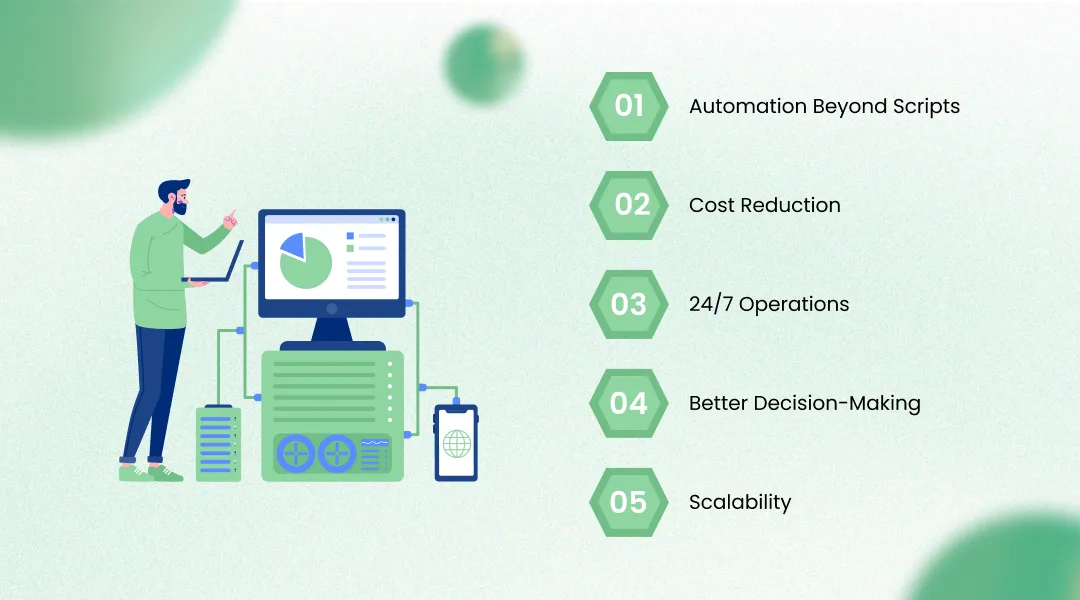
This isn’t “if-this-then-that” automation. These are AI decision-making systems that adapt in real time.
Fewer repetitive tasks. Smaller operational overhead.
No breaks. No downtime. No missed leads.
Agents analyze data continuously and act faster than humans.
One agent can handle thousands of interactions simultaneously.
And this is why AI automation for business is shifting toward agent-based systems.
Let me ground this in reality.
Because theory is cheap.
They don’t just answer queries; they resolve issues end-to-end.
They qualify leads, follow up, and even close deals.
Human-like conversations. Real-time decisions.
Inventory, logistics, and scheduling are handled autonomously.
becomes even more powerful when paired with finance and financial services solutions for fraud detection, compliance, and workflow automation.
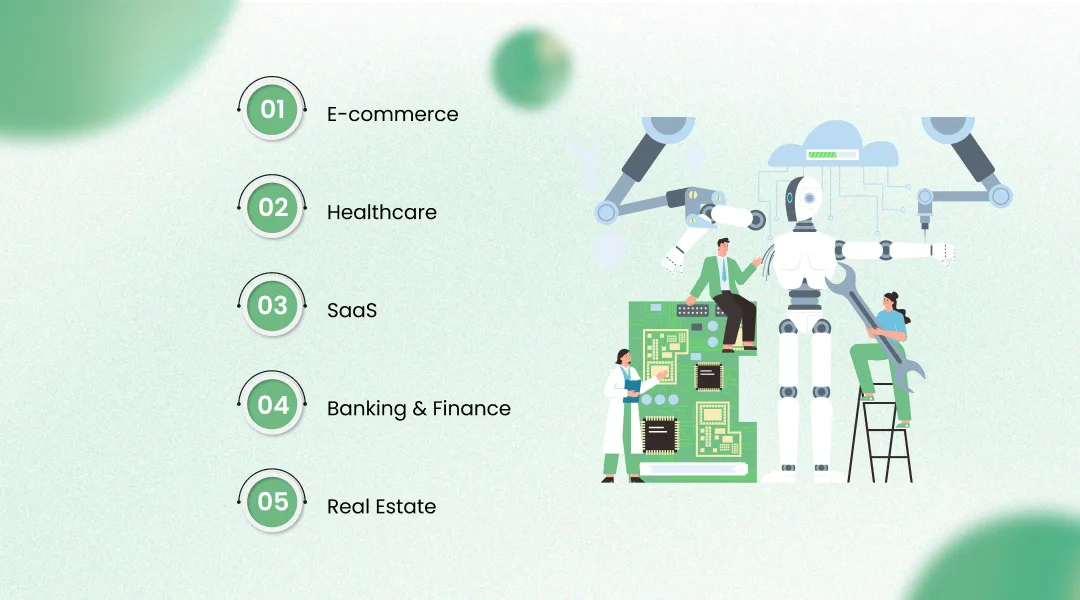
This isn’t limited to tech companies.
Personalized shopping experiences powered by AI agents for business
Patient triage, appointment management, diagnostics support
Self-optimizing platforms and automated onboarding
Fraud detection and automated decision systems
Lead qualification and property matching
Different industries. Same pattern.
Autonomy wins.
Let’s not pretend this is perfect.
It’s not.
What happens when an agent makes the wrong decision?
More autonomy means more access to sensitive data.
This isn’t plug-and-play.
Who’s responsible for AI decisions?
(These are real concerns. Anyone telling you otherwise hasn’t built one.)
Here’s where things get uncomfortable.
Because the future isn’t subtle.
Businesses where AI handles operations end-to-end
Teams built around AI capabilities, not human limitations
Not a replacement. Partnership.
This is the future of AI in business in 2026. And more specifically, the future of AI agents 2026 is about systems that think, act, and improve.
Let that sink in.
Now the practical part.
Because ideas are useless without execution.
Don’t chase trends. Choose what fits your problem.
One workflow. One agent. Test. Learn.
(Yes, this matters more than tools.)
Connect agents with your existing systems step by step
At KriraAI, this is exactly how we approach it—custom solutions, not one-size-fits-all.
Because every business problem is different.
Let me leave you with this.
Agentic AI isn’t about replacing humans.
It’s about removing friction.
The kind that slows down decisions. Blocks growth. Wastes time.
You can ignore it. Many will.
But the businesses that adopt enterprise AI agents early? They won’t just improve efficiency.
They’ll redefine how work gets done.
Agentic AI is an AI system that can make decisions and take actions independently without constant human input.
Traditional AI responds to inputs, while Agentic AI proactively decides and executes tasks.
Cost reduction, automation, scalability, and better decision-making.
Yes. Chatbots respond to queries, while AI agents handle entire workflows.
Start with a specific use case, choose the right tools, and work with experienced AI partners.
Founder & CEO
Divyang Mandani is the CEO of KriraAI, driving innovative AI and IT solutions with a focus on transformative technology, ethical AI, and impactful digital strategies for businesses worldwide.